


Questions
5 questionsShowing 1–5 of 5 questions
-
- (A) \(4.3\times10^{-7}\, m\)
- (B) \(7.8\times10^{-7}\, m\)
- (C) \(0.0078\times10^{-7}\, m\)
- (D) \(3.4\times10^{-7}\, m\)
Show answer and solution
Correct Answer: (B)
\(\mathrm{F}=\mathrm{qE}=\mathrm{mg}\left(\mathrm{q}=6 \mathrm{e}=6 \times 1.6 \times 10^{-19}\right)\)Density \((\mathrm{d})=\frac{\text { mass }}{\text { volume }}=\frac{\mathrm{m}}{\frac{4}{3} \pi r^{3}}\)
or \(r^{3}=\frac{m}{\frac{4}{3} \pi d}\)
Putting the value of \(\mathrm{d}\) and \(\mathrm{m}\left(=\frac{\mathrm{qE}}{\mathrm{g}}\right)\) and
solving we get \(r=7.8 \times 10^{-7} \,\mathrm{m}\)
-
- (A) straight line
- (B) hyperbola
- (C) parabola
- (D) circle
Show answer and solution
Correct Answer: (C)
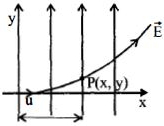
When charged particle enters perpendicularly in an electric field, it describes a parabolic path\(y=\frac{1}{2}\left(\frac{Q E}{m}\right)\left(\frac{x}{4}\right)^{2}\)
This is the equation of parabola.
-
- (A) reduces by \(70. 7\%\)
- (B) reduces by \(29.3\%\)
- (C) reduces by \(9.7\%\)
- (D) reduces by \(14.6\%\)
Show answer and solution
Correct Answer: (A)
Electric field intensity at the centre of the disc.\(E=\frac{\sigma}{2 \epsilon_{0}} \quad(\text { given })\)
Electric field along the axis at any distance
\(x\) from the centre of the disc
\(E^{\prime}=\frac{\sigma}{2 \epsilon_{0}}\left(1-\frac{x}{\sqrt{x^{2}+R^{2}}}\right)\)
From question, \(x=R(\text { radius of disc })\)
\(\therefore \mathrm{E}^{\prime}=\) \( \frac{\sigma}{2 \epsilon_{0}}\left(1-\frac{\mathrm{R}}{\sqrt{\mathrm{R}^{2}+\mathrm{R}^{2}}}\right) \)
\(= \frac{\sigma}{2 \epsilon_{0}}\left(\frac{\sqrt{2} \mathrm{R}-\mathrm{R}}{\sqrt{2} \mathrm{R}}\right) \)
\(=\frac{4}{14} \mathrm{E}\)
\(\therefore\) \(\%\) reduction in the value of electric field
\(=\frac{\left(\mathrm{E}-\frac{4}{14} \mathrm{E}\right) \times 100}{\mathrm{E}}=\frac{1000}{14} \%=70.7 \%\)
-
- (A) \(l\)
- (B) \(l^2\)
- (C) \({l^{2/3}}\)
- (D) \({l^{1/3}}\)
Show answer and solution
Correct Answer: (D)
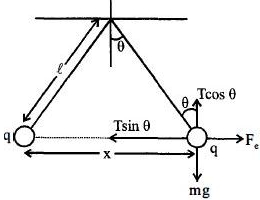
\(\text { In equilibrium, } \mathrm{F}_{\mathrm{e}}=\mathrm{T} \sin \theta\)\(\mathrm{mg}=\mathrm{T} \cos \theta\)
\(\tan \theta = \frac{{{F_e}}}{{mg}} = \frac{{{q^2}}}{{4\pi {_0}\,{x^2}}} \times mg\)
\(\text { also } \tan \theta \approx \sin =\frac{x / 2}{\ell}\)
Hence, \(\frac{x}{2 \ell}=\frac{q^{2}}{4 \pi \epsilon_{0} x^{2} \times m g}\)
\(\Rightarrow x^{3}=\frac{2 q^{2} \ell}{4 \pi \epsilon_{0} m g}\)
\(\therefore x=\left(\frac{q^{2} \ell}{2 \pi \epsilon_{0} m g}\right)^{1 / 3}\)
Therefore \(x \propto \ell^{1 / 3}\)
-
- (A) \(y\)
- (B) \(-y\)
- (C) \(\frac{1}{y}\)
- (D) \(-\)\(\;\frac{1}{y}\)
Show answer and solution
Correct Answer: (A)
\(\Rightarrow \mathrm{F}_{\mathrm{net}}=2 \mathrm{F} \cos \theta\)\(F_{n e t}=\frac{2 k q\left(\frac{q}{2}\right)}{(\sqrt{y^{2}+a^{2}})^{2}} \cdot \frac{y}{\sqrt{y^{2}+a^{2}}}\)
\(F_{n e t}=\frac{2 k q\left(\frac{q}{2}\right) y}{\left(y^{2}+a^{2}\right)^{3 / 2}} \Rightarrow \frac{k q^{2} y}{a^{3}}\)
So, \(F \propto y\)

No questions on this page match these filters.