


Questions
6 questionsShowing 1–6 of 6 questions
-
- (A) \(500\)
- (B) \(506\)
- (C) \(512\)
- (D) \(494\)
Show answer and solution
Correct Answer: (C)
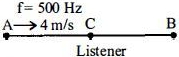
\(Case\, 1:\) When source is moving towards stationary listenerapparent frequency \(\eta^{\prime}=\eta\left(\frac{\mathrm{v}}{\mathrm{v}-\mathrm{v}_{\mathrm{s}}}\right)\)
\(=500\left(\frac{340}{336}\right)=506 \mathrm{Hz}\)
\(Case\, 2:\) When source is moving away from the stationary listener
\(\eta^{\prime \prime}=\eta\left(\frac{v}{v+v_{s}}\right)=500\left(\frac{340}{344}\right)=494 \mathrm{Hz}\)
In case \(1\) rumber of beats heard is \(6\) and in
\(case\, 2\) number of beats heard is \(18\) therefore frequency of the source at \(\mathrm{B}=512 \mathrm{Hz}\)
-
- (A) At \(36\, cm\) and \(84\, cm\) from one end
- (B) At \(24\, cm\) and \(72\, cm\) from one end
- (C) At \(48\, cm\) and \(96\, cm\) from one end
- (D) At \(72\, cm\) and \(96\, cm\) from one end
Show answer and solution
Correct Answer: (D)
Total length of the wire, \(L=114 \mathrm{cm}\)\(\mathrm{n}_{1}: \mathrm{n}_{2}: \mathrm{n}_{3}=1: 3: 4\)
Let \(L_{1}, L_{2}\) and \(L_{3}\) be the lengths of the three parts
As \(n \propto \frac{1}{L}\)
\(\therefore \quad \mathrm{L}_{1}: \mathrm{L}_{2}: \mathrm{L}_{3}=\frac{1}{1}: \frac{1}{3}: \frac{1}{4}=12: 4: 3\)
\(\therefore \quad \mathrm{L}_{1}=72 \mathrm{cm}\left(\frac{12}{12+4+3} \times 114\right)\)
\(\mathrm{L}_{2}=24 \mathrm{cm}\left(\frac{4}{19} \times 114\right)\)
and \(\mathrm{L}_{3}=18 \mathrm{cm}\left(\frac{3}{19} \times 114\right)\)
Hence the bridges should be placed at
\(72 \mathrm{cm}\) and \(72+24=96 \mathrm{cm}\) from oneend
-
- (A) \(770\)
- (B) \(188.5\)
- (C) \(178.2\)
- (D) \(200.5\)
Show answer and solution
Correct Answer: (C)
Fundamental frequency,\(f=\frac{v}{2 \ell}=\frac{1}{2 \ell} \sqrt{\frac{T}{\mu}}=\frac{1}{2 \ell} \sqrt{\frac{T}{A \rho}}\left[\because v=\sqrt{\frac{T}{\mu}} \text { and } \mu=\frac{m}{\ell}\right]\)
Also, \(Y=\frac{T \ell}{A \Delta \ell} \Rightarrow \frac{T}{A}=\frac{Y \Delta \ell}{\ell} \Rightarrow f=\frac{1}{2 \ell} \sqrt{\frac{\gamma \Delta \ell}{\ell \rho}}\) \(...(i)\)
Putting the value of \(\ell, \frac{\Delta \ell}{\ell}, \rho\) and \(\gamma\) in eq \(^{n} .\) \((i)\) we get,
\(f=\sqrt{\frac{2}{7}} \times \frac{10^{3}}{3}\) or, \(f \approx 178.2 \mathrm{Hz}\)
-
- (A) \(32\)
- (B) \(27.5\)
- (C) \(60\)
- (D) \(30\)
Show answer and solution
Correct Answer: (D)
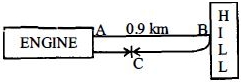
Let after 5 sec engine at point \(C\)\(t=\frac{A B}{330}+\frac{B C}{330}\)
\(5=\frac{0.9 \times 1000}{330}+\frac{\mathrm{BC}}{330}\)
\(\therefore \mathrm{BC}=750 \mathrm{m}\)
Distance travelled by engine in \(5\, sec\)
\(=900 \mathrm{m}-750 \mathrm{m}=150 \mathrm{m}\)
Therefore velocity of engine
\(=\frac{150 \mathrm{m}}{5 \mathrm{sec}}=30 \mathrm{m} / \mathrm{s}\)
-
- (A) \(\frac{{3\pi }}{2}\,cm/s\)
- (B) \(\frac{{5\pi }}{2}\,cm/s\)
- (C) \(\frac{{\pi }}{2}\,cm/s\)
- (D) \(2\pi \,cm/s\)
Show answer and solution
Correct Answer: (B)
Transverse wave equation\(y=a \sin (\omega t+k x)\)
Next crest appears at time interval of \(0.4 \mathrm{s}\)
So, the time period \(T=0.4\)
\(\therefore\) Angular Frequency \(\omega=\frac{2 \pi}{T}=\frac{2 \pi}{0.4}\)
\(\therefore\) Speed of the particle
\(\nu=\frac{d y}{d t}=a \omega \sin (\omega t+k x)\)
\(\nu_{\max }=a \omega\)
\(a=1 / 2 c m\)
\(=\frac{1}{2} \times \frac{2 \pi}{0.4}=\frac{2 \pi}{8} \times 10\)
\(=\frac{5 \pi}{2} \mathrm{cm} / \mathrm{s}\)
-
- (A) \(92\)
- (B) \(200\)
- (C) \(100\)
- (D) \(332\)
Show answer and solution
Correct Answer: (B)
Standard equation\(\mathrm{y}(\mathrm{x}, \mathrm{t})=\mathrm{A} \cos \left(\frac{\omega}{\mathrm{V}} \mathrm{x}-\omega \mathrm{t}\right)\)
From any of the displacement equation Say \(y_1\)
\(\frac{\omega}{V}=0.50 \pi \text { and } \omega=100 \pi\)
\(\therefore \frac{100 \pi}{V}=0.5 \pi\)
\(\therefore \mathrm{V}=\frac{100 \pi}{0.5 \pi}=200 \mathrm{m} / \mathrm{s}\)
No questions on this page match these filters.