


Questions
6 questionsShowing 1–6 of 6 questions
-
- (A) \(5.5\)
- (B) \(3.5\)
- (C) \(4.5\)
- (D) \(2.5\)
Show answer and solution
Correct Answer: (C)
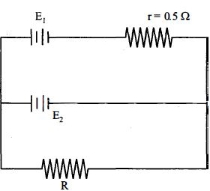
\(\frac{100}{R+r}=\frac{90}{R}\)\(\Rightarrow \frac{R+r}{R}=\frac{10}{9}\)
\(\Rightarrow \quad 1+\frac{0.5}{\mathrm{R}}=\frac{10}{9}\)
\(\Rightarrow \quad \frac{0.5}{\mathrm{R}}=\frac{1}{9}\)
\(\therefore R=4.5 \,\Omega\)
-
- (A) \(50\)
- (B) \(10\)
- (C) \(36.7\)
- (D) \(26.7\)
Show answer and solution
Correct Answer: (D)
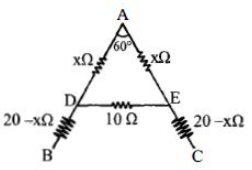
For \(ADE\) \(\frac{1}{\mathrm{R}^{\prime}}=\frac{1}{2 \mathrm{x}}+\frac{1}{10}\)or \(\quad \mathrm{R}^{\prime}=\frac{20 \mathrm{x}}{10+2 \mathrm{x}}\)
\(\mathrm{R}_{\mathrm{BC}}=\frac{20 \mathrm{x}}{10+2 \mathrm{x}}+20-\mathrm{x}+20-\mathrm{x}\) ....\((i)\)
or \(\frac{20 x}{10+2 x}+40=2 x\)
Solving we get
\(x=10\, \Omega\)
Putting the value of \(x=10\, \Omega\) in equation \(( i )\) We get
\( R_{B C} =\frac{20 \times 10}{10+2 \times 10}+20-10+20-10 \)
\(=\frac{80}{3}=26.7\, \Omega \)
-
- (A) \(80\)
- (B) \(75\)
- (C) \(67\)
- (D) \(50\)
Show answer and solution
Correct Answer: (C)
From question, \(\frac{x}{y}=\frac{40}{100-40}=\frac{2}{3}\)\(\Rightarrow x=\frac{2}{3} y\)
Again, \(\frac{3 x}{y}=\frac{z}{100-z}\)
or \(\frac{3 \times \frac{2 y}{3}}{y}=\frac{z}{100-z}\)
Solving we get \(Z=67\, \mathrm{cm}\)
Therefore new position of null point
\(\cong 67\, \mathrm{cm}\)
-
- (A) \(P\) and \(R\)
- (B) \(P\) and \(Q\)
- (C) \(Q\) and \(R\)
- (D) Any two points
Show answer and solution
Correct Answer: (B)
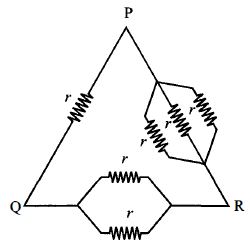
Resistance between \(\mathrm{P\,and} \,\mathrm{Q}\)\(r_{P Q}=r_{11}\left(\frac{r}{3}+\frac{r}{2}\right)=\frac{r \times \frac{5}{6} r}{r+\frac{5}{6} r}=\frac{5}{11} r\)
Resistance between \(Q\) and \(R\)
\(\mathrm{r}_{\mathrm{QR}}=\frac{\mathrm{r}}{2} 11\left(\mathrm{r}+\frac{\mathrm{r}}{3}\right)=\frac{\frac{\mathrm{r}}{2} \times \frac{4}{3} \mathrm{r}}{\frac{\mathrm{r}}{2}+\frac{4}{3} \mathrm{r}}=\frac{4}{11} \mathrm{r}\)
Resistance between \(\mathrm{P}\) and \(\mathrm{R}\)
\({{\rm{r}}_{{\rm{PR}}}} = \frac{{\rm{r}}}{3}11\left( {\frac{{\rm{r}}}{2} + {\rm{r}}} \right) = \frac{{\frac{{\rm{r}}}{3} \times \frac{3}{2}{\rm{r}}}}{{\frac{{\rm{r}}}{3} + \frac{3}{2}{\rm{r}}}} = \frac{3}{{11}}{\rm{r}}\)
Hence, it is clear that \(\mathrm{r}_{\mathrm{PQ}}\) is maximum
-
- (A) \(10.4 \)
- (B) \(0\)
- (C) \(2.9\)
- (D) \(13.3\)
Show answer and solution
Correct Answer: (A)
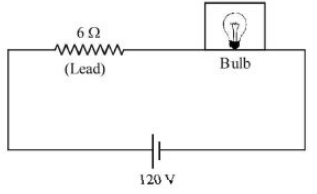
Power of bulb \(=60\, \mathrm{W}\) (given)Resistance of bulb \(=\frac{120 \times 120}{60}=240\, \Omega\left[\because \mathrm{P}=\frac{\mathrm{V}^{2}}{\mathrm{R}}\right]\)
Power of heater \(=240\, \mathrm{W}\) (given)
Resistance of heater \(=\frac{120 \times 120}{240}=60\, \Omega\)
Voltage across bulb before heater is switched on,
\(\mathrm{V}_{1}=\frac{240}{246} \times 120=117.73\, \text { volt }\)
Voltage across bulb after heater is switched on,
\(\mathrm{V}_{2}=\frac{48}{54} \times 120=106.66\, \mathrm{volt}\)
Hence decrease in voltage
\(\mathrm{V}_{1}-\mathrm{V}_{2}=117.073-106.66=10.04\, \mathrm{Volt}\) (approximately)
-
- (A) \(Q\)
- (B) \(S\)
- (C) \(P\)
- (D) \(R\)
Show answer and solution
Correct Answer: (B)
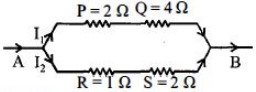
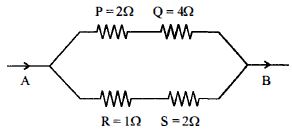
\(\mathrm{R}_{1}=\mathrm{P}+\mathrm{Q}=2\, \Omega+4 \,\Omega=6\, \Omega\)\(\mathrm{R}_{2}=\mathrm{R}+\mathrm{S}=1 \,\Omega+2 \,\Omega=3 \,\Omega\)
\(\mathrm{I}_{1} \mathrm{R}_{1}=\mathrm{I}_{2} \mathrm{R}_{2}\)
\(\mathrm{I}_{1}=\frac{\mathrm{R}_{2}}{\mathrm{R}_{1}} \mathrm{I}_{2}=\frac{3}{6} \mathrm{I}_{2}=\frac{\mathrm{I}_{2}}{2}\)
or \(\mathrm{I}_{2}=2 \mathrm{I}_{1}\)
Heat flow \(\mathrm{H}=\mathrm{I}^{2} \mathrm{Rt}\)
For \(Q, H_{Q}=I_{1}^{2} Q t=\frac{I_{2}^{2}}{4} \times 4 t=I_{2}^{2} t\)
For \(\mathrm{S}, \mathrm{H}_{\mathrm{S}}=\mathrm{I}_{2}^{2} \mathrm{St}=\mathrm{I}_{2}^{2} \cdot 2 \mathrm{t}=2 \mathrm{I}_{2}^{2} \mathrm{t}\)
\(\therefore \) Greatest amount of heat generated by \(S\).
No questions on this page match these filters.