


Questions
4 questionsShowing 1–4 of 4 questions
-
- (A) \(5.5 \times {10^{ - 13}}\,C\)
- (B) \(7.5 \times {10^{ - 13}}\,C\)
- (C) \(4.5 \times {10^{ - 12}}\,C\)
- (D) \(2.5 \times {10^{ - 11}}\,C\)
Show answer and solution
Correct Answer: (A)
Let us assume that,Lost energy of electron is equal to its stopping potential
\(E\, = \,KE\, + \,\Phi \)
\(\frac{12100}{\lambda A}=V+4.47 \mathrm{eV}\)
\(\frac{12100}{2500}=V+4.47\)
\(\frac{124}{25}=V+4.47\)
\(4.95=V+4.47\)
\(\mathrm{V}=4.95-4.47=0.48\)
\(\mathrm{V}_{\text {sphere }}=\frac{K Q}{r}=\frac{9 \times 10^{9} \mathrm{Q}}{100}\)
\(0.48=\frac{9 \times 10^{8} Q}{100}\)
\(Q=\frac{48 \times 10^{9}}{9 \times 100}\)
\(Q=5.5 \times 10^{-13} \mathrm{C}\)
-
- (A) \(\frac{{{\lambda _e}}}{{{\lambda _p}}} = \sqrt {\frac{{{m_p}}}{{{m_e}}}} \)
- (B) \(\frac{{{\lambda _e}}}{{{\lambda _p}}} = \sqrt {\frac{{{m_e}}}{{{m_p}}}} \)
- (C) \(\frac{{{\lambda _e}}}{{{\lambda _p}}} = \frac{1}{2}\sqrt {\frac{{{m_e}}}{{{m_p}}}} \)
- (D) \(\frac{{{\lambda _e}}}{{{\lambda _p}}} = 2\sqrt {\frac{{{m_p}}}{{{m_e}}}} \)
Show answer and solution
Correct Answer: (D)
Energy in joule \((E)\)\(=\) charge \(\times\) potential diff. in volt
\({{\text{E}}_{{\text{electron }}}} = {q_{\text{e}}}{\text{V}}\) and \({{\text{E}}_{{\text{proton }}}} = {q_{\text{p}}}4{\text{V}}\)
de-Broglie wavelength
\(\lambda=\frac{\mathrm{h}}{\mathrm{P}}=\frac{\mathrm{h}}{\sqrt{2 \mathrm{mE}}}\)
\(\lambda_{\mathrm{c}}=\frac{\mathrm{h}}{\sqrt{2 \mathrm{m}_{\mathrm{e}} \mathrm{e} \mathrm{V}}}\) and \(\lambda_{\mathrm{P}}=\frac{\mathrm{h}}{\sqrt{2 \mathrm{m}_{\mathrm{p}} \mathrm{e} 4 \mathrm{V}}}\)
\({\text{(}}\because {q_c} = {q_p}{\text{)}}\)
\(\therefore \frac{{{\lambda _{\text{c}}}}}{{{\lambda _{\text{P}}}}} = \frac{{\frac{{\text{h}}}{{\sqrt {2{{\text{m}}_{\text{e}}}{\text{eV}}} }}}}{{\frac{{\text{h}}}{{\sqrt {2{{\text{m}}_p}{\text{e4V}}} }}}}\) \( = \sqrt {\frac{{2{{\text{m}}_p}{\text{e4V}}}}{{2{{\text{m}}_e}{\text{eV}}}}} \)
\( = 2\sqrt {\frac{{{{\text{m}}_{\text{p}}}}}{{{{\text{m}}_{\text{e}}}}}} \)
-
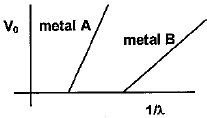
- (A) Work function of metal \(B\) is greater than that of metal \(A\)
- (B) For light of certain wavelength falling on both metal, maximum kinetic energy of electrons emitted from \(A\) will be greater than those emitted from \(B\)
- (C) Work function of metal \(A\) is greater than that of metal \(B\)
- (D) Students data is not correct
Show answer and solution
Correct Answer: (D)
\(\frac{\mathrm{hc}}{\lambda}-\phi=\mathrm{eV}_{0}\)\(v_{0}=\frac{h c}{e \lambda}-\frac{\phi}{e}\)
For metal \(A\) For metal \(B\)
\(\frac{{\phi A}}{{hc}} = \frac{1}{\lambda }\) \(\frac{{\phi B}}{{hc}} = \frac{1}{\lambda }\)
As the value of \(\frac{1}{\lambda}\) (increasing and decreasing) is not specified hence we cannot say that which metal has comparatively greater or lesser work function \((\phi)\).
-
- (A) \(n^2\)
- (B) \(n\)
- (C) \(n^{1/2}\)
- (D) \(n^{1/4}\)
Show answer and solution
Correct Answer: (C)
According to the question,\(2 \pi r=n \lambda=\frac{n h}{p}=\frac{n h}{m v}\)
or \(\operatorname{mvr}=\frac{\mathrm{nh}}{2 \pi}\) or \(\mathrm{mv}=\frac{\mathrm{nh}}{2 \pi \mathrm{r}}\)
\(\mathrm{F}=\mathrm{qv}_{\mathrm{B}}=\frac{\mathrm{mv}^{2}}{\mathrm{r}}\)
or, \(\quad \mathrm{q}_{B}=\frac{\mathrm{mv}}{\mathrm{r}}=\frac{\mathrm{nh}}{2 \pi \mathrm{r} \cdot \mathrm{r}}\)
or, \(\quad \mathrm{r}^{2}=\frac{\mathrm{nh}}{2 \pi \mathrm{qB}}\)
or, \(\quad r=\sqrt{\frac{n h}{2 \pi q B}}\)
i.e., \(r\propto n^{1/2}\)
No questions on this page match these filters.