


Questions
4 questionsShowing 1–4 of 4 questions
-
- (A) \(P, M\) and \(D\)
- (B) \(M, D\) and \(P\)
- (C) \(P, D\) and \(M\)
- (D) \(D, M\) and \(P\)
Show answer and solution
Correct Answer: (B)
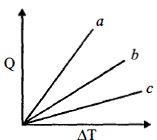
On giving same amount of heat at constant pressure, there is no change in temperature for mono, dia and polyatomic.\((\Delta \mathrm{Q})_{\mathrm{P}}=\mu \mathrm{C}_{\mathrm{p}} \Delta \mathrm{T}\left(\mu=\begin{array}{l}{\text { No. of molecules }} \\ {\text { Avogedro's na }}\end{array}\right)\)
or \(\quad \Delta \mathrm{T} \propto \frac{1}{\text { no of molecules }}\)
-
- (A) \(398\)
- (B) \(520\)
- (C) \(499\)
- (D) \(532\)
Show answer and solution
Correct Answer: (C)
\({v_{rms}} = \sqrt {\frac{{3PV}}{{{\rm{mass\, of\, the\, gas}}}}} \) -
- (A) Statement \(-1\) is false and Statement \(-2\) is true
- (B) Statement \(-1\) and Statement \(-2\) both are true. Statement \(-2\) is the correct explanation of Statement \(-1\)
- (C) Statement \(-1\) is true and Statemcnt \(-2\) is false
- (D) Statement \(-1\) and Statement \(-2\) both are true. Statement \(-2\) is not correct explanation of Statement \(- 1\)
Show answer and solution
Correct Answer: (A)
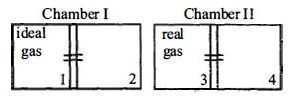
In ideal gases the molecules are considered as point particles and for point particles, there is no internal excitation, no vibration and no rotation. For an ideal gas the internal energy can only be translational kinetic energy and for real gas both kinetic as well as potential energy -
- (A) Statement \(- 1\) is true, Statement \(-2\) is true and
Statement \(-2\) is the correct explanation of Statement \(-1\) - (B) Statement \(-1\) is true, Statement \(-2\) is false.
- (C) Statement \(-1\) is true, Statement \(-2\) is true but
Statement \(-2\) is not the correct explanation of Statement \(-1\) - (D) Statement \(-1\) is false, Statement \(-2\) is true
Show answer and solution
Correct Answer: (C)
Internal energy of a system is the energy possessed by the system due to molecular motion and molecular configuration.Internal energy \(u=u_{k}+u_{p}\)
For an ideal gas there is no molecular attraction \(u_{p}=0\)
\(\therefore\) Internal energy \(\mathrm{u}=\mathrm{u}_{\mathrm{k}}\)
\((i.e.,\, internal\, kinetic\, energy)\)
and \(u=u_{k}=\frac{3}{2} \mu R T\)
At constant pressure \((\Delta \mathrm{Q})_{\mathrm{P}}=\mu \mathrm{C}_{\mathrm{p}} \Delta \mathrm{T}\)
At constant volume \((\Delta \mathrm{Q})_{\mathrm{v}}=\mu \mathrm{C}_{\mathrm{v}} \Delta \mathrm{T}\)
\(\mathrm{AsC}_{\mathrm{P}}>\mathrm{C}_{\mathrm{V}} \quad \therefore \quad(\Delta \mathrm{T})_{\mathrm{P}}<(\Delta \mathrm{T})_{\mathrm{V}}\)
- (A) Statement \(- 1\) is true, Statement \(-2\) is true and
No questions on this page match these filters.