


All JEE Mains 2023 Chemistry questions
25 chaptersShowing 251–300 of 366 questions
-
- (A) \(226\)
- (B) \(223\)
- (C) \(227\)
- (D) \(229\)
Show answer and solution
Correct Answer: (C)
\(2 C ( s )+ O _2( g ) \rightarrow 2 CO ( g )\)\(1\,mol \qquad 1.5\,mol\)
Limiting reagent is carbon. One mole carbon produces one mole CO. Hence, volume at STP is \(227 \times 10^{-1}\) litre
-
- (A) \(2\)
- (B) \(3\)
- (C) \(4\)
- (D) \(1\)
Show answer and solution
Correct Answer: (D)
\(3 BaCl _2+2 Na _3 PO _4 \rightarrow Ba _3\left( PO _4\right)_2+6 NaCl\)\(Na _3 PO _4\) is limiting reagent.
\(2\) mole \(Na _3 PO _4\) gives \(1\) mole of \(Ba _3\left( PO _4\right)_2\)
-
- (A) \(4\)
- (B) \(5\)
- (C) \(3\)
- (D) \(2\)
Show answer and solution
Correct Answer: (B)
\(Na _2 O + H _2 O \rightarrow 2 NaOH\)\(Cl _2 O _7+ H _2 O \rightarrow 2 HClO _4\)
\(1+4=5\)
-
- (A) \(A-I, B-III, C-II, D-IV\)
- (B) \(A-II, B-III, C-IV, D-I\)
- (C) \(A-II, B-IV, C-III, D-I\)
- (D) \(A-II, B-IV, C-I, D-III\)
Show answer and solution
Correct Answer: (D)
\(16\,g\,CH _4=1\) mole \(CH _4\) contains \(10 \times 6.02 \times 10^{23}\) electrons\(=60.2 \times 10^{23}\)
\(1\,g\,H _2=0.5\) mole \(H _2\) gas occupy \(11.35\) litre volume at STP
\(1 \text { mole of } N _2=28\,g\)
\(0.5 \text { mole of } SO _2=32\,g\)
-
- (A) \(6\)
- (B) \(12\)
- (C) \(3\)
- (D) \(24\)
Show answer and solution
Correct Answer: (B)
millimole of \(NaOH =0.24 \times 25\)\(\therefore \quad \text { millimole of acid }=0.24 \times 25\)
\(\Rightarrow \quad \text { mass of acid }=0.24 \times 25 \times 24.2\,mg\)
\(\text { for pure acid, }\)
\(\qquad V =\frac{ w }{ d } ;( d =1.21\,kg / L =1.21\,g / ml )\)
\(\therefore V =\frac{0.24 \times 25 \times 24.2}{1.12} \times 10^{-3}\)
\(=120 \times 10^{-3}\,ml\)
\(=12 \times 10^{-2}\,ml\)
-
- (A) \(138\)
- (B) \(139\)
- (C) \(137\)
- (D) \(136\)
Show answer and solution
Correct Answer: (B)
\((10\,ml\) solute in \(90\,ml\) solvent\(\text { mass of solute }=10 \times 3.2=32\,g\)
\(\text { mass of solvent }=90 \times 1.6\,g\)
\(m =\frac{32 \times 1000}{160 \times 90 \times 1.6}=1.388\)
\(m =138.8 \times 10^{-2}=139\)
- 257. The number of molecules and moles in \(2.8375\) litres of \(O _2\) at STP are respectively 2023 Hard
- (A) \(7.527 \times 10^{22}\) and \(0.250\,mol\)
- (B) \(1.505 \times 10^{23}\) and \(0.250\,mol\)
- (C) \(7.527 \times 10^{23}\) and \(0.125\,mol\)
- (D) \(7.527 \times 10^{22}\) and \(0.125\,mol\)
Show answer and solution
Correct Answer: (D)
Number of moles of \(O _2=\frac{2.8375}{22.7}=0.125\)Number of molecules \(=0.125\,N _{ A }\)
\(=7.525 \times 10^{22}\)
-
- (A) \(4\)
- (B) \(3\)
- (C) \(2\)
- (D) \(1\)
Show answer and solution
Correct Answer: (A)
\(\left[ Cr \left( H _2 O \right)_5 Cl \right] Cl _2+2 AgNO _3 \rightarrow\)\(\begin{array}{ll}0.01\,M , 20\, mL & 0.1\, M \\ \text { For } 0.2 \text { milimole } & AgNO _3 \text { required }\end{array}\)
\(0.4=0.1 \times V ( ml )\)
\(V =4\,mL\)
-
- (A) \(14\)
- (B) \(12\)
- (C) \(15\)
- (D) \(13\)
Show answer and solution
Correct Answer: (C)
Mole of \(Na =\frac{0.69}{23}=3 \times 10^{-2}\)\(Na + H _2 O \longrightarrow NaOH +\frac{1}{2} H _2\)
By using \(POAC\)
Moles of \(NaOH =3 \times 10^{-2}\)
\(NaOH\) reacts with \(HCl\)
No. of equivalent of \(NaOH = No\). of equivalent of \(HCl\)
\(3 \times 10^{-2} \times 1=\frac{73}{36.5} \times V (\text { in L }) \times 1\)
\(V =1.5 \times 10^{-2}\,L\)
Volume of \(HCl =15\,ml\).
-
- (A) \(24\)
- (B) \(23\)
- (C) \(25\)
- (D) \(22\)
Show answer and solution
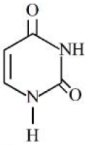
Correct Answer: (C)
Mol. Wt of \(C _4 N _2 H _4 O _2=112\)\(\% N =\frac{28}{112} \times 100=25 \%\)
-
- (A) \(1: 1\)
- (B) \(3: 1\)
- (C) \(2: 1\)
- (D) \(1: 2\)
Show answer and solution
Correct Answer: (C)
Assume : Mass of solvent \(\approx\) Mass of solutionCase \(I:-\)
\(0.25=\frac{ W _1}{62} \times \frac{1000}{500}\)
Case \(II:-\)
\(0.25=\frac{ W _2}{62} \times \frac{1000}{250}\)
\(\frac{ W _1}{ W _2}=\frac{2}{1}\)
-
- (A) \(100\)
- (B) \(50\)
- (C) \(200\)
- (D) \(150\)
Show answer and solution
Correct Answer: (C)
Let \(M\) is the molar mass of the compound \(( g / mol )\) mass of compound \(=0.01\,M\,gm\)\(\text { mass of carbon }=0.01 M \times \frac{60}{100}\)
\(\text { moles of carbon }=\frac{0.01 M }{12} \times \frac{60}{100}\)
moles of \(CO _2\) from combustion \(=\frac{4.4}{44}=\) moles of carbon
\(\frac{0.01\,M }{12} \times \frac{60}{100}=\frac{4.4}{44}\)
\(M =\frac{4.4}{44} \times \frac{100}{60} \times \frac{12}{0.01}=200\, gm / mol\)
-
- (A) \(C _9 H _8\)
- (B) \(C _{11} H _4\)
- (C) \(C _5 H _8\)
- (D) \(C _{11} H _8\)
Show answer and solution
Correct Answer: (A)
\(C _{ x } H _{ y }+\left( x +\frac{ y }{4}\right) O _2 \rightarrow xCO _2+\frac{ y }{2} H _2 O\)\(\frac{ y }{2}=4 \therefore y =8\)
\(x +\frac{8}{4}=11\)
\(\therefore x =9\)
\(\therefore \text { Hydrocarbon will be }= C _9 H _8\)
-
- (A) \(A, B\) and \(C\) only
- (B) \(C\) and \(D\) only
- (C) \(A, C\) and \(D\) only
- (D) \(B\) and \(C\) only
Show answer and solution
Correct Answer: (C)
All non zero digits are significant.\(0.00253\)
\(\text { Significant figures }=3(2,5,3)\)
\(1.0003\)
Zeros between non-zero digit are significant.
Thus,\(1.0003\) has \(5\) significant figures.
\(15.0\)
Significant number \(=3\)
\(163\)
Significant number \(=3\)
Options (3) - \(A,C\) and \(D\)
-
- (A) \(2\)
- (B) \(6\)
- (C) \(8\)
- (D) \(4\)
Show answer and solution
Correct Answer: (D)
\(Zn +2 HCl \rightarrow ZnCl _2+ H _2 \uparrow\)Moles of \(Zn\) used \(=\frac{11.5}{65.4}=\) Moles of \(H _2\) evolved
Volume of \(H _2=\frac{11.5}{65.4} \times 22.7\,L =3.99\, L\)
-
- (A) \(3\)
- (B) \(6\)
- (C) \(9\)
- (D) \(12\)
Show answer and solution
Correct Answer: (A)
Moles of hydrocarbon \(=\frac{17 \times 10^{-3}}{136}=1.25 \times 10^{-4}\)Mole of \(H _2\) gas
\(\Rightarrow 1 \times \frac{8.40}{1000}= n \times 0.0821 \times 273\)
\(\Rightarrow n =3.75 \times 10^{-4}\)
Hydrogen molecule used for 1 molecule of hydrocarbon is 3
\(=\frac{3.75 \times 10^{-4}}{1.25 \times 10^{-4}}=3\)
-
- (A) \(A\) is true but \(R\) is false.
- (B) \(A\) is false but \(R\) is true.
- (C) Both \(A\) and \(R\) are correct and \(R\) is the correct explanation of \(A\).
- (D) Both \(A\) and \(R\) are correct but \(R\) is NOT the correct explanation of \(A\).
Show answer and solution
Correct Answer: (C)
Assertion \(- A\) : Benzene is more stable than cyclohexatriene (True)Reason \(- R :\) Delocalised \(\pi-\) e cloud lies \(B.M.O\) so more attracted by nuclei of carbon atom.
(True and Correct Explanation)
-
- (A) Both Statement \(I\) and Statement \(II\) are true
- (B) Statement \(I\) is true but Statement \(II\) is false
- (C) Statement \(I\) is false but Statement \(II\) is true
- (D) Both Statement \(I\) and Statement \(II\) are false
Show answer and solution
Correct Answer: (B)
Tropolone is an aromatic compound and has \(8 \pi\) electrons \(\left(6 \pi e ^{-}\right.\)are endocyclic and \(2 \pi e^{-}\) are exocyclic) and \(\pi\) electrons of \( > C = O\) group in tropolone is not involved in aromaticity.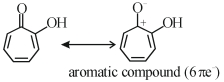
- 269. In the following reaction ' \(X\) ' is \(CH _3\left( CH _2\right)_4 CH _3 \xrightarrow[HCl,\Delta]{Anhy.AlCl_3} X\) 2023 Medium
- (A) \(CH _3\left( CH _2\right)_4 CH _2 Cl\)
- (B) \(Cl - CH _2-\left( CH _2\right)_4- CH _2- Cl\)
Show answer and solution
Correct Answer: (C)
\(n\)-alkanes on heating in this presence of anhydrous \(AlCl _3\) and hydrogen chloride gas isomerise to branched chain alkanes. The major product has one methyl side chain.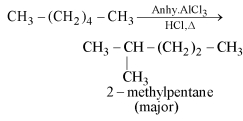
-
- (A) \(13\)
- (B) \(14\)
- (C) \(15\)
- (D) \(12\)
Show answer and solution
Correct Answer: (D)
Element Percentage Mole Mole ratio \(C\) \(85.8\) \(\frac{85.8}{12}=7.15\) \(1\) \(H\) \(14.2\) \(\frac{14.2}{1}=14.2\) \(2\) Empirical formula \(\left( CH _2\right)\)
\(14 \times n=84\)
\(n =6\)
\(\therefore\) Molecular formula \(C _6 H _{12}\)
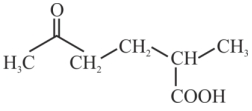
-
- (A) \(5-\)Formyl\(-2-\)methylhexanoic acid
- (B) \(2-\)Methyl\(-5-\)oxohexanoic acid
- (C) \(2-\)Formyl\(-5-\)methylhexan\(-6-\)oic acid
- (D) \(5-\)Methyl\(-2-\)oxohexan\(-6-\)oic acid
Show answer and solution
Correct Answer: (B)
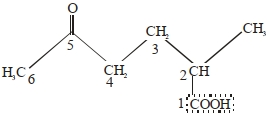
IUPAC NAME\(2-\)Methyl\(-5-\)oxohexanoic acid
- 272. According to \(MO\) theory the bond orders for \(O _2{ }^{2-}\), \(CO\) and \(NO ^{+}\)respectively, are 2023 Medium
- (A) \(1,3\) and \(3\)
- (B) \(1, 3\) and \(2\)
- (C) \(1,2\) and \(3\)
- (D) \(2,3\) and \(3\)
Show answer and solution
Correct Answer: (A)
Theory based. -
- (A) \((A)\) and \((D)\) are correct
- (B) \((C)\) and \((D)\) are correct
- (C) \((A)\) and \((B)\) are correct
- (D) \((B)\) and \((C)\) are correct
Show answer and solution
Correct Answer: (D)
\((A)\) \(NF _3\) has trigonal pyramidal shape.\((B)\) Bond order \(\Rightarrow N _2 > O _2\)
\((D)\) Dipole moment \(H _2 O > H _2 S\)
Due to Electronegativity difference.
- 274. Decreasing order of the hydrogen bonding in following forms of water is correctly represented by
A. Liquid water
B. Ice
C. Impure water 2023 Easy- (A) A = B > C
- (B) B > A > C
- (C) C > B > A
- (D) A > B > C
Show answer and solution
Correct Answer: (B)
Ice > Liquid water > Impure water
Due to impurity extent of H-Bonding decreases. -
- (A) Both Statement \(I\) and Statement \(II\) are correct
- (B) Statement \(I\) is correct but Statement \(II\) is incorrect
- (C) Both Statement \(I\) and Statement \(II\) are incorrect
- (D) Statement \(I\) is incorrect but Statement \(II\) is correct
Show answer and solution
Correct Answer: (B)
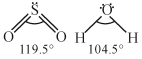
Both are bent in shape.Bond angle of \(SO _2\left( sp ^2\right)\) is greater than that of \(H _2 O\) \(\left( sp ^3\right)\) due to higher repulsion of multiple bonds.
- 276. In which of the following processes, the bond order increases and paramagnetic character changes to diamagnetic one? 2023 Medium
- (A) \(O _2 \rightarrow O _2^{2-}\)
- (B) \(NO \rightarrow NO ^{+}\)
- (C) \(N _2 \rightarrow N _2^{+}\)
- (D) \(O _2 \rightarrow O _2^{+}\)
Show answer and solution
Correct Answer: (B)
\(NO\) is paramagnetic with \(BO =2.5, NO ^{+}\)is diamagnetic with \(BO =3\) -
- (A) \(A - II, B - III, C - IV, D - I\)
- (B) \(A - IV, B - III, C - II, D - I\)
- (C) \(A - II, B - I, C - IV, D - III\)
- (D) \(A - IV, B - I, C - II, D - III\)
Show answer and solution
Correct Answer: (B)
\(IF _7 \quad\) zero lone pair\(ICl _4^{-} \quad\) two lone pair
\(XeF _6\) one lone pair
\(XeF _2 \quad\) three lone pair
-
- (A) \(C, E\) only
- (B) \(B, C\) only
- (C) \(B, C\), \(E\) only
- (D) \(A, B\) only
Show answer and solution
Correct Answer: (C)
According to Fajan's Rule,\(A.\) \(KF > KI - False ; LiF > KF -\) True
\(B.\) \(KF < KI -\) True; \(LiF > KF -\) True
\(C.\) \(SnCl _4 > SnCl _2\) - True; \(CuCl > NaCl\) - True
\(D.\) \(LiF > KF\) - True; \(CuCl < NaCl - False\)
\(E.\) \(KF < KI -\) True; \(CuCl > NaCl -\) True
-
- (A) Both Statement \(I\) and Statement \(II\) are correct.
- (B) Statement \(I\) is incorrect but Statement \(II\) is correct.
- (C) Both Statement \(I\) and Statement \(II\) are incorrect.
- (D) Statement \(I\) is correct but Statement \(II\) is incorrect.
Show answer and solution
Correct Answer: (B)
Explanation:
1. Evaluation of Statement I:
In chemistry, by standard convention, the dipole moment is represented by a crossed arrow (\(\mapsto\)) placed over the Lewis structure of a molecule. The cross is situated at the positive (less electronegative) center, and the arrowhead points toward the negative (more electronegative) center. Since Statement I states that the tail is on the negative center and the head points towards the positive center, it is factually incorrect.
2. Evaluation of Statement II:
The crossed arrow representation explicitly symbolizes the direction of the shift of electron density (separation of partial charges) towards the more electronegative atom in the covalent bond. Therefore, Statement II is factually correct.
Hence, Option B is the correct choice. - 280. The bond order and magnetic property of acetylide ion are same as that of \(........\). 2023 Medium
- (A) \(NO ^{+}\)
- (B) \(O _2^{+}\)
- (C) \(O _2^{-}\)
- (D) \(N _2^{+}\)
Show answer and solution
Correct Answer: (A)
Acetylide ion \(\rightarrow C _2^{2-}(\overline{ C } \equiv \overline{ C })\)Bond order \(=3\) and Diamagnetic
\(NO ^{+} 14 e ^{-} \rightarrow\) Bond order \(=3\) and Diamagnetic
- 281. The covalency and oxidation state respectively of boron in \(\left[ BF _4\right]^{-}\), are 2023 Medium
- (A) \(4\) and \(3\)
- (B) \(4\) and \(4\)
- (C) \(3\) and \(4\)
- (D) \(3\) and \(5\)
Show answer and solution
Correct Answer: (A)
Number of covalent bond formed by Boron is \(4\)Oxidation number of fluorine is \(-1\),
Oxidation number of \(B +4 \times(-1)=-1\),
Thus, Oxidation number of \(B =+3\)

- 282. The number of bent-shaped molecule/s from the following is \(.....\). \(N _3^{-}, NO _2^{-}, I _3^{-}, O _3, SO _2\) 2023 Medium
- (A) \(2\)
- (B) \(3\)
- (C) \(1\)
- (D) \(5\)
Show answer and solution
Correct Answer: (B)
\(N _3^{-}\)linear\(NO _2^{-}\)bent
\(I _3^{-}\)linear
\(O _3\) bent
\(SO _2\) bent
-
- (A) \(4\)
- (B) \(3\)
- (C) \(2\)
- (D) \(1\)
Show answer and solution
Correct Answer: (B)
\((a),(b)\) and \((c)\) are factors which affect the percent covalent character of the ionic bond according to Fajan's rule -
- (A) \(2.00\)
- (B) \(2.5\)
- (C) \(6.00\)
- (D) \(5\)
Show answer and solution
Correct Answer: (D)
\(p _{ x }, p _{ y }, p _{ z }, d _{ z ^2}\) and \(d _{ x ^2- y ^2}\) are axial orbitals. -
- (A) \(3\)
- (B) \(5\)
- (C) \(4\)
- (D) \(1\)
Show answer and solution
Correct Answer: (A)
\(ICl _4^{-}, BrF _3\) and \(NO _2^{+}\)do not have odd number of \(e^{-}\) - 286. The total number of lone pairs of electrons on oxygen atoms of ozone is \(...........\). 2023 Medium
- (A) \(5\)
- (B) \(6\)
- (C) \(4\)
- (D) \(3\)
Show answer and solution
Correct Answer: (B)
(Total no, of lone pairs on oxygen atoms \(=6\)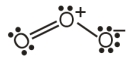
- 287. What is the number of unpaired electron(s) in the highest occupied molecular orbital of the following species : \(N _2: N _2^{+} ; O _2 ; O _2^{+}\)? 2023 Medium
- (A) \(0,1,2,1\)
- (B) \(2,1,2,1\)
- (C) \(0,1,0,1\)
- (D) \(2,1,0,1\)
Show answer and solution
Correct Answer: (A)
\(N _2\)\(\sigma 1 s ^2 \sigma^* 1 s ^2 \sigma 2 s ^2 \sigma^* 2 s ^2 \pi 2 p _{ x }^2=\pi 2 p _y^2 \frac{\sigma 2 p _z^2}{\text { HOMO }}\)
\(N _2^{+}-\sigma 1 s ^2 \sigma^* 1 s ^2 \sigma^* 2 s ^2 \sigma^* 2 s ^2 \pi 2 p _{ x }^2=\pi 2 p _{ y }^2 \frac{\sigma 2 p _z^1}{\text { HOMO }}\)
\(O _2-\sigma 1 s ^2 \sigma^* 1 s ^2 \sigma 2 s ^2 \sigma^* 2 s ^2 \sigma 2 p _z^2\)
\(\pi 2 p _{ x }^2=\pi 2 p _{ y }^2\)
\(\pi^* 2 p _{ x }^1=\pi^* 2 p _{ y }^1( HOMO )\)
\(O _2^{+}-\sigma 1 s ^2 \sigma * 1 s ^2 \sigma 2 s ^2 \sigma * 2 s ^2 \sigma 2 p _z^2 \pi 2 p _{ x }^2=\pi 2 p _y^2\)
\(\pi^* 2 p _{ x }^1=\pi^* 2 p _{ y }^0( HOMO )\)
\(N _2 \Rightarrow 0 \text { unpaired } e ^{-} \text {in HOMO }\)
\(N _2^{+} \Rightarrow 1 \text { unpaired } e ^{-} \text {in HOMO }\)
\(O _2 \Rightarrow 2 \text { unpaired } e ^{-} \text {in HOMO }\)
\(O _2^{+} \Rightarrow 1 \text { unpaired } e ^{-} \text {in HOMO }\)
-
- (A) \(SO _2( s ), NH _3( s )\)
- (B) \(SO _2( s ), CO _2( s )\)
- (C) \(HCl ( s ), AlN ( s )\)
- (D) \(MgO ( s ), SO _2( s )\)
Show answer and solution
Correct Answer: (A)
\(SO _2\) and \(NH _3\) are polar molecules. They are constituent particles of polar molecular solids. - 289. For electron gain enthalpies of the elements denoted as \(\Delta_{ eg } H\), the incorrect option is : 2023 Medium
- (A) \(\Delta_{ eg } H ( Cl ) < \Delta_{ eg } H ( F )\)
- (B) \(\Delta_{ eg } H ( Se ) < \Delta_{ eg } H ( S )\)
- (C) \(\Delta_{ eg } H (I) < \Delta_{ eg } H (At)\)
- (D) \(\Delta_{ eg } H ( Te ) < \Delta_{ eg } H\) (Po)
Show answer and solution
Correct Answer: (B)
\((1)\) \(\Delta_{ eg } H ( Cl ) < \Delta_{ eg } H ( F )\)\((-345) (-328)\) Correct
\((2)\) \(\Delta_{ eg } H ( Se ) < \Delta_{ eg } H ( S )\)
\((-195) \quad(-200)\) Incorrect
\((3)\) \(\Delta_{ eg } H (I) < \Delta_{ eg } H ( At )\)
\((-295) (-270)\) Correct
\((4)\) \(\Delta_{ eg } H ( Te ) < \Delta_{ eg } H ( Po )\)
\((-190) (-183)\) Correct
- 290. For elements \(B , C , N , Li , Be , O\) and \(F\) the correct order of first ionization enthalpy is 2023 Medium
- (A) \(Li < Be < B < C < N < O < F\)
- (B) \(B > Li > Be > C > N > O > F\)
- (C) \(Li < B < Be < C < O < N < F\)
- (D) \(Li < Be < B < C < O < N < F\)
Show answer and solution
Correct Answer: (C)
First I.E.\(F > N > O > C > Be > B > Li\)
\(Li -520\, kJ / mol\)
\(Be -899\, kJ / mol\)
\(B -801 \,kJ / mol\)
\(C -1086 \,kJ / mol\)
\(N -1402 \,kJ / mol\)
\(O -1314\, kJ / mol\)
\(F -1681\,kJ / mol\)
-
- (A) Both \((A)\) and \((R)\) are true and \((R)\) is the correct explanation of \((A)\)
- (B) Both \((A)\) and \((R)\) are true but \((R)\) is not the correct explanation of \((A)\)
- (C) \((A)\) is false but \((R)\) is true
- (D) \((A)\) is true but \((R)\) is false
Show answer and solution
Correct Answer: (A)
From Sc to Mn ionization energy is less than that of \(Mg\).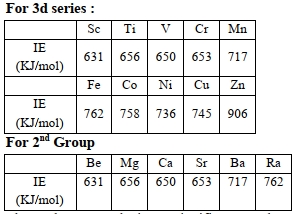
-
- (A) \(1\)
- (B) \(2\)
- (C) \(0.5\)
- (D) \(3\)
Show answer and solution
Correct Answer: (C)
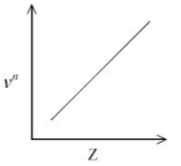
According to Henry Moseley \(\sqrt{v}\,\alpha z - b\)So \(n =\frac{1}{2}\)
-
- (A) \(A - II, B - IV, C - I, D - III\)
- (B) \(A - I, B - III, C - IV, D - II\)
- (C) \(A - IV, B - III, C - II, D - I\)
- (D) \(A - IV, B - II, C - I, D - III\)
Show answer and solution
Correct Answer: (D)
Atomic number Block \(37\) \((K)\) \(s-\)block \(78\) \((Pt)\) \(d-\)block \(52\) \((Te)\) \(p-\)block \(65\) \((Tb)\) \(f-\)block -
- (A) \(C > P > At > Br\)
- (B) \(Br > P > At > C\)
- (C) \(P > Br > C > At\)
- (D) \(Br > C > At > P\)
Show answer and solution
Correct Answer: (D)
Atom \(E.N\) \(Br\) \(3.0\) \(C\) \(2.5\) \(At\) \(2.2\) \(P\) \(2.1\) -
- (A) \(Be > Ca > K\)
- (B) \(Ca > K > Be\)
- (C) \(K > Ca > Be\)
- (D) \(K > Be > Ca\)
Show answer and solution
Correct Answer: (C)
On moving from top to bottom metallic character increases while on moving from left to right metallic decreases.\(K > Ca > Be\)
-
- (A) \(Ne\) and \(F\)
- (B) \(Ne\) and \(Cl\)
- (C) \(Ar\) and \(Cl\)
- (D) \(Ar\) and \(F\)
Show answer and solution
Correct Answer: (B)
\(Cl\) has the most negative \(\Delta H _{\text {eg }}\) among all the elements and \(Ne\) has the most positive \(\Delta H _{ eg }\). - 297. Which of the following represents the correct order of metallic character of the given elements ? 2023 Medium
- (A) \(Si < Be < Mg < K\)
- (B) \(Be < Si < Mg < K\)
- (C) \(K < Mg < Be < Si\)
- (D) \(Be < Si < K < Mg\)
Show answer and solution
Correct Answer: (A)
Metallic character increases down the group and decreases along the period. -
- (A) \(A,B,C\) and \(D\)
- (B) \(A,C\) and \(D\) Only
- (C) \(B\) and \(D\) Only
- (D) \(A,B\) and \(D\) Only
Show answer and solution
Correct Answer: (B)
Electronegativity of an element depends on the atom with which it is attached.\(NO =\text { neutral oxide }\)
\(Al _2 O _3=\text { amphoteric oxide }\)
-
- (A) \(1\)
- (B) \(2\)
- (C) \(3\)
- (D) \(4\)
Show answer and solution
Correct Answer: (A)
\(H _{2( g )}+ I _{2( g )} \rightleftharpoons 2 HI _{( g )}\)\(K _{ c }=\frac{[ HI ]^2}{\left[ H _2\right]\left[ I _2\right]}=\frac{(3)^2}{3 \times 3}=\frac{9}{9}=1\)
-
- (A) \(2\)
- (B) \(4\)
- (C) \(3\)
- (D) \(5\)
Show answer and solution
Correct Answer: (C)
\(A _{( g )} \rightleftharpoons 2 B _{( g )}+ C _{( g )}\)\(t=0 \quad 450\)
\(\text { timet } 450-x \quad 2 x\)
\(P_T=P_A+P_B+P_C\)
\(720=450-x+2 x+x\)\(2 x=270\)
\(x=135\)
Fraction of A decomposed \(=\frac{135}{450}=0.3=3 \times 10^{-1}\)
So, \(x=3\)

No questions on this page match these filters.