


Questions
7 questionsShowing 1–7 of 7 questions
- 1. Arrange the following compounds in increasing order of rate of aromatic electrophilic substitution reaction
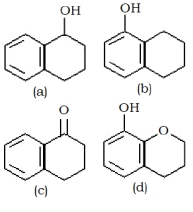 2023 Hard
- (A) \(d, b, c, a\)
- (B) \(b, c, a, d\)
- (C) \(c, a, b, d\)
- (D) \(d, b, a, c\)
Show answer and solution
Correct Answer: (C)
Benzene becomes more reactive towards EAS when any substituent raises the electron density.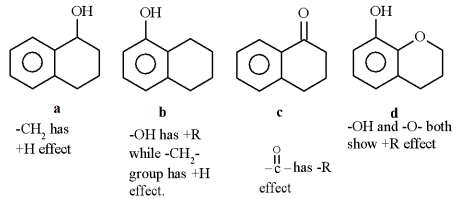
- 2. Decreasing order of reactivity towards electrophilie substitution for the following compounds is:
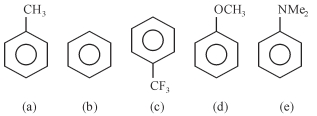 2023 Medium
- (A) \(c > b > a > d > e\)
- (B) \(e > d > a > b > c\)
- (C) \(a > d > e > b > c\)
- (D) \(d > a > e > c > b\)
Show answer and solution
Correct Answer: (B)
Higher the electron density on Benzene Ring, Higher its Reactivity towards electrophilic substitution Reaction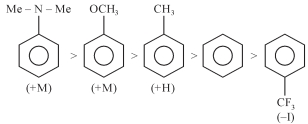
-
- (A) \(A\) is false but \(R\) is true
- (B) Both \(A\) and \(R\) are correct and \(R\) is the correct explanation of \(A\)
- (C) Both \(A\) and \(R\) are correct but \(R\) is NOT the correct explanation of \(A\)
- (D) \(A\) is true but \(R\) is false
Show answer and solution
Correct Answer: (C)
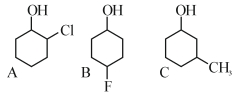
Acidic strength \(\alpha-\) I effect\(\alpha \frac{1}{+ I }\) effect
\(F , Cl\) exerts \(- I\) effect, Methyl exerts \(+ I\) effect, \(C\) is least acidic.
Among \(A\) and \(B\); since inductive effect is distance dependent, Extent of \(- I\) effect is higher in \(A\) followed by \(B\) even though \(F\) is stronger electron withdrawing group than \(Cl\). Thus, \(A\) is more acidic than \(B\).
-
- (A) \(C , D , B , A\)
- (B) \(C, A, B, D\)
- (C) \(D, C, A, B\)
- (D) \(D , C , B , A\)
Show answer and solution
Correct Answer: (B)
Based on Theory -
- (A) \(A-I, B-IV, C-II, D-III\)
- (B) \(A-III, B-II, C-I, D-IV\)
- (C) \(A-III, B-II, C-IV, D-I\)
- (D) \(A-III, B-II, C-IV, D-I\)
Show answer and solution
Correct Answer: (D)
Basic Strength \(\alpha \frac{1}{ pK _{ b }}\) Order for \(pK _{ b }: A > B > D > C\)
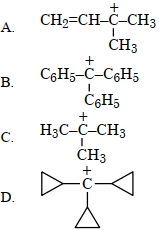
- 6. The decreasing order of hydride affinity for following carbocations is: Choose the correct answer from the options given below:
 2023 Medium
- (A) \(A,C,B,D\)
- (B) \(C,A,B,D\)
- (C) \(C,A,D,B\)
- (D) \(A,C,D,B\)
Show answer and solution
Correct Answer: (B)
Stability order of cations is: \(C < A < B < D\) -
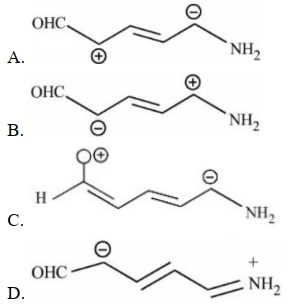
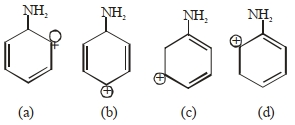
- (A) \(c\)
- (B) \(d\)
- (C) \(b\)
- (D) \(a\)
Show answer and solution
Correct Answer: (A)
The \(+ M\) effect of \(NH _2\) is stabilizing the carbocation.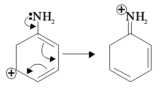
No questions on this page match these filters.