


All JEE Mains 2023 Chemistry questions
25 chaptersShowing 351–366 of 366 questions
-
- (A) \(2\)
- (B) \(3\)
- (C) \(1\)
- (D) \(4\)
Show answer and solution
Correct Answer: (C)
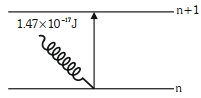
\(\Delta E = R _{ H } Z ^2\left(\frac{1}{ n _1^2}-\frac{1}{ n _2^2}\right)\)\(1.47 \times 10^{-17}=2.18 \times 10^{-15} \times 9\left(\frac{1}{n^2}-\frac{1}{(n+1)^2}\right)\)
\(\frac{1.47}{1.96}=\frac{3}{4}=\frac{1}{n^2}-\frac{1}{(n+1)^2}\)
So, \(n =1\)
- 352. The energy of an electron in the first Bohr orbit of hydrogen atom is \(-2.18 \times 10^{-18}\,J\). Its energy in the third Bohr orbit is \(........\). 2023 Medium
- (A) \(\frac{1}{27}\) of this value
- (B) One third of this value
- (C) Three times of this value
- (D) \(\frac{1}{9}\) th of this value
Show answer and solution
Correct Answer: (D)
\(E _{ n }=\frac{-2.18 \times 10^{-18} Z ^2}{ n ^2}\)\(\text { i.e. } E _{ n } \propto \frac{1}{ n ^2}\)
-
- (A) \(796\)
- (B) \(798\)
- (C) \(797\)
- (D) \(785\)
Show answer and solution
Correct Answer: (B)
For one photon \(E = hv\)For one mole photon,
\(E=6 \cdot 023 \times 10^{23} \times 6.626 \times 10^{-34} \times 2 \times 10^{12}\)
- 354. The number of atomic orbitals from the following having \(5\) radial nodes is \(.......\). \(7 s , 7 p , 6 s , 8 p , 8 d\) 2023 Medium
- (A) \(3\)
- (B) \(2\)
- (C) \(1\)
- (D) \(4\)
Show answer and solution
Correct Answer: (A)
Radial node \(= n -\ell-1\)\(7 s \Rightarrow R \cdot N =7-0-1=6\)
\(7 p \Rightarrow R \cdot N =7-1-1=5\)
\(6 s \Rightarrow R \cdot N =6-0-1=5\)
\(8 p \Rightarrow R \cdot N =8-1-1=6\)
\(8 d \Rightarrow R \cdot N =8-2-1=5\)
So, Answer is \(3\)
-
- (A) \(3\)
- (B) \(4\)
- (C) \(2\)
- (D) \(5\)
Show answer and solution
Correct Answer: (A)
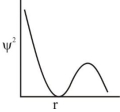
\(A, D\) and \(E\) statements are correct.For \(2 s\) orbital, the probability density first decreases and then increases.
At any distance from nucleus the probability density of finding electron is never zero and it always have some finite value.
-
- (A) \(2\)
- (B) \(1\)
- (C) \(3\)
- (D) \(0\)
Show answer and solution
Correct Answer: (B)
(A) This statement is correct. Line emission spectra (or atomic emission spectra) are indeed used to study the electronic structure of atoms. These spectra are produced when photons are emitted from atoms as excited electrons return to a lower energy level. Each line corresponds to a particular quantum leap between energy levels. (B) This statement is incorrect. The emission spectra of atoms in the gas phase do not show a continuous spread of wavelength from red to violet. Instead, they show distinct lines corresponding to specific electron transitions, hence they are known as line emission spectra. (C) This statement is correct. An absorption spectrum is like the photographic negative of an emission spectrum. In an absorption spectrum, light passes through a cold, dilute gas and atoms in the gas absorb at characteristic frequencies; since the re-emitted light is unlikely to be emitted in the same direction as the absorbed photon, this gives rise to dark lines (absence of light) in the spectrum. (D) This statement is correct. The element helium was indeed discovered in the sun through spectroscopy before it was found on Earth. The name helium comes from Helios, the Greek name for the sun. So, the number of incorrect statements is 1. -
- (A) \(1\)
- (B) \(0\)
- (C) \(2\)
- (D) \(3\)
Show answer and solution
Correct Answer: (B)
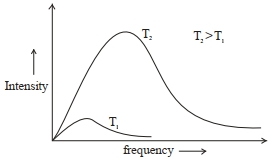
A blackbody can emit and absorb all the wavelengths in electromagnetic spectrum \(\Rightarrow(A)\) is correct\(\Rightarrow(B),(C),(D)\) correct
- 358. The number of s-electrons present in an ion with \(55\) protons in its unipositive state is 2023 Hard
- (A) \(8\)
- (B) \(9\)
- (C) \(12\)
- (D) \(10\)
Show answer and solution
Correct Answer: (D)
\(Z =55[ Cs ] \Rightarrow[ Xe ] 6 s ^1\)\(\left[ Cs ^{+}\right] \Rightarrow[ Xe ]\) i.e. upto \(5 s\) count \(e ^{-}\)of s-subshell i.e. \(1 s , 2 s , 3 s , 4 s , 5 s \Rightarrow 10\) electrons
- 359. The orbital angular momentum of an electron in \(3 s\) orbital is \(\frac{x h}{2 \pi}\). The value of.\(x\) is \(..........\). 2023 Easy
- (A) \(1\)
- (B) \(2\)
- (C) \(3\)
- (D) \(0\)
Show answer and solution
Correct Answer: (D)
\(l\) for \(3s\) orbital is \(0\).
Orbital angular momentum \(=\) \(\sqrt{l(l+1)} \frac{h}{2\pi}\)
\(= \sqrt{0(0+1)} \frac{h}{2\pi} = 0\)
Given \(=\) \(\frac{x h}{2 \pi}\)
\(x = 0\)
-
- (A) \(\frac{9}{4} x\)
- (B) \(\frac{4}{9} x\)
- (C) \(\frac{27}{16} x\)
- (D) \(\frac{16}{27} x\)
Show answer and solution
Correct Answer: (C)
\(Li ^{2+}\)\(r _2= x = k \times \frac{2^2}{3}=\frac{4 k }{2}\)
\(Be ^{3+}\)
\(r _3= y = k \times \frac{3^2}{4}\)
\(\frac{y}{x}=\frac{9}{4} \times \frac{3}{4}=\frac{27}{16}\)
\(y=\frac{27}{16} x\)
- 361. The shortest wavelength of hydrogen atom in Lyman series is \(\lambda\). The longest wavelength in Balmer series of \(He ^{+}\)is 2023 Hard
- (A) \(\frac{5}{9 \lambda}\)
- (B) \(\frac{9 \lambda}{5}\)
- (C) \(\frac{36 \lambda}{5}\)
- (D) \(\frac{5 \lambda}{9}\)
Show answer and solution
Correct Answer: (B)
For \(H : \frac{1}{\lambda}= R _{ H } \times 1^2\left(\frac{1}{1^2}-\frac{1}{\infty^2}\right)\)\(\frac{1}{\lambda_{ He ^{+}}}= R _{ H } \times 2^2 \times\left(\frac{1}{4}-\frac{1}{9}\right)\)
From \((1)\) and \((2)\) \(\frac{\lambda_{ He ^{+}}}{\lambda}=\frac{9}{5}\)
\(\lambda_{ He ^{+}}=\lambda \times \frac{9}{5}\)
\(\lambda_{ He ^{+}}=\frac{9 \lambda}{5}\)
- 362. The total number of isoelectronic species from the given set is \(.......\) \(O ^{2-}, F ^{-}, Al , Mg ^{2+}, Na ^{+}, O ^{+}, Mg , Al ^{3+}, F\) 2023 Medium
- (A) \(5\)
- (B) \(4\)
- (C) \(3\)
- (D) \(2\)
Show answer and solution
Correct Answer: (A)
Isoelectronic species \(O ^{2 \Theta}, F ^{\Theta}, Mg ^{2+}, Na ^{\oplus}, Al ^{3+}\) -
- (A) \(r_0=a_0\)
- (B) \(r_0=4 a_0\)
- (C) \(r _0=\frac{ a _0}{2}\)
- (D) \(r_0=2 a_0\)
Show answer and solution
Correct Answer: (D)
At node \(\Psi_{2 s }=0\)\(\therefore 2-\frac{ r _0}{ a _0}=0\)
\(\therefore r _0=2 a _0\)
-
- (A) \(6\)
- (B) \(5\)
- (C) \(4\)
- (D) \(7\)
Show answer and solution
Correct Answer: (D)
\(\lambda_{ d }=\frac{ h }{ mv }=\frac{ h }{\sqrt{2 mKE }}=\frac{6.6 \times 10^{-34}}{\sqrt{2 \times 9 \times 10^{-31} \times 4.5 \times 10^{-29}}}\)\(=\frac{6.6 \times 10^{-34}}{\sqrt{9^2 \times 10^{-60}}}\)
\(=\frac{6.6 \times 10^{-34}}{9 \times 10^{-30}}=\frac{6.6}{9} \times 10^{-4}\)
\(=7.3 \times 10^{-5}\,m\)
\(\text { Therefore Ans }=7\)
-
- (A) \(Ci ^{+}, Na ^{+}, Mg ^{2+}, Ca ^{2+}\)
- (B) \(\left. Ba ^{2+}, Sr ^{2+}, K +, Ca ^{2+}\right.\)
- (C) \(\left. N ^{3-}, O ^{2-}, F , S ^{2-}\right.\)
- (D) \(\left. K ^{+}, Cl ^{-}, Ca ^{2+}, Sc ^{3+}\right.\)
Show answer and solution
Correct Answer: (D)
\(K ^{+} Cl ^1 Ca ^{2+} Sc ^{3+}\)\(\begin{array}{llll}18 & 18 & 18 & 18\end{array}\)
- 366. Which transition in the hydrogen spectrum would have the same wavelength as the Balmer type transition from \(n =4\) to \(n =2\) of \(He ^{+}\)spectrum 2023 Medium
- (A) \(n =2\) to \(n =1\)
- (B) \(n =1\) to \(n =3\)
- (C) \(n =1\) to \(n =2\)
- (D) \(n =3\) to \(n =4\)
Show answer and solution
Correct Answer: (A)
\(He ^{+}\)ion :\(\frac{1}{\lambda( H )}= R (1)^2\left[\frac{1}{ n _1^2}-\frac{1}{ n _2^2}\right]\)
\(\frac{1}{\lambda\left( He ^{+}\right)}= R (2)^2\left[\frac{1}{2^2}-\frac{1}{4^2}\right]\)
Given \(\lambda( H )=\lambda\left( He ^{+}\right)\)
\(R (1)^2\left[\frac{1}{ n _1^2}-\frac{1}{ n _2^2}\right]= R (4)\left[\frac{1}{2^2}-\frac{1}{4^2}\right]\)
\(\frac{1}{ n _1^2}-\frac{1}{ n _2^2}=\frac{1}{1^2}-\frac{1}{2^2}\)
On comparing \(n _1=1\) and \(n _2=2\)
No questions on this page match these filters.