


All JEE Mains 2023 Chemistry questions
25 chaptersShowing 201–250 of 366 questions
-
- (A) \(160\)
- (B) \(162\)
- (C) \(161\)
- (D) \(163\)
Show answer and solution
Correct Answer: (C)
\(W = z \times i \times t\)Density \(\times\) volume \(=\frac{E \times i \times t}{96500}\)
\(10 \times 100 \times 0.0001=\frac{\left(\frac{\text { atomic wt. }}{\text { v.f }}\right) \times 2 \times x}{96500}(\text { v.f }=2)\)
\(\therefore x=161\,sec \text {. }\)
-
- (A) \(916\)
- (B) \(915\)
- (C) \(917\)
- (D) \(914\)
Show answer and solution
Correct Answer: (C)
\(Cr _2 O _7^{2-}+14 H ^{+}+6 e ^{-} \rightarrow 2 Cr ^{3+}+7 H _2 O\)\(E =1.33-\frac{0.059}{6} \log \frac{(0.1)^2}{\left(10^{-2}\right)\left(10^{-3}\right)^{14}}\)
\(E =1.33-\frac{0.059}{6} \times 42=0.917\)
\(E =917 \times 10^{-3}\)
\(x =917\)
-
- (A) \(24\)
- (B) \(23\)
- (C) \(22\)
- (D) \(25\)
Show answer and solution
Correct Answer: (D)
\(Cu ( OH )_2( s ) \rightleftharpoons Cu ^{2+}( aq )+2 OH ^{-}( aq )\)\(Ksp =\left[ Cu ^{2+}\right]\left[ OH ^{-}\right]^2\)
\(pH =14 ; pOH =0 ;\left[ OH ^{-}\right]=1\,M\)
\({\left[ Cu ^{2+}\right]=\frac{ Ksp }{[1]^2}=10^{-20} M }\)
\(Cu ^{2+}( aq )+2 e ^{-} \rightarrow Cu ( s )\)
\(E = E ^{\circ}-\frac{0.059}{2} \log _{10} \frac{1}{\left[ Cu ^{2+}\right]}\)
\(=0.34-\frac{0.059}{2} \log _{10} \frac{1}{10^{-20}}\)
\(=-0.25=-25 \times 10^{-2}\)
-
- (A) \(30\)
- (B) \(10\)
- (C) \(20\)
- (D) \(50\)
Show answer and solution
Correct Answer: (B)
\(Pt _{( s )}\left| H _2( g , 1 atm )\right| H ^{+}( aq , 1 M ) \| Fe ^{3+}( aq ), Fe ^{2+}( aq )| Pt |( s )\)\(\text { at anode } H _2 \longrightarrow 2 H ^{+}+2 e ^{-}\)
\(\text {At cathode } Fe _{ aq }^{3+}+ e ^{-} \longrightarrow Fe _{ aq }^{2+}\)
\(E ^{\circ}= E _{ H _2 / H ^{+}}^{\circ}+ E _{ Fe ^{3+} Fe ^{2+}}^{\circ}=0 \cdot 771\,V\)
\(E = E ^{\circ}-\frac{0 \cdot 06}{1} \log \frac{ Fe ^{2+}}{ Fe ^{3+}}\)
\(0 \cdot 712=(0+0 \cdot 771)-\frac{0 \cdot 06}{1} \log \frac{ Fe ^{2+}}{ Fe ^{3+}}\)
\(\log \frac{ Fe ^{2+}}{ Fe ^{3+}}=\frac{0 \cdot 059}{0 \cdot 06} \approx 1\)
\(\frac{ Fe ^{2+}}{ Fe ^{3+}}=10\)
-
- (A) \(100\)
- (B) \(10\)
- (C) \(105\)
- (D) \(852\)
Show answer and solution
Correct Answer: (B)
\(\frac{1}{2} H _2( g )+ Fe ^{3+} \text { (aq.) } \longrightarrow H ^{+}( aq )+ Fe ^{2+}( aq .)\)\(E = E ^{\circ}-\frac{0.059}{1} \log \frac{\left[ Fe ^{2+}\right]}{\left\lfloor Fe ^{3+}\right\rfloor}\)
\(\Rightarrow \quad 0.712=(0.771-0)-\frac{0.059}{1} \log \frac{\left[ Fe ^{2+}\right]}{\left[ Fe ^{3+}\right]}\)
\(\Rightarrow \quad \log \frac{\left[ Fe ^{2+}\right]}{\left[ Fe ^{3+}\right]}=\frac{(0.771-0712)}{0.059}=1\)
\(\Rightarrow \frac{\left[ Fe ^{2+}\right]}{\left[ Fe ^{3+}\right]}=10\)
-
- (A) \(1824\)
- (B) \(1825\)
- (C) \(1823\)
- (D) \(1822\)
Show answer and solution
Correct Answer: (B)
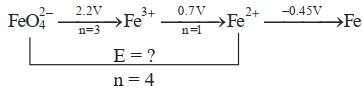
\(4 \times E =3 \times 2.2+1 \times 0.7\)\(E =\frac{7.3}{4}=1.825 V =1825 \times 10^{-3}\,V\)
-
- (A) \(2\)
- (B) \(4\)
- (C) \(6\)
- (D) \(8\)
Show answer and solution
Correct Answer: (A)
Statement \((A)\) and Statement \((C)\) are incorrect -
- (A) B, D only
- (B) B, C, D only
- (C) A, B, D only
- (D) B, C only
Show answer and solution
Correct Answer: (A)
Lead storage battery consists of lead anode and a grid of lead packed with lead oxide \(\left( PbO _2\right)\) as cathode, a \(38 \%\) solution of \(H _2 SO _4\) is used as an electrolyte.On charging the battery the reaction is reversed and \(PbSO _4( s )\) on anode and cathode is converted into \(Pb\) and \(PbO _2\) respectively.
-
- (A) A is correct but R is not correct
- (B) Both A and R are correct and R is the correct explanation of A
- (C) A is not correct but R is correct
- (D) Both A and R are correct and R is NOT the correct explanation of A
Show answer and solution
Correct Answer: (B)
Be has less negative value compared to other AEM. However it's reducing nature is due to large hydration energy associated with the small size of \(Be ^{2+}\) ion and relatively large value of the atomization enthalpy of metal. -
- (A) \(4\)
- (B) \(6\)
- (C) \(8\)
- (D) \(2\)
Show answer and solution
Correct Answer: (D)
\(Pb ^{2+}+2 e ^{-} \rightarrow Pb \quad \Delta G _1^0=-2 FE _1^0\)\(Pb ^{4+}+4 e ^{-} \rightarrow Pb \quad \Delta G _2^0=-4 FE _2^0\)
\(Pb ^{2+} \rightarrow Pb ^{4+}+2 e ^{-} \quad \Delta G _3^0=-2 FE _3^0\)
\(\Delta G _3^0=\Delta G _1^0-\Delta G _2^0\)
\(-2 FE _3^0=2 F (2 n - m )\)
\(E _3^0= m -2 n = m - xn\)
Hence \(x=2\)
-
- (A) \(2\)
- (B) \(6\)
- (C) \(8\)
- (D) \(3\)
Show answer and solution
Correct Answer: (D)
Overall reaction :-\(H _{2( g )}+ M _{( aq )}^{3+} \longrightarrow M _{( aq )}^{+}+2 H _{( aq )}^{+}\)
\(E _{\text {Coll }}= E _{\text {Cathode }}^{\circ}- E _{\text {amode }}^{\circ}-\frac{0.059}{2} \log \frac{\left[ M ^{+}\right] \times 1^2}{\left[ M ^{+3}\right] 1}\)
\(0.1115=0.2-\frac{0.059}{2} \log \frac{\left[ M ^{+}\right]}{\left[ M ^{+3}\right]}\)
\(\quad 3=\log \frac{\left[ M ^{+}\right]}{\left[ M ^{+3}\right]}\)
\(\therefore a =3\)
-
- (A) \(274\)
- (B) \(273\)
- (C) \(272\)
- (D) \(275\)
Show answer and solution
Correct Answer: (D)
\(X + Y ^{2+} \rightarrow Y + X ^{2+}\)\(E _{\text {Cell }}^0=0.36-(-2.36)=2.72\,V\)
\(E _{\text {Cell }}=2.72-\frac{0.06}{2} \log \frac{0.001}{0.01}\)
\(=2.72+0.03=2.75\,V\)
\(=275 \times 10^{-2}\,V\)
-
- (A) \(16\)
- (B) \(15\)
- (C) \(17\)
- (D) \(14\)
Show answer and solution
Correct Answer: (C)
\(Zn ( s )+ Sn ^{2+}( aq ) \rightleftharpoons Zn ^{2+}( aq )+ Sn ( s )\)\(\Delta G ^0=-2.303\,RT \log _{10} Keq\)
\(- nF \left( E _{ cell }^0\right)=-2.303\,RT \log _{10} Keq\)
\(E _{ Zn / Zn ^{2+}}^0+ E _{ Sn ^{2+} / Sn }^0=\frac{0.059}{2} \log _{10} Keq\)
\(0.76+ E _{ Sn ^{2+} / Sn }^0=\frac{0.059}{2} \log _{10} 10^{20}\)
\(0.76+ E _{ Sn ^{2+} / Sn }^0=\frac{0.059 \times 20}{2}\)
\(E _{ Sn 2+/ Sn }^0=0.59-0.76=-0.17\)
\(E _{ Sn / Sn ^{2+}}^0=17 \times 10^{-2}\,V\)
\(=17\)
-
- (A) \(3\)
- (B) \(4\)
- (C) \(12\)
- (D) \(6\)
Show answer and solution
Correct Answer: (D)
\(\Delta G ^{\circ}=- RT \ell nK\)\(- nFE\)
\(\text { cell }=- RT \times 2.303\left(\log _{10} K \right)\)
\(\frac{ E _{ Cell }^{ o }}{0.06} \times n =\log K\)
\(Pd ^{+2}( aq .)+ 2 e ^{-} \rightleftharpoons Pd ( s ), E _{\text {cat,red }}^{ o }=0.83\)
\(\left. Pd ( s )+4 Cl ^{-} \text {(aq. }\right) \rightleftharpoons PdCl _4^{2-},( aq )+2 e ^{-}, E _{\text {Anode,Oxid }}^0=0.65\)
Net Reaction \(\rightarrow Pd ^{2+}\) (aq.) \(+4 Cl ^{-}\)(aq.) \(\rightleftharpoons PdCl _4^{2-}\) (aq.)
\(E _{\text {cell }}^{\circ}= E _{\text {cat,reed }}^0- E _{\text {Andode,oxid }}^0\)
\(E _{\text {cell }}^{\circ}=0.83-0.65\)
\(E _{\text {cell }}^{\circ}=0.18\)
Also \(n =2\)
Using equation \((1),(2)\) and \((3)\) \(\log K=6\)
-
- (A) \(4\)
- (B) \(3\)
- (C) \(2\)
- (D) \(1\)
Show answer and solution
Correct Answer: (A)
Given statements \(A, B, C\) and \(D\) are correct. - 216. The reaction \(\frac{1}{2} H _2( g )+ AgCl ( s ) \rightleftharpoons H ^{+}( aq )+ Cl ^{-}( aq )+ Ag ( s )\) occurs in which of the given galvanic cell. 2023 Medium
- (A) \(Pt \mid H _2\) (g) \(\left| KCl \left( sol ^{ n }\right)\right| \operatorname{AgCl}( s ) \mid Ag\)
- (B) \(Pt \left| H _2( g )\right| HCl \left( sol ^{ n }\right)| AgCl ( s )| Ag\)
- (C) \(Ag | AgCl ( s )| KCl \left( sol ^{ I }\right)| AgCl ( s )| Ag\)
- (D) \(Pt \left| H _2( g )\right| HCl \left( sol ^{ n }\right)\left| AgNO _3\left( sol ^{ n }\right)\right| Ag\)
Show answer and solution
Correct Answer: (B)
Anode : \(\frac{1}{2} H _2( g ) \rightleftharpoons H ^{+}( aq )+ e ^{-}\)Cathode : \(AgCl ( s )+ e ^{-} \rightarrow Ag ( s )+ Cl ^{-}( aq )\)
-
- (A) \(24\)
- (B) \(23\)
- (C) \(25\)
- (D) \(22\)
Show answer and solution
Correct Answer: (C)
\(\Lambda_{ m }= \frac{\kappa \times 1000}{ M }\)\(\Lambda_{ m }= \frac{1}{\rho} \times \frac{1000}{ M }\)
\(\frac{1}{5 \times 10^{-3}} \times \frac{1000}{0.8}\)
Ans. \(25 \times 10^4\,\Omega^{-1}\, cm ^{-2}\, mol ^{-1}\)
-
- (A) \(65\)
- (B) \(64\)
- (C) \(66\)
- (D) \(63\)
Show answer and solution
Correct Answer: (C)
\(\wedge_{ m }=\frac{ k }{ C } \times 1000\)Given \(k =5 \times 10^{-5} S cm ^{-1}\)
\(C =0.0025\,M\)
\(\wedge_{ m } =\frac{5 \times 10^{-5} \times 10^3}{0.0025}=\frac{5 \times 10^{-2}}{2.5 \times 10^{-3}}\)
\(=20\,S\,cm ^2\,mol ^{-1}\)
\(\alpha =\frac{20}{400}=\frac{1}{20}\)
\(\alpha=\frac{20}{400}=\frac{1}{20}\)
\(K_a=\frac{C \alpha^2}{1-\alpha} =\frac{0.0025 \times \frac{1}{20} \times \frac{1}{20}}{\frac{19}{20}}\)
\(=\frac{0.0025}{19 \times 20}=6.6 \times 10^{-6}\)
\(=66 \times 10^{-7}\)
-
- (A) \(V ^{2+}\) and \(Mn ^{2+}\)
- (B) \(Cr ^{2+}\) and \(CO ^{2+}\)
- (C) \(V ^{2+}\) and \(Cr ^{2+}\)
- (D) \(Mn ^{2+}\) and \(Co ^{2+}\)
Show answer and solution
Correct Answer: (C)
Metal cation with \((-)\) value of reduction potential \(\left( M ^{+3} / M ^{+2}\right)\) or with \((+)\) value of oxidation potential \(\left( M ^{+2} / M ^{+3}\right)\) will liberate \(H _2\) Therefore they will reduce \(H ^{+}\) i.e \(V { }^{+2}\) and \(Cr ^{+2}\) -
- (A) \(71\)
- (B) \(73\)
- (C) \(74\)
- (D) \(75\)
Show answer and solution
Correct Answer: (D)
Isotonic solutions,\(\pi_{ K _2 SO _4}=\pi_{ Glucose }\)
\(i \times 0.004 \times RT =0.01 \times RT\)
\(i =2.5\)
For \(K _2 SO _4 \quad\{\) for dissociation \(i =1+( n -1) \alpha\}\)
\(\operatorname{DOD}(\alpha)=\frac{ i -1}{ n -1}=\frac{2.5-1}{3-1}=0.75\)
\(\%\) dissociation \(=75\)
-
- (A) \(371\)
- (B) \(372\)
- (C) \(373\)
- (D) \(375\)
Show answer and solution
Correct Answer: (B)
\(i =1+( n -1) \alpha\)\( i =1+0.2(2-1)=1.2\)
\(\Delta T _{ f }= i K _{ f } m\)
\(\Delta T _{ f }=1.2 \times 1.86 \times \frac{5 \times 1000}{60 \times 500}\)
\(\Delta t _{ f }=3.72\)
\(\Delta T _{ f }=372 \times 10^{-2}\)
-
- (A) \(47\)
- (B) \(48\)
- (C) \(46\)
- (D) \(45\)
Show answer and solution
Correct Answer: (B)
\(MgCl _2 \rightarrow Mg ^{+2}+2 Cl ^{-}\)\(1-\alpha \quad \alpha \quad 2 \alpha\)
\(i =1+2 \alpha(\alpha=0.8)\)
\(i =2.6\)
\(\frac{\Delta p }{ p ^{\circ}}=\frac{ i \times n _2}{ n _1}\)
\(\Delta p =2.34\)
\(p _s=47.66\)
\(p _{ s } \cong 48\)
-
- (A) \(10\)
- (B) \(100\)
- (C) \(80\)
- (D) \(90\)
Show answer and solution
Correct Answer: (B)
\(\Delta T _{ b }=373.52-373\)\(=0.52\)
\(\Delta T _{ b }= Kb \cdot m\)
\(0.52=0.52 \times \frac{2}{\text { Molar Mass }} \times \frac{1}{20 \times 10^{-3}}\)
\(\text { Molar Mass }=100\,g / mol\)
- 224. A solution is prepared by adding \(2\,g\) of " \(X\) " of \(1\,mole\) of water. Mass percent of " \(X\) " in the solution is \(.............\%\) 2023 Medium
- (A) \(20\)
- (B) \(5\)
- (C) \(2\)
- (D) \(10\)
Show answer and solution
Correct Answer: (D)
Solute \(( X )=2\,g\)Solvent \(\left( H _2 O \right)=1\) mole \(=18\,g\)
Total mass \(=2+18=20\,g\)
\(\%\) mass of \(X =\frac{2}{20} \times 100=10 \%\)
-
- (A) \(40536\)
- (B) \(40537\)
- (C) \(40535\)
- (D) \(40538\)
Show answer and solution
Correct Answer: (C)
\(\because \pi= CRT\)\(\pi=\frac{n}{V} R T\)
\(\pi=\frac{\omega}{V} \frac{R T}{M}\)
\(M=\frac{\omega R T}{\pi \times V}\)
\(M=\frac{0.63 \times 0.083 \times 300}{1.29 \times 10^{-3} \times 300 \times 10^{-3}}\)
\(M=40535\,gm / moL\)
-
- (A) \(62240\)
- (B) \(62258\)
- (C) \(62240\)
- (D) \(62250\)
Show answer and solution
Correct Answer: (D)
\(\pi= CRT\)\(\frac{400\,Pa }{10^5}=\frac{\frac{2.5\,g }{ M _o}}{250 / 1000\,L } \times 0.83 \frac{ L - bar }{ K \cdot mol } \times 300\,K\)
\(M _0=62250\)
-
- (A) \(B, D\) and \(E\) only
- (B) \(A, B\) and \(D\) only
- (C) \(A\) and \(C\) only
- (D) \(B\) and \(D\) only
Show answer and solution
Correct Answer: (D)
\((A)\) \(\Delta T _{ b } \propto i \times c\)\((B)\) Azeotropic mixtures have same composition in both liquid and vapour phase.
\((C)\) Osmosis always takes place from hypotonic to hypertonic solution.
\((D)\) \(M =\frac{30 \times 10 \times 1.26}{98} \approx 4.09\,M\)
\((E)\) When \(KI\) solutions is added to \(AgNO _3\) solution, positively charged solution results due to adsorption of \(Ag ^{ F }\) ions from dispersion medium
\(AgI / Ag ^{+}\)
Positively charged
-
- (A) Both \(A\) and \(R\) are true but \(R\) is NOT the correct explanation of \(A\).
- (B) \(A\) is false but \(R\) is true.
- (C) \(A\) is true but \(R\) is false.
- (D) Both \(A\) and \(R\) are true and \(R\) is the correct explanation of \(A\).
Show answer and solution
Correct Answer: (D)
Assertion is correct.\(H _2 C _2 O _4 \cdot 2 H _2 O\)
\(M =\frac{3.15 \times 1000}{126 \times 250}\)
\(\frac{12.6}{126}=0.1\)
Reason is correct. It is used as a fact in explanation of assertion.
-
- (A) \(8\)
- (B) \(6\)
- (C) \(4\)
- (D) \(2\)
Show answer and solution
Correct Answer: (A)
\(\frac{\left( T _{ B }\right)_{ x }}{\left( T _{ B }\right)_{ y }}=\frac{2}{1} \quad \frac{(\Delta H )_{ x }}{(\Delta H )_{ y }}=\frac{1}{2}\)\(\frac{\left(\Delta T _{ B }\right)_{ x }}{\left(\Delta T _{ B }\right)_{ y }}= m =\frac{\left( K _{ B }\right)_{ x } \times \text { molality }}{\left( K _{ B }\right)_{ y } \times \text { molality }}\)
\(=\frac{( T \cdot B )_{ x }^2}{( T \cdot B )_{ y }^2} \times \frac{\Delta H _{ y }}{\left(\Delta H _{ x }\right.}=(2)^2 \times 2=8\)
-
- (A) \(31\)
- (B) \(30\)
- (C) \(32\)
- (D) \(33\)
Show answer and solution
Correct Answer: (B)
\(i=1+\alpha(\text { for } HA )\)\(=1.3\)
\(\%\) increase \(=\frac{\left(\Delta T _{ f }\right)_{ obs }-\left(\Delta T _{ f }\right)_{ cal }}{\left(\Delta T _{ f }\right)_{ cal }} \times 100\)
\(=\frac{K_f \times i \times m-K_f \times m}{K_f \times m} \times 100\)
\(=\frac{i-1}{1} \times 100=30 \%\)
-
- (A) A and D only
- (B) B and C only
- (C) A and C only
- (D) A only
Show answer and solution
Correct Answer: (A)
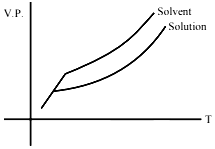
Vapour pressure (V.P.) of solvent is greater than vapour pressure (V.P.) of solution. Only solvent freezes. -
- (A) \(241\)
- (B) \(242\)
- (C) \(256\)
- (D) \(243\)
Show answer and solution
Correct Answer: (D)
\(\Delta T _{ f }= i \cdot K _{ f } \cdot m\)\(\Rightarrow \Delta T _{ f }=2.67 \times 1.8 \times \frac{38}{98} \times \frac{1000}{62}\)
\(\Rightarrow \Delta T _{ f }=30.05\)
\(\therefore \text { F.P. }=243\,K\)
-
- (A) \(1112\)
- (B) \(1113\)
- (C) \(1114\)
- (D) \(1111\)
Show answer and solution
Correct Answer: (D)
\(\frac{ P ^0- P _{ s }}{ P _{ s }}=\frac{ n _{\text {solute }}}{ n _{\text {solvent }}}=\frac{\frac{ x }{60}}{\frac{1000}{18}}=\frac{ P ^0-0.75 P ^0}{0.75 P ^0}\)\(\Rightarrow x =\frac{10000}{9}=1111\,gm\)
-
- (A) \(A-III, B-I, C-II, D-IV\)
- (B) \(A-III, B-II, C-I, D-IV\)
- (C) \(A-III, B-I, C-IV, D-II\)
- (D) \(A-I, B-III, C-II, D-IV\)
Show answer and solution
Correct Answer: (A)
\((A)\) van't Hoff factor, \(i\)\(i =\frac{\text { Normal molar mass }}{\text { Abnormal molar mass }}\)
\((B)\) \(k _{ f }=\) Cryoscopic constant
\((C)\) Solutions with same osmotic pressure are known as isotonic solutions.
\((D)\) Solutions with same composition of vapour over them are called Azeotrope.
-
- (A) \(115\)
- (B) \(114\)
- (C) \(113\)
- (D) \(116\)
Show answer and solution
Correct Answer: (D)
\(\text { Amount of solvent }=100-(29.25+19)=51.75\,g\)\(\Delta T _{ b }=\left[\frac{2 \times 29.25 \times 1000}{58.5 \times 51.75}+\frac{3 \times 19 \times 1000}{95 \times 51.75}\right] \times 0.52\)
\(\Delta Tb =16.075\)
\(\Delta Tb =\left( T _{ b }\right)_{\text {solution }}-\left( T _{ b }\right)_{\text {solvent }}\)
\(\left( T _{ b }\right)_{\text {solution }}=100+16.07\)
-
- (A) \(241\)
- (B) \(242\)
- (C) \(240\)
- (D) \(243\)
Show answer and solution
Correct Answer: (C)
\(\pi_1=\pi_2\)\(\Rightarrow C_1=C_2\)
\(\frac{12}{ x }=0.05[ x \rightarrow \text { Molar Mass of } A ]\)
\(X =240\)
-
- (A) \(220\)
- (B) \(148\)
- (C) \(256\)
- (D) \(250\)
Show answer and solution
Correct Answer: (B)
Molarity \(=\frac{\text { mole }}{\text { volume }}\)\(2.6 \times 10^{-3}=\frac{ x / 85}{0.67141}\)
\(x =0.148\,g\)
conc. Fo \(DCM\) in \(ppm\) \(=\frac{0.148}{1.49 \times 671.141} \times 10^6\)
\(=148\,ppm\)
-
- (A) \(2.00\)
- (B) \(6.00\)
- (C) \(8.00\)
- (D) \(4\)
Show answer and solution
Correct Answer: (D)
\(\pi= iCRT\)\(\pi \propto iC\)
\(A, B, D\) and \(E\) have same value of osmatic pressure.
-
- (A) 3
- (B) 4
- (C) 5
- (D) 6
Show answer and solution
Correct Answer: (C)
Mole fraction, molarity, molality, mass % and ppm describes the concentration of solution. -
- (A) \(314\)
- (B) \(312\)
- (C) \(311\)
- (D) \(310\)
Show answer and solution
Correct Answer: (A)
Let \(V.P.\) of pure \(A\) be \(P _{ A }^0\)Let \(V.P\) of pure \(B\) be \(P _B^0\)
When \(X _{ A }=0.7 \& X _{ B }=0.3\) \(P _{ s }=350\)
\(\Rightarrow P _{ A }^0 \times 0.7+ P _{ B }^0 \times 0.3=350\)
When \(X _{ A }=0.2 \& X _{ B }=0.8\)
\(P _{ s }=410\)
\(\Rightarrow P _{ A }^0 \times 0.2+ P _{ B }^0 \times 0.8=410\)
Solving \((i)\) and \((ii)\) \(P _{ A }^0=314\,mm\,Hg\)
\(P _{ B }^0=434\,mm\,Hg\)
\(=(314)\)
-
- (A) \(550\)
- (B) \(552\)
- (C) \(553\)
- (D) \(555\)
Show answer and solution
Correct Answer: (D)
\(P _{ X }=\chi_{ X } P _{ T }\)\(=\frac{\frac{0.6}{20}}{\frac{0.6}{20}+\frac{0.45}{45}} \times 740\)
\(P _{ X }=555\,mm\,Hg\)
-
- (A) \(23\)
- (B) \(22\)
- (C) \(21\)
- (D) \(24\)
Show answer and solution
Correct Answer: (A)
\(\frac{24- P _{ s }}{ P _{ s }}=\frac{ m \times 18}{1000}\)wt of solute \(=30\,gm\)
Volume of solution \(=100\,mL\)
wt. of solution \(=1.2 \times 100=120\,gm\)
wt. of solvent \(=120-30=90\,gm\)
\(m =\frac{30 \times 1000}{180 \times 90}=1.85\)
\(\frac{24- P _{ s }}{ P _{ s }}=\frac{1.85 \times 18}{1000}\)
\(24- P _{ s }=0.0333 P _{ s }\)
\(P _{ s }(1.033)=24\)
\(P _{ s }=23.22\)
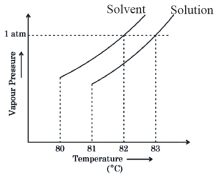
- 243. `The vapour pressure vs. temperature curve for a solution solvent system is shown below.The boiling point of the solvent is \(........\,{ }^{\circ} C\)
 2023 Medium
- (A) \(81\)
- (B) \(82\)
- (C) \(83\)
- (D) \(84\)
Show answer and solution
Correct Answer: (B)
Boiling point of solvent is \(82^{\circ} C\)Boiling point of solution is \(83^{\circ} C\)
-
- (A) \(4.69\,g\)
- (B) \(3.59\,g\)
- (C) \(2.59\,g\)
- (D) \(3.69\,g\)
Show answer and solution
Correct Answer: (D)
\(\frac{ P ^0- P _5}{ P ^0}=\frac{ n }{ N }\) (for dilute solution)\(\frac{0.2}{54.2}=\frac{ n \times 18}{100}\)
\(n =\frac{100}{271 \times 18}\)
\(w =\frac{100 \times 180}{271 \times 18} ; w =3.69\,g\)
-
- (A) \(200\)
- (B) \(300\)
- (C) \(50\)
- (D) \(100\)
Show answer and solution
Correct Answer: (D)
\(\underset{1\,gm }{ M _2 CO _3}+\underset{\text { Excess }}{2 HCl } \rightarrow \underset{0.02 \text { mole }}{2 MCl }+ H _2 O +\underset{0.01 \text { mole }}{ CO _2}\)From principle of atomic conservation of carbon atom,
Mole of \(M _2 CO _3 \times 1=\) Mole of \(CO _2 \times 1\)
\(\frac{1 gm }{\text { molar mass of } M _2 CO _3}=0.01 \times 1\)
\(\text { Molar mass of } M _2 CO _3=100\,gm / mole\)
-
- (A) \(2\)
- (B) \(3\)
- (C) \(1\)
- (D) \(4\)
Show answer and solution
Correct Answer: (C)
Reaction with \(HCl\)\(Ca ( OH )_2+2 HCl \rightarrow CaCl _2+2 H _2 O\)
Volume of \(Ca ( OH )_2=10 ml\)
Volume of \(HCl =20 ml\)
Concentration of \(HCl =0.5 M\).
No. of milli moles of \(HCl =10\)
No. of milli moles of \(Ca ( OH )_2=5\).
\(\text { i.e. }M _{ Ca ( OH )_2}=\frac{\text { no. of milli moles }}{ V ( ml )}=\frac{5}{10}\)
\(=0.5\,M.\)
Reaction with \(H _2 SO _4\)
\(Ca ( OH )_2+ H _2 SO _4 \rightarrow CaSO _4+2 H _2 O\)
No. of milli moles of \(Ca ( OH )_2=20 \times 0.5\)
\(=10\)
i.e. no. of milli moles of \(H _2 SO _4=10\)
\(\Rightarrow M _{ H _2 so }=\frac{\text { no. of mil lim oles }}{ V ( ml )}\)
\(=\frac{10}{10}\)
\(=1\,M\)
-
- (A) \(181\)
- (B) \(182\)
- (C) \(180\)
- (D) \(183\)
Show answer and solution
Correct Answer: (C)
\(M =\frac{5}{40} \times \frac{1000}{450}\)\(M _1 V _1= M _2 V _2\)
\(\left(\frac{5}{40} \times \frac{1000}{450}\right) \times V _1=0.1 \times 500\)
\(V _1=180\)
-
- (A) \(1361\)
- (B) \(1362\)
- (C) \(1360\)
- (D) \(1368\)
Show answer and solution
Correct Answer: (B)
Mole of \(CO _2=0.2\,M \times\left(300 \times 10^{-3}\right)\,L\)\(=0.06 Mole\)
Volume of \(0.06\) mole \(CO _2\) at S.T.P
\(=0.06 \times 22.7\)
\(=1.362\,L\)
-
- (A) \(MCl _2\)
- (B) \(MCl _4\)
- (C) \(MCl _3\)
- (D) \(MCl\)
Show answer and solution
Correct Answer: (A)
Molecular. weight of metal chloride\(=\frac{0.57}{100} \times 22700\)
\(=129.39\)
weight of \(Cl =129.39 \times 0.55\)
\(=71.1645\)
\(\therefore\) Mole of \(Cl =\frac{71.1645}{35.5} \cong 2\)
Hence \(MCl _2\)
-
- (A) \(51\)
- (B) \(52\)
- (C) \(56\)
- (D) \(53\)
Show answer and solution
Correct Answer: (C)
Moles of \(CO _2=\frac{0.22}{44}=\frac{1}{200}\)\(\therefore\) Moles of carbon
\(=\left(\text { Moles of } CO _2\right) \times 1\)
\(=\frac{1}{200}\)
\(\therefore\) wt. of \(C =\frac{1}{200} \times 12=0.06\)
\(\text { \% of } C =\frac{0.06}{ W } \times 100=24\)
\(( W = Wt \text {. of Organic Compound })\)
\(W =0.25\)
Moles of \(H _2 O =\frac{0.126}{18}=0.007\)
\(\therefore \text { Moles of } H \text { atom }=2 \times 0.007=0.014\)
\(\%\) of Hydrogen \(=\frac{0.014 \times 1}{ W } \times 100\)
\(=\frac{0.014 \times 1}{0.25} \times 100\)
\(=5.6\)
\(=56 \times 10^{-1}\)
No questions on this page match these filters.