


Questions
14 questionsShowing 1–14 of 14 questions
-
- (A) \(A\) is false but \(R\) is true
- (B) \(A\) is true but \(R\) is false
- (C) Both \(A\) and \(R\) are true and \(R\) is the correct explanation of \(A\)
- (D) Both \(A\) and \(R\) are true but \(R\) is \(NOT\) the correct explanation of \(A\)
Show answer and solution
Correct Answer: (C)
The rate of hydrolysis of alkyl chloride improves because of better Nucleophilicity of \(I ^{-}\). - 2. Choose the halogen which is most reactive towards \(SN1\) reaction in the given compounds \((A, B, C , D)\)
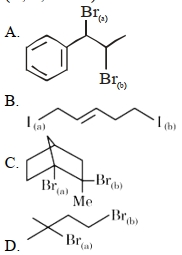 2023 Medium
- (A) \(A - Br _{(b)} ; B - I _{( b )} ; C - Br _{( b )} ; D - Br _{( b )}\)
- (B) \(A - Br _{( a )} ; BI _{( a )} ; C - Br _{( b )} ; D - Br _{( a )}\)
- (C) \(A - Br _{( b )} ; B - I _{( a )} ; C - Br _{( a )} ; D - Br _{( a )}\)
- (D) \(A - Br _{( b )} ; B - I _{( a )} ; C - Br _{( a )} ; D - Br _{( a )}\)
Show answer and solution
Correct Answer: (B)
Stable is the carbocation, faster will be rate of \(SN1\) reaction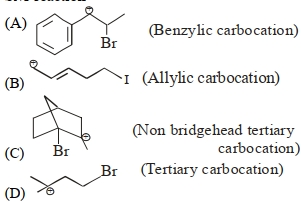
-
- (A) \(a > c > d > b\)
- (B) \(a > b > c > d\)
- (C) \(b > d > c > a\)
- (D) \(d > b > c > a\)
Show answer and solution
Correct Answer: (C)
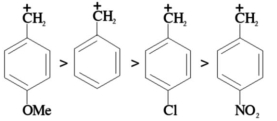
The rate of \(S_N 1\) reaction depends upon stability of carbocation which follows the order\(\therefore\) Reactivity order
\((b) > (d) > (c) > (a)\)
-
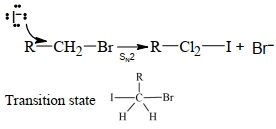
- (A) The transition state formed in the above reaction is less polar than the localised anion.
- (B) The reaction can occur in acetic acid also.
- (C) The solvent used in the reaction solvates the ions formed in rate determining step.
- (D) \(Br ^{-}\)can act as competing nucleophile.
Show answer and solution
Correct Answer: (A)
This is finkelstein reactionClearly, the transition state is less polar than free anions. \(Br ^{-}\)and \(I ^{-}\)
Acetic acid is protic which does not support \(S _{ N } 2\)
Acetone does not solvate anion
\(Br ^{-}\)gets precipitated and hence can not compete with \(I\)
- 5. Identify the correct order for the given property for following compounds.Choose the correct answer from the option given below :-
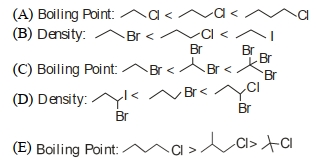 2023 Medium
- (A) \((B), (C)\) and \((D)\) only
- (B) \((A), (C)\) and \((E)\) only
- (C) \((A), (C)\) and \((D)\) only
- (D) \((A), (B)\) and \((E)\) only
Show answer and solution
Correct Answer: (B)
Boiling point of alkyl halide increases with increase in size, mass of halogen atom and size of alkyl groupBoiling point of isomeric alkyl halide decreases with increase in branching
Density increases with increase in atomic mass of halogen atom
-
- (A) (A), (B) and (D) only
- (B) (A), (B), (C) and (D)
- (C) (A), (C) and (D) only
- (D) (B), (C) and (D) only
Show answer and solution
Correct Answer: (B)
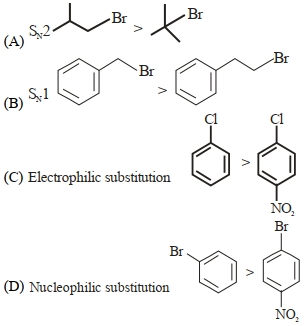
All are correct\((A)\) \(S _{ N } 2\) reaction decreases with increase in steric crowding.
\((B)\) \(S _{ N } 1\) reaction increases with stability of carbocation.
\((C)\) EAS reaction decreases with decrease in electron density.
\((D)\) Presence of electron withdrawing group at ortho and para-position to a halogen in haloarene increase nucleophilic aryl substitution.
-
- (A) \(A-IV,B-III,C-II,D-I\)
- (B) \(A-III,B-I,C-IV,D-II\)
- (C) \(A-I,B-II,C-III,D-IV\)
- (D) \(A-I,B-III,C-IV,D-II\)
Show answer and solution
Correct Answer: (B)
\(CH _3- CH _2- CH _2- Br + KOH ( Alc ) \rightarrow CH _3-\underset{\text { (Alkene) }}{ CH }= CH _2\)\(CH _3- CH _2- CH _2- Br + KCN ( Alc ) \rightarrow CH _3- CH _2- CH _2- CN\)
\(CH _3- CH _2- CH _2- Br + AgNO _2 \rightarrow CH _3- CH _2- CH _2- COO _2+ AgBr \downarrow\)
\(\left. CH _3- CH _2- CH _2- Br + CH _3- COOAg _2 \rightarrow CH _3- COO - CH _2\right)= CH _2- CH _3+ AgBr \downarrow\)
-
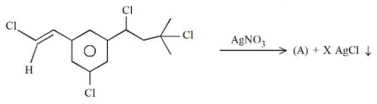
- (A) \(3\)
- (B) \(4\)
- (C) \(5\)
- (D) \(6\)
Show answer and solution
Correct Answer: (A)
Total numbers of isomer \(=03\)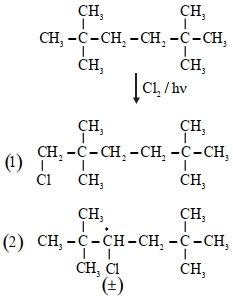
-
- (A) \(4\)
- (B) \(6\)
- (C) \(2\)
- (D) \(8\)
Show answer and solution
Correct Answer: (C)
Benzylic and tertiary carbocations are stable. -
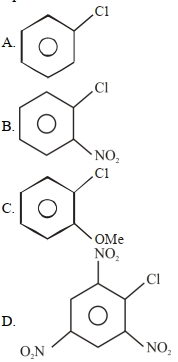
- (A) \(A > B > D > C\)
- (B) \(C > A > D > B\)
- (C) \(D > C > B > A\)
- (D) \(D > B > A > C\)
Show answer and solution
Correct Answer: (D)
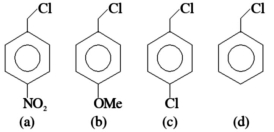
\((-M)\) group increases reactivity where as \((+M)\) group decreases reactivity of Halobenzene towards Nucleophilic substitution reaction.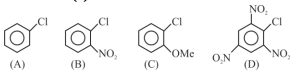
- 11. The number of hyperconjugation structures involved to stabilize carbocation formed in the above reaction is \(.............\).
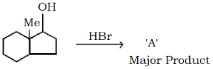 2023 Hard
- (A) \(6\)
- (B) \(5\)
- (C) \(4\)
- (D) \(7\)
Show answer and solution
Correct Answer: (A)
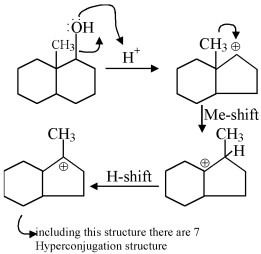
Let's analyze the step-by-step carbocation rearrangement mechanism for the given reaction:
1. Initial Carbocation Formation: Protonation of the alcohol (\( -\text{OH} \)) group followed by the loss of a water molecule (\( \text{H}_2\text{O} \)) forms a secondary (\( 2^\circ \)) carbocation on the 5-membered ring.
2. 1,2-Methyl Shift: To increase stability, the methyl group (\( -\text{CH}_3 \)) on the bridgehead carbon undergoes a 1,2-shift to the adjacent positive carbon. This creates a highly stable tertiary (\( 3^\circ \)) carbocation at the bridgehead position.
Counting Alpha-Hydrogens (\( \alpha \)-H):
For this stable tertiary carbocation, the adjacent (\( \alpha \)) positions relative to the positive charge are:
- The neighboring \( \text{-CH}_2- \) group in the 5-membered ring: contains 2 \( \alpha \)-hydrogens.
- The neighboring \( \text{-CH}_2- \) group in the 6-membered ring: contains 2 \( \alpha \)-hydrogens.
- The adjacent bridgehead \( \text{-CH}- \) carbon: contains 1 \( \alpha \)-hydrogen.
Total number of \( \alpha \)-hydrogens = \( 2 + 2 + 1 = 5 \).
Total Hyperconjugation Structures:
The total number of hyperconjugation structures is given by the formula:
Total structures = \( \text{Number of } \alpha\text{-hydrogens} + 1 \) (including the parent contributing structure).
Total structures = \( 5 + 1 = 6 \).
Therefore, Option A is the correct answer. -
- (A) \(4\)
- (B) \(2\)
- (C) \(1\)
- (D) \(5\)
Show answer and solution
Correct Answer: (A)
Total Possible Isomeric product \(=1+3=4\)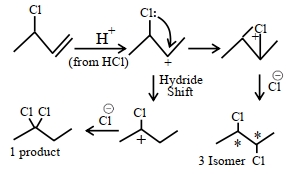
-
- (A) \(C Cl _2 F _2\)
- (B) \(C _2 HF _3\)
- (C) \(C _2 H _2 F _2\)
- (D) \(C _2 F _4\)
Show answer and solution
Correct Answer: (A)
Freons are chlorofluoro carbon. -
- (A) These are chlorofluorocarbon compounds
- (B) These are chemicals causing skin cancer
- (C) These are radicals of chlorine and chlorine monoxide
- (D) All radicals are called freons
Show answer and solution
Correct Answer: (A)
Fact
No questions on this page match these filters.