


All JEE Mains 2023 Chemistry questions
25 chaptersShowing 151–200 of 366 questions
-
- (A) \(A-II, B-IV, C-I, D-III\)
- (B) \(A-IV, B-I, C-II, D-III\)
- (C) \(A-IV, B-I, C-III, D-II\)
- (D) \(A-II, B-IV, C-III, D-I\)
Show answer and solution
Correct Answer: (B)
(A) \({\left[ Ti \left( H _2 O \right)_6\right]^{2+}}\)\(Ti ^{2+} \Rightarrow 3 d ^2 4 s ^0\)
\(t _{2 g } e ^{-}=2\)
\(e _{ g } e ^{-}=0\)
\(CFSE =[-0.4 \times 2+0.6 \times 0] \Delta_0\)
\(-0.8\,\Delta\)
(B) \({\left[ V \left( H _2 O \right)_6\right]^{2+}}\)
\(V ^{2+} \Rightarrow 3 d ^3 4 s ^0\)
\(t _{2 g } e ^{-}=3\)
\(e _{ g } e ^{-}=0\)
\(CFSE =[-0.4 \times 3+0.6 \times 0] \Delta_0\)
\(-1.2 \Delta_0\)
(C) \({\left[ Mn \left( H _2 O \right)_6\right]^{3+}}\)
\(Mn ^{3+} \Rightarrow 3 d ^4 4 s ^0\)
\(t _{2 g } e ^{-}=3\)
\(e _{ g } e ^{-}=1\)
\(CFSE =[-0.4 \times 3+0.6 \times 1] \Delta_0\)
\(=-0.6 \Delta_0\)
(D) \({\left[ Fe \left( H _2 O \right)_6\right]^{3+}}\)
\(Fe ^{3+} \Rightarrow 3 d ^5 4 s ^0\)
\(t _{2 g } e ^{-}=3 \quad e _{ g }=2\)
\(CFSE =[-0.4 \times 3+0.6 \times 2] \Delta_0\)
\(=0 \Delta_0\)
-
- (A) \(A - II, B - I, C - III, D - IV\)
- (B) \(A - I, B - II, C - III, D - IV\)
- (C) \(A - II, B - I, C - IV, D - III\)
- (D) \(A - I, B- II, C - IV, D - III\)
Show answer and solution
Correct Answer: (D)
For \(\left[ Fe \left( NH _3\right)_6\right]^{+2}, \Delta_0 < P\), hence the pairing of electrons does not occur in \(t_{2 g}\). Therefore complex is outer orbital and its hybridisation is \(sp ^3 d ^2\).List \(I\) (Complexes) List \(II\) (Hybridisation) \(A\) \(\left[ Ni ( CO )_4\right]\) \(I\) \(sp ^3\) \(B\) \(\left[ Cu \left( NH _3\right)_4\right]^{2+}\) \(II\) \(dsp^2\) \(C\) \(\left[ Fe \left( NH _3\right)_6\right]^{2+}\) \(III\) \(sp^3d^2\) \(D\) \(\left[ Fe \left( H _2 O \right)_6\right]^{2+}\) \(IV\) \(d^2sp^3\) -
- (A) \(A-IV, B-I, C-III, D-II\)
- (B) \(A-III, B-II, C-I, D-IV\)
- (C) \(A-III, B-I, C-II, D-IV\)
- (D) \(A- II, B-III, C-IV, D-I\)
Show answer and solution
Correct Answer: (B)
List \(I\) (Coordination entity) List \(II\) (Wavelength of light absorbed in \(nm\)) \(A\) \({\left[ CoCl \left( NH _3\right)_5\right]^{2+}}\) \(I\) \(535\) \(B\) \({\left[ Co \left( NH _3\right)_6\right]^{3+}}\) \(II\) \(475\) \(C\) \({\left[ Co ( CN )_6\right]^{3-}}\) \(III\) \(310\) \(D\) \({\left[ Cu \left( H _2 O \right)_4\right]^{2+}}\) \(IV\) \(600\) \(E =\frac{ hc }{\lambda} \Rightarrow E \propto \frac{1}{\lambda}\)
\(\Rightarrow \Delta( CFSE ) \propto \frac{1}{\lambda_{\text {absorb }}} \propto \text { strength of ligand. }\)
- 154. Number of ambidentate ligands in a representative metal complex \(\left[ M ( en )( SCN )_4\right]\) is \(\text { [en }=\text { ethylenediamine }]\) 2023 Medium
- (A) \(6\)
- (B) \(8\)
- (C) \(10\)
- (D) \(4\)
Show answer and solution
Correct Answer: (D)
\(\left[ M ( en )( SCN )_4\right]\)Ambidentate ligand means two ligand site,
so ambidentate ligand is \(SCN\).
- 155. Reaction of BeO with ammonia and hydrogen fluoride gives ' A ' which on thermal decomposition gives \(BeF _2\) and \(NH _4 F\). What is ' A '? 2023 Medium
- (A) H_3 NBeF_3
- (B) \left(NH_4\right)_2 BeF_4
- (C) \left(NH_4\right)\left(BeF_3\right)
- (D) \left(NH_4\right)_2\left(Be_2 F_6\right)
Show answer and solution
Correct Answer: (B)
\begin{array}{l} BeO+2 NH_3+4 HF \rightarrow\left(NH_4\right)_2 BeF_4+H_2 O \\ \left(NH_4\right)_2 BeF_4 \xrightarrow{\Delta} BeF_2+NH_4 F \end{array} - 156. The \(Cl - Co - Cl\) bond angle values in a fac\(\left[ Co \left( NH _3\right)_3 Cl _3\right]\) complex is/are: 2023 Medium
- (A) \(90^{\circ}\) and \(180^{\circ}\)
- (B) \(90^{\circ}\)
- (C) \(180^{\circ}\)
- (D) \(90^{\circ}\) and \(120^{\circ}\)
Show answer and solution
Correct Answer: (B)
The \(Cl - Co - Cl\) bond angle in above octahedral complex is \(90^{\circ}\)
-
- (A) \(\left[ Co \left( H _2 O \right)_6\right]^{3+}\)
- (B) \(\left[ Co \left( NH _3\right)_5 Cl \right]^{2+}\)
- (C) \(\left[ Co \left( NH _3\right)_5 NO _2\right]^{2+}\)
- (D) \(\left[ Co \left( NH _3\right)_5 Cl \right]^{+}\)
Show answer and solution
Correct Answer: (C)
\(\left(\left[ Co \left( NH _3\right)_5 NO _2\right]^{2+}\right.\)Two linkage isomers possible \(NO _2 \rightarrow\) Ambidentate ligand
-
- (A) \(Fe _4\left[ Fe ( CN )_6\right]_3\)
- (B) \(\left[ Fe _3( OH )_2( OAc )_6\right] Cl\)
- (C) \(K _3\left[ Co \left( NO _2\right)_6\right]\)
- (D) \(\left( NH _4\right)_3\left[\operatorname{As}\left( Mo _3 O _{10}\right)_4\right]\)
Show answer and solution
Correct Answer: (B)
\(Fe _4\left[ Fe ( CN )_6\right]_3\) Prussian Blue-water insoluble\(K _3\left[ Co \left( NO _2\right)_6\right]\) very poorly water soluble
\(\left( NH _4\right)_3\left[\right.\) As \(\left( MO _3 O _{10}\right)_4\) ] water insoluble ammonium arseno molybdate
\(\left[ Fe _3( OH )_2( OAc )_6\right] Cl\) is water soluble.
- 159. The complex with highest magnitude of crystal field splitting energy \(\left(\Delta_0\right)\) is 2023 Medium
- (A) \(\left[ Cr \left( OH _2\right)_6\right]^{3+}\)
- (B) \(\left[ Ti \left( OH _2\right)_6\right]^{3+}\)
- (C) \(\left[ Fe \left( OH _2\right)_6\right]^{3+}\)
- (D) \(\left[ Mn \left( OH _2\right)_6\right]^{3+}\)
Show answer and solution
Correct Answer: (A)
\(Ti ^{+3}=67\,pm\) radius\(Cr ^{3+}=62\,pm\) radius
\(Mn ^{+3}=65\, pm\) radius
\(Fe ^{+3}=65\, pm\) radius
So, \(Cr ^{3+}\) has highest tendency to attract ligand.
-
- (A) \(A < E < D < C < B\)
- (B) \(E < A < D < C < B\)
- (C) \(E < A < B < D < C\)
- (D) \(A < E < C < B < D\)
Show answer and solution
Correct Answer: (B)
\(A\). \(\left[ Fe ( CN )_6\right]^{3-} n =1\)\(B\). \(\left[ FeF _6\right]^{3-} n =5\)
\(C\). \(\left[ CoF _6\right]^{3-} n =4\)
\(D\). \(\left.[\text { Cr(oxalate })_3\right]^{3-} n =3\)
\(E\). \(\left[ Ni ( CO )_4\right] n =0\)
-
- (A) \(6\)
- (B) \(5\)
- (C) \(7\)
- (D) \(8\)
Show answer and solution
Correct Answer: (C)
\(Co ^{2+}: 3 d ^7 4 s ^0, Cl ^{-}: WFL\)Configuration \(e ^4 t _2^3: m =4\)
Number of unpaired electrons \(=3\)
So, answer \(=7\)

-
- (A) \(1\)
- (B) \(2\)
- (C) \(3\)
- (D) \(4\)
Show answer and solution
Correct Answer: (A)
\(Co ^{2+}: 3 d ^7\) configuration\(t _{2 g }^{221} e _{ g }^{11}\)
- 163. The hybridization and magnetic behaviour of cobalt ion in \(\left[ Co \left( NH _3\right)_6\right]^{3+}\) complex, respectively is 2023 Medium
- (A) \(sp ^3 d _3^2\) and diamagnetic
- (B) \(d ^2 sp _3^3\) and paramagnetic
- (C) \(d ^2 sp _3^3\) and diamagnetic
- (D) \(sp ^{3^1} d ^2\) and paramagnetic
Show answer and solution
Correct Answer: (C)
\(\left[ Co \left( NH _3\right)_6\right]^{+3}- d ^2 sp ^3\), diamagnetic -
- (A) \(6.92\,B.M.\) in both
- (B) \(4.89\,B.M.\) and \(6.92\,B.M.\)
- (C) \(3.87\,B.M.\) and \(1.732\,B.M.\)
- (D) \(5.92\,B.M.\) and \(1.732\,B.M\)
Show answer and solution
Correct Answer: (D)
\(\left[ Fe \left( H _2 O \right)_6\right]^{3+}\)\(\therefore \text { Unpaired } e ^{-}=5\)
\(\mu=\sqrt{ n ( n +2)}\)
\(=\sqrt{5(5+2)}\)
\(\mu=\sqrt{35}=5.92 \text { B.M. }\)
\({\left[ Fe ( CN )_6\right]^{-3}}\)
Pairing occur due to strong field ligand \(CN ^{-}\)
\(\therefore\) Unpaired \(e^-\) \(\Rightarrow 1\)
\(\mu=\sqrt{ n ( n +2)}\)
\(=\sqrt{1(1+2)}=\sqrt{3}=1.732 \text { B.M. }\)

-
- (A) \(A\) and \(C\) Only
- (B) \(A\) and \(E\) Only
- (C) \(D\) and \(E\) Only
- (D) \(A,C\) and \(E\) Only
Show answer and solution
Correct Answer: (A)
\(Mg\) is present in chlorophyll and in black and white photography the developed film is fixed by washing with hypo solution which dissolves the undecomposed \(AgBr\) to form a complex ion \(\left[ Ag \left( S _2 O _3\right)_2\right]^{3-}\) -
- (A) \(4\)
- (B) \(6\)
- (C) \(8\)
- (D) \(10\)
Show answer and solution
Correct Answer: (A)
\(\left[ Mn ( NCS )_6\right]^{x-}\)Number of unpaired electron \(=5\)
So, \(Mn\) must be in \(+2\) oxidation state \(\left( Mn ^{+2}\right)\)
\(\Rightarrow 2+(-6)=-x\)
\(\Rightarrow-4=-x\)
\(\Rightarrow x=4\)
-
- (A) \(\left[ NiCl _4\right]^{2-}\)
- (B) \(\left[ CoCl _6\right]^{3-}\)
- (C) \(\left[ CoF _6\right]^{3-}\)
- (D) \(\left[ Co \left( NH _3\right)_6\right]^{3+}\)
Show answer and solution
Correct Answer: (D)
(1) Paramagnetic, High Spin and Tetrahedral(2) Paramagnetic, High Spin and Octahedral
(3) Paramagnetic, High Spin and Octahedral
(4) Diamagnetic, Low Spin and Octahedral
\(\left[ Co \left( NH _3\right)_6\right]^{3+}, CN =6(\text { Octahedral })\)
\(NH _3= SFL\)
\(Co ^{+3}=[ Ar ] 3 d ^6\)
Diamagnetic and Low spin complex

- 168. The primary and secondary valencies of cobalt respectively in \(\left[ Co \left( NH _3\right)_5 Cl \right] Cl _2\) are : 2023 Medium
- (A) \(3\) and \(5\)
- (B) \(2\) and \(6\)
- (C) \(2\) and \(8\)
- (D) \(3\) and \(6\)
Show answer and solution
Correct Answer: (D)
\(\left[ Co \left( NH _3\right)_5 Cl \right] Cl _2\)Oxidation number of \(Co\) is \(+3\).
So primary valency is \(3\).
It is an octahedral complex so secondary valency \(6\) or Co-ordination number \(6\).
-
- (A) \(2\)
- (B) \(3\)
- (C) \(4\)
- (D) \(1\)
Show answer and solution
Correct Answer: (D)
Spin magnetic moment of \(\left[ Cr ( CN )_6\right]^{3-}\left( t _{2 g }^3 e _{ g }^0\right)\)\(\mu_1=\sqrt{3(3+2)}=\sqrt{15}\,BM\)
Spin magnetic moment of \(\left[ Cr \left( H _2 O \right)_6\right]^{3+}\left( t _{2 g }^3 e _{ g }^0\right)\)
\(\mu_2=\sqrt{3(3+2)}=\sqrt{15}\,BM\)
\(\frac{\mu_1}{\mu_2}=\frac{\sqrt{15}}{\sqrt{15}}=1\)
-
- (A) \(3\)
- (B) \(6\)
- (C) \(9\)
- (D) \(12\)
Show answer and solution
Correct Answer: (B)
\(\left(\left[ Mn \left( H _2 O \right)_6\right]^{2+}\right.\)\(Mn ^{2+}=3 d ^5\)
\(\mu=\sqrt{5(5+2)}=5.91\,BM\)
- 171. The total number of stereoisomers for the complex \(\left[ Cr ( ox )_2 ClBr ^{3-}\right.\) (where ox = oxalate) is: 2023 Hard
- (A) \(2\)
- (B) \(3\)
- (C) \(1\)
- (D) \(4\)
Show answer and solution
Correct Answer: (B)
\(\left[ Cr ( Ox )_2 ClBr ^{-3}\right.\)- No. of isomers -
- This structure has plane of symmetry, So no optical isomerism will be shown.
- This structure does not contain plane of symmetry, So two forms \(d\) as well as \(1\) will be shown.

-
- (A) \(B\) and \(D\) Only
- (B) \(C\) and \(D\) Only
- (C) \(A\) and \(B\) Only
- (D) \(A\) and \(C\) Only
Show answer and solution
Correct Answer: (A)
Cis - Platin is used in chemotherapy to inhibits the growth of tumors. ( \(\operatorname{cis}\left[ Pt \left( NH _3\right)_2 Cl _2\right]\) ) -
- (A) \(4.00\)
- (B) \(3.00\)
- (C) \(6.00\)
- (D) \(5.00\)
Show answer and solution
Correct Answer: (D)
\(\left[ Co \left( NH _3\right)_4 Cl _2\right] Cl \Rightarrow\) Gives \(1\) mole \(AgCl\)\(\left[ Ni \left( H _2 O \right)_6\right] Cl _2 \Rightarrow\) Gives \(2\) moles \(AgCl\)
\(\left[ Pt \left( NH _3\right)_2 Cl _2\right] \Rightarrow\) Gives No \(AgCl\)
\(\left[ Pd \left( NH _3\right)_4\right] Cl _2 \Rightarrow\) Gives \(2\) moles \(AgCl\)
Total number of moles of \(AgCl =5\) mole.
-
- (A) The order of spectrochemical series
- (B) Magnetic properties of transition metal complexes
- (C) Colour of metal complexes
- (D) Stability of metal complexes
Show answer and solution
Correct Answer: (D)
Crystal field theory introduce spectrochemical series based upon the experimental values of \(\Delta\) but can't explain it's order. While other three points are explained by \(CFT\). Specially when the \(CFSE\) increases thermodynamic stability of the complex increases. -
- (A) \(\left[ Co \left( NH _3\right)_3\left( NO _2\right)_3\right]\)
- (B) \(\left[ Co ( en )_3\right]\)
- (C) \(\left[ Co (\text { en })_2 Cl _2\right]\)
- (D) \(\left[ Pt \left( NH _3\right)_2 Cl _2\right]\)
Show answer and solution
Correct Answer: (A)
\(\left[ MA _3 B _3\right]\) type of compound exists as facial and meridonial isomer.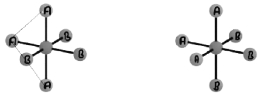
-
- (A) \(Na _3\left[ CoCl _6\right]\)
- (B) \(\left[ Ni \left( NH _3\right)_6\right] Cl _2\)
- (C) \(K _3\left[ Co ( CN )_6\right]\)
- (D) \(\left[ Co \left( H _2 O \right)_6\right] Cl _2\)
Show answer and solution
Correct Answer: (C)
\(Co ^{+3}= t _2 g ^6 eg ^0\)\(CN ^{-}\)-strong field ligand
All d-electrons should be paired \(\left(\mu_5=0\right)\)
Hence diamagnetic.
- 177. Which of the following complexes will exhibit maximum attraction to an applied magnetic field? 2023 Medium
- (A) \(\left[ Zn \left( H _2 O \right)_6\right]^{2+}\)
- (B) \(\left[ Co \left( H _2 O \right)_6\right]^{2+}\)
- (C) \(\left[ Co ( en )_3\right]^{3+}\)
- (D) \(\left[ Ni \left( H _2 O _6\right]^{2+}\right.\)
Show answer and solution
Correct Answer: (B)
Complex with maximum number of unpaired electron will exhibit maximum attraction to an applied magnetic field\({\left[ Zn \left( H _2 O \right)_6\right]^{2+} \rightarrow d ^{10} \text { system } \rightarrow t _{2 g }^6 eg ^4, 0 \text { unpaired } e ^{-}}\)
\({\left[ Co \left( H _2 O \right)_6\right]^{2+} \rightarrow d ^7 \text { system } \rightarrow t _{2 g }^5 eg ^2, 3 \text { unpaired } e ^{-}}\)
\({\left[ Co ( en )_3\right]^{3+} \rightarrow d ^6 \text { system } \rightarrow t _{2 g }^6 eg ^0, 0 \text { unpaired } e ^{-}}\)
\({\left[ Ni \left( H _2 O _6\right]^{2+} \rightarrow d ^8 \text { system } \rightarrow t _{2 g }^6 \text { eg }^2, 2 \text { unpaired } e ^{-}\right.}\)
-
- (A) \(CO < en < NH _3 < C _2 O _4^{2-} < S ^{2-}\)
- (B) \(S ^{2-} < C _2 O _4^{2-} < NH _3 < en < CO\)
- (C) \(NH _3 < en < CO < S ^{2-} < C _2 O _4^{2-}\)
- (D) \(S ^{2-} < NH _3 < en < CO < C _2 O _4^{2-}\)
Show answer and solution
Correct Answer: (B)
The increasing order of field strength of ligands (according to spectrochemical series)\(S ^{2-} < C _2 O _4^{2-} < NH _3 < en < CO\)
-
- (A) \(NO _2, N _2 O _5\)
- (B) \(NO _2, N _2 O _4\)
- (C) \(NO , NO _2\)
- (D) \(N _2 O _3, NO _2\)
Show answer and solution
Correct Answer: (C)
\(4 NH _3+5 O _2 \stackrel{\Delta}{\longrightarrow} 4 NO +6 H _2 O\)\(2 NO + O _2 \longrightarrow 2 NO _2\)
-
- (A) \(A > B > C > D\)
- (B) \(A > B > D > C\)
- (C) \(B > A > C > D\)
- (D) \(D > C > B > A\)
Show answer and solution
Correct Answer: (A)
Bond dissociation energy of \(E - H\) bond in hydrides of group \(16\) follows the order\(H _2 O > H _2 S > H _2 Se > H _2 Te\)
-
- (A) Colourless gas with trigonal bipyramidal geometry.
- (B) Colourless gas with square pyramidal geometry
- (C) Colourless liquid with square pyramidal geometry
- (D) Colourless liquid with trigonal bipyramidal geometry
Show answer and solution
Correct Answer: (C)
\(ClF _5\) is colourless liquid.
-
- (A) \(C, D, E\) only
- (B) \(B, E, A\) only
- (C) \(A, C, D\) only
- (D) \(A, B, D\) only
Show answer and solution
Correct Answer: (D)
- Two lone pair one oxygen- Molecule is ' \(v\) ' shaped
- Bond angle is less than \(104.5^{\circ}\left(102^{\circ}\right)\)
- \(O \cdot S \cdot\) of ' \(O\) ' is \(+2\)

-
- (A) Both statement \(I\) and Statement \(II\) are correct
- (B) Both statement \(I\) and Statement \(II\) are incorrect
- (C) Statement \(I\) is correct but Statement \(II\) is incorrect
- (D) Statement \(I\) is incorrect but Statement \(II\) is correct
Show answer and solution
Correct Answer: (A)
Statement \(I:\) Is correct according to Fajan's rule \(Sb ^{+5}\) more polarising power than \(Sb ^{+3}\).Statement \(II:\) Stability of higher oxides of halogen is primarily due to
\(a)\) Higher oxidation state
\(b)\) More EN halogen
\(c)\) Resonance stabilization
-
- (A) \(Xe < Kr < Ne < He\)
- (B) \(He < Ne < Kr < Xe\)
- (C) \(He < Xe < Kr < Ne\)
- (D) \(He < Kr < Xe < Ne\)
Show answer and solution
Correct Answer: (C)
From NCRETSo, order is \(Ne > Kr > Xe > He\)
-
- (A) \(A-II, B-IV, C-III, D-I\)
- (B) \(A-II, B-I, C-III, D-IV\)
- (C) \(A-III, B-I, C-IV, D-II\)
- (D) \(A-III, B-I, C-II, D-IV\)
Show answer and solution
Correct Answer: (D)
\(N _2 O _4\)
-
- (A) \(PCl _3, S _2 Cl _2\) and \(4\)
- (B) \(POCl _3, S _2 Cl _2\) and \(4\)
- (C) \(PCl _3, S _2 Cl _2\) and \(2\)
- (D) \(POCl _3, S _2 Cl _2\) and \(2\)
Show answer and solution
Correct Answer: (A)
\(P _4+8 SOCl _2 \rightarrow 4 PCl _5+2 S _2 Cl _2+4 SO _2\) -
- (A) \(P _4 O _6\) and \(H _3 PO _3\)
- (B) \(PCl _3\) and \(H _3 PO _3\)
- (C) \(PCl _5\) and \(H _3 PO _4\)
- (D) \(POCl _3\) and \(H _3 PO _4\)
Show answer and solution
Correct Answer: (B)
\(P _4+8 SOCl _2 \rightarrow 4 PCl _3+4 SO _2+2 S _2 Cl _2\)\(PCl _3+3 H _2 O \rightarrow H _3 PO _3+3 HCl\)
-
- (A) \(8\)
- (B) \(16\)
- (C) \(24\)
- (D) \(32\)
Show answer and solution
Correct Answer: (A)
(a)No. of \(\pi-\) bonds \(=4\)
(b)
No. of \(\pi-\) bonds \(=4\)
Total \(\pi-\) bonds \(=8\)

-
- (A) \(Cl _2\)
- (B) \(I _2\)
- (C) \(Br _2\)
- (D) \(F_2\)
Show answer and solution
Correct Answer: (A)
Bond energy of \(F _2\) less than \(Cl _2\) due to lone pair lone pair repulsions.Bond energy order \(Cl _2 > Br _2 > F _2 > I _2\)
- 190. The correct group of halide ions which can be oxidised by oxygen in acidic medium is 2023 Medium
- (A) \(Br ^{-}\)only
- (B) \(Cl ^{-}, Br ^{-}\)and \(I ^{-}\)only
- (C) \(Br ^{-}\)and \(I ^{-}\)only
- (D) \(I ^{-}\)only
Show answer and solution
Correct Answer: (D)
Only \(I ^{-}\)among halides can be oxidised to Iodine by oxygen in acidic medium\(4 I ^{-}( aq )+4 H ^{+}( aq )+ O _2( g ) \rightarrow 2 I _2( s )+2 H _2 O ( l )\)
- 191. The difference in the oxidation state of \(Xe\) between the oxidised product of \(Xe\) formed on complete hydrolysis of \(XeF _4\) and \(XeF _4\) is 2023 Medium
- (A) \(4\)
- (B) \(6\)
- (C) \(2\)
- (D) \(8\)
Show answer and solution
Correct Answer: (C)
\(6 XeF _4+12 H _2 O \longrightarrow 2 XeO _3+4 Xe +24 HF +3 O _2\)in \(XeO _3\), Oxidation state of \(Xe =+6\)
in \(XeF _4\), Oxidation state of \(Xe =+4\)
So difference in oxidation state \(=2\)
- 192. The effect of addition of helium gas to the following reaction in equilibrium state, is : \(PCI _5( g ) \rightleftharpoons PCl _3( g )+ Cl _2( g )\) 2023 Medium
- (A) the equilibrium will shift in the forward direction and more of \(Cl _2\) and \(PCl _3\) gases will be produced.
- (B) the equilibrium will go backward due to suppression of dissociation of \(PCl _5\).
- (C) helium will deactivate \(PCl _5\) and reaction will stop.
- (D) addition of helium will not affect the equilibrium.
Show answer and solution
Correct Answer: (D)
Addition of an inert gas (helium) to a gaseous equilibrium at constant volume does not change the partial pressures of the reacting gases.
Therefore, it does not affect the equilibrium position.
-
- (A) \(2\)
- (B) \(8\)
- (C) \(6\)
- (D) \(4\)
Show answer and solution
Correct Answer: (D)
\(H _4 P _2 O _6\)\(O.S.\) of \(P\) is \(+4\)

-
- (A) \(6\)
- (B) \(8\)
- (C) \(5\)
- (D) \(4\)
Show answer and solution
Correct Answer: (A)
\(\frac{\sigma}{\pi}=\frac{12}{2}=6\)So, Answer is \(6\)

- 195. The sum of lone pairs present on the central atom of the interhalogen \(IF _5\) and \(IF _7\) is \(...........\). 2023 Medium
- (A) \(2\)
- (B) \(1\)
- (C) \(3\)
- (D) \(4\)
Show answer and solution
Correct Answer: (B)
\(IF_5=1\) lone pair\(IF _7=0\) lone pair
\(1+0=1\)
- 196. Total number of acidic oxides among \(N _2 O _3, NO _2, N _2 O , Cl _2 O _7, SO _2, CO , CaO , Na _2 O\) and \(NO\) is \(...........\) 2023 Medium
- (A) \(8\)
- (B) \(2\)
- (C) \(4\)
- (D) \(9\)
Show answer and solution
Correct Answer: (C)
Acidic oxides are \(N _2 O _3, NO _2, Cl _2 O _7, SO _2\) -
- (A) It is a crystalline solid.
- (B) It is associated with more than one \(pK _{ a }\) values.
- (C) It has a fairly high melting point.
- (D) It has high solubility in benzene.
Show answer and solution
Correct Answer: (D)
Arginine exist is zwitterion, so solid in nature and soluble in polar solvent.
- 198. Which of the Phosphorus oxoacid can create silver mirror from \(AgNO _3\) solution ? 2023 Medium
- (A) \(\left( HPO _3\right)_{ n }\)
- (B) \(H _4 P _2 O _5\)
- (C) \(H _4 P _2 O _6\)
- (D) \(H _4 P _2 O _7\)
Show answer and solution
Correct Answer: (B)
Oxyacid having \(P - H\) bond can reduce \(AgNO _3\) to \(Ag\).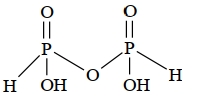
- 199. \(XeF _4\) reacts with \(SbF _5\) to form \({\left[ XeF _{ m }\right]^{ n +}\left[ SbF _{ y }\right]^{ z- }}\) \(m + n + y + z =.......\). 2023 Medium
- (A) \(10\)
- (B) \(11\)
- (C) \(12\)
- (D) \(13\)
Show answer and solution
Correct Answer: (B)
\(XeF _4+ SbF _5 \rightarrow\left[ XeF _3\right]^{+}\left[ SbF _6\right]^{-}\)\(m =3\)
\(n =1\)
\(y =6\)
\(z =1\)
\(m + n + y + z =11\)
-
- (A) \(12\)
- (B) \(14\)
- (C) \(13\)
- (D) \(15\)
Show answer and solution
Correct Answer: (B)
\({\left[ Ag ^{+}\right]=10^{-5}}\)\({\left[ NO _3^{-}\right]=10^{-5}}\)
\({\left[ Br ^{-}\right]=\frac{ Ksp }{\left[ Ag ^{+}\right]}=4.9 \times 10^{-8}}\)
\(\Lambda_{ m }=\frac{ k }{1000 \times M }\)
For \(Ag ^{+}\)
\(6 \times 10^{-3}=\frac{ K _{ Ag ^{+}}}{1000 \times 10^{-5}}\)
\(K _{ Ag +}=6 \times 10^{-5}\)
\(\Rightarrow 6000 \times 10^{-8}\)
\(\text { for } Br ^{-}\)
\(8 \times 10^{-3}=\frac{ K _{ Br ^{-}}}{1000 \times 4.9 \times 10^{-8}}\)
\(K _{ BI -}=39.2 \times 10^{-8}\)
\(\text { for } NO _3^{-}\)
\(7 \times 10^{-3} =\frac{ K _{ No -}^3}{1000 \times 10^{-5}}\)
\(K _{ No _3} =7 \times 10^{-5}\)
\(=7000 \times 10^{-8}\)
Conductivity of solution
\(\Rightarrow(6000+7000+39.2) \times 10^{-8}\)
\(\Rightarrow 13039.2 \times 10^{-8} S m ^{-1}\)
No questions on this page match these filters.