


Questions
21 questionsShowing 1–21 of 21 questions
-
- (A) \(NO _2, N _2 O _5\)
- (B) \(NO _2, N _2 O _4\)
- (C) \(NO , NO _2\)
- (D) \(N _2 O _3, NO _2\)
Show answer and solution
Correct Answer: (C)
\(4 NH _3+5 O _2 \stackrel{\Delta}{\longrightarrow} 4 NO +6 H _2 O\)\(2 NO + O _2 \longrightarrow 2 NO _2\)
-
- (A) \(A > B > C > D\)
- (B) \(A > B > D > C\)
- (C) \(B > A > C > D\)
- (D) \(D > C > B > A\)
Show answer and solution
Correct Answer: (A)
Bond dissociation energy of \(E - H\) bond in hydrides of group \(16\) follows the order\(H _2 O > H _2 S > H _2 Se > H _2 Te\)
-
- (A) Colourless gas with trigonal bipyramidal geometry.
- (B) Colourless gas with square pyramidal geometry
- (C) Colourless liquid with square pyramidal geometry
- (D) Colourless liquid with trigonal bipyramidal geometry
Show answer and solution
Correct Answer: (C)
\(ClF _5\) is colourless liquid.
-
- (A) \(C, D, E\) only
- (B) \(B, E, A\) only
- (C) \(A, C, D\) only
- (D) \(A, B, D\) only
Show answer and solution
Correct Answer: (D)
- Two lone pair one oxygen- Molecule is ' \(v\) ' shaped
- Bond angle is less than \(104.5^{\circ}\left(102^{\circ}\right)\)
- \(O \cdot S \cdot\) of ' \(O\) ' is \(+2\)

-
- (A) Both statement \(I\) and Statement \(II\) are correct
- (B) Both statement \(I\) and Statement \(II\) are incorrect
- (C) Statement \(I\) is correct but Statement \(II\) is incorrect
- (D) Statement \(I\) is incorrect but Statement \(II\) is correct
Show answer and solution
Correct Answer: (A)
Statement \(I:\) Is correct according to Fajan's rule \(Sb ^{+5}\) more polarising power than \(Sb ^{+3}\).Statement \(II:\) Stability of higher oxides of halogen is primarily due to
\(a)\) Higher oxidation state
\(b)\) More EN halogen
\(c)\) Resonance stabilization
-
- (A) \(Xe < Kr < Ne < He\)
- (B) \(He < Ne < Kr < Xe\)
- (C) \(He < Xe < Kr < Ne\)
- (D) \(He < Kr < Xe < Ne\)
Show answer and solution
Correct Answer: (C)
From NCRETSo, order is \(Ne > Kr > Xe > He\)
-
- (A) \(A-II, B-IV, C-III, D-I\)
- (B) \(A-II, B-I, C-III, D-IV\)
- (C) \(A-III, B-I, C-IV, D-II\)
- (D) \(A-III, B-I, C-II, D-IV\)
Show answer and solution
Correct Answer: (D)
\(N _2 O _4\)
-
- (A) \(PCl _3, S _2 Cl _2\) and \(4\)
- (B) \(POCl _3, S _2 Cl _2\) and \(4\)
- (C) \(PCl _3, S _2 Cl _2\) and \(2\)
- (D) \(POCl _3, S _2 Cl _2\) and \(2\)
Show answer and solution
Correct Answer: (A)
\(P _4+8 SOCl _2 \rightarrow 4 PCl _5+2 S _2 Cl _2+4 SO _2\) -
- (A) \(P _4 O _6\) and \(H _3 PO _3\)
- (B) \(PCl _3\) and \(H _3 PO _3\)
- (C) \(PCl _5\) and \(H _3 PO _4\)
- (D) \(POCl _3\) and \(H _3 PO _4\)
Show answer and solution
Correct Answer: (B)
\(P _4+8 SOCl _2 \rightarrow 4 PCl _3+4 SO _2+2 S _2 Cl _2\)\(PCl _3+3 H _2 O \rightarrow H _3 PO _3+3 HCl\)
-
- (A) \(8\)
- (B) \(16\)
- (C) \(24\)
- (D) \(32\)
Show answer and solution
Correct Answer: (A)
(a)No. of \(\pi-\) bonds \(=4\)
(b)
No. of \(\pi-\) bonds \(=4\)
Total \(\pi-\) bonds \(=8\)

-
- (A) \(Cl _2\)
- (B) \(I _2\)
- (C) \(Br _2\)
- (D) \(F_2\)
Show answer and solution
Correct Answer: (A)
Bond energy of \(F _2\) less than \(Cl _2\) due to lone pair lone pair repulsions.Bond energy order \(Cl _2 > Br _2 > F _2 > I _2\)
- 12. The correct group of halide ions which can be oxidised by oxygen in acidic medium is 2023 Medium
- (A) \(Br ^{-}\)only
- (B) \(Cl ^{-}, Br ^{-}\)and \(I ^{-}\)only
- (C) \(Br ^{-}\)and \(I ^{-}\)only
- (D) \(I ^{-}\)only
Show answer and solution
Correct Answer: (D)
Only \(I ^{-}\)among halides can be oxidised to Iodine by oxygen in acidic medium\(4 I ^{-}( aq )+4 H ^{+}( aq )+ O _2( g ) \rightarrow 2 I _2( s )+2 H _2 O ( l )\)
-
- (A) \(4\)
- (B) \(6\)
- (C) \(2\)
- (D) \(8\)
Show answer and solution
Correct Answer: (C)
\(6 XeF _4+12 H _2 O \longrightarrow 2 XeO _3+4 Xe +24 HF +3 O _2\)in \(XeO _3\), Oxidation state of \(Xe =+6\)
in \(XeF _4\), Oxidation state of \(Xe =+4\)
So difference in oxidation state \(=2\)
-
- (A) the equilibrium will shift in the forward direction and more of \(Cl _2\) and \(PCl _3\) gases will be produced.
- (B) the equilibrium will go backward due to suppression of dissociation of \(PCl _5\).
- (C) helium will deactivate \(PCl _5\) and reaction will stop.
- (D) addition of helium will not affect the equilibrium.
Show answer and solution
Correct Answer: (D)
Addition of an inert gas (helium) to a gaseous equilibrium at constant volume does not change the partial pressures of the reacting gases.
Therefore, it does not affect the equilibrium position.
-
- (A) \(2\)
- (B) \(8\)
- (C) \(6\)
- (D) \(4\)
Show answer and solution
Correct Answer: (D)
\(H _4 P _2 O _6\)\(O.S.\) of \(P\) is \(+4\)

-
- (A) \(6\)
- (B) \(8\)
- (C) \(5\)
- (D) \(4\)
Show answer and solution
Correct Answer: (A)
\(\frac{\sigma}{\pi}=\frac{12}{2}=6\)So, Answer is \(6\)

- 17. The sum of lone pairs present on the central atom of the interhalogen \(IF _5\) and \(IF _7\) is \(...........\). 2023 Medium
- (A) \(2\)
- (B) \(1\)
- (C) \(3\)
- (D) \(4\)
Show answer and solution
Correct Answer: (B)
\(IF_5=1\) lone pair\(IF _7=0\) lone pair
\(1+0=1\)
- 18. Total number of acidic oxides among \(N _2 O _3, NO _2, N _2 O , Cl _2 O _7, SO _2, CO , CaO , Na _2 O\) and \(NO\) is \(...........\) 2023 Medium
- (A) \(8\)
- (B) \(2\)
- (C) \(4\)
- (D) \(9\)
Show answer and solution
Correct Answer: (C)
Acidic oxides are \(N _2 O _3, NO _2, Cl _2 O _7, SO _2\) -
- (A) It is a crystalline solid.
- (B) It is associated with more than one \(pK _{ a }\) values.
- (C) It has a fairly high melting point.
- (D) It has high solubility in benzene.
Show answer and solution
Correct Answer: (D)
Arginine exist is zwitterion, so solid in nature and soluble in polar solvent.
- 20. Which of the Phosphorus oxoacid can create silver mirror from \(AgNO _3\) solution ? 2023 Medium
- (A) \(\left( HPO _3\right)_{ n }\)
- (B) \(H _4 P _2 O _5\)
- (C) \(H _4 P _2 O _6\)
- (D) \(H _4 P _2 O _7\)
Show answer and solution
Correct Answer: (B)
Oxyacid having \(P - H\) bond can reduce \(AgNO _3\) to \(Ag\).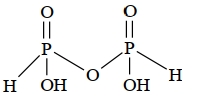
- 21. \(XeF _4\) reacts with \(SbF _5\) to form \({\left[ XeF _{ m }\right]^{ n +}\left[ SbF _{ y }\right]^{ z- }}\) \(m + n + y + z =.......\). 2023 Medium
- (A) \(10\)
- (B) \(11\)
- (C) \(12\)
- (D) \(13\)
Show answer and solution
Correct Answer: (B)
\(XeF _4+ SbF _5 \rightarrow\left[ XeF _3\right]^{+}\left[ SbF _6\right]^{-}\)\(m =3\)
\(n =1\)
\(y =6\)
\(z =1\)
\(m + n + y + z =11\)
No questions on this page match these filters.