


All JEE Mains 2023 Chemistry questions
25 chaptersShowing 101–150 of 366 questions
-
- (A) \(1\)
- (B) \(2\)
- (C) \(3\)
- (D) \(3\)
Show answer and solution
Correct Answer: (D)
\(4\)
- 102. In Dumas method for the estimation of \(N _2\), the sample is heated with copper oxide and the gas evolved is passed over : 2023 Medium
- (A) \(Ni\)
- (B) Copper gauze
- (C) \(Pd\)
- (D) Copper oxide
Show answer and solution
Correct Answer: (B)
Duma's method.The nitrogen containing organic compound, when heated with \(CuO\) in a atmosphere of \(CO _2\), yields free \(N _2\) in addition to \(CO _2\) and \(H _2 O\).
\(C _{ x } H _{ y } N _{ z }+\left(2 x +\frac{ y }{2}\right) CuO \rightarrow x CO _2+\frac{ y }{2} H _2 O +\frac{ z }{2} N _2+\left(2 x +\frac{ y }{2}\right) Cu\)
Traces of nitrogen oxides formed, if any, are reduced to nitrogen by passing the gaseous mixture over heated copper gauze.
- 103. The correct order in aqueous medium of basic strength in case of methyl substituted amines is : 2023 Medium
- (A) \(Me _2 NH > MeNH _2 > Me _3 N > NH _3\)
- (B) \(Me _2 NH > Me _3 N > MeNH _2 > NH _3\)
- (C) \(NH _3 > Me _3 N > MeNH _2 > Me _2 NH\)
- (D) \(Me _3 N > Me _2 NH > MeNH _2 > NH _3\)
Show answer and solution
Correct Answer: (A)
In aqueous medium basic strength is dependent on electron density on nitrogen as well as solvation of cation formed after accepting \(H ^{+}\). After considering all these factors overall basic strength order is\(Me _2 NH > MeNH _2 > Me _3 N > NH _3\)
-
- (A) The electrophile involved in the reaction is \(NO ^{+}\)
- (B) ' \(B\) ' is N-nitroso ammonium compound
- (C) The reaction occurs at low temperature
- (D) The product ' \(B\) ' formed in the above reaction is p-nitroso compound at low temperature
Show answer and solution
Correct Answer: (B)
\(NaNO _2+ HX \rightarrow HNO _2+ NaX\)\(P -\) Nitroso product

- 105. \(2-\) hexene \(\xrightarrow[(ii)H_2O]{(i) O_3}\) Products The two products formed in above reaction are - 2023 Medium
- (A) Butanoic acid and acetic acid
- (B) Butanal and acetic acid
- (C) Butanal and acetaldehyde
- (D) Butanoic acid and acetaldehyde
Show answer and solution
Correct Answer: (A)

Explanation:
1. Determine the type of Ozonolysis:
The reaction involves treating 2-hexene with ozone followed by water (\( \text{H}_2\text{O} \)) alone, without any reducing agent like \( \text{Zn} \) or \( \text{Me}_2\text{S} \). This represents an oxidative ozonolysis pathway.
2. Identify initial intermediate cleavage:
The structural formula of 2-hexene is:
\( \text{CH}_3-\text{CH}=\text{CH}-\text{CH}_2-\text{CH}_2-\text{CH}_3 \)
Cleaving the double bond initially forms two aldehydes:
- Acetaldehyde (\( \text{CH}_3\text{CHO} \)) from the 2-carbon fragment.
- Butanal (\( \text{CH}_3\text{CH}_2\text{CH}_2\text{CHO} \)) from the 4-carbon fragment.
3. Oxidation of intermediates:
During the reaction with water, hydrogen peroxide (\( \text{H}_2\text{O}_2 \)) is produced. Since no zinc is available to neutralize it, the \( \text{H}_2\text{O}_2 \) oxidizes the aldehydes to their corresponding carboxylic acids:
- Acetaldehyde (\( \text{CH}_3\text{CHO} \)) \( \rightarrow \) Acetic acid (\( \text{CH}_3\text{COOH} \))
- Butanal (\( \text{CH}_3\text{CH}_2\text{CH}_2\text{CHO} \)) \( \rightarrow \) Butanoic acid (\( \text{CH}_3\text{CH}_2\text{CH}_2\text{COOH} \))
Hence, Option A is the correct choice. -
- (A) Both \((A)\) and \((R)\) are correct and \((R)\) is the correct explanation of \((A)\).
- (B) Both \((A)\) and \((R)\) are correct but \((R)\) is not the correct explanation of \((A)\).
- (C) \((A)\) is correct but \((R)\) is not correct.
- (D) \((A)\) is not correct but \((R)\) is correct.
Show answer and solution
Correct Answer: (A)
Theory Based -
- (A) Statement \(I\) is correct but Statement \(II\) is incorrect.
- (B) Both Statement \(I\) and Statement \(II\) are incorrect.
- (C) Both Statement \(I\) and Statement \(II\) are correct.
- (D) Statement \(I\) is incorrect but Statement \(II\) is correct.
Show answer and solution
Correct Answer: (D)
Does not show esterification test.Presence of both sulphur and nitrogen give red colour in Lassigne's test.

- 108. What is the correct order of acidity of the protons marked \(A-D\) in the given compounds?
 2023 Hard
- (A) \(H _{ C } > H _{ D } > H _{ B } > H _{ A }\)
- (B) \(H _{ C } > H _{ D } > H _{ A } > H _{ B }\)
- (C) \(H _{ D } > H _{ C } > H _{ B } > H _{ A }\)
- (D) \(H _{ C } > H _{ A } > H _{ D } > H _{ B }\)
Show answer and solution
Correct Answer: (B)
acidity of an acid depends upon the stability of its conjugate base
-
- (A) optically active and adds one mole of bromine
- (B) racemic mixture and is neutral
- (C) racemic mixture and gives a gas with saturated \(NaHCO _3\) solution
- (D) optically active alcohol and is neutrall
Show answer and solution
Correct Answer: (C)
Carboxylic acid will give \(CO _2\) gas, with \(NaHCO _3\) solution
- 110. Given below are two statements, one is labelled as Assertion \(A\) and the other is labelled as Reason \(R\).
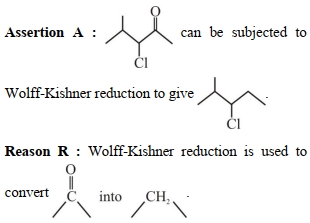 2023 Medium
- (A) Both \(A\) and \(R\) are true but \(R\) is NOT the correct explanation of \(A\).
- (B) \(A\) is true but \(R\) is false.
- (C) \(A\) is false but \(R\) is true.
- (D) Both \(A\) and \(R\) are true and \(R\) is the correct explanation of \(A.\)
Show answer and solution
Correct Answer: (C)
Wolff-Kishner reduction is not suitable for base sensitive group.
- 111. Match List\(-I\) with List\(-II\) : Choose the correct answer from the options given below:
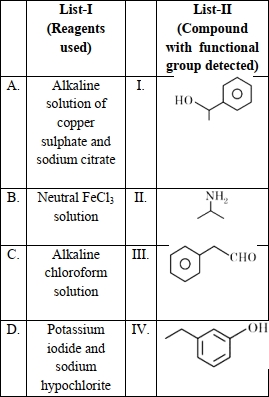 2023 Hard
- (A) \(A-II, B-IV, C-III, D-I\)
- (B) \(A-IV, B-I, C-II, D-III\)
- (C) \(A-III, B-IV, C-I, D-II\)
- (D) \(A-III, B-IV, C-II, D-I\)
Show answer and solution
Correct Answer: (D)
\(A.\) Alkaline solution of copper sulphate and sodium citrate is known as Benedict's solution and it is used to test aliphatic aldehydes. Hence it can be used to test compound \((III)\)\(B.\) Neutral \(FeCl _3\) solution is used to test phenolic compound \((IV)\)
\(C.\) Alkaline chloroform solution is used to test primary amines \((II)\)
\(D.\) \(2 KI + NaOCl + H _2 O \rightarrow NaCl + I _2+2 KOH\)
Potassium iodide and sodium hypochlorite gives \(\left( I _2+ KOH \right)\) which is used to test those compounds which have \(image\) group (iodoform test). Hence the compound is \(image\)

-
- (A) \(A-III, B-II, C-I, D-IV\)
- (B) \(A-III, B-I, C-IV, D-II\)
- (C) \(A-I, B-II, C-III, D-IV\)
- (D) \(A-III, B-I, C-II, D-IV\)
Show answer and solution
Correct Answer: (D)
\(HVZ\) reactions \(= Br _2 / \operatorname{red} P\)Iodoform reaction \(= NaOH + I _2\)
Etard reaction \(=\) (i) \(CrO _2 Cl _2, CS _2\) (ii) \(H _2 O\)
Gatterman-Koch Reaction \(= CO , HCl\), Anhydrous, \(AlCl _3\)
-
- (A) \((A) - III, (B) - IV, (C) - II, (D) - I\)
- (B) \((A) - II, (B) - IV, (C) - I, (D) - III\)
- (C) \((A) - III, (B) - IV, (C) - I, (D) - II\)
- (D) \((A) - II, (B) - I, (C) - III, (D) - IV\)
Show answer and solution
Correct Answer: (C)
NCERT Based -
- (A) \(4\)
- (B) \(5\)
- (C) \(6\)
- (D) \(3\)
Show answer and solution
Correct Answer: (D)
Compound \(2,3,7\) -
- (A) \(61\)
- (B) \(60\)
- (C) \(62\)
- (D) \(63\)
Show answer and solution
Correct Answer: (B)
\(W _{ NH _3}=\frac{131.8 \times 1000}{112} \times 3 \times 17\)\(=60\,Kg\)

-
- (A) \(a\) only
- (B) \(c\) only
- (C) Both \(a\) and \(c\)
- (D) \(b\) only
Show answer and solution
Correct Answer: (A)
Most easily deprotonation
-
- (A) Both \(A\) and \(R\) are correct and \(R\) is the correct explanation of \(A.\)
- (B) \(A\) is correct but \(R\) is not correct.
- (C) \(A\) is not correct but \(R\) is correct.
- (D) Both \(A\) and \(R\) are correct but \(R\) is \(NOT\) the correct explanation of \(A.\)
Show answer and solution
Correct Answer: (A)
Butylated hydroxyl anisole is an antioxidant. -
- (A) \(A\) is false but \(R\) is true
- (B) \(A\) is true but \(R\) is false
- (C) Both \(A\) and \(R\) are true but \(R\) is not the correct explanation of \(A\)
- (D) Both \(A\) and \(R\) are true and \(R\) is the correct explanation of \(A\)
Show answer and solution
Correct Answer: (A)
The acid sensitive alcohol group reacts with \(HCl\), hence Clemmenson reduction is not suitable for above conversion.
-
- (A) Both \(A\) and \(R\) are true and \(R\) is the correct explanation of \(A\)
- (B) \(A\) is true but \(R\) is false
- (C) Both \(A\) and \(R\) are true but \(R\) is not the correct explanation of \(A\)
- (D) \(A\) is false but \(R\) is true
Show answer and solution
Correct Answer: (A)
Butan\(-1-\)ol \(\left( CH _3 CH _2 CH _2 CH _2 OH \right)\) can undergo hydrogen bonding. Ethoxyethane \(\left( CH _3 CH _2-\right.\) \(O - CH _2 CH _3\) ) has no hydrogen (attached with \(F\), \(O , N\) ) which can undergo hydrogen bonding. More is the extent of intermolecular \(H\)-bonding, more will be association of molecules. Thus leading to higher boiling point.Hence both Assertion \((A)\) and Reason\((R)\) are true and \(( R )\) is the correct explanation of \(( A )\). -
- (A) Ozonolysis of alkene.
- (B) Reaction of Ketone with \(RMgBr\) followed by hydrolysis.
- (C) Hydroboration-oxidation of alkene.
- (D) Reaction of alkyl halide with aqueous \(NaOH\).
Show answer and solution
Correct Answer: (A)
Ozonolysis of alkene, gives aldehyde, ketone and carboxylic acid. - 121. The correct order for acidity of the following hydroxyl compound is: Choose the correct answer from the options given below:
 2023 Medium
- (A) \(E > C > D > A > B\)
- (B) \(D > E > C > A > B\)
- (C) \(C > E > D > B > A\)
- (D) \(E > D > C > B > A\)
Show answer and solution
Correct Answer: (A)
\(E > C > D > A > B\) -
- (A) \(c > a > d > b\)
- (B) \(b > d > a > c\)
- (C) \(b > a > d > c\)
- (D) \(a > b > c > d\)
Show answer and solution
Correct Answer: (B)
Due to \(- M\) effect of \(- NO _2\) group, it increases acidity \(+ M\) effect of \(N \left( CH _3\right)_2\) decreases acidity.Hyperconjugation of isopropyl decrease acidity
\(\therefore\) order of acidic strength
\((c) > (a) > (d) > (b)\)
-
- (A) \((C), (D), (E), (B), (A)\)
- (B) \((A), (B), (E), (D), (C)\)
- (C) \((A), (E), (B), (D), (C)\)
- (D) \((C), (E), (D), (B), (A)\)
Show answer and solution
Correct Answer: (B)
Order of acidity for following phenol is\(-M\) and \(-I\) increases acidity
\(+ M\) and \(+ I\) decreases acidity

-
- (A) Ethanol
- (B) Methanoic acid
- (C) Methanal
- (D) Methanol
Show answer and solution
Correct Answer: (D)
\(CO +2 H _2 \stackrel{ Co}{\longrightarrow} CH _3 OH\) -
- (A) \(A\) is false but \(R\) is true
- (B) \(A\) is true but \(R\) is false
- (C) Both \(A\) and \(R\) are true and \(R\) is the correct explanation of \(A\)
- (D) Both \(A\) and \(R\) are true but \(R\) is \(NOT\) the correct explanation of \(A\)
Show answer and solution
Correct Answer: (C)
The rate of hydrolysis of alkyl chloride improves because of better Nucleophilicity of \(I ^{-}\). - 126. Choose the halogen which is most reactive towards \(SN1\) reaction in the given compounds \((A, B, C , D)\)
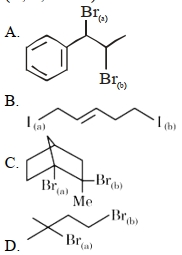 2023 Medium
- (A) \(A - Br _{(b)} ; B - I _{( b )} ; C - Br _{( b )} ; D - Br _{( b )}\)
- (B) \(A - Br _{( a )} ; BI _{( a )} ; C - Br _{( b )} ; D - Br _{( a )}\)
- (C) \(A - Br _{( b )} ; B - I _{( a )} ; C - Br _{( a )} ; D - Br _{( a )}\)
- (D) \(A - Br _{( b )} ; B - I _{( a )} ; C - Br _{( a )} ; D - Br _{( a )}\)
Show answer and solution
Correct Answer: (B)
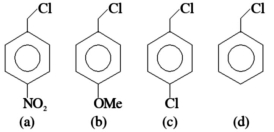
Stable is the carbocation, faster will be rate of \(SN1\) reaction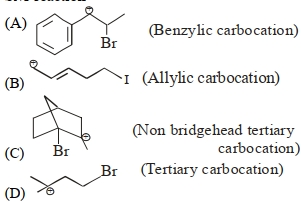
-
- (A) \(a > c > d > b\)
- (B) \(a > b > c > d\)
- (C) \(b > d > c > a\)
- (D) \(d > b > c > a\)
Show answer and solution
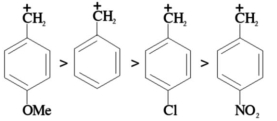
Correct Answer: (C)
The rate of \(S_N 1\) reaction depends upon stability of carbocation which follows the order\(\therefore\) Reactivity order
\((b) > (d) > (c) > (a)\)
-
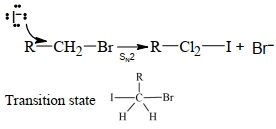
- (A) The transition state formed in the above reaction is less polar than the localised anion.
- (B) The reaction can occur in acetic acid also.
- (C) The solvent used in the reaction solvates the ions formed in rate determining step.
- (D) \(Br ^{-}\)can act as competing nucleophile.
Show answer and solution
Correct Answer: (A)
This is finkelstein reactionClearly, the transition state is less polar than free anions. \(Br ^{-}\)and \(I ^{-}\)
Acetic acid is protic which does not support \(S _{ N } 2\)
Acetone does not solvate anion
\(Br ^{-}\)gets precipitated and hence can not compete with \(I\)
- 129. Identify the correct order for the given property for following compounds.Choose the correct answer from the option given below :-
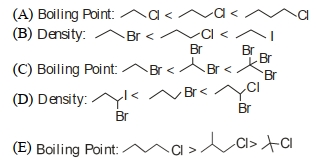 2023 Medium
- (A) \((B), (C)\) and \((D)\) only
- (B) \((A), (C)\) and \((E)\) only
- (C) \((A), (C)\) and \((D)\) only
- (D) \((A), (B)\) and \((E)\) only
Show answer and solution
Correct Answer: (B)
Boiling point of alkyl halide increases with increase in size, mass of halogen atom and size of alkyl groupBoiling point of isomeric alkyl halide decreases with increase in branching
Density increases with increase in atomic mass of halogen atom
-
- (A) (A), (B) and (D) only
- (B) (A), (B), (C) and (D)
- (C) (A), (C) and (D) only
- (D) (B), (C) and (D) only
Show answer and solution
Correct Answer: (B)
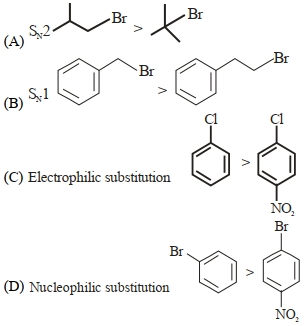
All are correct\((A)\) \(S _{ N } 2\) reaction decreases with increase in steric crowding.
\((B)\) \(S _{ N } 1\) reaction increases with stability of carbocation.
\((C)\) EAS reaction decreases with decrease in electron density.
\((D)\) Presence of electron withdrawing group at ortho and para-position to a halogen in haloarene increase nucleophilic aryl substitution.
-
- (A) \(A-IV,B-III,C-II,D-I\)
- (B) \(A-III,B-I,C-IV,D-II\)
- (C) \(A-I,B-II,C-III,D-IV\)
- (D) \(A-I,B-III,C-IV,D-II\)
Show answer and solution
Correct Answer: (B)
\(CH _3- CH _2- CH _2- Br + KOH ( Alc ) \rightarrow CH _3-\underset{\text { (Alkene) }}{ CH }= CH _2\)\(CH _3- CH _2- CH _2- Br + KCN ( Alc ) \rightarrow CH _3- CH _2- CH _2- CN\)
\(CH _3- CH _2- CH _2- Br + AgNO _2 \rightarrow CH _3- CH _2- CH _2- COO _2+ AgBr \downarrow\)
\(\left. CH _3- CH _2- CH _2- Br + CH _3- COOAg _2 \rightarrow CH _3- COO - CH _2\right)= CH _2- CH _3+ AgBr \downarrow\)
- 132. Maximum number of isomeric monochloro derivatives which can be obtained from \(2,2,5,5\) tetramethylhexane by chlorination is \(..............\). 2023 Medium
- (A) \(3\)
- (B) \(4\)
- (C) \(5\)
- (D) \(6\)
Show answer and solution
Correct Answer: (A)
Total numbers of isomer \(=03\)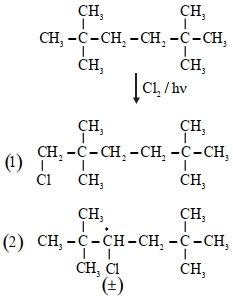
-
- (A) \(4\)
- (B) \(6\)
- (C) \(2\)
- (D) \(8\)
Show answer and solution
Correct Answer: (C)
Benzylic and tertiary carbocations are stable. -
- (A) \(A > B > D > C\)
- (B) \(C > A > D > B\)
- (C) \(D > C > B > A\)
- (D) \(D > B > A > C\)
Show answer and solution
Correct Answer: (D)
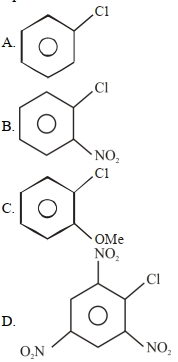
\((-M)\) group increases reactivity where as \((+M)\) group decreases reactivity of Halobenzene towards Nucleophilic substitution reaction.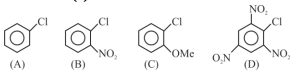
- 135. The number of hyperconjugation structures involved to stabilize carbocation formed in the above reaction is \(.............\).
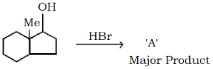 2023 Hard
- (A) \(6\)
- (B) \(5\)
- (C) \(4\)
- (D) \(7\)
Show answer and solution
Correct Answer: (A)
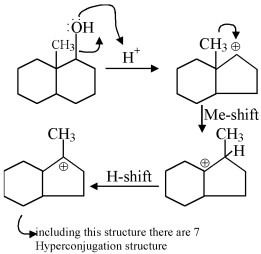
Let's analyze the step-by-step carbocation rearrangement mechanism for the given reaction:
1. Initial Carbocation Formation: Protonation of the alcohol (\( -\text{OH} \)) group followed by the loss of a water molecule (\( \text{H}_2\text{O} \)) forms a secondary (\( 2^\circ \)) carbocation on the 5-membered ring.
2. 1,2-Methyl Shift: To increase stability, the methyl group (\( -\text{CH}_3 \)) on the bridgehead carbon undergoes a 1,2-shift to the adjacent positive carbon. This creates a highly stable tertiary (\( 3^\circ \)) carbocation at the bridgehead position.
Counting Alpha-Hydrogens (\( \alpha \)-H):
For this stable tertiary carbocation, the adjacent (\( \alpha \)) positions relative to the positive charge are:
- The neighboring \( \text{-CH}_2- \) group in the 5-membered ring: contains 2 \( \alpha \)-hydrogens.
- The neighboring \( \text{-CH}_2- \) group in the 6-membered ring: contains 2 \( \alpha \)-hydrogens.
- The adjacent bridgehead \( \text{-CH}- \) carbon: contains 1 \( \alpha \)-hydrogen.
Total number of \( \alpha \)-hydrogens = \( 2 + 2 + 1 = 5 \).
Total Hyperconjugation Structures:
The total number of hyperconjugation structures is given by the formula:
Total structures = \( \text{Number of } \alpha\text{-hydrogens} + 1 \) (including the parent contributing structure).
Total structures = \( 5 + 1 = 6 \).
Therefore, Option A is the correct answer. - 136. The number of possible isomeric products formed when \(3-\)chloro\(-1-\)butene reacts with \(HCl\) through carbocation formation is \(.............\). 2023 Medium
- (A) \(4\)
- (B) \(2\)
- (C) \(1\)
- (D) \(5\)
Show answer and solution
Correct Answer: (A)
Total Possible Isomeric product \(=1+3=4\)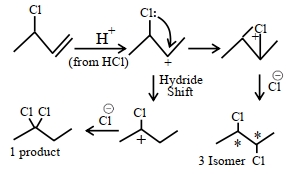
-
- (A) \(C Cl _2 F _2\)
- (B) \(C _2 HF _3\)
- (C) \(C _2 H _2 F _2\)
- (D) \(C _2 F _4\)
Show answer and solution
Correct Answer: (A)
Freons are chlorofluoro carbon. -
- (A) These are chlorofluorocarbon compounds
- (B) These are chemicals causing skin cancer
- (C) These are radicals of chlorine and chlorine monoxide
- (D) All radicals are called freons
Show answer and solution
Correct Answer: (A)
Fact -
- (A) \(0.02,0.02\)
- (B) \(0.01,0.01\)
- (C) \(0.02,0.01\)
- (D) \(0.01,0.02\)
Show answer and solution
Correct Answer: (B)
\(\begin{array}{l}{\left[ Co \left( NH _3\right)_5 SO _4\right] Br + AgNO _3 \rightarrow AgBr \downarrow} \\ 0.01\, mol \qquad\quad \text { excess } \quad 0.01\,Mol \\ {\left[ Co \left( NH _3\right)_5 Br \right] SO _4+ BaCl _2 \rightarrow BaSO _4 \downarrow} \\ 0.01 mol \qquad\quad \text { excess } \quad 0.01\,Mol \\\end{array}\) - 140. An ammoniacal metal salt solution gives a brilliant red precipitate on addition of dimethylglyoxime. The metal ion is : 2023 Medium
- (A) \(Cu ^{2+}\)
- (B) \(Co ^{2+}\)
- (C) \(Fe ^{2+}\)
- (D) \(Ni ^{2+}\)
Show answer and solution
Correct Answer: (D)
\(Ni ^{+2}+2 DMG \stackrel{ NH _3( aq )}{\longrightarrow}\left[ Ni ( DMG )_2\right]\) -
- (A) cis \(-\left[ PtCl _2( en )_2\right]^{2+}\)
- (B) trans \(-\left[ PtCl _2( en )_2\right]^{2+}\)
- (C) cis \(-\left[ PtCl _2\left( NH _3\right)_2\right]\)
- (D) trans \(-\left[ Co \left( NH _3\right)_4 Cl _2\right]^{+}\)
Show answer and solution
Correct Answer: (A)
this is chiral complex form
- 142. For a metal ion, the calculated magnetic moment is \(4.90\,BM\). This metal ion has \(........\) number of unpaired electons. 2023 Medium
- (A) \(6\)
- (B) \(8\)
- (C) \(4\)
- (D) \(5\)
Show answer and solution
Correct Answer: (C)
\(\mu=\sqrt{n(n+2)}\,B M\)\(4.90=\sqrt{n(n+2)}\)
\(n=4\)
-
- (A) \(A\) is false but \(R\) is true.
- (B) \(A\) is true but \(R\) is false.
- (C) Both \(A\) and \(R\) are true and \(R\) is the correct explanation of \(A\).
- (D) Both \(A\) and \(R\) are true and R is NOT the correct explanation of \(A\).
Show answer and solution
Correct Answer: (A)
Since \(H _2 O\) is strong field ligand compared to chloride and \(Co ^{3+}\) ion is present.\(\therefore\) CFSE is higher for \(\left[ Co \left( NH _3\right)_5 H _2 O \right]^{+3}\), hence it will absorb at lower wavelength.
-
- (A) \(4\)
- (B) \(2\)
- (C) \(6\)
- (D) \(8\)
Show answer and solution
Correct Answer: (B)
\(\mu_{ s }=\sqrt{ n ( n +2)} BM \quad\) (n=no. of unpaired electrons)\(n\) \(V ^{3+}:[ Ar ] 3 d ^2 4 s ^0\) \(2\) \(Cr ^{3+}:[ Ar ] 3 d ^3 4 s ^0\) \(3\) \(Fe ^{2+}:[ Ar ] 3 d ^6 4 s ^0\) \(4\) \(Ni ^{3+}:[ Ar ] 3 d ^7 4 s ^0\) \(5\) \(Cr ^{3+}\) and \(Ni ^{3+}\) have same value of \(\mu_{ s }\)
-
- (A) \(A, B\) and \(C\)
- (B) \(A, B\) and \(D\)
- (C) \(A\) and \(D\)
- (D) \(B\) and \(C\)
Show answer and solution
Correct Answer: (B)
\(\left[ NiBr _2 Cl _2\right]^{2-} \rightarrow\) This complex species is tetrahedral as \(Br ^{\Theta}\) and \(Cl ^{\Theta}\) are weak field ligands. \(\left[ PtBr _2 Cl _2\right]^{2-} \rightarrow As\) Pt belongs to 5 d series. This complex species is square planar.Both the complex species are optically inactive. \(\left[ NiBr _2 Cl _2\right]^{2-}\), being tetrahedral does not show Geometrical Isomerism. \(\left[ PtBr _2 Cl _2\right]^{2-}\) shows two Geometrical Isomers.
\(\left[ PtBr _2 Cl _2\right]^{2-}\) shows two Geometrical Isomers.
-
- (A) \(481\)
- (B) \(482\)
- (C) \(480\)
- (D) \(483\)
Show answer and solution
Correct Answer: (C)
\(\left( Ti ^{+3}\left( H _2 O \right)_6\right)^{3+}\)\(Ti ^{+3}: 3 d ^1\)
\(C.F.S.E.\) \(=-0.4 \times \Delta_0\)
\(=-\frac{96 \times 10^3}{ N _0}\,J\)
\(\Delta_0=\frac{96 \times 10^3}{0.4 \times 6 \times 10^{23}}\)
\(\frac{ hc }{\lambda}=\frac{96 \times 10^3}{0.4 \times 6 \times 10^{23}}\)
\(\lambda=\frac{0.4 \times 6 \times 10^{23} \times 6.4 \times 10^{-34} \times 3 \times 10^8}{96 \times 10^3}\)
\(=0.48 \times 10^{-6}\,m\)
\(=480 \times 10^{-9}\,m\)
\(=480\,nm\)
- 147. In ammonium-phosphomolybdate, the oxidation state of Mo is \({ }^{+}\) \(..........\). 2023 Medium
- (A) \(8\)
- (B) \(4\)
- (C) \(10\)
- (D) \(6\)
Show answer and solution
Correct Answer: (D)
\(\left( NH _4\right)_3 PO _4 \cdot 12 MoO _3\)Let \(X =\) oxidation state of \(Mo\) in \(MoO _3\)
\(X +(-2) \times 3=0\)
\(X =+6\)
- 148. In potassium ferrocyanide, there are \(..........\) pairs of electrons in the \(t _{2 g }\) set of orbitals 2023 Medium
- (A) \(4\)
- (B) \(3\)
- (C) \(2\)
- (D) \(1\)
Show answer and solution
Correct Answer: (B)
\(K _4\left[ Fe ( CN )_6\right]\)\(Fe ^{+2}=[ Ar ] 3 d ^6\)
\(CN ^{-}= SFL\)
\(t _{2 g }\) contain \(6\) electron so it become \(3\) pairs:-

-
- (A) A - II, B - IV, C - I, D - III
- (B) A - IV, B-III, C - II, D - I
- (C) A - III, B - IV, C - I, D - II
- (D) A - II , B - I , C - IV , D - III
Show answer and solution
Correct Answer: (A)
For option \((A)\)\(Cr ^{+3}: 3 d ^3\)
\(CN ^{-} \rightarrow SFL\)
\(\Rightarrow \text { No. of unpaired electrons }=3\)
For option \((B)\)
\(Fe ^{+2}: 3 d ^6\)
\(H _2 O : WFL\)
No. of unpaired electrons \(=4\)
For option \((C)\)
\(Co ^{+3}: 3 d ^6\)
\(NH _3: SFL\)
No. of unpaired electrons \(=0\)
For option \((D)\)
\(Ni ^{-+2}: 3 d ^8\)
\(NH _3: SFL\)
No. of unpaired electrons \(=2\)
-
- (A) \(A-I, B-IV, C-II, D-III\)
- (B) \(A-II, B-III, C-I, D-IV\)
- (C) \(A-I, B-II, C-IV, D-III\)
- (D) \(A-III, B-IV, C-I, D-II\)
Show answer and solution
Correct Answer: (A)
CFSE \(=\left(-0.4 nt _{2 g }+0.6 n _{ eg }\right) \Delta_0\)\(nt _{2 g }=\) number of electrons in \(t _{2 g }\) orbital
\(n_{ eg }=\) number of electrons in eg orbital


No questions on this page match these filters.