


Questions
10 questionsShowing 1–10 of 10 questions
- 1. For electron gain enthalpies of the elements denoted as \(\Delta_{ eg } H\), the incorrect option is : 2023 Medium
- (A) \(\Delta_{ eg } H ( Cl ) < \Delta_{ eg } H ( F )\)
- (B) \(\Delta_{ eg } H ( Se ) < \Delta_{ eg } H ( S )\)
- (C) \(\Delta_{ eg } H (I) < \Delta_{ eg } H (At)\)
- (D) \(\Delta_{ eg } H ( Te ) < \Delta_{ eg } H\) (Po)
Show answer and solution
Correct Answer: (B)
\((1)\) \(\Delta_{ eg } H ( Cl ) < \Delta_{ eg } H ( F )\)\((-345) (-328)\) Correct
\((2)\) \(\Delta_{ eg } H ( Se ) < \Delta_{ eg } H ( S )\)
\((-195) \quad(-200)\) Incorrect
\((3)\) \(\Delta_{ eg } H (I) < \Delta_{ eg } H ( At )\)
\((-295) (-270)\) Correct
\((4)\) \(\Delta_{ eg } H ( Te ) < \Delta_{ eg } H ( Po )\)
\((-190) (-183)\) Correct
- 2. For elements \(B , C , N , Li , Be , O\) and \(F\) the correct order of first ionization enthalpy is 2023 Medium
- (A) \(Li < Be < B < C < N < O < F\)
- (B) \(B > Li > Be > C > N > O > F\)
- (C) \(Li < B < Be < C < O < N < F\)
- (D) \(Li < Be < B < C < O < N < F\)
Show answer and solution
Correct Answer: (C)
First I.E.\(F > N > O > C > Be > B > Li\)
\(Li -520\, kJ / mol\)
\(Be -899\, kJ / mol\)
\(B -801 \,kJ / mol\)
\(C -1086 \,kJ / mol\)
\(N -1402 \,kJ / mol\)
\(O -1314\, kJ / mol\)
\(F -1681\,kJ / mol\)
-
- (A) Both \((A)\) and \((R)\) are true and \((R)\) is the correct explanation of \((A)\)
- (B) Both \((A)\) and \((R)\) are true but \((R)\) is not the correct explanation of \((A)\)
- (C) \((A)\) is false but \((R)\) is true
- (D) \((A)\) is true but \((R)\) is false
Show answer and solution
Correct Answer: (A)
From Sc to Mn ionization energy is less than that of \(Mg\).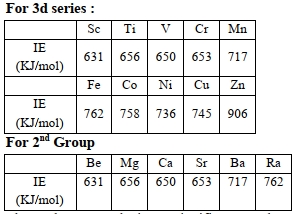
-
- (A) \(1\)
- (B) \(2\)
- (C) \(0.5\)
- (D) \(3\)
Show answer and solution
Correct Answer: (C)
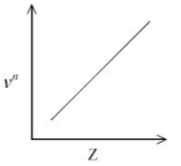
According to Henry Moseley \(\sqrt{v}\,\alpha z - b\)So \(n =\frac{1}{2}\)
-
- (A) \(A - II, B - IV, C - I, D - III\)
- (B) \(A - I, B - III, C - IV, D - II\)
- (C) \(A - IV, B - III, C - II, D - I\)
- (D) \(A - IV, B - II, C - I, D - III\)
Show answer and solution
Correct Answer: (D)
Atomic number Block \(37\) \((K)\) \(s-\)block \(78\) \((Pt)\) \(d-\)block \(52\) \((Te)\) \(p-\)block \(65\) \((Tb)\) \(f-\)block -
- (A) \(C > P > At > Br\)
- (B) \(Br > P > At > C\)
- (C) \(P > Br > C > At\)
- (D) \(Br > C > At > P\)
Show answer and solution
Correct Answer: (D)
Atom \(E.N\) \(Br\) \(3.0\) \(C\) \(2.5\) \(At\) \(2.2\) \(P\) \(2.1\) -
- (A) \(Be > Ca > K\)
- (B) \(Ca > K > Be\)
- (C) \(K > Ca > Be\)
- (D) \(K > Be > Ca\)
Show answer and solution
Correct Answer: (C)
On moving from top to bottom metallic character increases while on moving from left to right metallic decreases.\(K > Ca > Be\)
-
- (A) \(Ne\) and \(F\)
- (B) \(Ne\) and \(Cl\)
- (C) \(Ar\) and \(Cl\)
- (D) \(Ar\) and \(F\)
Show answer and solution
Correct Answer: (B)
\(Cl\) has the most negative \(\Delta H _{\text {eg }}\) among all the elements and \(Ne\) has the most positive \(\Delta H _{ eg }\). - 9. Which of the following represents the correct order of metallic character of the given elements ? 2023 Medium
- (A) \(Si < Be < Mg < K\)
- (B) \(Be < Si < Mg < K\)
- (C) \(K < Mg < Be < Si\)
- (D) \(Be < Si < K < Mg\)
Show answer and solution
Correct Answer: (A)
Metallic character increases down the group and decreases along the period. -
- (A) \(A,B,C\) and \(D\)
- (B) \(A,C\) and \(D\) Only
- (C) \(B\) and \(D\) Only
- (D) \(A,B\) and \(D\) Only
Show answer and solution
Correct Answer: (B)
Electronegativity of an element depends on the atom with which it is attached.\(NO =\text { neutral oxide }\)
\(Al _2 O _3=\text { amphoteric oxide }\)
No questions on this page match these filters.