


JEE Mains · Physics · STD 11 - 12 . kinetic theory of gases
The specific heats, \(C_P\) and \(C_V\) of a gas of diatomic molecules, \(A\), are given (in units of \(J\, mol^{-1}\, K^{-1}\)) by \(29\) and \(22\), respectively. Another gas of diatomic molecules \(B\), has the corresponding values \(30\) and \(21\). If they are treated as ideal gases, then
- A \(A\) has one vibrational mode and \(B\) has two
- B Both \(A\) and \(B\) have a vibrational mode each
- C \(A\) is rigid but \(B\) has a vibrational mode
- D \(A\) has a vibrational mode but \(B\) has none
Answer & Solution
Correct Answer
(D) \(A\) has a vibrational mode but \(B\) has none
Step-by-step Solution
Detailed explanation
For \(A:\) \(\frac{C_{p}}{C_{v}}=\gamma=1+\frac{2}{f}=\frac{29}{22}\) It gives \(f=6.3 \approx 6 \quad(3 \text { translational, } 2 \text { rotational and } 1\) vibrational) For \(B:\) \(\frac{C_{p}}{C_{v}}=\gamma=1+\frac{2}{f}=\frac{30}{21}\) \(\Rightarrow \mathrm{f}=4.67\)…
See the Complete Solution
Get step-by-step explanations for this and 2.5 Lakh+ more JEE, NEET & CET questions.
- Unlock all solutions
- Practice the full chapter
- Track accuracy across PYQs
4.8 rated on Google Play · 14,000+ reviews
More questions from Physics
- \(500\, g\) of water and \(100\, g\) of ice at \(0\,^oC\) are in a calorimeter whose water equivalent is \(40\, g\). \(10\, g\) of steam at \(100\,^oC\) is added to it. Then water in the calorimeter is ....... \(g\) (Latent heat of ice \(\,= 80\, cal/g\), Latent heat of steam \(\,= 540\, cal/ g\))JEE Mains 2013 Medium
- The range of the projectile projected at an angle of \(15^{\circ}\) with horizontal is \(50\,m\). If the projectile is projected with same velocity at an angle of \(45^{\circ}\) with horizontal, then its range will be \(........\,m\)JEE Mains 2023 Medium
- The translational degrees of freedom \((f)\) and rotational degrees of freedom \((f)\) of \(\mathrm{CH}_4\) molecule are _______.JEE Mains 2024 Hard
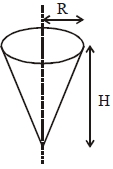
- Shown in the figure is a hollow icecream cone (it is open at the top). If its mass is \(M,\) radius of its top, \(R\) and height, \(H\), then its moment of inertia about its axis is
 JEE Mains 2020 Hard
 - A force \(\overrightarrow{ F }=4 \hat{ i }+3 \hat{ j }+4 \hat{ k }\) is applied on an intersection point of \(x =2\) plane and \(x\) -axis. The magnitude of torque of this force about a point \((2,3,4)\) is.......... . (Round off to the Nearest Integer)JEE Mains 2021 Hard
- In Young's double slit experiment, monochromatic light of wavelength \(5000\) \(A\) is used. The slits are \(1.0 \mathrm{~mm}\) apart and screen is placed at \(1.0 \mathrm{~m}\) away from slits. The distance from the centre of the screen where intensity becomes half of the maximum intensity for the first time is _______ \(10^{-6} \mathrm{~m}\).JEE Mains 2024 Hard
More PYQs from JEE Mains
- Let \(\vec \alpha =(\lambda -2) \vec a + \vec b\) and \(\vec \beta = (4\lambda -2)\vec a + 3\vec b\) be two given vectors where \(\vec a\) and \(\vec b\) are non collinear. The value of \(\lambda \) for which vectors and \(\vec \alpha \) and \(\vec \beta \) are collinear, isJEE Mains 2019 Medium
- The explosive in a Hydrogen bomb is a mixture of \({ }_1 \mathrm{H}^2,{ }_1 \mathrm{H}^3\) and \({ }_3 \mathrm{Li}^6\) in some condensed form. The chain reaction is given by \( { }_3 \mathrm{Li}^6+{ }_0 \mathrm{n}^1 \rightarrow{ }_2 \mathrm{He}^4+{ }_1 \mathrm{H}^3 \) \( { }_1 \mathrm{H}^2+{ }_1 \mathrm{H}^3 \rightarrow{ }_2 \mathrm{He}^4+{ }_0 \mathrm{n}^1\) During the explosion the energy released is approximately [Given : \(\mathrm{M}(\mathrm{Li})=6.01690\ \mathrm{amu} . \mathrm{M}\left({ }_1 \mathrm{H}^2\right)=2.01471 \ amu.\) \(\mathrm{M}\left({ }_2 \mathrm{He}^4\right)=4.00388\ \mathrm{amu}\),\( and\ \)\(1 \ \mathrm{amu}=931.5\) \(\mathrm{MeV}]\)JEE Mains 2024 Hard
- Let for \(n =1,2, \ldots \ldots, 50, S _{ a }\) be the sum of the infinite geometric progression whose first term is \(n ^{2}\) and whose common ratio is \(\frac{1}{(n+1)^{2}}\). Then the value of \(\frac{1}{26}+\sum\limits_{n=1}^{50}\left(S_{n}+\frac{2}{n+1}-n-1\right)\) is equal toJEE Mains 2022 Hard
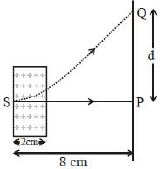
- An electron, moving along the \(x-\) axis with an initial energy of \(100\, eV\), enters a region of magnetic field \(\vec B = (1.5\times10^{-3}T)\hat k\) at \(S\) (See figure). The field extends between \(x = 0\) and \(x = 2\, cm\). The electron is detected at the point \(Q\) on a screen placed \(8\, cm\) away from the point \(S\). The distance \(d\) between \(P\) and \(Q\) (on the screen) is :......\(cm\) (electron's charge \(= 1.6\times10^{-19}\, C\), mass of electron \(= 9.1\times10^{-31}\, kg\))
 JEE Mains 2019 Hard
 - Let \(\vec a = 3\hat i + 2\hat j + x\hat k\) and \(\vec b = \hat i - \hat j + \hat k\), for some real \(x\). Then \(\left| {\vec a \times \vec b} \right| = r\) is possible ifJEE Mains 2019 Hard
- A parallel plate capacitor of area \(A=16 \mathrm{~cm}^2\) and separation between the plates 10 cm , is charged by a DC current. Consider a hypothetical plane surface of area \(\mathrm{A}_0=3.2 \mathrm{~cm}^2\) inside the capacitor and parallel to the plates. At an instant, the current through the circuit is 6A. At the same instant the displacement current through \(\mathrm{A}_0\) is ________ mA .JEE Mains 2025 Medium