


JEE Mains · Physics · STD 12 - 11. Dual nature of radiation and matter
A nucleus \(A\), with a finite de -broglie wavelength \(\lambda_A\), undergoes spontaneous fission into two nuclei \(B\) and \(C\) of equal mass. \(B\) flies in the same direction as that of \(A\), while \(C\) flies in the opposite direction with a velocity equal to half of that of \(B\). The de -Broglie wavelength \(\lambda_B\) and \(\lambda_C\) of \(B\) and \(C\) are respectively
- A \(\lambda_A\), \(2\lambda_A\)
- B \(2\lambda_A\), \(\lambda_A\)
- C \(\lambda_A\), \(\frac{\lambda_A}{2}\)
- D \(\frac{\lambda_A}{2}\), \(\lambda_A\)
Answer & Solution
Correct Answer
(D) \(\frac{\lambda_A}{2}\), \(\lambda_A\)
Step-by-step Solution
Detailed explanation
Let mass of \(B\) and \(C\) is \(m\) each. By momentum conservation \(2 m v_{0}=m v-\frac{m v}{2}\) \(\mathrm{v}=4 \mathrm{v}_{0}\) \({{\text{P}}_{\text{A}}} = 2{\text{m}}{{\text{v}}_0}\) \({{\text{p}}_{\text{B}}} = 4{\text{m}}{{\text{v}}_0}\)…
See the Complete Solution
Get step-by-step explanations for this and 2.5 Lakh+ more JEE, NEET & CET questions.
- Unlock all solutions
- Practice the full chapter
- Track accuracy across PYQs
4.8 rated on Google Play · 14,000+ reviews
More questions from Physics
- A bi-convex lens has radius of curvature of both the surfaces same as \(1 / 6 \mathrm{~cm}\). If this lens is required to be replaced by another convex lens having different radii of curvatures on both sides \(\left(R_1 \neq R_2\right)\), without any change in lens power then possible combination of \(R_1\) and \(R_2\) is :JEE Mains 2025 Hard
- A time varying potential difference is applied between the plates of a parallel plate capacitor of capacitance \(2.5 \mu \mathrm{~F}\). The dielectric constant of the medium between the capacitor plates is 1 . It produces an instantaneous displacement current of 0.25 mA in the intervening space between the capacitor plates, the magnitude of the rate of change of the potential difference will be _____ \(\mathrm{Vs}^{-1}\).JEE Mains 2025 Hard
- The position of the image formed by the combination of lenses is _______. \(\mathrm{f}_1=10 \mathrm{~cm} \quad \mathrm{f}_2=10 \quad \mathrm{f}_3=30 \mathrm{~cm}\)
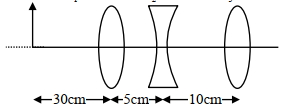 JEE Mains 2024 Hard
 - Given below are two statements: one is labelled as Assertion \(A\) and the other is labelled as Reason \(R\). \(Assertion\) \(A\) : Number of photons increases with increase in frequency of light. \(Reason\) \(R\) : Maximum kinetic energy of emitted electrons increases with the frequency of incident radiation. In the light of the above statements, choose the most appropriate answer from the options given below :JEE Mains 2024 Hard
- In an octagon \(ABCDEFGH\) of equal side, what is the sum of \(\overrightarrow{ AB }+\overrightarrow{ AC }+\overrightarrow{ AD }+\overrightarrow{ AE }+\overrightarrow{ AF }+\overrightarrow{ AG }+\overrightarrow{ AH }\) if, \(\overrightarrow{ AO }=2 \hat{ i }+3 \hat{ j }-4 \hat{ k }\)
 JEE Mains 2021 Hard
 - A progressive wave travelling along the positive \(x-\) direction is represented by \(y(x, t) = A\,sin\,\left( {kx - \omega t + \phi } \right)\). Its snapshot at \(t = 0\) is given in the figure For this wave, the phase \(\phi \) is
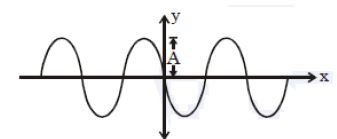 JEE Mains 2019 Medium
More PYQs from JEE Mains
- The focal length \(f\) is related to the radius of curvature \(R\) of the spherical convex mirror byJEE Mains 2021 Easy
- If the net electric field at point \(\mathrm{P}\) along \(\mathrm{Y}\) axis is zero, then the ratio of \(\left|\frac{q_2}{q_3}\right|\) is \(\frac{8}{5 \sqrt{x}}\), where \(\mathrm{x}=\) _______.
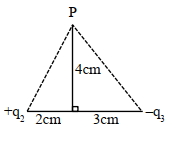 JEE Mains 2024 Hard
 - Let \(\mathrm{A}\) be the set of all points \((\alpha, \beta)\) such that the area of triangle formed by the points \((5,6),(3,2)\) and \((\alpha, \beta)\) is \(12\, square\, units.\) Then the least possible length of a line segment joining the origin to a point in \(A,\) is :JEE Mains 2021 Hard
- Let \(\overrightarrow{\mathrm{a}}=\hat{\mathrm{i}}+2 \hat{\mathrm{j}}+\mathrm{k}, \overrightarrow{\mathrm{b}}=3(\hat{\mathrm{i}}-\hat{\mathrm{j}}+\mathrm{k})\). Let \(\overrightarrow{\mathrm{c}}\) be the vector such that \(\vec{a} \times \vec{c}=\vec{b}\) and \(\vec{a} \cdot \vec{c}=3\). Then \(\overrightarrow{\mathrm{a}} \cdot((\overrightarrow{\mathrm{c}} \times \overrightarrow{\mathrm{b}})-\overrightarrow{\mathrm{b}}-\overrightarrow{\mathrm{c}})\) is equal to :JEE Mains 2024 Hard
- A hollow spherical ball of uniform density rolls up a curved surface with an initial velocity \(3\, m / s\) (as shown in figure). Maximum height with respect to the initial position covered by it will be \(...........cm\).
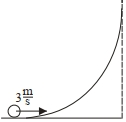 JEE Mains 2023 Hard
 - A circle \(C_{1}\) passes through the origin \(O\) and has diameter \(4\) on the positive \(x\)-axis. The line \(y =2 x\) gives a chord \(OA\) of a circle \(C _{1}\). Let \(C _{2}\) be the circle with \(OA\) as a diameter. If the tangent to \(C _{2}\) at the point \(A\) meets the \(x\)-axis at \(P\) and \(y\)-axis at \(Q\), then \(QA : AP\) is equal to.JEE Mains 2022 Hard