


JEE Mains · Chemistry · STD 11 - 6.2. Equilibrium - II (icon Equilibrium)
For the following Assertion and Reason, the correct option is Assertion : The \(pH\) of water increases with increase in temperature. Reason : The dissociation of water into \(H^+\) and \(OH^-\) is an exothermic reaction.
- A Both assertion and reason are true, but the reason is not the correct explanation for the assertion.
- B Both assertion and reason are false.
- C Assertion is not true, but reason is true.
- D Both assertion and reason are true, and the reason is the correct explanation for the assertion.
Answer & Solution
Correct Answer
(B) Both assertion and reason are false.
Step-by-step Solution
Detailed explanation
\(\mathrm{H}_{2} \mathrm{O}(\ell) \rightleftharpoons \mathrm{H}_{(\mathrm{aq})}^{+}+\mathrm{OH}_{(\mathrm{aq})}^{-}\) For ionization of \(\mathrm{H}_{2} \mathrm{O}: \Delta \mathrm{H}>\mathrm{O}\) \(\Rightarrow\) Endothermic On temperature increase reaction shifts forward…
See the Complete Solution
Get step-by-step explanations for this and 2.5 Lakh+ more JEE, NEET & CET questions.
- Unlock all solutions
- Practice the full chapter
- Track accuracy across PYQs
4.8 rated on Google Play · 14,000+ reviews
More questions from Chemistry
- Out of the following, which type of interaction is responsible for the stabilisation of \(\alpha-\) helix structure of proteins ?JEE Mains 2021 Easy
- Which of the following conversions involves change in both shape and hybridisation?JEE Mains 2018 Medium
- Consider separate solutions of \(0.500\, M\, C_2H_5OH\,(aq),\) \(0.100\,M\,Mg_3(PO_4)_2\, (aq), \) \(0.250\, M\,KBr\,(aq)\) and \(0.125\, M\,Na_3PO_4\,(aq)\) at \(25^o C.\) Which statement is true about these solutions, assuming all salts to be strong electrolytes ?JEE Mains 2014 Hard
- Given below are two statements :
1 M aqueous solution of each of \(\mathrm{Cu}\left(\mathrm{NO}_3\right)_2, \mathrm{AgNO}_3\), \(\mathrm{Hg}_2\left(\mathrm{NO}_3\right)_2 ; \mathrm{Mg}\left(\mathrm{NO}_3\right)_2\) are electrolysed using inert electrodes,
\(\begin{aligned} & \text { Given : } \mathrm{E}_{\mathrm{Ag}^{+} / \mathrm{Ag}}^\theta=0.80 \mathrm{~V}, \mathrm{E}_{\mathrm{Hg}_2^{2+} / \mathrm{Hg}}^\theta=0.79 \mathrm{~V}, \\ & \mathrm{E}_{\mathrm{Cu}^{2+} / \mathrm{Cu}}^\theta=0.24 \mathrm{~V} \text { and } \mathrm{E}_{\mathrm{Mg}^{2+} / \mathrm{Mg}}^\theta=-2.37 \mathrm{~V}\end{aligned}\)
Statement (I) : With increasing voltage, the sequence of deposition of metals on the cathode will be \(\mathrm{Ag}, \mathrm{Hg}\) and Cu
Statement (II) : Magnesium will not be deposited at cathode instead oxygen gas will be evolved at the cathode.
In the light of the above statement, choose the most appropriate answer from the options given belowJEE Mains 2025 Easy - The number of lone pairs of electrons on the central \(I\) atom in \(I_{3}^{-}\) is \(.......\)
 JEE Mains 2021 Medium
 - The number of chiral carbons present in sucrose isJEE Mains 2020 Medium
More PYQs from JEE Mains
- In a hydrogen like atom, when an electron jumps from the \(M -\) shell to the \(L-\) shell the wavelength of emitted radiation is \(\lambda \). If an electron jumps from \(N-\) shell to the \(L-\) shell the wavelength of emitted radiation will beJEE Mains 2019 Medium
- If the mirror image of the point \(\mathrm{P}(3,4,9)\) in the line \(\frac{x-1}{3}=\frac{y+1}{2}=\frac{z-2}{1}\) is \((\alpha, \beta, \gamma)\), then \(14(\alpha+\beta+\gamma)\) is :JEE Mains 2024 Hard
- A hot body, obeying Newton's law of cooling is cooling down from its peak value \(80\,^oC\) to an ambient temperature of \(30\,^oC\) . It takes \(5\, minutes\) in cooling down from \(80\,^oC\) to \(40\,^oC\). ........ \(\min.\) will it take to cool down from \(62\,^oC\) to \(32\,^oC\) ? (Given \(ln\, 2\, = 0.693, ln\, 5\, = 1.609\))JEE Mains 2014 Hard
- A positive charge \('q'\) of mass \('m'\) is moving along the \(+ x\) axis. We wish to apply a uniform magnetic field \(B\) for time \(\Delta t\) so that the charge reverses its direction crossing the \(y\) axis at a distance \(d.\) ThenJEE Mains 2014 Hard
- Total enthalpy change for freezing of 1 mol of water at \(10^{\circ} \mathrm{C}\) to ice at \(-10^{\circ} \mathrm{C}\) is _______.
(Given : \(\Delta_{\text {fus }} H=x \mathrm{~kJ} / \mathrm{mol}\))
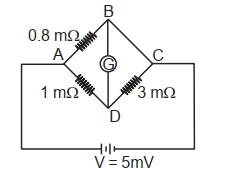
\(\begin{aligned} & \mathrm{C}_{\mathrm{p}}\left[\mathrm{H}_2 \mathrm{O}(\mathrm{l})\right]=\mathrm{y} \mathrm{J} \mathrm{mol}^{-1} \mathrm{~K}^{-1} \\ & \mathrm{C}_{\mathrm{p}}\left[\mathrm{H}_2 \mathrm{O}(\mathrm{s})\right]=\mathrm{z} \mathrm{J} \mathrm{mol}^{-1} \mathrm{~K}^{-1}\end{aligned}\)JEE Mains 2025 Medium - To measure the temperature coefficient of resistivity \(\alpha\) of a semiconductor, an electrical arrangement shown in the figure is prepared. The arm BC is made up of the semiconductor. The experiment is being conducted at \(25^{\circ} \mathrm{C}\) and resistance of the semiconductor arm is \(3 \mathrm{~m} \Omega\). Arm BC is cooled at a constant rate of \(2^{\circ} \mathrm{C} / \mathrm{s}\). If the galvanometer \(\mathrm{G}\) shows no deflection after \(10 \mathrm{~s}\), then \(\alpha\) is _______.
 JEE Mains 2024 Hard