


JEE Mains · Chemistry · STD 11 - 8.3. Organic chemistry purification and characterization
A chromatography column, packed with silica gel as stationary phase, was used to separate a mixture of compounds consisting of \((A)\) benzanilide \((B)\) aniline and \((C)\) acetophenone. When the column is eluted with a mixture of solvents, hexane: ethyl acetate \((20: 80),\) the sequence of obtained compounds
- A \((\mathrm{B}),(\mathrm{C})\) and \((\mathrm{A})\)
- B \((\mathrm{C}),(\mathrm{A})\) and \((\mathrm{B})\)
- C \((\mathrm{A}),(\mathrm{B})\) and \((\mathrm{C})\)
- D \((\mathrm{B}),(\mathrm{A})\) and \((\mathrm{C})\)
Answer & Solution
Correct Answer
(B) \((\mathrm{C}),(\mathrm{A})\) and \((\mathrm{B})\)
Step-by-step Solution
Detailed explanation
Benzanilide \(\rightarrow\) Ph-NH-CO-Ph \((\mu=2.71 \mathrm{D})\) Aniline \(\rightarrow \mathrm{Ph}-\mathrm{NH}_{2}\), \((\mu=1.59 \mathrm{D})\) Acetophenone \(\rightarrow\) Ph-O-CH \(_{3}\) ( \(\mu=3.05 \mathrm{D}\) ) Dipole moment : \({C}>{A}>{B}\) Hence the sequence of…
See the Complete Solution
Get step-by-step explanations for this and 2.5 Lakh+ more JEE, NEET & CET questions.
- Unlock all solutions
- Practice the full chapter
- Track accuracy across PYQs
4.8 rated on Google Play · 14,000+ reviews
More questions from Chemistry
- Given below are two statements: one is labelled as Assertion \(A\) and the other is labelled as Reason \(R\). Assertion \(A\) : Boric acid is a weak acid Reason \(R\) : Boric acid is not able to release \(H ^{+}\)ion on its own. It receives \(OH ^{-}\)ion from water and releases \(H ^{+}\)ion. In the light of the above statements, choose the most appropriate answer from the options given below.JEE Mains 2022 Medium
- Match List-\(I\) with List-\(II\)
Choose the correct answer from the options given below:List-\(I\) (Species) List-\(II\) (Electronic distribution) \((A)\) \(\mathrm{Cr}^{+2}\) \((I)\) \(3 \mathrm{~d}^8\) \((B)\) \(\mathrm{Mn}^{+}\) \((II)\) \(3 \mathrm{~d}^3 4 \mathrm{~s}^1\) \((C)\) \(\mathrm{Ni}^{+2}\) \((III)\) \(3\mathrm{~d}^4\) \((D)\) \(\mathrm{V}^{+}\) \((IV)\) \(3 \mathrm{~d}^5 4 \mathrm{~s}^1\) JEE Mains 2024 Hard - The volume (in \(mL\) ) of \(0.1\, N\) \(NaOH\) required to neutralise \(10\, mL\) of \(0.1\, N\) phosphinic acid is........JEE Mains 2020 Hard
- In the cell \(Pt(s)| H_2 (g,1\,bar)| HCl(aq)| AgCl(s)| Ag(s)| Pt(s)\) the cell potential is \(0.92\,V\) when a \(10^{-6}\) molal \(HCl\) solution is used. The standard electrode potential of \((AgCl / Ag,Cl^- )\) electrode is ............. \(\mathrm{V}\) \(\left\{ {Given,\frac{{2.303RT}}{F} = 0.06\,V\,at\,298\,K} \right\}\)JEE Mains 2019 Hard
- The total number of isomers for a square planar complex \([M(F)(Cl)(SCN (NO_2)]\) isJEE Mains 2019 Medium
- Molarity \((M)\) of an aqueous solution containing \(\mathrm{x} g\) of anhyd. \(\mathrm{CuSO}_4\) in \(500 \mathrm{~mL}\) solution at \(32^{\circ} \mathrm{C}\) is \(2 \times 10^{-1} \mathrm{M}\). Its molality will be _______\(\times 10^{-3} \mathrm{~m}\) (nearest integer). [Given density of the solution \(=1.25 \mathrm{~g} / \mathrm{mL}\).]JEE Mains 2024 Medium
More PYQs from JEE Mains
- Three Carnot engines operate in series between a heat source at a temperature \(T_1\) and a heat sink at temperature \(T_4\) (see figure). There are two other reservoirs at temperature \(T_2\) and \(T_3\), as shown, with \(T_1 > T_2 > T_3 > T_4\). The three engines are equally efficient if
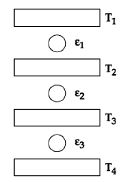 JEE Mains 2019 Hard
 - If \(\frac{1}{{\sqrt \alpha }}\) and \(\frac{1}{{\sqrt \beta }}\) are the roots of the equation , \(ax^2 + bx + 1 = 0\) \(\left( {a \ne 0,a,b \in R} \right)\), then the equation, \(x ( x + b^3 ) + (a^3 - 3abx ) = 0\) has rootsJEE Mains 2014 Hard
- The local maximum value of the function \(f(x)=\left(\frac{2}{x}\right)^{x^{2}}, x>0\), isJEE Mains 2021 Hard
- Five persons \(P_1, P_2, P_3, P_4\) and \(P_5\) recorded object distance (u) and image distance (v) using same convex lens having power +5 D as \((25,96),(30,62)\), \((35,37),(45,35)\) and \((50,32)\) respectively. Identify correct statementJEE Mains 2026 Hard
- A spherical chocolate ball has a layer of ice-cream of uniform thickness around it. When the thickness of the ice-cream layer is 1 cm , the ice-cream melts at the rate of \(81 \mathrm{~cm}^3 / \mathrm{min}\) and the thickness of the ice-cream layer decreases at the rate of \(\frac{1}{4 \pi} \mathrm{~cm} / \mathrm{min}\). The surface area (in \(\mathrm{cm}^2\) ) of the chocolate ball (without the ice-cream layer) is :JEE Mains 2025 Easy
- Given below are two statements. One is labelled as Assertion (A) and the other is labelled as Reason (R).
Assertion (A) :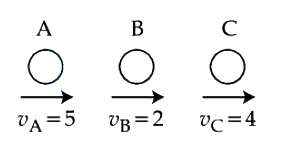
Three identical spheres of same mass undergo one dimensional motion as shown in figure with initial velocities \(v_{\mathrm{A}}=5 \mathrm{~m} / \mathrm{s}, v_{\mathrm{B}}=2 \mathrm{~m} / \mathrm{s}, v_{\mathrm{C}}=4 \mathrm{~m} / \mathrm{s}\). If we wait sufficiently long for elastic collision to happen, then \(v_{\mathrm{A}}=4 \mathrm{~m} / \mathrm{s}, v_{\mathrm{B}}=2 \mathrm{~m} / \mathrm{s}\), \(v_{\mathrm{C}}=5 \mathrm{~m} / \mathrm{s}\) will be the final velocities.
Reason (R): In an elastic collision between identical masses, two objects exchange their velocities.
In the light of the above statements, choose the correct answer from the options given below :JEE Mains 2025 Easy