


All JEE Mains 2020 Chemistry questions
25 chaptersShowing 51–100 of 204 questions
-
- (A) \(b\) and \(d\)
- (B) \(a, b\) and \(c\)
- (C) \(a\) and \(c\)
- (D) \(a\) and \(b\)
Show answer and solution
Correct Answer: (B)
\(S _{ N }{ }^{1}\) favours\((a)\) The reaction is favoured by weak nucleophiles
\((b)\) \(R^ \oplus\) would be easily formed if the substituents are bulky
\((c)\) The reaction is accompained by recemization
-
- (A) \(NH _{4} Cl\) and \(N _{2}\)
- (B) \(NCl _{3}\) and \(NH _{4} Cl\)
- (C) \(NH _{4} Cl\) and \(HCl\)
- (D) \(NCl _{3}\) and \(HCl\)
Show answer and solution
Correct Answer: (D)
\(\begin{array}{*{20}{c}} {N{H_3} + 3C{l_2} \to NC{l_3} + 3HCl} \\ {excess\,\,\,\,\,\,\,\,\,\,\,\,\,\,\,\,\,\,\,\,\,} \end{array}\) - 53. The most appropriate reagent for conversion of \(C _{2} H _{5} CN\) into \(CH _{3} CH _{2} CH _{2} NH _{2}\) is 2020 Medium
- (A) \(Na ( CN ) BH _{3}\)
- (B) \(LiAlH _{4}\)
- (C) \(NaBH _{4}\)
- (D) \(CaH _{2}\)
Show answer and solution
Correct Answer: (B)
\(CH _{3}- CH _{2}- C \equiv N\)\(\xrightarrow{?}\)\(CH _{3}- CH _{2}- CH _{2}- NH _{2}\)\(CH _{3}- CH _{2}- C \equiv N\)\(\xrightarrow{{LiAl{H_4}}}\)\(CH _{3}- CH _{2}- CH _{2}- NH _{2}\)
-
- (A) \(b > c > d > a\)
- (B) \(c > b > a > d\)
- (C) \(b > a > c > d\)
- (D) \(c > b > d > a\)
Show answer and solution
Correct Answer: (A)
\(\begin{array}{*{20}{c}} {O\;\;} \\ {||\;\;} \\ {R - C - OH} \end{array} > R - OH > R - C \equiv CH\)Reason: \(\begin{array}{*{20}{c}} O \\ {||} \\ {R - C - {O^\theta }} \end{array}\) stable by equivalent resonance.
Stable:
So answer is \(b > c > d > a\)
- 55. The increasing order of the acidity of the \(\alpha\)\(-\)hydrogen of the following compounds is :
 2020 Medium
- (A) \((C)<(A)<(B)<(D)\)
- (B) \((B)<(C)<(A)<(D)\)
- (C) \(( A )<( C )<( D )<( B )\)
- (D) \((D)<(C)<(A)<(B)\)
Show answer and solution
Correct Answer: (D)
\(D\)
-
- (A) \(LiAlH_4\)
- (B) \(NaBH_4\)
- (C) \(H_2/Pd\)
- (D) \(B_2H_6\)
Show answer and solution
Correct Answer: (D)
Most suitable reagent for given conversion is \(\mathrm{B}_{2} \mathrm{H}_{6}\) (electrophilic reducing agent)
-
- (A) \(72.72\)
- (B) \(37.62\)
- (C) \(33.33\)
- (D) \(66.67\)
Show answer and solution
Correct Answer: (D)
\(A\xrightarrow[(ii)\;H_3O^+]{(i)\;CH_3MgBr}B\xrightarrow[573\;K]{Cu}2-\)methyl \(2-\)butene\(\begin{array}{*{20}{c}}
{C{H_3} - C - C{H_2} - C{H_3}} \\
{||\,\,\,\,\,\,\,\,\,\,\,\,\,\,\,\,\,\,} \\
{O\,\,\,\,\,\,\,\,\,\,\,\,\,\,\,\,\,\,\,}
\end{array}\xrightarrow[{{H_3}{O^ + }}]{{C{H_3}MgBr}}\)\(\begin{array}{*{20}{c}}
{C{H_3}\,\,\,\,\,\,\,\,\,\,\,} \\
{|\,\,\,\,\,\,\,\,\,\,\,\,\,\,\,\,\,} \\
{C{H_3} - C - C{H_2}- C{H_3}} \\
{|\,\,\,\,\,\,\,\,\,\,\,\,\,\,\,\,\,} \\
{OH\,\,\,\,\,\,\,\,\,\,\,\,\,\,\,}
\end{array}\xrightarrow[{573\,K}]{{Cu}}\)\(\begin{array}{*{20}{c}}
{C{H_3}\,\,\,\,\,\,\,\,\,\,\,\,\,\,} \\
{|\,\,\,\,\,\,\,\,\,\,\,\,\,\,\,\,\,\,\,} \\
{C{H_3} - C = CH - C{H_3}}
\end{array}\)\(\mathrm{C} \Rightarrow 12 \times 4=48\)
\(\mathrm{H} \Rightarrow 8 \times 1=8\)
\(\mathrm{O} \Rightarrow 16 \times 1=16\)
Total \(= 72\)
\(\%\) of \(\mathrm{C}=\frac{48}{72} \times 100=66.66 \%\)
-
- (A) \((iii)\) \( < ( iv ) < ( ii ) < ( i )\)
- (B) \((iii)\) \( < ( iv ) < ( i ) < ( ii )\)
- (C) \((iii)\) \( < (1) < (i v) < (i i)\)
- (D) \((i)\) \( < (\) iii) \( < ( iv ) < ( ii )\)
Show answer and solution
Correct Answer: (C)
Increasing order of reactivity towards \(HCN\) addition Greater the electrophilicity on \(\begin{array}{*{20}{c}} O \\ {||} \\ { - C - } \end{array}\) group greater the reactivity in nucleophilic addition.\((iii)\) \(< (1) < ( iv ) < ( ii )\)

-
- (A) Butanone \(<\) Propanone \(<\) Benzaldehyde \(<\) Propanal
- (B) Benzaldehyde \(<\) Butanone \(<\) Propanone \(<\) Propanal
- (C) Propanal \(<\) Propanone \(<\) Butanone \(<\) Benzaldehyde
- (D) Benzaldehyde \(<\) Propanal \(<\) Propanone \(<\) Butanone
Show answer and solution
Correct Answer: (A)
Reactivity order of various carbonyl compounds \(\rightarrow\) Aldehydes \(>\) Ketones
-
- (A) \(12\)
- (B) \(9\)
- (C) \(5\)
- (D) \(10\)
Show answer and solution
Correct Answer: (C)
No. of chiral centres
-
- (A) \(N _{2} O _{5}\)
- (B) \(NO _{2}\)
- (C) \(N _{2} O\)
- (D) \(N _{2} O _{3}\)
Show answer and solution
Correct Answer: (D)
\(2 NO + N _{2} O _{4} \stackrel{250 K }{\longrightarrow} 2 N _{2} O _{3}\)blue solid
-
- (A) \(70.56\)
- (B) \(68.85\)
- (C) \(65.52\)
- (D) \(60.75\)
Show answer and solution
Correct Answer: (B)
Molecular weight of \(C _{7} H _{6} O _{2}=122\)\(\% C =\frac{12 \times 7 \times 100}{122}=68.85 \approx 69\)

- 63. Arrange the following compounds in increasing order of \(C-OH\) bond length methanol, phenol, \(p-\)ethoxyphenol 2020 Medium
- (A) phenol < methanol < \(p-\)ethoxyphenol
- (B) phenol < \(p-\)ethoxyphenol < methanol
- (C) methanol < \(p-\)ethoxyphenol < phenol
- (D) methanol < phenol < \(p-\)ethoxyphenol
Show answer and solution
Correct Answer: (B)
\(CH_3 -OH\) (\(100\%\) single bond)
-
- (A) \(C = {H_3}C - \begin{array}{*{20}{c}} {C{H_3}\,\,\,\,\,\,\,\,} \\ |\,\,\,\,\,\,\,\,\,\,\,\,\,\,\,\,\, \\ {C - OH} \\ |\,\,\,\,\,\,\,\,\,\,\,\,\,\,\,\,\, \\ {C{H_3\,\,\,\,\,\,\,\,}} \end{array}\) \(\begin{array}{*{20}{c}} {D = {H_3}C - C{H_2} - CH - C{H_3}} \\ {\,\,\,\,\,\,\,\,\,\,\,\,\,\,\,\,\,\,\,\,\,\,\,\,\,|} \\ {\,\,\,\,\,\,\,\,\,\,\,\,\,\,\,\,\,\,\,\,\,\,\,\,\,\,\,\,\,\,\,OH} \end{array}\)
- (B) \(C = H _{3} C - CH _{2}- C H _{2}- CH _{2}- OH\) \(D = {H_3}C - \begin{array}{*{20}{c}} {C{H_3}\,\,\,\,\,} \\ |\,\,\,\,\,\,\,\,\,\,\,\,\,\,\, \\ {C - OH} \\ |\,\,\,\,\,\,\,\,\,\,\,\,\,\,\, \\ {C{H_3}\,\,\,\,\,} \end{array}\)
- (C) \(\begin{array}{*{20}{c}} {\,\,\,\,\,\,\,\,\,\,\,\,\,\,\,\,\,\,\,\,\,\,\,\,\,\,\,\,\,\,\,\,OH} \\ {\,\,\,\,\,\,\,\,\,\,\,\,\,\,\,\,\,\,\,\,\,\,\,\,\,|} \\ {C = {H_3}C - C{H_2} - CH - C{H_3}} \end{array}\) \(D = {H_3}C - \begin{array}{*{20}{c}} {C{H_3}\,\,\,\,\,} \\ |\,\,\,\,\,\,\,\,\,\,\,\,\,\,\, \\ {C - OH} \\ |\,\,\,\,\,\,\,\,\,\,\,\,\,\,\, \\ {C{H_3}\,\,\,\,\,} \end{array}\)
- (D) \(C = H _{3} C - CH _{2}- CH _{2}- CH _{2}- OH\) \(\begin{array}{*{20}{c}} {D = {H_3}C - C{H_2} - CH - C{H_3}} \\ {\,\,\,\,\,\,\,\,\,\,\,\,\,\,\,\,\,\,|} \\ {\,\,\,\,\,\,\,\,\,\,\,\,\,\,\,\,\,\,\,\,\,\,\,\,\,OH} \end{array}\)
Show answer and solution
Correct Answer: (C)
\(\begin{array}{*{20}{c}} {\,\,\,\,\,\,\,\,\,\,\,\,\,\,\,\,\,\,\,\,\,\,\,\,\,\,O} \\ {\,\,\,\,\,\,\,\,\,\,\,\,\,\,\,\,\,\,\,\,\,\,\,\,\,||} \\ {C{H_3}C - C{H_2} - C - H} \\ {(A)} \end{array}\) \(\xrightarrow{CH_3MgBr}\)\(\begin{array}{*{20}{c}} {\,\,\,\,\,\,\,\,\,\,\,\,\,\,\,\,\,\,\,\,\,\,\,OH} \\ {\,\,\,\,\,\,\,\,\,\,\,\,\,\,\,|} \\ {C{H_3} - C{H_2} - CH - C{H_3}} \\ {\,\,\,\,\,\,\,\,\,\,\,\,\,\,\,\,\,\,\,\,\,\,\,\,\,\,\,\,\,\,\,\,\,\,\,{2^o}\,Alcohol} \\ {\,\,\,\,\,\,\,\,\,\,\,\,\,\,\,\,\,\,\,\,\left( C \right)} \end{array}\)\(CAN\) test for alcohol : \((yes)\)
Iodoform test \(:(yes)\)
\(\begin{array}{*{20}{c}} O\,\,\,\,\,\,\,\,\,\,\,\,\,\,\,\,\,\,\,\,\,\,\,\,\,\,\,\,\, \\ {||\,\,\,\,\,\,\,\,\,\,\,\,\,\,\,\,\,\,\,\,\,\,\,\,\,\,\,\,\,\,\,} \\ {C{H_3} - C - C{H_3}\,\xrightarrow{{C{H_3}MgBr}}} \\ {(B)\,\,\,\,\,\,\,\,\,\,\,\,\,\,\,\,\,\,\,\,\,\,\,\,\,\,\,} \\ {} \end{array}\)\(\begin{array}{*{20}{c}} {\,\,\,\,\,\,\,OH} \\ | \\ {C{H_3} - C - C{H_3}} \\ | \\ {\,\,\,\,\,\,\,\,C{H_3}} \\ {\,\,\,\,\,\,\,\,\,\,\,\,\,\,\,\,\,\,\,{3^o}\,Alcohol} \end{array}\)
\(CAN\) test for alcohol : \((yes)\)
Lucas test : Immediately
Iodoform test : \((no)\)
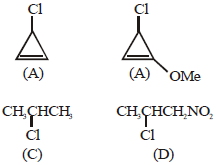
- 65. The decreasing order of reactivity of the following organic molecules towards \(AgNO\) \(_{3}\) solution is :
 2020 Medium
- (A) \(( A )>( B )>( D )>( C )\)
- (B) \(( A )>( B )>( C )>( D )\)
- (C) \((C)>(D)>(A)>(B)\)
- (D) \((B)>(A)>(C)>(D)\)
Show answer and solution
Correct Answer: (D)
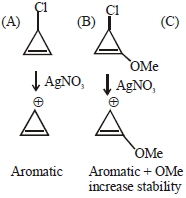
\((C)\) \(\begin{gathered} \begin{array}{*{20}{c}} {C{H_3} - CH - C{H_3}} \\ {|\,\,\,\,\,\,\,\,\,\,\,\,} \\ {Cl\,\,\,\,\,\,\,\,\,\,} \\ {\,\,\,\,\,\,\,\,\,\, \downarrow AgN{O_3}} \end{array} \hfill \\ \begin{array}{*{20}{c}} { \oplus \,\,\,\,} \\ {C{H_3} - CH - C{H_3}} \\ {({2^o}\,Cation)} \end{array} \hfill \\ \end{gathered} \)\((D)\) \(\begin{gathered} \begin{array}{*{20}{c}} {C{H_3} - CH - C{H_3}} \\ {|\,\,\,\,\,\,\,\,\,\,\,\,} \\ {Cl\,\,\,\,\,\,\,\,\,\,} \\ {\,\,\,\,\,\,\,\,\, \downarrow AgN{O_3}} \end{array} \hfill \\ \begin{array}{*{20}{c}} { \oplus \,\,\,\,\,\,\,\,\,\,\,\,\,\,\,\,\,\,\,\,} \\ {C{H_3} - CH - C{H_2} - N{O_2}} \\ {{2^o}\,Cation\,and\,\left( { - I\,of\,N{O_2}} \right)} \end{array} \hfill \\ \end{gathered}\)
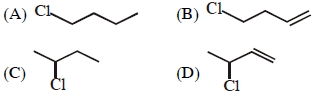
- 66. The decreasing order of reactivity towards dehydrohalogenation \((E_1)\) reaction of the following compounds is
 2020 Hard
- (A) \(B > D > A > C\)
- (B) \(B > D > C > A\)
- (C) \(D > B > C > A\)
- (D) \(B > A > D > C\)
Show answer and solution
Correct Answer: (C)
Reactivity \(D > B > C > A\) Carbocation formed from \(D\) is most stable Carbocation formed from \(A\) is least stable - 67. The major product formed in the following reaction is : \(CH _{3} CH = CHCH \left( CH _{3}\right)_{2} \stackrel{ HBr }{\longrightarrow}\) 2020 Medium
- (A) \(CH _{3} CH _{2} CH _{2} C ( Br )\left( CH _{3}\right)_{2}\)
- (B) \(Br \left( CH _{2}\right)_{3} CH \left( CH _{3}\right)_{2}\)
- (C) \(CH _{3} CH _{2} CH ( Br ) CH \left( CH _{3}\right)_{2}\)
- (D) \(CH _{3} CH ( Br ) CH _{2} CH \left( CH _{3}\right)_{2}\)
Show answer and solution
Correct Answer: (A)
\(CH _{3} CH = CHCH \\left( CH _{3}\\right)_{2} + H^{+} \longrightarrow CH _{3} CH _{2} \stackrel{+}{C} H CH \\left( CH _{3}\\right)_{2}\)
\(CH _{3} CH _{2} \stackrel{+}{C} H CH \\left( CH _{3}\\right)_{2} \stackrel{1,2-H\, shift}{\longrightarrow} CH _{3} CH _{2} CH _{2} \stackrel{+}{C} \\left( CH _{3}\\right)_{2}\)
\(CH _{3} CH _{2} CH _{2} \stackrel{+}{C} \\left( CH _{3}\\right)_{2} + Br^{-} \longrightarrow CH _{3} CH _{2} CH _{2} C ( Br )\\left( CH _{3}\\right)_{2}\)
- 68. Which of the following compounds will show retention in configuration on nucleophic substitution by \(OH ^{-}\) ion \(?\) 2020 Medium
- (A) \(\begin{array}{*{20}{c}} {C{H_3} - CH - C{H_2}Br} \\ {|\,\,\,\,\,\,\,\,\,\,\,\,} \\ {{C_2}{H_5}\,\,\,\,} \end{array}\)
- (B) \(\begin{array}{*{20}{c}} {C{H_3} - CH - Br} \\ {|\,\,\,} \\ {\,\,\,\,\,\,\,{C_6}{H_5}} \end{array}\)
- (C) \(\begin{array}{*{20}{c}} {C{H_3} - CH - Br} \\ {|\,\,\,} \\ {\,\,\,\,C{H_3}} \end{array}\)
- (D) \(\begin{array}{*{20}{c}} {\,\,\,\,\,\,Br} \\ {\,\,\,|\,} \\ {C{H_3} - C - H} \\ {\,\,\,|} \\ {\,\,\,\,\,\,\,\,\,\,\,\,\,\,\,{C_6}{H_{13}}} \end{array}\)
Show answer and solution
Correct Answer: (A)
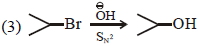
\((1)\)\(\begin{array}{*{20}{c}} { * \,\,\,\,\,\,\,\,\,\,\,\,\,\,\,\,\,\,\,\,\,\,\,\,\,\,\,\,\,\,\,} \\ {C{H_3} - CH - C{H_2} - Br\,\xrightarrow[{{S_{{N^2}}}}]{{\mathop O\limits^ \ominus H}}} \\ {|\,\,\,\,\,\,\,\,\,\,\,\,\,\,\,\,\,\,\,\,\,\,\,\,\,\,\,\,\,\,\,\,} \\ {Et\,\,\,\,\,\,\,\,\,\,\,\,\,\,\,\,\,\,\,\,\,\,\,\,\,\,\,\,\,} \end{array}\)\(\begin{array}{*{20}{c}} { * \,\,\,\,\,\,\,\,\,\,\,\,} \\ {C{H_3} - CH - C{H_2}OH} \\ {|\,\,\,\,\,\,\,\,\,\,\,\,\,\,} \\ {Et\,\,\,\,\,\,\,\,\,\,\,} \end{array}\)\((2)\)\(\begin{array}{*{20}{c}} {C{H_3} - CH - Br\,\xrightarrow[{{S_{{N^2}}}}]{{\mathop O\limits^ \ominus H}}} \\ {|\,\,\,\,\,\,\,\,\,\,\,\,\,\,\,\,\,\,\,} \\ {ph\,\,\,\,\,\,\,\,\,\,\,\,\,\,\,} \end{array}\)\(\begin{array}{*{20}{c}} {ph - CH - OH} \\ {|\,\,\,\,\,\,\,\,} \\ {C{H_3}} \end{array}\)
\((4)\)\(\begin{array}{*{20}{c}} {C{H_3} - CH - Br\,\xrightarrow[{{S_{{N^2}}}}]{{\mathop O\limits^ \ominus H}}} \\ {|\,\,\,\,\,\,\,\,\,\,\,\,\,\,\,\,\,\,\,} \\ {{C_6}{H_{13}\,\,\,\,\,\,}} \end{array}\)\(\begin{array}{*{20}{c}} {C{H_3} - CH - OH} \\ {|\,\,\,\,\,} \\ {\,\,\,\,{C_6}{H_3}} \end{array}\)
As language given, we have to go with option \((1)\) as stereochemistry of chiral centre is not distortet.
-
- (A) \(\mathrm{Mg}\) and \(\mathrm{Mg}_{3} \mathrm{N}_{2}\)
- (B) \(Na\) and \(\mathrm{NaNO}_{3}\)
- (C) \(\mathrm{Mg}\) and \(\mathrm{Mg}\left(\mathrm{NO}_{3}\right)_{2}\)
- (D) \(\mathrm{Na}\) and \(\mathrm{Na}_{3} \mathrm{N}\)
Show answer and solution
Correct Answer: (A)
\(3 \mathrm{Mg} (A)+\mathrm{N}_{2} \stackrel{\Delta}{\longrightarrow} \mathrm{Mg}_{3} \mathrm{N}_{2} (B)\stackrel{6H_2O}{\longrightarrow}\)\(3Mg(OH)_2+2NH_3 (colorless\; gas)\)\(\mathrm{CuSO}_{4}+4 \mathrm{NH}_{3} \rightarrow\left[\mathrm{Cu}\left(\mathrm{NH}_{3}\right)_{4}\right] \mathrm{SO}_{4}\) deep blue solution
-
- (A) \((d)\) and \((a)\)
- (B) \((a)\) and \((b)\)
- (C) \((b)\) and \((c)\)
- (D) \((c)\) and \((d)\)
Show answer and solution
Correct Answer: (D)
\(\left[\mathrm{Pt}\left(\mathrm{NH}_{3}\right)_{3} \mathrm{Cl}\right]^{+}\) and \(\left[\mathrm{Pt}\left(\mathrm{NH}_{3}\right) \mathrm{Cl}_{5}\right]^{-}\) does not show geometrical isomerism
-
- (A) \((a)\) and \((b)\) only
- (B) \((c)\) and \((d)\) only
- (C) \((b)\) and \((c)\) only
- (D) \((a)\) and \((d)\) only
Show answer and solution
Correct Answer: (D)
(c) Splitting power of ethylenediamine (en) is greater than fluoride (F) ligand therefore more energy absorbed by \(\left[\mathrm{Co}(\mathrm{en})_{3}\right]^{3+}\) as compared to \(\left[\mathrm{CoF}_{6}\right]^{3-}\)So wave length of light absorbed by \(\left[\mathrm{Co}(\mathrm{en})_{3}\right]^{3+}\) is lower than that of \(\left[\mathrm{CoF}_{6}\right]^{3-}\)
(d) \(\Delta_{t}=\frac{4}{9} \Delta_{0}\)
so if \(\Delta_{0}=18,000 \mathrm{cm}^{-1}\)
\(\Delta_{t}=\frac{4}{9} \times 18000=8000 \mathrm{cm}^{-1}\)
Statement (a) and (d) are incorrect.

-
- (A) \(\left[ Cr \left( H _{2} O \right)_{5} Cl \right] Cl _{2} \cdot H _{2} O\)
- (B) \(\left[ Cr \left( H _{2} O \right)_{3} Cl _{3}\right] \cdot 3 H _{2} O\)
- (C) \(\left[ Cr \left( H _{2} O \right)_{4} Cl _{2}\right] Cl \cdot 2 H _{2} O\)
- (D) \(\left[ Cr \left( H _{2} O \right)_{6}\right] Cl _{3}\)
Show answer and solution
Correct Answer: (C)
\(\%\) mass of water\(=\frac{x \times 18}{(12+6 \times 16+35 \times 3+52)} \times 100=13.5\)
\(\Rightarrow \quad x=\frac{265 \times 13.5}{18 \times 100} \simeq 2\)
-
- (A) Tetraaquadichlorido chromium \((III)\) chloride dihydrate
- (B) Hexaaqua chromium \((III)\) chloride
- (C) Dichloridotetraaqua chromium \((IV)\) chloride dihydrate
- (D) Tetraaquadichlorido chromium \((IV)\) chloride dihydrate
Show answer and solution
Correct Answer: (A)
\(\mathrm{Cr}\left(\mathrm{H}_{2} \mathrm{O}\right)_{6} \mathrm{Cl}_{\mathrm{n}}\)if magnetic mement is 3.83 BM then it contain three unpaired electrons. It means chromium in \(+3\) oxidation state so molecular formula is
\(\mathrm{Cr}\left(\mathrm{H}_{2} \mathrm{O}\right)_{6} \mathrm{Cl}_{3}\)
This formula have following isomers
(a) \(\left[\mathrm{Cr}\left(\mathrm{H}_{2} \mathrm{O}\right)_{6}\right] \mathrm{Cl}_{3}:\) react with \(\mathrm{AgNO}_{3}\) but does not show geometrical isomerism.
(b) \(\left[\mathrm{Cr}\left(\mathrm{H}_{2} \mathrm{O}\right)_{5} \mathrm{Cl}\right] \mathrm{Cl}_{2} \cdot \mathrm{H}_{2} \mathrm{O}\) react with \(\mathrm{AgNO}_{3}\) but does not show geometrical isomerism.
(c) \(\left[\mathrm{Cr}\left(\mathrm{H}_{2} \mathrm{O}\right)_{4} \mathrm{Cl}_{2}\right] \mathrm{Cl} .2 \mathrm{H}_{2} \mathrm{O}\) react with \(\mathrm{AgNO}_{3}\) and show geometrical isomerism.
(d) \(\left[\mathrm{Cr}\left(\mathrm{H}_{2} \mathrm{O}\right)_{3} \mathrm{Cl}_{3}\right] .3 \mathrm{H}_{2} \mathrm{O}\) does not react with \(\mathrm{AgNO}_{3}\) and show geometrical isomerism.
\(\left[\mathrm{Cr}\left(\mathrm{H}_{2} \mathrm{O}\right)_{4} \mathrm{Cl}_{2}\right] \mathrm{Cl} .2 \mathrm{H}_{2} \mathrm{O}\) react with \(\mathrm{AgNO}_{3}\) and show geometrical isomerism and it's IUPAC nomenclature is \(\quad\) Tetraaquadichlorido chromium (III) Chloride dihydrate.
-
- (A) tetrahedral and \(-1.6 \Delta_{ t }+1 P\)
- (B) tetrahedral and \(-0.6 \Delta_{ t }\)
- (C) octahedral and \(-1.6 \Delta_{0}\)
- (D) octahedral and \(-2.4 \Delta_{0}+2 P\)
Show answer and solution
Correct Answer: (B)
If spin only magnetic moment of the complex is \(4.90 BM ,\) it means number of unpaired electrons should be \(4.\)\((A)\) In octahedral complex: \(\left[ M \left( H _{2} O \right)_{6}\right]^{2+}\)
\(C.F.S.E.\) \(=\left(-0.4 \Delta_{0}\right) \times 4+\left(+0.6 \Delta_{0}\right) \times 2+0 \times P\)
\((B)\) In tetrahedral complex: \(\left[ M \left( H _{2} O \right)_{4}\right]^{2+}\)
\(C.F.S.E.\) \(=\left(-0.6 \Delta_{t}\right) \times 3+\left(+0.4 \Delta_{t}\right) \times 3+0 \times P\)
\(=-0.6 \Delta_{ t }\)

- 75. Considering that \(\Delta_{0}> P ,\) the magnetic moment (in \(BM\)) of \(\left[ Ru \left( H _{2} O \right)_{6}\right]^{2+}\) would be 2020 Medium
- (A) \(0\)
- (B) \(3\)
- (C) \(6\)
- (D) \(9\)
Show answer and solution
Correct Answer: (A)
Magnetic moment (in \(B.M.\)) of \(\left[ Ru \left( H _{2} O \right)_{6}\right]^{2+}\) would be; while considering that \(\Delta_{0}> P ,\)\(Ru _{(44)} ;[ Kr ] 4 d ^{7} 5 s ^{1}\) (in ground state)
\(\Rightarrow\) Here number of unpaired electrons in
\(Ru ^{2+}=\left( t _{2} g \right)^{6}( eg )^{0}=0\) and Hence
\(\mu_{ m }=\sqrt{ n ( n +2)} B \cdot M =0 \, B \cdot M\)

- 76. For a \(d ^{4}\) metal ion in an octahedral field, the correct electronic configuration is: 2020 Medium
- (A) \(t _{2 g }^{4} e _{ g }^{0}\) when \(\Delta_{ o }< P\)
- (B) \(e _{ g }^{2} t _{2 g }^{2}\) when \(\Delta_{ O }< P\)
- (C) \(t _{2 g }^{3} e _{ g }^{1}\) when \(\Delta_{ o }< P\)
- (D) \(t _{2 e }^{3} e _{ e }^{1}\) when \(\Delta_{ O }> P\)
Show answer and solution
Correct Answer: (C)
back pairing is not possible because pairing energy \(>\Delta_{0}\)
-
- (A) \(( I ),( III )\) and \(( IV )\) only
- (B) \(( II ),( III )\) and \(( IV )\) only
- (C) \(( I ),( II )\) and \(( III )\) only
- (D) \((I)\) and \((II)\) only
Show answer and solution
Correct Answer: (C)
\((I)\) Under weak field ligand, octahedral \(Mn(II)\) and tetrahedral \(Ni(II)\) both the complexes are high spin complex.\((II)\) Tetrahedral \(Ni(II)\) complex can very rarely be low spin because square planar (under strong ligand) complexes of \(Ni ( II )\) are low spin complexes.
\((III)\) With strong field ligands \(Mn (II)\) complexes can be low spin because they have less number of unpaired electron (unpaired electron \(=1\) )
While with weak field ligands \(Mn(II)\) complexes can be high spin because they have more number of unpaired electron (unpaired electron \(=5)\)
\((IV)\) Aqueous solution of \(Mn(II)\) ions is pink in colour.
-
- (A) \(2.84\; \mathrm{BM}\) and \(-1.6 \Delta_{0}\)
- (B) \(1.73\; \mathrm{BM}\) and \(-2.0 \Delta_{0}\)
- (C) \(0\; \mathrm{BM}\) and \(-2.4 \Delta_{0}\)
- (D) \(5.92\; \mathrm{BM}\) and \(0\)
Show answer and solution
Correct Answer: (B)
\([\mathrm{Pb}(\mathrm{F})(\mathrm{Cl})(\mathrm{Br})(\mathrm{I})]^{2-}\) have three geometrical isomer so formula for \(\left[\mathrm{Fe}(\mathrm{CN})_{6}\right]^{\mathrm{n}-6}\) is \(\left[\mathrm{Fe}(\mathrm{CN})_{6}\right]^{3-}\) and \(\mathrm{CFSE}\) for this complex is\(\mathrm{Fe}^{3+} \Rightarrow 3 \mathrm{d}^{5} 4 \mathrm{s}^{\circ}\)
\(\text { Magnetic Moment }=\sqrt{3}\)
\(=1.73 \mathrm{B.M}\)
\(\mathrm{CFSE}=[(-0.4 \times 5)+(0.6 \times 0)] \Delta_{0}\)
\(=-2.0 \Delta_{0}\)

-
- (A) \(A-(i i), B-(i), C-(i i i)\)
- (B) \(A-(i i i), B-(i), C-(i i)\)
- (C) \(A-(i 1), B-(i i), C-(i)\)
- (D) \(A-(i), B-(i i), C-(i i i)\)
Show answer and solution
Correct Answer: (B)
Strength of ligand \(F^{-}< NCS ^{-}< NH _{3}\)\(\Delta_{oh}\) order
\(\left[ MF _{6}\right]^{(-6+ n )} < [ M ( NCS )]^{(-6+ n )} < \quad\left[ M \left( NH _{3}\right)_{6}\right]^{ n ^{+}}\)
\(\Delta_{max}\) order
\(\left[ MF _{6}\right]^{(-6+ n )} > [ M ( NCS )]^{(-6+ n )} > \quad\left[ M \left( NH _{3}\right)_{6}\right]^{ n ^{+}}\)
As given in graph \(A < B < C\) \((\lambda_{max})\)
\(\therefore\) Correct matching is \(A -( iii ), B -( i ), C -( ii )\)
-
- (A) \(3,\) diamagnetic
- (B) \(2 \frac{1}{2},\) paramagnetic
- (C) \(3,\) paramagnetic
- (D) \(2 \frac{1}{2},\) diamagnetic
Show answer and solution
Correct Answer: (A)
According to \(MOT\) (If \(z\) is internuclear axis)The configuration of
\(\mathrm{CN}^{-}: \sigma_{1 \mathrm{s}}^{2}, \sigma_{1 \mathrm{s}}^{* 2}, \sigma_{2 \mathrm{s}}^{2}, \sigma_{2 \mathrm{s}}^{*2}, \pi_{2 \mathrm{p}_{\mathrm{x}}}^{2}=\pi_{2 \mathrm{p}_{\mathrm{y}}}^{2}, \sigma_{2 \mathrm{p}_{\mathrm{z}}}^{2}\)
Bond order \(=\frac{1}{2}(10-4)\)
\(=3\)
\(\mathrm{CN}^{-}\) is diamagnetic due to absence of unpaired electron
-
- (A) \(\left[\mathrm{Pt}\left(\mathrm{NH}_{3}\right)_{2} \mathrm{Cl}_{2}\right]\)
- (B) \(\left[\mathrm{Co}\left(\mathrm{NH}_{3}\right)_{4} \mathrm{Cl}_{2}\right]^{+}\)
- (C) \(\left[\mathrm{Co}\left(\mathrm{NH}_{3}\right)_{3}\left(\mathrm{NO}_{2}\right)_{3}\right]\)
- (D) \(\left[\mathrm{CoCl}_{2}(\mathrm{en})_{2}\right]\)
Show answer and solution
Correct Answer: (C)
\(\left[\mathrm{Ma}_{3} \mathrm{b}_{3}\right]\) type complex shows fac and mer isomerism.\(\left[\mathrm{Co}\left(\mathrm{NH}_{3}\right)_{3}\left(\mathrm{NO}_{2}\right)_{3}\right]\)

-
- (A) \((\mathrm{A}) \approx(\mathrm{C}) \approx(\mathrm{D}) < (\mathrm{B})\)
- (B) \((\mathrm{A}) \approx(\mathrm{C}) < (\mathrm{B}) \approx(\mathrm{D})\)
- (C) \((\mathrm{C}) < (\mathrm{D}) < (\mathrm{B}) < (\mathrm{A})\)
- (D) \((\mathrm{C}) \approx(\mathrm{D}) < (\mathrm{B}) < (\mathrm{A})\)
Show answer and solution
Correct Answer: (A)
\(\left[\mathrm{Ni}(\mathrm{CO})_{4}\right] \quad \mu_{\mathrm{m}}=0 \mathrm{B}. \mathrm{M}\)\({\left[\mathrm{Ni}\left(\mathrm{H}_{2} \mathrm{O}\right)_{6}\right] \mathrm{Cl}_{2}}\quad {\mu_{\mathrm{m}}=2.8 \mathrm{B} . \mathrm{M}}\)
\({\mathrm{Na}_{2}\left[\mathrm{Ni}(\mathrm{CN})_{4}\right]} \quad {\mu_{\mathrm{m}}=0 \mathrm{B.M}}\)
\(\left[\mathrm{PdCl}_{2}\left(\mathrm{PPh}_{3}\right)_{2}\right] \quad \mu_{\mathrm{m}}=0 \mathrm{B.M}\)
\((\mathrm{A}) \approx(\mathrm{C}) \approx(\mathrm{D}) < (\mathrm{B})\)
-
- (A) \((III) > (I) > (II) > (IV)\)
- (B) \((I) > (IV) > (III) > (II)\)
- (C) \((\mathrm{II}) \approx(\mathrm{I})>(\mathrm{IV})>(\mathrm{III})\)
- (D) \((\mathrm{III})>(\mathrm{I})>(\mathrm{IV})>(\mathrm{II})\)
Show answer and solution
Correct Answer: (B)
\((I)\;\;\left[\mathrm{Cr}\left(\mathrm{H}_{2} \mathrm{O}\right)_{6}\right]^{2+}\)\(\mathrm{Cr}^{+2} \Rightarrow[\mathrm{Ar}] 3 \mathrm{d}^{4}\)
\(\mathrm{H}_{2} \mathrm{O} \rightarrow\) Weak field ligand
\(\text { Unpaired } \mathrm{e}^{-}=4\)
\(\text { Magnetic moment } =\sqrt{24} \mathrm{BM} =4.89 \mathrm{BM}\)
\((II)\;\;\left[\mathrm{Fe}(\mathrm{CN})_{6}\right]^{4-}\)
\(\mathrm{Fe}^{+2} \Rightarrow[\mathrm{Ar}] 3 \mathrm{d}^{6}\)
\(\mathrm{CN}^{-} \rightarrow\) Strong field ligand
Unpaired \(\mathrm{e}^{-}=0\)
Magnetic moment \(=0 \mathrm{BM}\) \(=0 \mathrm{BM}\)
\(\mathrm{III}\;\;\left[\mathrm{Fe}\left(\mathrm{C}_{2} \mathrm{O}_{4}\right)_{3}\right]^{3-}\)
\(\mathrm{Fe}^{+3} \Rightarrow[\mathrm{Ar}] 3 \mathrm{d}^{5}\)
As \(\Delta_{0}>P\)
Unpaired \(\mathrm{e}^{-}=1\)
\(\text { Magnetic moment } =\sqrt{3} \mathrm{BM}\)\(=1.73 \mathrm{BM}\)
\((IV)\;\;\left(\mathrm{Et}_{4} \mathrm{N}\right)^{+}\left[\mathrm{CoCl}_{4}\right]^{2-}\)
\(\mathrm{Co}^{+2} \Rightarrow[\mathrm{Ar}] 3 \mathrm{d}^{7}\)
Unpaired electrons \(=3\)
\(\begin{aligned} \text { Magnetic moment } &=\sqrt{15} \mathrm{BM} \\ =3.87 \mathrm{BM} \end{aligned}\)
Hence order of magnetic moment is \(I>IV>III>II\)
-
- (A) \(-0.8 \Delta_{0}\)
- (B) \(-0.4 \Delta_{0}+ p\)
- (C) \(-0.8 \Delta_{0}+2 P\)
- (D) \(-0.4 \Delta_{0}\)
Show answer and solution
Correct Answer: (D)
\(\left[ CoF _{3}\left( H _{2} O \right)_{3}\right] \quad \Delta_{0}< P\)Means all ligands behaves as weak field ligands
\(=[-0.4 \times 4+0.6 \times 2] \Delta_{0}\)
\(=[-1.6+1.2] \Delta_{0}\)
\(=\left[-0.4 \Delta_{0}\right]\)

-
- (A) \(t _{2 g }^{4} e _{ g }^{2}\) and \(t _{2 g }^{6} e _{ g }^{0}\)
- (B) \(t_{2 g }^{6} e _{ g }^{0}\) and \(t _{2 g }^{6} e _{ g }^{0}\)
- (C) \(t_{2 g}^{6} e_{g}^{0}\) and \(t_{2 g}^{4} e_{g}^{2}\)
- (D) \(t _{2 g }^{4} e _{ g }^{2}\) and \(t _{2 g }^{4} e _{ g }^{2}\)
Show answer and solution
Correct Answer: (C)
\(\left[ Ru ( en )_{3}\right] Cl _{2} \quad R _{ u } \Rightarrow 4 d\) seriesen \(\Rightarrow\) chelating ligand
\(CN =6,\) octahedral splitting hence laye splitting of \(d-\)subshell
\(\left[ Fe \left( H _{2} O \right)_{6}\right] Cl _{2} \Rightarrow H _{2} O \Rightarrow\) Weak filled ligand
\(Fe ^{+2} \Rightarrow[ Ar ] 3 d ^{6} 4 s ^{0}\) less plitting
\(CN =6\) octahedral splitting

-
- (A) \(242.5\)
- (B) \(83.7\)
- (C) \(145.5\)
- (D) \(97\)
Show answer and solution
Correct Answer: (D)
\(CFSE =0.4 \Delta_{0}\)\(=0.4 \times \frac{20300}{83.7}\)
\(=97\, kJ / mol\)
-
- (A) meridional and trans
- (B) cis and trans
- (C) trans only
- (D) cis only
Show answer and solution
Correct Answer: (D)
\(\left.\mathrm{Co}\left(\mathrm{NH}_{3}\right)_{4} \mathrm{Cl}_{2}\right]\) has 2 geometrical isomerscis isomer has \(\mathrm{Cl}-\mathrm{Co}-\mathrm{Cl}\) angle of \(90^{\circ}\)

- 88. The number of isomers possible for \(\left[ Pt ( en )\left( NO _{2}\right)_{2}\right]\) is : 2020 Medium
- (A) \(3\)
- (B) \(2\)
- (C) \(1\)
- (D) \(4\)
Show answer and solution
Correct Answer: (A)
\(\left[ Pt ( en )\left( NO _{2}\right)_{2}\right] \Rightarrow\) does not show \(G.I.\) as well as optical isomerism.This complex will have three linkage isomers as follows
\(\left[ Pt ( en )\left( NO _{2}\right) 2\right] I\)
\(\left[ Pt ( en )\left( NO _{2}\right)( ONO )\right] II\)
\(\left[ Pt ( en )( ONO )_{2}\right] III\)

-
- (A) \(0\) and \(0\)
- (B) \(0\) and \(2\)
- (C) \(0\) and \(1\)
- (D) \(2\) and \(2\)
Show answer and solution
Correct Answer: (A)
If the complex \(MA_2B_2\) is \(sp^3\) hybridised then the shape of this complex is tetrahedral this structure is opticaly inactive due to the presence of plane of symmetry.Optical isomes \(= 0\)
If the complex \(MA_2B_2\) is \(dsp^2\) hybridised then the shape of this complex is square planar
Both isomers are optically inactive due to the presence of plane of symmetry.
Optical isomers \(= 0\)

- 90. The one that can exhibit highest paramagnetic behaviour among the following is :- gly \(=\) glycinato; bpy \(=2,2\) '-bipyridine 2020 Medium
- (A) \(\left[ Pd ( gly )_{2}\right]\)
- (B) \(\left[ Ti \left( NH _{3}\right)_{6}\right]^{3+}\)
- (C) \(\left[ Co ( OX )_{2}( OH )_{2}\right]^{-}\left(\Delta_{0}> P \right)\)
- (D) \(\left[ Fe ( en )( bpy )\left( NH _{3}\right)_{2}\right]^{2+}\)
Show answer and solution
Correct Answer: (C)
\(\left[ Co ( OX )_{2}( OH )_{2}\right]^{-}\) \(\Delta_{0}> P [\) S.F.L \(]\)It has highest number of unpaired \(e^{-}s.\) so it is most paramagnetic.

-
- (A) \(\left[ Ni \left( NH _{3}\right)_{4}\left( H _{2} O \right)_{2}\right]^{2+}\)
- (B) \(\left[ Ni \left( NH _{3}\right)_{2} Cl _{2}\right]\)
- (C) \(\left[ Pt \left( NH _{3}\right)_{2} Cl _{2}\right]\)
- (D) \(\left[ Ni ( en )_{3}\right]^{2+}\)
Show answer and solution
Correct Answer: (B)
\(\left[ Ni \left( NH _{3}\right)_{2} Cl _{2}\right]\) is tetrahedral complex, therefore does not show geometrical and optical isomerism.\(\left[ Ni \left( NH _{3}\right)_{2} Cl _{2}\right]\) does not show structural isomerism
\(\left[ Ni \left( NH _{3}\right)_{4}\left( H _{2} O \right)_{2}\right]^{2+} \&\left[ Pt \left( NH _{3}\right)_{2} Cl _{2}\right]\) show geometrical isomerism
\(\left[ Ni ( en )_{3}\right]^{2+}\) show optical isomerism
-
- (A) \(14\)
- (B) \(10\)
- (C) \(8\)
- (D) \(6\)
Show answer and solution
Correct Answer: (D)
\(\left( A \right)\,N{a_4}\left[ {\mathop F\limits^x e{{\left( {CN} \right)}_5}\left( {NOS} \right)} \right]\)\((+1) 4+x+(-1) 5+(-1) 1=0\)
\(x=+2\)
\(\left( B \right)\,N{a_4}\left[ {\mathop {Fe{O_4}}\limits^y } \right]\)
\((+1) 4+y+(-2) 4=0\)
\(y=+4\)
\(\left( C \right)\,\left[ {F\mathop {{e_2}}\limits^z {{\left( {CO} \right)}_9}} \right]\)
\(2 z+0 \times 9=0\)
\(z=0\)
so \(( x + y + z )=+2+4+0\)
\(=6\)
-
- (A) \(\left[\operatorname{Mn}\left( H _{2} O \right)_{6}\right]^{2+}\) and \(\left[ Cr \left( H _{2} O \right)\right]^{2+}\)
- (B) \(\left[ Cr \left( H _{2} O \right)_{6}\right]^{2+}\) and \(\left[ CoCl _{4}\right]^{2-}\)
- (C) \(\left[ Cr \left( H _{2} O \right)_{6}\right]^{2+}\) and \(\left[ Fe \left( H _{2} O \right)_{6}\right]^{2+}\)
- (D) \(\left[ Co ( OH )_{4}\right]^{2-}\) and \(\left[ Fe \left( NH _{3}\right)_{6}\right]^{2+}\)
Show answer and solution
Correct Answer: (C)
Thus complex \(\left[ Cr \left( H _{2} O \right)_{6}\right]^{2+}\) and \(\left[ Fe \left( H _{2} O \right)_{6}\right]^{2+}\) have same no. of unpaired \(e^-\) and hence same magnetic moment (spin only).
- 94. The theory that can completely/properly explain the nature of bonding in \([Ni(CO)_4]\) is 2020 Easy
- (A) Werner's theory
- (B) Crystal field theory
- (C) Valence bond theory
- (D) Molecular orbital theory
Show answer and solution
Correct Answer: (D)
In complex \([Ni(CO)_4]\) decrease in \(Ni-C\) bond length and increase in \(C-O\) bond length as well as it's magnetic property is explained by \(MOT.\) - 95. The total number of coordination sites in ethylenedi aminetetraacetate \((EDTA^ {4 -})\) is 2020 Medium
- (A) \(15\)
- (B) \(8\)
- (C) \(6\)
- (D) \(10\)
Show answer and solution
Correct Answer: (C)
\(EDTA^{4-}\) is hexadentate ligand, so its donation sites are six.
-
- (A) \(\mathrm{C}-\mathrm{I}>\mathrm{C}-\mathrm{Br}>\mathrm{C}-\mathrm{C} 1>\mathrm{C}-\mathrm{F}\)
- (B) \(\mathrm{C}-\mathrm{Br}>\mathrm{C}-\mathrm{I}>\mathrm{C}-\mathrm{C} 1>\mathrm{C}-\mathrm{F}\)
- (C) \(\mathrm{C}-\mathrm{F}>\mathrm{C}-\mathrm{C} 1>\mathrm{C}-\mathrm{Br}>\mathrm{C}-\mathrm{I}\)
- (D) \(\mathrm{C}-\mathrm{C} 1>\mathrm{C}-\mathrm{Br}>\mathrm{C}-\mathrm{I}>\mathrm{C}-\mathrm{F}\)
Show answer and solution
Correct Answer: (C)
Bond length order in carbon halogen bonds are in the order of \(\mathrm{C}-\mathrm{F} < \mathrm{C}-\mathrm{C} 1 < \mathrm{C}-\mathrm{Br} < \mathrm{C}-\mathrm{I}\)Hence, Bond energy order
\(\mathrm{C}-\mathrm{F}>\mathrm{C}-\mathrm{C} 1>\mathrm{C}-\mathrm{Br}>\mathrm{C}-\mathrm{I}\)
- 97. In a molecule of pyrophosphoric acid, the number of \(P - OH , P = O\) and \(P - O - P\) bonds \(/\) moiety(ies) respectivey are : 2020 Medium
- (A) \(3,3\) and \(3\)
- (B) \(2,4\) and \(1\)
- (C) \(4,2\) and \(0\)
- (D) \(4,2\) and \(1\)
Show answer and solution
Correct Answer: (D)
Pyrophosphoric acid.\(P - OH\) linkage \(s =4\)
\(P = O\) linkages \(=2\)
\(P - O - P\) linkages \(=1\)

-
- (A) \(\mathrm{NaClO}_{3}\) and \(\mathrm{Ca}(\mathrm{OCl})_{2}\)
- (B) \(\mathrm{NaOCl}\) and \(\mathrm{Ca}\left(\mathrm{ClO}_{3}\right)_{2}\)
- (C) \(\mathrm{NaClO}_{3}\) and \(\mathrm{Ca}\left(\mathrm{ClO}_{3}\right)_{2}\)
- (D) \(\mathrm{NaOCl}\) and \(\mathrm{Ca}(\mathrm{OCl})_{2}\)
Show answer and solution
Correct Answer: (A)
\(6 \mathrm{NaOH}+3 \mathrm{Cl}_{2} \rightarrow \mathrm{NaClO}_{3}+5 \mathrm{NaCl}+3 \mathrm{H}_{2} \mathrm{O}\)\((hot \;and \;conc.)\quad \quad (A)\quad \quad \quad side \;product\)
\(2 \mathrm{Ca}(\mathrm{OH})_{2}+2 \mathrm{Cl}_{2} \rightarrow \mathrm{Ca}(\mathrm{OCl})_{2}+\mathrm{CaCl}_{2}+2 \mathrm{H}_{2} \mathrm{O}\)
\((dry)\quad \quad \quad \quad \quad \quad \quad \quad (B)\quad \quad \quad side \;product\)
- 99. Kjeldahl's method cannot be used to estimate nitrogen for which of the following compounds? 2020 Hard
- (A) \(\mathrm{C}_{6} \mathrm{H}_{5} \mathrm{NO}_{2}\)
- (B) \(\mathrm{C}_{6} \mathrm{H}_{5} \mathrm{N} \mathrm{H}_{2}\)
- (C) \(\mathrm{CH}_{3} \mathrm{CH}_{2}-\mathrm{C}\equiv \mathrm{N}\)
- (D) \(\begin{array}{*{20}{c}}
O \\
{||} \\
{N{H_2} - C - N{H_2}}
\end{array}\)
Show answer and solution
Correct Answer: (A)
Kjeldahl's method for estimation of nitrogen is not applicable for nitrobenzene \(\mathrm{C}_{6} \mathrm{H}_{5} \mathrm{NO}_{2}\) because reaction with \(\mathrm{H}_{2} \mathrm{SO}_{4},\) nitrobenzene can not give ammonia. -
- (A) \(+5\)
- (B) \(+2\)
- (C) \(+4\)
- (D) \(+3\)
Show answer and solution
Correct Answer: (D)
\(Pb \left( NO _{3}\right)_{2} \stackrel{\Delta}{\longrightarrow} PbO +\underset{ Brown\, gas (A) }{2 NO _{2}}+\frac{1}{2} O _{2}( g )\)\(NO _{2}( g )\)\(\xrightarrow \Delta\) \(\begin{array}{*{20}{c}} {{N_2}{O_3}} \\ {\left( B \right)} \end{array}\)
\(N_2 O _{4}+ NO \stackrel{\Delta}{\longrightarrow}\)\(\begin{array}{*{20}{c}} {{N_2}{O_3}} \\ {Blue\,solid\,\left( C \right)} \end{array}\)
\(O.S.\) of nitrogen in \(N _{2} O _{3}\) is +3
\(N _{2} O _{3} 2 x +3(-2)=0\)
\(x=+3\)


No questions on this page match these filters.