


All JEE Mains 2020 Chemistry questions
25 chaptersShowing 151–200 of 204 questions
-
- (A) \(Cl-CH=CH-OCH_3\)
- (B) \(Cl-CH=CH-CH_3\)
- (C) \(Cl-CH=CH_2\)
- (D) \(Cl-CH=CH-NO_2\)
Show answer and solution
Correct Answer: (D)
Explanation:
Let us analyze the bond length of the given vinyl chloride derivatives step-by-step using electronic effects in organic chemistry:
1. Resonance in Vinylic Halides:
In all the given options, the chlorine atom is directly attached to an \(sp^2\) hybridized carbon atom belonging to a carbon-carbon double bond (\(C=C\)). The lone pairs of electrons on the chlorine atom can undergo delocalization with the adjacent pi-bond through resonance (mesomeric effect). This resonance introduces a partial double bond character into the \(C-Cl\) bond, making it shorter and stronger than a standard single bond.
2. Role of the Substituent Group:
The degree of partial double bond character depends heavily on the nature of the substituent group attached at the opposite end of the conjugated system.
Effect in Option D:
The nitro group (\(-NO_2\)) is a very strong electron-withdrawing group via the resonance (\(-M\)) effect. It pulls electron density away from the double bond, which strongly facilitates the push of electrons from the chlorine lone pair into the conjugated system.
Impact of Delocalization:
This extensive delocalization significantly enhances the stability and contribution of the resonating structure containing the \(C=Cl^+\) double bond.
3. Comparison:
Because the \(-M\) effect of the \(-NO_2\) group maximizes the double-bond character of the \(C-Cl\) linkage, it results in the greatest contraction of bond distance. In contrast, groups like \(-OCH_3\) (Option A) and \(-CH_3\) (Option B) are electron-donating and oppose this delocalization.
Therefore, \(Cl-CH=CH-NO_2\) has the shortest \(C-Cl\) bond length.
Hence, Option D is the correct choice.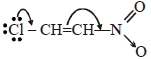
-
- (A) \(1.67\)
- (B) \(0.67\)
- (C) \(1.33\)
- (D) \(2.33\)
Show answer and solution
Correct Answer: (A)
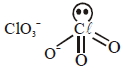
\(3 \mathrm{Cl}_{2}+6 \mathrm{NaOH} \rightarrow 5 \mathrm{NaCl}+\mathrm{NaClO}_{3}+3 \mathrm{H}_{2} \mathrm{O}\)\(\quad \quad \quad \quad \quad \quad \quad \quad (\mathrm{X})\quad \quad \quad(\mathrm{Y})\)
\(\mathrm{NaCl}+\mathrm{AgNO}_{3} \rightarrow \mathrm{AgCl} \downarrow+\mathrm{NaNO}_{3}\)
\((\mathrm{X})\)
Bond order of \(\mathrm{Cl}-\mathrm{O}\) Bond \(=1+\frac{2}{3}=\frac{5}{3}\)
\(=1.66\) or \(1.67\)
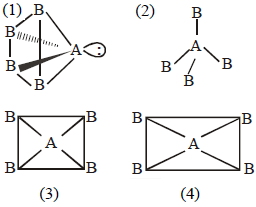
- 153. If \(AB _{4}\) molecule is a polar molecule, a possible geometry of \(AB _{4}\) is : 2020 Medium
- (A) Square pyramidal
- (B) Tetrahedral
- (C) Square planar
- (D) Rectangular planar
Show answer and solution
Correct Answer: (A)
\((1)\) If \(AB _{4}\) molecule is a square pyramidal then it has one lone pair and their structure should be and it should be polar because dipole moment of lone pair of \('A'\) never be cancelled by others.\((2)\) If \(AB _{4}\) molecule is a tetrahedral then it has no lone pair and their structure should be and it should be non polar due to perfect symmetry.
\((3)\) If \(AB _{4}\), molecule is a square planar then it should be non polar because vector sum of dipole moment is zero.
\((4)\) If \(AB _{4}\) molecule is a rectangular planar then it should be non polar because vector sum of dipole moment is zero.
-
- (A) \(\mathrm{O}_{2}^{-}\) or \(\mathrm{O}_{2}^{+}\)
- (B) \(\mathrm{O}_{2}\) or \(\mathrm{O}_{2}^{+}\)
- (C) \(\mathrm{O}_{2}\) or \(\mathrm{O}_{2}^{-}\)
- (D) \(\mathrm{O}_{2}, \mathrm{O}_{2}^{-}\) or \(\mathrm{O}_{2}^{+}\)
Show answer and solution
Correct Answer: (A)
\(\begin{array}{|c|c|c|} \hline & \text { unpaired electron } & \text { magnetic moment } \\ \hline O _{2}^{\oplus} & 1 & 1.73 B . M \\ \hline O _{2}^{\ominus} & 1 & 1.73 B . M \\ \hline O _{2} & 2 & 2.83 B.M \\ \hline \end{array}\) - 155. Of the species, \(NO , NO ^{+}, NO ^{2+}, NO ^{-},\) the one with minimum bond strength is : 2020 Hard
- (A) \(NO ^{2+}\)
- (B) \(NO ^{+}\)
- (C) \(NO\)
- (D) \(NO ^{-}\)
Show answer and solution
Correct Answer: (D)
Bond order of \(NO ^{2+}=2.5\)Bond order of \(NO ^{+}=3\)
Bond order of \(NO =2.5\)
Bond order of \(NO ^{-}=2\)
Bond order \(\alpha\) bond strength.
- 156. The molecular geometry of \(S\,F _{6}\) is octahedral. What is the geometry of \(S\,F _{4}\) (including lone pair(s) of electrons, if any)? 2020 Medium
- (A) Trigonal bipyramidal
- (B) Square planar
- (C) Tetrahedral
- (D) Pyramidal
Show answer and solution
Correct Answer: (A)
\(4 \sigma\) bonds \(+1\) lone pairShape (including lone pair of electrons) is Trigonal bipyramidal

- 157. The molecule in which hybrid \(MOs\) involve only one \(d-\)orbital of the central atom is 2020 Hard
- (A) \(\left[ Ni ( CN )_{4}\right]^{2-}\)
- (B) \(\left[ CrF _{6}\right]^{3-}\)
- (C) \(BrF _{5}\)
- (D) \(XeF _{4}\)
Show answer and solution
Correct Answer: (A)
\(\left[ Ni ( CN )_{4}\right]^{2-}\)\(dsp\)\(^{2}\) hybridisation.
-
- (A) hydrogen bonding and London dispersion
- (B) Dipole-dipole and hydrogen bonding
- (C) London dispersion and dipole-dipole
- (D) London dispersion, dipole-dipole and hydrogen bonding
Show answer and solution
Correct Answer: (C)
Ethyl acetate is polar molecule. Hence there will be dipole-dipole
attraction and london dispersion forces are present. -
- (A) \(\underline{N}{H }_{3} \stackrel{ H ^{+}}{\longrightarrow}\)
- (B) \(\underline {Xe}F _{4}+ SbF _{5} \rightarrow\)
- (C) \(H _{2} \underline SO _{4}+ NaCl \xrightarrow{{420\,\,K}}\)
- (D) \(H _{3} \underline PO _{2} \xrightarrow{{ Disproportionation }}\)
Show answer and solution
Correct Answer: (B)
\(XeF _{4}+ SbF _{5} \rightarrow\left[ XeF _{3}\right]^{+}\left[ SbF _{6}\right]^{-}\)\(sp ^{3} d ^{2}\,\,\,\,\, sp ^{3} d\,\,\, \quad sp ^{3} d\,\,\,\,\, \quad sp ^{3} d ^{2}\)
-
- (A) ion-dipole > ion-ion > dipole-dipole
- (B) dipole-dipole > ion-dipole > ion-ion
- (C) ion-dipole > dipole-dipole > ion-ion
- (D) ion-ion > ion-dipole > dipole-dipole
Show answer and solution
Correct Answer: (D)
Interionic\(/\) Intermolecular forces \(\propto\) charge on the speciesIons are charged species whereas dipoles are partially charged.
\(\therefore\) Ion-Ion \(\,>\,\) Ion-dipole \(\,>\,\) dipole-dipole
Hence, option \(d\) is correct.
-
- (A) \(( I ),( II )\) and \(( IV )\)
- (B) \(( II ),( III )\) and \(( IV )\)
- (C) \((I), (II)\) and \((III)\)
- (D) \((I), (III)\) and \((IV)\)
Show answer and solution
Correct Answer: (C)
\(I , A _{ N }: Be < Mg\)\(II\, IE : Be > Al\)
\(III\) Charge/radius ratio of \(Be\) \(w\) less than that of \(Al\)
\(IV\) \(Be\), \(Al\) mainly form covalent compounds
-
- (A) \((I), (II)\) and \((III)\)
- (B) \((II), (III)\) and \((IV)\)
- (C) \((I), (III)\) and \((IV)\)
- (D) \((I), (II)\) and \((IV)\)
Show answer and solution
Correct Answer: (A)
\(\mathrm{Be} \Rightarrow 1 \mathrm{s}^{2} 2 \mathrm{s}^{2}\)\(\mathrm{B} \Rightarrow 1 \mathrm{s}^{2} 2 \mathrm{s}^{2} 2 \mathrm{p}^{1}\)
\(\mathrm{B}\) has a smaller size than \(Be\)
it is easier to remove \(2 \mathrm{p}\) electron than \(2 \mathrm{s}\)
electron due to less pentration effect of \(2 \mathrm{p}\) than \(2 \mathrm{s}\)
\(2 \mathrm{p}\) electron of Boron is more shielded from the nucleus by the inner core of electron than the \(2 \mathrm{s}\) electron of \(\mathrm{Be}\)
\(B\) has a smaller size than \(Be\)
- 163. In general, the property (magnitudes only) that shows an opposite trend in comparison to other properties across a period is 2020 Medium
- (A) Electronegativity
- (B) Electron gain enthalpy
- (C) Ionization enthalpy
- (D) Atomic radius
Show answer and solution
Correct Answer: (D)
In general across a period atomic radius decreases while ionisation enthalpy, electron gain enthalpy and electronegativity increases because effective nuclear charge \(\left(Z_{\text {eff }}\right)\) increases. -
- (A) \(\mathrm{MgO}, \mathrm{Cl}_{2} \mathrm{O}, \mathrm{Al}_{2} \mathrm{O}_{3}\)
- (B) \(\mathrm{Cl}_{2} \mathrm{O}, \mathrm{CaO}, \mathrm{P}_{4} \mathrm{O}_{10}\)
- (C) \(\mathrm{Na}_{2} \mathrm{O}, \mathrm{SO}_{3}, \mathrm{Al}_{2} \mathrm{O}_{3}\)
- (D) \(\mathrm{N}_{2} \mathrm{O}_{3}, \mathrm{Li}_{2} \mathrm{O}, \mathrm{Al}_{2} \mathrm{O}_{3}\)
Show answer and solution
Correct Answer: (D)
1. \(MgO\) Basic\(\mathrm{Cl}_{2} \mathrm{O}\) Acidic
\(\mathrm{Al}_{2} \mathrm{O}_{3}\) amphoteric
2. \(\mathrm{Cl}_{2} \mathrm{O}\) Acidic
\(\mathrm{CaO}\) Basic
\(\mathrm{P}_{4} \mathrm{O}_{10}\) Acidic
3. \(\mathrm{Na}_{2} \mathrm{O}\) Basic
\(\mathrm{SO}_{3}\) Acidic
\(\mathrm{Al}_{2} \mathrm{O}_{3}\) amphoteric
4. \(\mathrm{N}_{2} \mathrm{O}_{3}\) Acidic
\(\mathrm{Li}_{2} \mathrm{O}\) Basic
\(\mathrm{Al}_{2} \mathrm{O}_{3}\) amphoteric
-
- (A) \(119\)
- (B) \(108\)
- (C) \(102\)
- (D) \(109\)
Show answer and solution
Correct Answer: (D)
Explanation:
According to the IUPAC systematic nomenclature for elements with atomic numbers \( Z > 100 \), the name is derived directly from the numerical roots of the constituent digits of the atomic number:
- \( 1 = \text{un} \)
- \( 0 = \text{nil} \)
- \( 9 = \text{enn} \)
Combining these roots sequentially along with the standard suffix "-ium", we get:
\( \text{un} + \text{nil} + \text{enn} + \text{ium} = \text{unnilennium} \)
Therefore, the atomic number corresponding to the name unnilennium is \( 109 \).
Hence, Option D is the correct choice. -
- (A) \(101\)
- (B) \(95\)
- (C) \(98\)
- (D) \(106\)
Show answer and solution
Correct Answer: (A)
Explanation:
According to the IUPAC systematic nomenclature rules for elements with atomic numbers greater than 100, the name is derived directly from the numerical roots of the digits composing the atomic number:
1. Numerical Roots for Digits:
- 1 = un
- 0 = nil
- 1 = un
2. Assembling the Name:
The systematic name is formed by combining these roots in sequence and appending the suffix "-ium" at the end:
\( \text{un} + \text{nil} + \text{un} + \text{ium} = \text{Unnilunium} \)
3. Identification:
The digits 1, 0, and 1 construct the atomic number 101 (Mendelevium). Note that atomic number 100 uses the digits 1, 0, 0 and is systematically named Unnilnilium (\( \text{un} + \text{nil} + \text{nil} + \text{ium} \)). Therefore, the question and the original answer key are completely correct.
Hence, Option A is the correct choice. - 167. The correct order of the ionic radii of \(O ^{2-}, N ^{3-}, F ^{-}, Mg ^{2+}, Na ^{+}\) and \(Al ^{3+}\) is 2020 Hard
- (A) \(Al ^{3+}< Na ^{+}< Mg ^{2+}< O ^{2-}< F ^{-}< N ^{3-}\)
- (B) \(N ^{3-}< O ^{2-}< F ^{-}< Na ^{+}< Mg ^{2+}< Al ^{3+}\)
- (C) \(Al ^{3+}< Mg ^{2+}< Na ^{+}< F ^{-}< O ^{2-}< N ^{3-}\)
- (D) \(N ^{3-}< F ^{-}< O ^{2-}< Mg ^{2+}< Na ^{+}< Al ^{3+}\)
Show answer and solution
Correct Answer: (C)
Correct order of size for isoelectronic species.\(Al ^{3+}< Mg ^{2+}< Na ^{+}< F ^{-}< O ^{2-}< N ^{3-}\)
- 168. The first ionization energy (in \(\mathrm{kJ} / \mathrm{mol}\) ) of \(Na, \;\mathrm{Mg}, \mathrm{Al}\) and \(Si\) respectively, are 2020 Medium
- (A) \(496,737,577,786\)
- (B) \(786,737,577,496\)
- (C) \(496,577,737,786\)
- (D) \(496,577,786,737\)
Show answer and solution
Correct Answer: (A)
Elecronic configuration of \(\mathrm{Na}=[\mathrm{Ne}] 3 \mathrm{s}^{1}\)\({\mathrm{Mg}=[\mathrm{Ne}] 3 \mathrm{s}^{2}}\)
\({\mathrm{Al}=[\mathrm{Ne}] 3 \mathrm{s}^{2} 3 \mathrm{p}^{1}}\)
So order of first ionisation energy is
\(\mathrm{Na}(496)<\mathrm{Mg}(737)>\mathrm{Al}(577)<\text { Si }{(786)}\)
\(\mathrm{Na}<\mathrm{Al}<\mathrm{Mg}<\mathrm{Si}\left(\mathrm{IE}_{1} \text { order }\right)\)
-
- (A) \(2\)
- (B) \(3\)
- (C) \(4\)
- (D) \(5\)
Show answer and solution
Correct Answer: (B)
Let suppose element \(X \Rightarrow\)\({X_{\left( g \right)}}\xrightarrow[{800}]{{I{E_1}}}X\mathop {\left( g \right)}\limits^ + \xrightarrow[{2427}]{{I{E_2}}}X(\mathop {g)}\limits^{ + 2} \xrightarrow[{3658}]{{I{E_3}}}\)
\(x\mathop {\left( g \right)\xrightarrow[{25024}]{{I{E_4}}}}\limits^{ + 3\,\,\,\,\,\,\,\,\,\,\,\,\,\,\,} X(\mathop g\limits^{ + 4} )\xrightarrow[{32824}]{{I{E_5}}}X(\mathop g\limits^{ + 5} )\)
\(X ^{+3}\) has stable inert gas configuration as there is high jump after \(IE\)\(_{3}\)
So valence electrons are \(3\)
- 170. The increasing order of the atomic radii of the following elements is \((a)\; C \;\;(b)\; O \;\;(c)\; F\;\; (d) \;Cl\;\; (e)\; Br\) 2020 Hard
- (A) \((b) < (c) < (d) < (a) < (e)\)
- (B) \((a) < (b) < (c) < (d) < (e)\)
- (C) \((d) < (c) < (b) < (a) < (e)\)
- (D) \((c) < (b) < (a) < (d) < (e)\)
Show answer and solution
Correct Answer: (D)
If the given elements are arranged according to their position in periodic table Atomic radius\(C > O > F < Cl < Br\)
\(Br > Cl > C > O > F\)
-
- (A) \(F ^{-}> O ^{2-}> Na ^{+}> Mg ^{2+}\)
- (B) \(Mg ^{2+}> Na ^{+}> F ^{-}> O ^{2-}\)
- (C) \(O ^{2-}> F ^{-}> Mg ^{2+}> Na ^{+}\)
- (D) \(O ^{2-}> F ^{-}> Na ^{+}> Mg ^{2+}\)
Show answer and solution
Correct Answer: (D)
\(O ^{-2}\) \(F ^{-}\) \(Na ^{+}\) \(Mg ^{2+}\) \(Z\) \(8\) \(9\) \(11\) \(12\) \(e^{-}\) \(10\) \(10\) \(10\) \(10\) \(\frac{z}{e}\) \(0.8\) \(0.9\) \(1.1\) \(1.2\) as \(\frac{z}{e}\) ratio increases size decreases.
Thus correct ionic radiit order is \(O ^{-2}> F ^{-}> Na ^{+}> Mg ^{2+}\)
Therefore correct option is \((4)\)
-
- (A) \(Fe\)
- (B) \(Ni\)
- (C) \(Co\)
- (D) \(Mn\)
Show answer and solution
Correct Answer: (A)
Electronic configuration of\(\quad \quad \quad \quad _{25} \mathrm{Mn} \quad \quad \quad _{26} \mathrm{Fe} \quad \quad \quad _{27} \mathrm{Co} \quad \quad \quad \quad _{28}Ni\)
\(\mathrm{M}= \quad [\mathrm{Ar}] 3 \mathrm{d}^{3} 4 \mathrm{s}^{2} \quad[\mathrm{Ar}] 3 \mathrm{d}^{6} 4 \mathrm{s}^{2} \quad[\mathrm{Ar}] 3 \mathrm{d}^{7} 4 \mathrm{s}^{2} \quad[\mathrm{Ar}] 3 \mathrm{d}^{2} 4 \mathrm{s}^{2}\)
\(\mathrm{M}^{2+}=[\mathrm{Ar}] 3 \mathrm{d}^{3} 4 \mathrm{s}^{0} \quad[\mathrm{Ar}] 3 \mathrm{d}^{6} 4 \mathrm{s}^{0} \quad[\mathrm{Ar}] 3 \mathrm{d}^{7} 4 \mathrm{s}^{0} \quad[\mathrm{Ar}] 3 \mathrm{d}^{2} 4 \mathrm{s}^{6}\)
So third ionisation energy is minimum for \(Fe\)
-
- (A) \(Z < Y < X\)
- (B) \(X < Z < Y\)
- (C) \(X < Y < Z\)
- (D) \(Y < X < Z\)
Show answer and solution
Correct Answer: (C)
When we are moving from left to right in a periodic table acidic character of oxides increases (as well as atomic number of atom increases)\(X < Y < Z\)
\(X < Y < Z \quad \text { (atomic number) }\)
-
- (A) \((a)\) towards reactant, \((b)\) no change
- (B) \((a)\) towards product, \((b)\) towards reactant
- (C) \((a)\) towards product, \((b)\) no change
- (D) \((a)\) towards reactant, \((b)\) towards product
Show answer and solution
Correct Answer: (A)
\(\Delta H ^{\circ}>0 \quad T \downarrow\) equation shifts back ward.\(N _{2}\) is treated as inert gas in this case hence no effect on equilibrium.
-
- (A) \(18\)
- (B) \(20\)
- (C) \(16\)
- (D) \(22\)
Show answer and solution
Correct Answer: (C)
\(\quad\quad \quad x\quad +\quad Y\quad =\quad 2 Z\)\(t=0 \quad 1 \quad 1.5 \quad 0.5\)
\(At\,eq. \quad 0.75\quad 1.25 \quad 1\)
\(K_{e q .}=\frac{1^{2}}{\frac{3}{4} \times \frac{5}{4}}=\frac{16}{15}\)
- 176. For the reaction : \(Fe _{2} N ( s )+\frac{3}{2} H _{2}( g ) \rightleftharpoons 2 Fe ( s )+ NH _{3}( g )\) 2020 Hard
- (A) \(K _{ C }= K _{ P }( RT )\)
- (B) \(K _{ C }= K _{ P }( RT )^{-1 / 2}\)
- (C) \(K _{ C }= K _{ P }( RT )^{-3 / 2}\)
- (D) \(K _{ C }= K _{ P }( RT )^{1 / 2}\)
Show answer and solution
Correct Answer: (D)
\(Fe _{2} N ( s )+\frac{3}{2} H _{2}( g ) \rightleftharpoons 2 Fe ( s )+ NH _{3}( g )\)\(\Delta n _{9}=1-\frac{3}{2}=\frac{-1}{2}\)
\(\frac{ K _{ p }}{ K _{ c }}=( RT )^{\Delta n_g}=( RT )^{-1 / 2}\)
\(K _{ c }=\frac{ K _{ p }}{( RT )^{-1 / 2}}= K _{ p ^{\prime}}( RT )^{1 / 2}\)
-
- (A) \(K _{ eq }^{(2)}- K _{ eq }^{(1)}\)
- (B) \(K _{ eq }^{(1)} K _{ eq }^{(2)}\)
- (C) \(K _{ eq }^{(1)} / K _{ eq }^{(2)}\)
- (D) \(K _{ eq }^{(1)}+ K _{ eq }^{(2)}\)
Show answer and solution
Correct Answer: (B)
\(A \rightleftharpoons B+C \quad K_{e q}^{(1)}=\frac{[B][C]}{[A]}\)\(.....(1)\)\(B + C \rightleftharpoons P \quad K _{ eq }^{(2)}=\frac{[ P ]}{[ B ][ C ]}\)\(.....(2)\)
For
\(A \rightleftharpoons P \quad K_{e q}=\frac{[P]}{[A]}\)
Multiplying equation \((1)\) \(\&\) \((2)\)
\(K _{ eq }^{( l )} \times K _{ eq }^{(2)}=\frac{[ P ]}{[ A ]}= K _{ eq }\)
-
- (A) \(\mathrm{Q} < \mathrm{K}_{\mathrm{sp}}\)
- (B) \(\mathrm{Q} > \mathrm{K}_{\mathrm{sp}}\)
- (C) \(\mathrm{Q} = \mathrm{K}_{\mathrm{sp}}\)
- (D) Not enough data provided
Show answer and solution
Correct Answer: (B)
\(\left[\mathrm{Pb}^{2+}\right] =\frac{300 \times 0.134}{400}\)\(=1.005 \times 10^{-1} \mathrm{M}\)
\(\left[\mathrm{C}^{-}\right] =\frac{100 \times 0.4}{400}\)
\(=10^{-1} \mathrm{M}\)
\(\mathrm{PbCl}_{2(3)} \rightleftharpoons \mathrm{Pb}_{(a q)}^{+2}+2 \mathrm{Cl}_{(aq.)^{2}}^{+2}\)
\(\mathrm{Q}=\left[\mathrm{Pb}^{2+}\right] \times\left[\mathrm{Cl}^{-}\right]^{2}\)
\(=1.005 \times 10^{-3} > \mathrm{k}_{\mathrm{sp}}\)
-
- (A) \(\frac{1}{4}\)
- (B) \(\frac{1}{8}\)
- (C) \(8\)
- (D) \(\frac{1}{64}\)
Show answer and solution
Correct Answer: (B)
\(N _{2}+3 H _{2} \rightleftharpoons 2 NH _{3} \rightarrow K _{ C }=64\)\(2 NH _{3} \rightleftharpoons N _{2}+3 H _{2} \rightarrow K _{ C }=\frac{1}{64}\)
\(NH _{3} \rightleftharpoons \frac{1}{2} N _{2}+\frac{3}{2} H _{2} \rightarrow K _{ C }=\left(\frac{1}{64}\right)^{\frac{1}{2}}=\frac{1}{8}\)
-
- (A) all the atoms of a given element have identical properties including identical mass. Atoms of different elements differ in mass
- (B) chemical reactions involve reorganisation of atoms. These are neither created nor destroyed in a chemical reaction.
- (C) when gases combine or reproduced in a chemical reaction they do so in a simple ratio by volume provided all gases are at the same \(T\) and \(P.\)
- (D) matter consists of indivisible atoms.
Show answer and solution
Correct Answer: (C)
according to Gaylussac's law of volume combination when gases combine or reproduced in a chemical reaction they do so in a simple ratio by volume provided all gases are at the same \(T\) and \(P.\) -
- (A) \(6\)
- (B) \(8\)
- (C) \(10\)
- (D) \(12\)
Show answer and solution
Correct Answer: (A)
\(\Delta G ^{\circ}=- AFE ^{\circ}=-3 \times 96500 \times E ^{\circ}\)\(\Rightarrow E ^{\circ}=-6 \times 10^{-2} V\)
-
- (A) \(7.25\)
- (B) \(6.75\)
- (C) \(7\)
- (D) \(6.25\)
Show answer and solution
Correct Answer: (D)
For ideal gas:\(\Delta \mathrm{U}=\mathrm{nC}_{\mathrm{V}}\left[\mathrm{T}_{2}-\mathrm{T}_{1}\right]\)
\(\Rightarrow \quad 5000=4 \times \mathrm{C}_{\mathrm{V}}[500-300]\)
\(\Rightarrow \quad \mathrm{C}_{\mathrm{v}}=\frac{5000}{800}=6.25 \mathrm{J}\) \(mole\) \(^{-1} \mathrm{K}^{-1}\)
- 183. Five moles of an ideal gas at \(1\) bar and \(298\, K\) is expanded into vacuum to double the volume. The work done is :- 2020 Medium
- (A) \(C _{ V }\left( T _{2}- T _{1}\right)\)
- (B) \(- RT \ln V _{2} / V _{1}\)
- (C) \(- RT \left( V _{2}- V _{1}\right)\)
- (D) zero
Show answer and solution
Correct Answer: (D)
As the expansion is done in vaccum that is in absence of \(p _{\text {ext }}\) so\(W=\) zero
-
- (A) \(13536.6\)
- (B) \(-13537.6\)
- (C) \(-13535.5\)
- (D) \(13530.2\)
Show answer and solution
Correct Answer: (B)
\(\Delta G^{\circ}=\Delta H^{\circ}-T \Delta S^{\circ}\)\(=\left(\Delta U^{\circ}+\Delta n_{g} R T\right)-T \Delta S^{\circ}\)
\(\left.=\left[\{-20+(-1)) \frac{8.314}{1000} \times 298\right\}-\frac{298}{1000} \times(-30)\right] k J\)
\(=-13.537572 kJ\)
\(=-13537.57\) Joule
-
- (A) \(-1.3\)
- (B) \(-2.7\)
- (C) \(-3.7\)
- (D) \(-4.2\)
Show answer and solution
Correct Answer: (B)
\(\mathrm{A}(\ell) \longrightarrow 2 \mathrm{B}(\mathrm{g})\)\(\Delta \mathrm{U}=2.1 \mathrm{Kcal}, \Delta \mathrm{S}=20 \mathrm{cal} \mathrm{K}^{-1}\) at \(300 \mathrm{K}\)
\(\Delta \mathrm{H}=\Delta \mathrm{U}+\Delta \mathrm{n}_{\mathrm{g}} \mathrm{RT}\)
\(\Delta \mathrm{G}=\Delta \mathrm{H}-\mathrm{T} \Delta \mathrm{S}\)
\(\Delta \mathrm{G}=\Delta \mathrm{U}+\Delta \mathrm{n}_{\mathrm{g}} \mathrm{RT}-\mathrm{T} \Delta \mathrm{S}\)
\(=2.1+\frac{2 \times 2 \times 300}{1000}-\frac{300 \times 20}{1000}\)
\(\left(\mathrm{R}=2 \mathrm{cal} \mathrm{K}^{-1} \mathrm{mol}^{-1}\right)\)
\(=2.1+1.2-6=-2.70 \mathrm{Kcal} / \mathrm{mol}\)
-
- (A) is \(x = y\)
- (B) is \(x < y\)
- (C) does not exist
- (D) is \(x > y\)
Show answer and solution
Correct Answer: (D)
Enthalpy of atomisation of \(\mathrm{Br}_{2}(l)\)\(\mathrm{Br}_{2}(l) \stackrel{\Delta \mathrm{H}_{\mathrm{vap}}}{\longrightarrow} \mathrm{Br}_{2}(\mathrm{g}) \stackrel{\Delta \mathrm{H}_{\mathrm{BE}}}{\longrightarrow} 2 \mathrm{Br}(\underline{\mathrm{g}})\)
\(\Delta \mathrm{H}_{\mathrm{atom}}=\Delta \mathrm{H}_{\mathrm{vap}}+\Delta \mathrm{H}_{\mathrm{BE}}\)
\(\mathrm{x}=\Delta \mathrm{H}_{\mathrm{vap}}+\mathrm{y}\)
So, \(x>y\)
-
- (A) \(-780\)
- (B) \(-784\)
- (C) \(780\)
- (D) \(784\)
Show answer and solution
Correct Answer: (B)
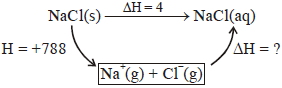
\(4=788+\Delta H\)\(\Delta H =-784 kJ\)
-
- (A) \(326400\)
- (B) \(312400\)
- (C) \(322425\)
- (D) \(322500\)
Show answer and solution
Correct Answer: (A)
\(C _{2} H _{5} OH _{(\ell)}+3 O _{2( g )} \longrightarrow 2 CO _{2( g )}+3 H _{2} O _{(\ell)}\)\(\Delta n _{ g }=2-3=-1\)
\(\Delta_{ C } H =\Delta_{ c } U +\left(\Delta n _{ g }\right) RT\)
\(\Delta_{ c } H =\Delta_{ c } U - RT\)
\(\Delta_{ c } U =\Delta_{ c } H + RT\)
\(=-327 \times 10^{3}+2 \times 300\)
\(=-326400 cal\)
: Heat evolved
\(=326400 cal\)
-
- (A) \(189494\)
- (B) \(189480\)
- (C) \(189989\)
- (D) \(189950\)
Show answer and solution
Correct Answer: (A)
\(H _{2} O (\ell) \rightleftharpoons H _{2} O ( g ) \quad 90 gm\) of \(H _{2} O\)\(\Delta H =\Delta U +\Delta n _{ g } RT \quad \Rightarrow 5\) moles of \(H _{2} O\)
\(5 \times 41000 J =\Delta U +1 \times 8.314 \times 373 \times 5\)
\(\Delta U =189494.39\) Joule
-
- (A) \(40\)
- (B) \(48\)
- (C) \(45\)
- (D) \(96\)
Show answer and solution
Correct Answer: (B)
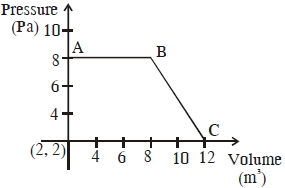
Area enclosed under\(P V\) curve \(= 48\)
\(= 48\; Joule\)
-
- (A) \(Ar _{( g )}+ e ^{-} \rightarrow Ar _{( g )}^{-}\)
- (B) \(H _{( g )}+ e ^{-} \rightarrow H _{( g )}^{-}\)
- (C) \(Na _{( g )} \rightarrow Na _{( g )}^{+}+ e ^{-}\)
- (D) \(O _{( g )}^{-}+ e ^{-} \rightarrow O _{( g )}^{2-}\)
Show answer and solution
Correct Answer: (B)
\(H _{( g )}+ e ^{-} \rightarrow H ^{-} \quad\) is exothermic rest of all endothermic process. -
- (A) \(-172.5\)
- (B) \(-192.5\)
- (C) \(-202.5\)
- (D) \(-162\)
Show answer and solution
Correct Answer: (B)
\(2 \mathrm{C}(\text { graphite })+3 \mathrm{H}_{2}(\mathrm{g}) \longrightarrow \mathrm{C}_{2} \mathrm{H}_{6}(\mathrm{g})\)\(\Delta_{f} \mathrm{H}\left(\mathrm{C}_{2} \mathrm{H}_{6}\right) =2 \Delta \mathrm{H}_{\text {comb }}\left(\mathrm{C}_{\text {parplite }}\right)+3 \Delta \mathrm{H}_{\text {coond }}\left(\mathrm{H}_{2}\right) -\Delta \mathrm{H}_{\text {comb }}\left(\mathrm{C}_{2} \mathrm{H}_{6}\right)\)
\(=-(286 \times 2)-(393.5 \times 3)-(-1560)\)
\(=-572-1180.5+1560=-192.5 \mathrm{kJ} / \mathrm{mol} \mathrm{e}\)
-
- (A) Both \(\Delta S\) and \(S\) are functions of temperature.
- (B) \(S\) is not a function of temperature but \(\Delta \mathrm{S}\) is a function of temperature.
- (C) Both \(\mathrm{S}\) and \(\Delta \mathrm{S}\) are not functions of temperature.
- (D) \(S\) is a function of temperature but \(\Delta \mathrm{S}\) is not a function of temperature.
Show answer and solution
Correct Answer: (A)
\(\mathrm{ds}=\int \frac{\mathrm{q}_{\mathrm{rev}}}{\mathrm{T}}\) - 194. \('X'\) melts at low temperature and is a bad conductor of electricity in both liquid and solid state. \(X\) is 2020 Medium
- (A) Carbon tetrachloride
- (B) Mercury
- (C) Silicon carbide
- (D) Zinc sulphide
Show answer and solution
Correct Answer: (A)
\(CCl_4\) is molecular solid so does not conduct electricity in liquid and solid state. -
- (A) Boron nitride and \(MeBr\)
- (B) Borazine and \(MeMgBr\)
- (C) Borazine and \(MeBr\)
- (D) Diborane and \(MeMgBr\)
Show answer and solution
Correct Answer: (B)
\(\mathrm{H}_{3} \mathrm{N}_{3} \mathrm{B}_{3} \mathrm{Cl}_{3} (A)+3 \mathrm{LiBH}_{4} \xrightarrow [(T.H.F.)]{\text { In terahydrofurane }} \)\(\mathrm{H}_{3} \mathrm{N}_{3} \mathrm{B}_{3} \mathrm{H}_{3}(B)+3LiCl+3BH_3THF\)\(\mathrm{H}_{3} \mathrm{N}_{3} \mathrm{B}_{3} \mathrm{Cl}_{3}(A)+3 MeMgBr(C)\rightarrow\)\( \mathrm{H}_{3} \mathrm{N}_{3} \mathrm{B}_{3} \mathrm{(CH_3)}_{3}+3MgBrCl\)
-
- (A) \(13\) has a half\(-\)filled valence subshell
- (B) \(9\) is the first alkali metal
- (C) \(8\) is the first noble gas
- (D) \(6\) has a \(2 p-\) valence subshell
Show answer and solution
Correct Answer: (A)
\(l=0\) to \(( n +1)\)\(n =1 \quad n =2\)
\(l=0,1,2 \quad l=0,1,2,3\)
\((n+l) \Rightarrow \frac{1 s}{1} \frac{1 p}{2} \frac{1 d}{3} \quad \frac{2 s}{2} \frac{2 p}{3} \frac{2 d}{4} \frac{2 f}{5}\)
\(n=3\)
\(l=0,1,2,3,4\)
\(\frac{3 s }{3} \frac{3 p }{4} \frac{3 d }{5} \frac{3 f }{6} \frac{3 g }{7}\)
Now, in order to write electronic configuration, we need to apply \(( n +l)\) rule
Energy order : \(1 s <1 p <2 s <1 d <2 p <3 s <2 d\)
Option 1) \(13: 1 s^{2} 1 p^{6} 2 s^{2} 1 d^{3}\) is not half filled
Option 2) \(9: \quad 1 s^{2} 1 p^{6} 2 s^{1}\) is the first alkali metal because after losing one electron, it will achieve first noble gas configuration
Option \(3)\) \(8: \quad 1 s^{2} 1 p^{6}\) is the first noble gas because after \(1 p ^{6} e ^{-}\) will
Option \(4)\) \(6: \quad 1 s ^{2} 1 p ^{4}\) has \(1 p\) valence subshell.
-
- (A) \((II), (III), (IV)\)
- (B) \((I), (II), (III)\)
- (C) \((I), (III), (IV)\)
- (D) \((I), (II), (IV)\)
Show answer and solution
Correct Answer: (B)
For balmer : \(\mathrm{n}_{1}=2, \mathrm{n}_{2}=3,4,5, \ldots \infty\)\(\bar{v}=\frac{1}{\lambda}=R_{H}\left[\frac{1}{2^{2}}-\frac{1}{n_{2}^{2}}\right]\)
\(\frac{1}{\lambda_{\text {longest }}}=\mathrm{R}_{\mathrm{H}}\left[\frac{1}{2^{2}}-\frac{1}{3^{2}}\right]\)
-
- (A) \(6 s, 5 f, 6 d, 6 p\)
- (B) \(6 s, 6 p, 6 d, 6 f\)
- (C) \(6 s, 5 d, 5 f, 6 p\)
- (D) \(6 s, 4 f, 5 d, 6 p\)
Show answer and solution
Correct Answer: (D)
As per \(( n +\ell)\) rule in \(6^{th}\) period, order of orbitals filling is \(6 s, 4 f, 5 d, 6 p\) -
- (A) \(8 \pi a_{0}\)
- (B) \(2 \pi a_{0}\)
- (C) \(4 \pi a_{0}\)
- (D) \(6 \pi a_{0}\)
Show answer and solution
Correct Answer: (A)
\(2 \pi r=n \lambda\)for \(\quad \mathrm{n}=1, \mathrm{r}=\mathrm{a}_{0}\)
\(\mathrm{n}=4, \mathrm{r}=16 \mathrm{a}_{0}\)
So, \(\quad 2 \pi \times 16 \mathrm{a}_{0}=4 \times \lambda\)
\(\lambda=8 \pi \mathrm{a}_{0}\)
-
- (A) \(8:3\)
- (B) \(3:2\)
- (C) \(3:8\)
- (D) \(2:3\)
Show answer and solution
Correct Answer: (D)
\(\frac{\Delta R _{1}}{\Delta R _{2}}=\frac{\left( r _{4}- r _{3}\right)_{4^{2+}}}{\left( r _{4}- r _{3}\right)_{ He ^{+}}}=\frac{\frac{4^{2}}{3}-\frac{3^{2}}{3}}{\frac{4^{2}}{2}-\frac{3^{2}}{2}}=\frac{7 / 3}{7 / 2}=\frac{2}{3}\)
No questions on this page match these filters.