


Questions
3 questionsShowing 1–3 of 3 questions
-
- (A) \(4-\)Bromo\(-2-\)methylcyclopentane carboxylic acid
- (B) \(5-\)Bromo\(-3-\)methylcyclopentanoic acid
- (C) \(3-\)Bromo\(-5-\)methylcyclopentane carboxylic acid
- (D) \(3-\)Bromo\(-5-\)methylcyclopentanoic acid
Show answer and solution
Correct Answer: (A)
\(4-\)bromo\(-2-\)methyl cyclopentane carboxylic Acid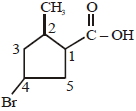
-
- (A) \(24\)
- (B) \(6\)
- (C) \(12\)
- (D) \(18\)
Show answer and solution
Correct Answer: (D)
Each carbon atom is \(sp^{2}\) hybridized Therefore each carbon has \(3 sp^{2}\) hybrid orbitals. Hence total \(\mathrm{sp}^{2}\) hybrid orbitals are \(18 .\)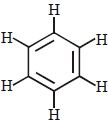
-
- (A) \(Cl-CH=CH-OCH_3\)
- (B) \(Cl-CH=CH-CH_3\)
- (C) \(Cl-CH=CH_2\)
- (D) \(Cl-CH=CH-NO_2\)
Show answer and solution
Correct Answer: (D)
Explanation:
Let us analyze the bond length of the given vinyl chloride derivatives step-by-step using electronic effects in organic chemistry:
1. Resonance in Vinylic Halides:
In all the given options, the chlorine atom is directly attached to an \(sp^2\) hybridized carbon atom belonging to a carbon-carbon double bond (\(C=C\)). The lone pairs of electrons on the chlorine atom can undergo delocalization with the adjacent pi-bond through resonance (mesomeric effect). This resonance introduces a partial double bond character into the \(C-Cl\) bond, making it shorter and stronger than a standard single bond.
2. Role of the Substituent Group:
The degree of partial double bond character depends heavily on the nature of the substituent group attached at the opposite end of the conjugated system.
Effect in Option D:
The nitro group (\(-NO_2\)) is a very strong electron-withdrawing group via the resonance (\(-M\)) effect. It pulls electron density away from the double bond, which strongly facilitates the push of electrons from the chlorine lone pair into the conjugated system.
Impact of Delocalization:
This extensive delocalization significantly enhances the stability and contribution of the resonating structure containing the \(C=Cl^+\) double bond.
3. Comparison:
Because the \(-M\) effect of the \(-NO_2\) group maximizes the double-bond character of the \(C-Cl\) linkage, it results in the greatest contraction of bond distance. In contrast, groups like \(-OCH_3\) (Option A) and \(-CH_3\) (Option B) are electron-donating and oppose this delocalization.
Therefore, \(Cl-CH=CH-NO_2\) has the shortest \(C-Cl\) bond length.
Hence, Option D is the correct choice.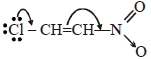
No questions on this page match these filters.