


Questions
15 questionsShowing 1–15 of 15 questions
-
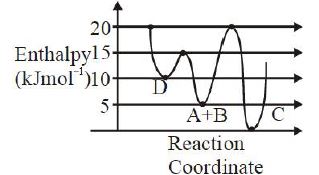
- (A) \(C\) is the thermodynamically stable product
- (B) Formation of \(A\) and \(B\) from \(C\) has highest enthalpy of activation
- (C) \(D\) is kinetically stable product
- (D) Activation enthalpy to form \(C\) is \(5\,kJ\, mol^{-1}\) less than that to form \(D\)
Show answer and solution
Correct Answer: (D)
\({E_a} = (D \to C)\)\( = 15 - 0 = 15\,kJ\,mo{l^{ - 1}}\)
\({E_a} = (A + B) \to C = 15\,kJ\,mo{l^{ - 1}}\)
\({E_a} = (A + B) \to D = 10\,kJ\,mo{l^{ - 1}}\)
\({E_a} = C \to (A + B) = 20\,kJ\,mo{l^{ - 1}}\) (high activation enthalpy in the reaction)
\(\therefore \) Activation enthalpy to form \(C\) is \(5\,kJ\,mol^{-1}\) more than that of form \(D\).
-
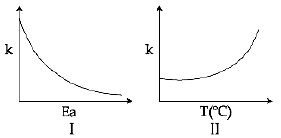
- (A) \(I\) is right but \(II\) is wrong
- (B) Both \(I\) and \(II\) are correct
- (C) \(I\) is wrong but \(II\) is right
- (D) Both \(I\) and \(II\) are wrong
Show answer and solution
Correct Answer: (A)
\(K = A{e^{ - {E_a}/RT}}\)
\((i)\) is true but \((ii)\) is false
\((ii)\) should be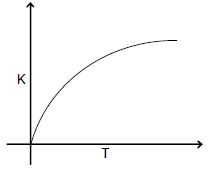
-
- (A) \(50\)
- (B) \(25\)
- (C) \(20\)
- (D) \(40\)
Show answer and solution
Correct Answer: (A)
According to unit of rate constant it is a zero order reaction then half life of reaction will be \({t_{1/2}} = \frac{{{C_0}}}{{2k}} = \frac{{5\,\mu g}}{{2 \times 0.05\,\mu g/year}} = 50\,years\) -
- (A) \(10^{-6}\,s^{-1}\)
- (B) \(2\times 10^{-4}\,s^{-1}\)
- (C) \(10^{-4}\,s^{-1}\)
- (D) \(4\times 10^{-4}\,s^{-1}\)
Show answer and solution
Correct Answer: (C)
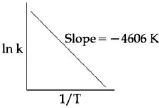
\(\ln \, = \,\ln \,A\, - \,\frac{{Ea}}{{RT}}\, = \,\ln \,A\, - \,\frac{{4606}}{T}\)\(\ln \,\left( {\frac{k}{{{{10}^{ - 5}}}}} \right) = \left( {\frac{{Ea}}{R}} \right)\, \times \,\frac{{500 - 400}}{{500 \times 400}}\)
\(\ln \,\left( {\frac{k}{{{{10}^{ - 5}}}}} \right) = 4606 \times \frac{1}{{2000}}\, = \,2.303\, = \,\ln \,10\)
\(\ln \,\left( {\frac{k}{{{{10}^{ - 5}}}}} \right) = \,\ln \,10\)
\(k\,=\,10^{-4}\)
-
- (A) \(\left( {\frac{{{k_1}}}{{{k_2}}}} \right)\left[ A \right]\)
- (B) \(\left( {{k_1} - {k_2}} \right)\left[ A \right]\)
- (C) \({k_1}{k_2}\left[ A \right]\)
- (D) \(\left( {{k_1} + {k_2}} \right)\left[ A \right]\)
Show answer and solution
Correct Answer: (A)
Applying steady state of approximation\(\frac{d}{{dt}}[B]\, = \,{K_1}[A]\, - \,{K_2}[B]\)
\(O\, = \,{K_1}[A]\, - \,{K_2}[B]\)
\(\frac{{{K_1}}}{{{K_2}}}[A]\, = \,[B]\)
-
- (A) \({k_1}\left[ {{A_2}} \right] - {k_{ - 1}}{\left[ A \right]^2}\)
- (B) \(2{k_1}\left[ {{A_2}} \right] - {k_{ - 1}}{\left[ A \right]^2}\)
- (C) \({k_1}\left[ {{A_2}} \right] + {k_{ - 1}}{\left[ A \right]^2}\)
- (D) \(2{k_1}\left[ {{A_2}} \right] - {2k_{ - 1}}{\left[ A \right]^2}\)
Show answer and solution
Correct Answer: (D)
\(\frac{1}{2}\frac{{d[A]}}{{dt}}\, = \, - \,{K_1}\,{[A]_2}\, + \,{K_{ - 1}}\,{[A]^2}\)\(\frac{{d[A]}}{{dt}}\, = \,2{K_1}\,{[A]_2}\, - \,2{K_{ - 1}}\,{[A]^2}\)
-
- (A) Rate \(= k[A]^2[B]^2\)
- (B) Rate \(= k[A][B]^2\)
- (C) Rate \(= k[A][B]\)
- (D) Rate \(= k[A]^2[B]\)
Show answer and solution
Correct Answer: (B)
\(r\, = \,K{[A]^x}\,{[B]^y}\)\(0.045\, = \,K{(0.05)^x}{(0.05)^y}\) ...... \((1)\)
\(0.090\, = \,K{(0.10)^x}{(0.05)^y}\) .......\((2)\)
\(0.72\, = \,K{(0.20)^x}{(0.10)^y}\) ........\((3)\)
Diving \((1)\) by \((2)\) We get
\(\frac{{0.045}}{{0.090}}\, = \,{\left( {\frac{{0.05}}{{0.10}}} \right)^x}\, \Rightarrow \,x = 1\)
Diving \((2)\) by \((3)\)
\(\frac{{0.090}}{{0.720}}\, = \,{\left( {\frac{{0.10}}{{0.20}}} \right)^x}\,{\left( {\frac{{0.05}}{{0.10}}} \right)^y}\, \Rightarrow \,y = 2\,\)
Hence, \(r\, = \,K[A]\,{[B]^2}\)
-
- (A) Total order of the reaction is \(4\)
- (B) Order of the reaction with respect to \(B\) is \(2\)
- (C) Order of the reaction with respect to \(B\) is \(1\)
- (D) Order of the reaction with respect to \(A\) is \(2\)
Show answer and solution
Correct Answer: (B)
\(2A+B\to \) productsRate \(=\,K\,[A]^x[B]^y\)
\(r\,=\,K\,[A]^x[B]^y\) ..... \((i)\)
\(0.3\,=\,K\,[A]^x[B]^y\) ..... \((1)\)
\(2.4\, = \,K{[2A]^x}\,{[2B]^y}\) ...... \((2)\)
\(0.6\, = \,K{[2A]^x}\,{[B]^y}\) ...... \((3)\)
From \((1)\,(2)\) and \((3)\)
\(X\,=\,1,\) \(Y\,=\,2\)
Overall order \(=\,2+1\,=3\)
Order w.r.t \(A=1\)
Order w.r.t \(B=2\)
-
- (A) \(72\)
- (B) \(166\)
- (C) \(150\)
- (D) \(59\)
Show answer and solution
Correct Answer: (B)
\({H_2}(g)\, + \,{I_2}(g)\, \to \,2HI\,(g)\)Apply Arrhenius equation
\(\log \,\frac{{{K_2}}}{{{K_1}}}\, = \,\frac{{{E_a}}}{{2.303\,R}}\left( {\frac{1}{{600}} - \frac{1}{{800}}} \right)\)
\(\log \,\frac{1}{{2.5 \times {{10}^{ - 4}}}}\, = \,\frac{{{E_a}}}{{2.303 \times 8.31}}\,\left( {\frac{{200}}{{600 \times 800}}} \right)\)
\(\therefore \,\,{E_a}\, \approx \,166\,\,kJ\,/\,mol\)
-
- (A) \(y/R\,\)unit
- (B) \(y\,\)unit
- (C) \(yR\,\)unit
- (D) \(-y\,\)unit
Show answer and solution
Correct Answer: (B)
\(\ln \,k = - \frac{{{E_a}}}{{RT}} + \ln \,A\)\(\therefore \) Slope \(= - E_a = -y\)
-
- (A) \(C_2H_2\) and \(C_6H_6\)
- (B) \(n-\) Butane and Iso-butane
- (C) \(N_2O_4\) and \(NO_2\)
- (D) \(C_2H_4\) and \(C_4H_8\)
Show answer and solution
Correct Answer: (D)
The correct option is \(B C _2 H _4\) and \(C _4 H _8\)\(\log \frac{- d [ A ]}{ dt }=\log \frac{ d [ B ]}{ dt }+0.3010 \)
\(\frac{- d [ A ]}{ dt }=2 \times \frac{ d [ B ]}{ dt } \)
\(\frac{1}{2} \times \frac{- d [ A ]}{ dt }=\frac{ d [ B ]}{ dt } \)
\(2 A \rightarrow B \)
\(2 C _2 H _4 \rightarrow C _4 H _8\)
-
- (A) \(1.667\times10^{-2}\)
- (B) \(4.167\times10^{-3}\)
- (C) \(8.333\times10^{-3}\)
- (D) \(2.083\times10^{-3}\)
Show answer and solution
Correct Answer: (A)
\(2N_2O_5 (g) \to 4NO_2 (g) + O_2 (g)\)\(t=0\) \(3.0\,M\)
\(t=30\) \(2.75\,M\)
\(\frac{{ - \,\Delta \,[{N_2}{O_5}]}}{{\Delta t}}\, = \,\frac{{0.25}}{{30}}\)
\(\frac{1}{2}\, \times \frac{{ - \,\Delta \,[{N_2}{O_5}]}}{{\Delta t}}\, = \frac{1}{4}\, \times \frac{{ - \,\Delta \,[N{O_2}]}}{{\Delta t}}\)
\(\frac{{\Delta \,[N{O_2}]}}{{\Delta t}}\, = \,\frac{{0.25}}{{30}}\, \times \,2\, = \,1.66\, \times \,{10^{ - 2}}\,M/\min \)
-
- (A) \(5\)
- (B) \(10\)
- (C) \(1\)
- (D) \(100\)
Show answer and solution
Correct Answer: (B)
\(R\,\, = \,k{[A]^x}\,{[B]^y}\)\(6.93\, \times \,{10^{ - 3}}\, = \,k\,{(0.1)^x}\,{(0.2)^y}\) ...... \((i)\)
\(6.93\, \times \,{10^{ - 3}}\, = \,k\,{(0.1)^x}\,{(0.25)^y}\) ...... \((ii)\)
\(1.386 \times \,{10^{ - 2}}\, = \,k\,{(0.2)^x}\,{(0.3)^y}\) . .... \((iii)\)
\( \Rightarrow \,y = 0\) (from \((i)\) and \((ii)\)), zero order w.r.t. \(B\)
\(x=1\) (from \((i)\) and \((ii)\))
\( \Rightarrow \,\) First order wrt \(A\)
\( \Rightarrow 6.93\times 10^{-3}\,=\,k(0.1)\)
\( \Rightarrow k=6.93\times 10^{-3}\,min^{-1}\)
-
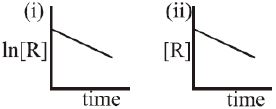
- (A) \(1,1\)
- (B) \(0,2\)
- (C) \(0,1\)
- (D) \(1,0\)
Show answer and solution
Correct Answer: (D)
For first order reaction\(\ln \,{[R]_t}\, = \, - \,Kt\, + \,\ln \,{[R]_0}\)
For zero oeder reaction
\({[R]_t}\, = \, - \,Kt\, + \,{[R]_0}\)
Where \('R'\) is reactant.
-
- (A) \(9.0\)
- (B) \(12.0\)
- (C) \(18.0\)
- (D) \(7.2\)
Show answer and solution
Correct Answer: (C)
For zero order reaction\({C_o}\, - \,{C_t}\, = \,Kt\)
\(0.5M\, - \,0.2M\, = \,Kt\)
\(0.3\, = \,Kt\) ....... \((1)\)
\('K'\) can be calculated by
\({t_{1/2}}\, = \,\frac{{{C_o}}}{{2K}}\)
\(6\, = \,\frac{{0.2}}{{2K}}\)
\(K\, = \,\frac{{0.2}}{{12}}\, = \,\frac{{2 \times {{10}^{ - 1}}}}{{12}}\, = \,\frac{1}{{60}}\)
Putting the value of \(K\) in eq \((1)\)
\(t\, = \,\frac{{0.3}}{K}\, = \,\frac{{0.3}}{{1/60}}\, = \,60\, \times \,0.3\, = \,18\,Hr\)
No questions on this page match these filters.