


JEE Mains · Chemistry · STD 12 - 4. d and f- block elements
The effect of lanthanoid contraction in the lanthanoid series of elements by the large means
- A increase in both atomic and ionic radii
- B decrease in atomic radii and increase in ionic radii
- C decrease in both atomic and ionic radii
- D increase in atomic radii and decrease in ionic radii
Answer & Solution
Correct Answer
(C) decrease in both atomic and ionic radii
Step-by-step Solution
Detailed explanation
Atomic and ionic radii decreases
See the Complete Solution
Get step-by-step explanations for this and 2.5 Lakh+ more JEE, NEET & CET questions.
- Unlock all solutions
- Practice the full chapter
- Track accuracy across PYQs
4.8 rated on Google Play · 14,000+ reviews
More questions from Chemistry
- \(CNG\) is an important transportation fuel. When \(100 \,g\) \(CNG\) is mixed with \(208\) oxygen in vehicles, it leads to the formation of \(CO _{2}\) and \(H _{2} O\) and produces large quantity of heat during this combustion, then the amount of carbon dioxide, produced in grams is ...... [nearest integer] [Assume CNG to be methane]JEE Mains 2022 Hard
- The number of isoelectronic species among \(Sc^{3+}\), \(Cr^{2+}\), \(Mn^{3+}\), \(Co^{3+}\) and \(Fe^{3+}\) is 'n'. If 'n' moles of AgCl is formed during the reaction of complex with formula \(CoCl_{3}(en)_{2}NH_{3}\) with excess of \(AgNO_{3}\), then the number of electrons present in the \(t_{2g}\) orbital of the complex is __________ .JEE Mains 2026 Medium
- Given below are two statements: Statement - \(I\): High concentration of strong nucleophilic reagent with secondary alkyl halides which do not have bulky substituents will follow \(\mathrm{S}_{\mathrm{N}} 2\) mechanism. Statement - \(II\): A secondary alkyl halide when treated with a large excess of ethanol follows \(\mathrm{S}_{\mathrm{N}} 1\) mechanism. In the the light of the above statements, choose the most appropriate from the questions given below:JEE Mains 2024 Hard
- Bouveault-Blanc reduction reaction involvesJEE Mains 2016 Hard
- For the decomposition of the compound, represented as \(N{H_2}COON{H_4}\left( s \right) \rightleftharpoons 2N{H_3}\left( g \right) + C{O_2}\left( g \right)\) the \(K_p\, =2.9\times10^{- 5}\, atm^3\) . If the reaction is started with \(1\, mol\) of the compound, the total pressure at equilibrium would be............\(\times10^{-2}\, atm\)JEE Mains 2014 Hard
- Given below are two statements: One is labelled as Assertion \(A\) and the other is labelled as Reason \(R\): Assertion \(A\) : The stability order of +\(1\) oxidation state of \(\mathrm{Ga}\), In and \(\mathrm{Tl}\) is \(\mathrm{Ga}<\mathrm{In}<\mathrm{Tl}\). Reason \(R\) : The inert pair effect stabilizes the lower oxidation state down the group. In the light of the above statements, choose the correct answer from the options given below :JEE Mains 2024 Medium
More PYQs from JEE Mains
- The energy of an electron in the first Bohr orbit of hydrogen atom is \(-2.18 \times 10^{-18}\,J\). Its energy in the third Bohr orbit is \(........\).JEE Mains 2023 Medium
- Let \(a_1, a_2, a_3, \ldots\) be a G. P. of increasing positive numbers. If \(\mathrm{a}_3 \mathrm{a}_5=729\) and \(\mathrm{a}_2+\mathrm{a}_4=\frac{111}{4}\), then \(24\left(a_1+a_2+a_3\right)\) is equal toJEE Mains 2025 Medium
- Let one root of the quadratic equation in \(x\): \((k^2 - 15k + 27)x^2 + 9(k-1)x + 18 = 0\) be twice the other. Then the length of the latus rectum of the parabola \(y^2 = 6kx\) is equal to:JEE Mains 2026 Medium
- \(\mathrm{K}_{\text {sp }}\) for \(\mathrm{Cr}(\mathrm{OH})_3\) is \(1.6 \times 10^{-30}\). What is the molar solubility of this salt in water?JEE Mains 2025 Medium
- A cylinder of mass \(M_c\) and sphere of mass \(M_s\) are placed at points \(A\) and \(B\) of two inclines, respectively (See Figure). If they roll on the incline without sipping such that their accelerations are the same, then the ratio \(\frac{{\sin \,{\theta _c}}}{{\sin \,{\theta _s}}}\) is
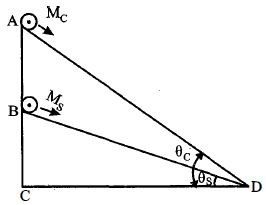 JEE Mains 2014 Hard
 - If two lines \(L_1\) and \(L_2\) in space, are defined by \({L_1} = \{ x = \sqrt \lambda y + \left( {\sqrt \lambda - 1} \right),z = \left( {\sqrt \lambda - 1} \right)y + \sqrt \lambda \} \) and \({L_2} = \{ x = \sqrt \mu y + \left( {1 - \sqrt \mu } \right),z = \left( {1 - \sqrt \mu } \right)y + \sqrt \mu \} \) then \(L_1\) is perpendicular to \(L_2\), for all non-negative reals \(\lambda \) and \( \mu \), such thatJEE Mains 2013 Hard