


All JEE Mains 2019 Chemistry questions
26 chaptersShowing 201–248 of 248 questions
-
- (A) \(\Delta U = 2.8\,k\,J ; \Delta (pV) = 0.8\,k\,J\)
- (B) \(\Delta U = 14\,k\,J ; \Delta (pV) = 4\,k\,J\)
- (C) \(\Delta U = 14\,k\,J ; \Delta (pV) = 18\,k\,J\)
- (D) \(\Delta U = 14\,k\,J ; \Delta (pV) = 0.8\,J\)
Show answer and solution
Correct Answer: (B)
\(\Delta U = n{C_v}m \times \Delta T\)\( = 5 \times 28 \times 100 = 14\,k\,J\)
\(\Delta PV = nR\Delta T\)
\( = 5 \times 8 \times 100\)
\( = 4\,k\,J\)
-
- (A) \(20\)
- (B) \(12\)
- (C) \(5\)
- (D) \(4\)
Show answer and solution
Correct Answer: (C)
\(\Delta S = \frac{{\Delta H}}{T}\) -
- (A) \(\Delta H < 0\) and \(\Delta S < 0\)
- (B) \(\Delta H < 0\) and \(\Delta S > 0\)
- (C) \(\Delta H > 0\) and \(\Delta S > 0\)
- (D) \(\Delta H > 0\) and \(\Delta S < 0\)
Show answer and solution
Correct Answer: (B)
At constant \(P\) and \(T\) and for the process to be spontaneous we should have \(\Delta G = -ve\) and we know that \(\Delta G = \Delta H - T\Delta S\)If \(\Delta H = -ve\) and \(\Delta S = +ve\) then at all the temperature the process will be spontaneous.
-
- (A) \((b)\) and \((c)\)
- (B) \((b), (c)\) and \((d)\)
- (C) \((a), (b)\) and \((c)\)
- (D) \((a)\) and \((d)\)
Show answer and solution
Correct Answer: (A)
\(\Delta U = q + w\)\(\Delta G = \Delta H - T\Delta S\)
- 205. An ideal gas is allowed to expand from \(1\, L\) to \(10\, L\) against a constant external pressure of \(1\,bar\). The work done in \(kJ\) is 2019 Medium
- (A) \(-8\)
- (B) \(-9\)
- (C) \(-2\)
- (D) \(+10\)
Show answer and solution
Correct Answer: (B)
\(W = - {P_{ext}}\,\left( {{V_2} - {V_1}} \right)\) -
- (A) \(\frac{3}{2}K\)
- (B) \(2\, K\)
- (C) \(\frac{2}{3}K\)
- (D) \(1\, K\)
Show answer and solution
Correct Answer: (C)
\(q = P\Delta V\)\(q = 16\)
\({C_P} = 24\)
\({C_P} = \frac{{qP}}{{\Delta T}}\)
\(\Delta T = \frac{{16}}{{24}}\,K = \frac{2}{3}\,K\)
-
- (A) \(8\)
- (B) \(12\)
- (C) \(-12\)
- (D) \(-8\)
Show answer and solution
Correct Answer: (A)
Work done on system \(= +10\, kJ\)
Heat escaped \(= -2\,kJ\)
\(\Delta U = q + w\)
\(= 10 -2 = 8\, kJ\) -
- (A) \(2.85\)
- (B) \(11.4\)
- (C) \(5.7\)
- (D) \(22.8\)
Show answer and solution
Correct Answer: (D)
\(\Delta {C_P} = \frac{{\Delta {H_2} - \Delta {H_1}}}{{{T_2} - {T_1}}}\) -
- (A) \(13\)
- (B) \(62\)
- (C) \(16\)
- (D) \(21\)
Show answer and solution
Correct Answer: (B)
\(\Delta H = n\int\limits_{{T_1}}^{{T_2}} {{C_{p.m}}dT = 3 \times \int\limits_{300}^{1000} {(23 + 0.01\,T)} } dT\)\( = 3[23(1000 - 300)] + \frac{{0.01}}{2}[{(1000)^2} - {(300)^2}]\)
\( = 61950\,J \approx 62\,kJ\)
-
- (A) \(Y\) if \(T = 300\,K\)
- (B) \(Y\) if \(T = 280\,K\)
- (C) \(X\) if \(T = 350\,K\)
- (D) \(X\) if \(T = 315\,K\)
Show answer and solution
Correct Answer: (D)
\(\Delta {G^o} = (120 - \frac{3}{8}\,T) = 0\)Then \(T = 320\,K\)
Hence \(T > 320\,K\,Y\) formed
\(T < 320\,K\,X\) formed
-
- (A) The equilibrium constant is large suggestive of reaction going to completion and so no catalyst is required.
- (B) The equilibrium will shift in forward direction as the pressure increase.
- (C) The equilibrium constant decreases as the temperature increases.
- (D) The addition of inert gas at constant volume will not affect the equilibrium constant.
Show answer and solution
Correct Answer: (A)
In option \((B)\,-\,\Delta n_g\) is \(-ve\) therefore increase in pressure will bring reaction in forward direction. In option \((C)-\) as the reaction is exothermic therefore increase in temperature will decrease the equilibrium constant. In option \((D)-\) Equilibrium constant changes only with temperature. Hence, option \((B), (C)\) and \((D)\) are correct therefore option \((1)\) is incorrect choice. -
- (A) \(x = y + z\)
- (B) \(z = x + y\)
- (C) \(y = 2z -x\)
- (D) \(x = y -z\)
Show answer and solution
Correct Answer: (A)
\((ii) + (iii) = (i)\)\(Y + z = x\)
-
- (A) \(-4\,RT\)
- (B) \(-3\,RT\)
- (C) \(3\,RT\)
- (D) \(4\,RT\)
Show answer and solution
Correct Answer: (A)
\({C_7}{H_{16}}(l) + 11{O_2}(g) \to 7C{O_2}(g) + 8{H_2}O(l)\)\(\Delta {n_g} = {n_p} - {n_r}\)
\( = 7 - 11 = - 4\)
\(\because \,\Delta H = \Delta U + \Delta {n_g}RT\)
\(\therefore \,\Delta H - \Delta U = - 4\,RT\)
-
- (A) \(7.90\)
- (B) \(2.64\)
- (C) \(8.49\)
- (D) \(9.26\)
Show answer and solution
Correct Answer: (D)
\(\mathop {\mathop {{H_2}O(s)}\limits_{1\,kg} }\limits_{at\,273\,K} \to \mathop {\mathop {{H_2}O(l)}\limits_{1\,kg} }\limits_{at\,273\,K} \to \mathop {\mathop {{H_2}O(l)}\limits_{1\,kg} }\limits_{at\,373\,K} \to \mathop {\mathop {{H_2}O(g)}\limits_{} }\limits_{at\,373\,K} \to \mathop {\mathop {{H_2}O(g)}\limits_{} }\limits_{at\,383\,K} \)\(\Delta S = \Delta {S_1} + \Delta {S_2} + \Delta {S_3} + \Delta {S_4}\)
\( = \frac{{334}}{{273}} + 4.2\,\ln \,\frac{{373}}{{273}} + \frac{{2491}}{{373}} + 2\ln \,\frac{{383}}{{373}}\)
\( = 9.267\,kJ\,K{g^{ - 1}}\,{Kg^{ - 1}}\)
-
- (A) \(\Delta G^o < 0, K > 1\)
- (B) \(\Delta G^o < 0, K < 1\)
- (C) \(\Delta G^o = 0, K = 1\)
- (D) \(\Delta G^o > 0, K < 1\)
Show answer and solution
Correct Answer: (B)
\(\Delta G^o = -2.303\, RT\, log\, K_{eq}\) -
- (A) Dissociation of \(CaSO_4(s)\) to \(CaO(s)\) and \(SO_3(g)\)
- (B) Sublimation of dry ice
- (C) Dissolution of iodine in water
- (D) Synthesis of ammonia from \(N_2\) and \(H_2\)
Show answer and solution
Correct Answer: (D)
\(CaS{O_4}(s) \to CaO(s) + S{O_3}(g)\)\(C{O_2}(s) \to C{O_2}(g)\)
\({I_2} \to {I_2}(aq)\)
\({N_2}(g) + 3{H_2}(g) \to 2N{H_3}(g)\)
\({N_2}(g) + 3{H_2} \leftrightarrow 2N{H_3}(g)\)
\(\Delta S = 2\Delta {S_{N{H_3}}} - [\Delta {S_{{N_2}}} + 3\Delta {S_{{H_2}}}]\)
There is decrease in number of moles of \(NH_3\) entropy is decreasing.
-
- (A) \(2040.5\)
- (B) \(1890\)
- (C) \(2480.3\)
- (D) \(2380.5\)
Show answer and solution
Correct Answer: (C)
In order to be spontaneous \(\Delta G^o\) should be \(-ve\)\(\Delta {G^o} = \Delta {H^o} - T\Delta {S^o}\)
\(0 = 491.1 \times {10^3} - T \times 198\)
\(T = \frac{{491100}}{{198}} = 2480\)
If temp is above \(2480\,K\), the reaction will be spontaneous.
-
- (A) \(-412.8\)
- (B) \(-384.0\)
- (C) \(1920\)
- (D) \(206.4\)
Show answer and solution
Correct Answer: (A)
\(\Delta G\, = \, - \,nFE_{cell}\, = \, - \,2\) \( \times \,96500\, \times \,2\,\, = \, - \,386\,\,kJ\)\(\Delta S=nF\left( \frac{dE}{dT} \right)=2\times 96500\,\,\times (-5\times {{10}^{-4}}J{{/}^{o}}C)=-96.5\,kJ\)
at \(298\,K\)
\(T\Delta S=298\times \,(-96.5\,\,J)\,=\,-\,28.8\,kJ\)
at constant \(T\,(=\,248\,K)\) and pressure
\(\Delta G\, = \,\,\Delta H\, - \,\,T\Delta S{\mkern 1mu} \)
\(\Delta H\, = \,\,\Delta G\, + \,\,T\Delta S{\mkern 1mu} \)
\(=-386-28.8=-412.8\,kJ\)
-
- (A) Endothermic if \(A > 0\)
- (B) Exothermic if \(A > 0\) and \(B < 0\)
- (C) Endothermic if \(A < 0\) and \(B > 0\)
- (D) Exothermic if \(B < 0\)
Show answer and solution
Correct Answer: (A)
\(\Delta {G^o} = \Delta {H^o} - T\Delta {S^o}\)\(\Delta {G^o} = A - BT\)
In endothermic reaction \(\Delta H = + ve\). Hence, \(A = +ve\)
-
- (A) \({C_p}\,\ln \,\left[ {\frac{{{{({T_1} + {T_2})}^2}}}{{4{T_1}{T_2}}}} \right]\)
- (B) \(2{C_p}\,\ln \,\left[ {\frac{{{{({T_1} + {T_2})}^{\frac{1}{2}}}}}{{{T_1}{T_2}}}} \right]\)
- (C) \(2{C_p}\,\ln \,\left[ {\frac{{({T_1} + {T_2})}}{{4{T_1}{T_2}}}} \right]\)
- (D) \(2{C_p}\,\ln \,\left[ {\frac{{({T_1} + {T_2})}}{{2{T_1}{T_2}}}} \right]\)
Show answer and solution
Correct Answer: (A)
\(\Delta {S_{Total}}\, = \,{C_p}\ln \frac{{({T_1} + {T_2})}}{{2{T_1}}} + {C_p}\ln \frac{{({T_1} + {T_2})}}{{2{T_2}}}\) -
- (A) Isochoric process: \(\Delta U = q\)
- (B) Adiabatic process: \(\Delta U = - w\)
- (C) Cyclic process: \(q = -w\)
- (D) Isothermal process: \(q = -w\)
Show answer and solution
Correct Answer: (B)
According to the first law of thermodynamics \(q=\Delta U-w\)For cyclic process : \(\Delta U = 0 \Rightarrow q = - w\)
For isothermal process : \(\Delta U = 0 \Rightarrow q = - w\)
For adiabatic process : \(q = 0 \Rightarrow \Delta U = W\)
For isochoric process : \(w = 0 \Rightarrow \Delta U = q\)
-
- (A) \(20\) hexagons and \(12\) pentagons.
- (B) \(12\) hexagons and \(20\) pentagons
- (C) \(18\) hexagons and \(14\) pentagons
- (D) \(16\) hexagons and \(16\) pentagons
Show answer and solution
Correct Answer: (A)
In \(\;{C_{60 < {\rm{ }}Vsub{\rm{ }} > }}\) molecule there are \(20\) hexagons and \(12\) pentagons \(\therefore\) Ans.\((1)\) -
- (A) \((i), (ii), (iii)\) and \((iv)\)
- (B) \((i), (ii)\) and \((iii)\)
- (C) \((i)\) and \((ii)\) only
- (D) \((i), (ii)\) and \((iv)\)
Show answer and solution
Correct Answer: (D)
Silicones are polymers and hydrophobic due to presence of alkyl groups. They are used as greases as some of them are cyclic - 224. Diborane \((B_2H_6)\) reacts independently with \(O_2\) and \(H_2O\) to produce, respectively 2019 Hard
- (A) \(H_3BO_3\) and \(B_2O_3\)
- (B) \(B_2O_3\) and \(H_3BO_3\)
- (C) \(HBO_2\) and \(H_3BO_3\)
- (D) \(B_2O_3\) and \([BH_4]^-\)
Show answer and solution
Correct Answer: (B)
\(B_2H_6 + 3H_2O \longrightarrow 2H_3BO_3 + 3H_2\)\(B_2H_6 + 3O_2 \longrightarrow B_2O_3 + 3H_2O\)
-
- (A) quartz
- (B) kieselguhr
- (C) cristobalite
- (D) tridymite
Show answer and solution
Correct Answer: (B)
Kieselguhr is amorphous form of silica -
- (A) \(\begin{array}{*{20}{c}}
{R\,\,\,\,\,\,\,\,\,\,} \\
{|\,\,\,\,\,\,\,\,\,\,} \\
{{{[ - Si - O - ]}_n}} \\
{|\,\,\,\,\,\,\,\,\,\,} \\
{R\,\,\,\,\,\,\,\,\,\,}
\end{array}\) \((R = Me)\) - (B) \({\left( {Si{O_3}} \right)^{2 - }}\)
- (C) \({Si{O_2}}\)
- (D) \({\left( {Si{O_4}} \right)^{4 - }}\)
Show answer and solution
Correct Answer: (D)
Basic unit is silicat \({\left( {Si{O_4}} \right)^{4 - }}\) - (A) \(\begin{array}{*{20}{c}}
-
- (A) graphite
- (B) \(C_{70}\)
- (C) diamond
- (D) \(C_{60}\)
Show answer and solution
Correct Answer: (C)
Since carbon in diamond is \(sp^3\) hybridized and its \(C -C\) bond order is \(1\). In graphite and fullerene there is both \(C -C\) and \(C = C\) in conjugation, hence there is partial double bond character between carbon atoms -
- (A) \(PbCl_4\)
- (B) \(CCl_4\)
- (C) \(SnCl_4\)
- (D) \(SiCl_4\)
Show answer and solution
Correct Answer: (B)
Central atom has no vacant orbital. -
- (A) \(C > Sn > Si \approx Ge\)
- (B) \(Ge > Sn > Si > C\)
- (C) \(Si > Sn > C > Ge\)
- (D) \(C > Si > Ge \approx Sn\)
Show answer and solution
Correct Answer: (D)
In this order of catenation is asked. Catenation is a self-linking property here and for group \(14\) : Self-linking is through covalent bonding \(C > Si > Ge \approx Sn\) In \(C\) there is \(2p -2p\) overlapping further \(3p -3p, 4p-4p\) and so on and the extent of overlapping is more in \(2p-2p > 3p-3p > 4p-4p \approx 5p-5p\) -
- (A) \(I, II\) and \(III\)
- (B) \(II\) and \(III\) only
- (C) \(I\) and \(III\) only
- (D) \(I\) and \(II\) only
Show answer and solution
Correct Answer: (A)
\(B_2O_3\) is acidic in nature
\(Al_2O_3\) and \(Ga_2O_3\) are amphoteric
Oxides of \(In\) and \(Tl\) are basic in nature. Because the metallic character of the elements increases on moving down the group. -
- (A) carbon
- (B) boron
- (C) beryllium
- (D) lithium
Show answer and solution
Correct Answer: (C)
E. N. of \(Al =(1.5) \approx \operatorname{Be}(1.5)\)Both Al and Be has diagonal relation to each other.
-
- (A) \(Ge\)
- (B) \(Si\)
- (C) \(Sn\)
- (D) \(Pb\)
Show answer and solution
Correct Answer: (D)
Due to the lowest bond energy of \(Pb -Pb\) bond. -
- (A) \(K\)
- (B) \(Na\)
- (C) \(H\)
- (D) \(Li\)
Show answer and solution
Correct Answer: (A)
Greater the nuclear charge, stronger will be the attraction, hence lower will be energy of \(2s\) -
- (A) \(5:4\)
- (B) \(4:1\)
- (C) \(9:4\)
- (D) \(27:5\)
Show answer and solution
Correct Answer: (C)
\(\Delta {{\bar V}_{Lymann}} = \frac{{{R_H}}}{4}\)\(\Delta {{\bar V}_{Balmer}} = \frac{{{R_H}}}{9}\)
\( \Rightarrow \frac{{\Delta {{\bar V}_{Lymann}}}}{{\Delta {{\bar V}_{Balmer}}}} = \frac{9}{4}\)
Formula
\(\bar V = {R_H}\left[ {\frac{1}{{n_1^2}} - \frac{1}{{n_2^{2}}}} \right]\)
-
- (A) Linear with intercept \(- R_H\)
- (B) Non linear
- (C) Linear with slope \(R_H\)
- (D) Linear with slope \(-R_H\)
Show answer and solution
Correct Answer: (D)
For emission line \(n_f < n_i\)\(\therefore \,\bar v = R{Z^2}\left[ {\frac{1}{{n_i^2}} - \frac{1}{{n_f^2}}} \right] = R\left[ {\frac{1}{{{8^2}}} - \frac{1}{{{n^2}}}} \right]\)
or, \(\bar v = {R_H}\left( {\frac{1}{{64}} - \frac{1}{{{n^2}}}} \right)\)
\( = \frac{{{R_H}}}{{64}} - \frac{{{R_H}}}{{{n^2}}}\)
\(\bar v = - {R_H}\left( {\frac{1}{n^2}} \right) + \frac{{{R_H}}}{{64}}\)
\(\therefore \,y = mx + c\)
Slope \(= -R_H\)
-
- (A) Paschen, \(\infty \, \to \,3\)
- (B) Paschen, \(5 \to 3\)
- (C) Balmer, \(\infty \, \to \,2\)
- (D) Lyman, \(\infty \, \to \,1\)
Show answer and solution
Correct Answer: (A)
\([i]\,\,900\,nm = 9000\,\mathop A\limits^o \)
It is in far infra red region hence paschen. -
- (A) \(\frac{3}{4}\lambda \)
- (B) \(\frac{1}{2}\lambda \)
- (C) \(\frac{4}{9}\lambda \)
- (D) \(\frac{2}{3}\lambda \)
Show answer and solution
Correct Answer: (C)
\(K.E = \frac{1}{2}m{u^2} = \frac{1}{2}\frac{{{m^2}{u^2}}}{m} = \frac{1}{2}\frac{{{P^2}}}{m}\)\(\frac{{hc}}{{{\lambda _1}}} = Wo + {(K.E)_1} = Wo + \frac{1}{2}\frac{{{P^2}}}{m}\)
\(\frac{{hc}}{{{\lambda _2}}} = Wo + {(K.E)_2} = Wo + \frac{1}{2}\frac{{{{(1.5P)}^2}}}{m}\)
On solving
\({\lambda _2} = \frac{4}{9}{\lambda _1}\)
Since the \(K.E\) is very high is comparison to work function, then we can assume that \(K.E+Wo = K.E\)
-
- (A) \(0.40\)
- (B) \(1.50\)
- (C) \(1.0\)
- (D) \(0.75\)
Show answer and solution
Correct Answer: (D)
\(2\pi r = n\lambda \)\(\lambda = \frac{{2\pi r}}{n} = \frac{{2\pi {n^2}{a_0}}}{{n \times Z}} = 2\pi \frac{n}{Z}{a_0}\)
\(\lambda = 1.5\pi {a_0}\)
\(\therefore \,2\pi \frac{n}{Z}{a_0} = 1.5\pi {a_0}\)
\(\therefore \frac{n}{Z} = \frac{{1.5}}{2} = 0.75\)
-
- (A) \(\lambda \propto \frac{1}{{\left( {v - {v_0}} \right)}}\)
- (B) \(\lambda \propto \frac{1}{{{{\left( {v - {v_0}} \right)}^{\frac{1}{4}}}}}\)
- (C) \(\lambda \propto \frac{1}{{{{\left( {v - {v_0}} \right)}^{\frac{3}{2}}}}}\)
- (D) \(\lambda \propto \frac{1}{{{{\left( {v - {v_0}} \right)}^{\frac{1}{2}}}}}\)
Show answer and solution
Correct Answer: (D)
\(\lambda = \frac{h}{{mv}}\)According to Einstein's theory of photoelectric effect:
\(hv = h{v_0} + KE\)
\(hv = h{v_0} + \frac{1}{2}m{v^2}\)
\(2h(v - {v_0}) = m{v^2}\)
\(\frac{{2h(v - {v_0})}}{m} = {v^2}\)
\(v \propto {(v - {v_0})^{\frac{1}{2}}}\)
\(\lambda \propto \frac{h}{{m{{(v - {v_0})}^{\frac{1}{2}}}}}\)
\(\lambda \propto \frac{1}{{{{(v - {v_0})}^{\frac{1}{2}}}}}\)
-
- (A) in the region \(a\) and \(b\)
- (B) in the region \(a\) and \(c\)
- (C) only in the region \(a\)
- (D) only in the region \(c\)
Show answer and solution
Correct Answer: (B)
At \(a\) & \(c\), probability of finding electron is maximum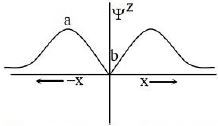
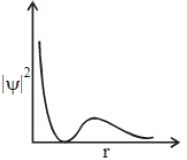
- 241. The graph between \({\left| \psi \right|^2}\) and \(r\)(radial distance) is shown below. This represents
 2019 Medium
- (A) \(1s\) orbital
- (B) \(3s\) orbital
- (C) \(2s\) orbital
- (D) \(2p\) orbital
Show answer and solution
Correct Answer: (C)
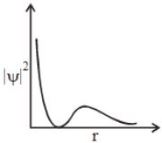
As we know that for \(s-\) orbital graph start from top and no. of radial node \(= n-l-1\) For \(2s\) orbital it will \(= 2-0-1=1\)\(\therefore \) The graph is of \(2s\)
- 242. The ground state energy of hydrogen atom is \(-13.6\, eV\). The energy of second excited state of \(He^+\) ion in \(eV\) is 2019 Medium
- (A) \(-54.4\)
- (B) \(-3.4\)
- (C) \(-6.04\)
- (D) \(-27.2\)
Show answer and solution
Correct Answer: (C)
\(E = - 13.6\frac{{{z^2}}}{{{n^2}}}\,eV\)\(E_{He}^ + = - 13.6\frac{4}{9}\)
-
- (A) \(Li^, Na^+, O^{2-}\) and \(F^-\)
- (B) \(F^-, Li^+, Na^+\) and \(Mg^{2+}\)
- (C) \(N^{3-}, O^{2-}, F^-\) and \(Na^+\)
- (D) \(N^{3-}, Li^+, Mg^{2+}\) and \(O^{2-}\)
Show answer and solution
Correct Answer: (C)
In this we have to choose isoelectronic set of ions: Isoelectronic species are those which have same no. of electron in total, so option \(3\) is correct -
- (A) \(I < III < II < IV\)
- (B) \(I < II < III < IV\)
- (C) \(IV < II < III < I\)
- (D) \(IV < III < II < I\)
Show answer and solution
Correct Answer: (C)
According to Aufbau principle, the energy sequence is
\(3p < 3d < 4p < 4d\) - 245. The ratio of the shortest wavelength of two spectral series of hydrogen spectrum is found to be about \(9\). The spectral series are 2019 Medium
- (A) Lyman and Paschen
- (B) Brackett and Pfund
- (C) Paschen and Pfund
- (D) Balmer and Brackett
Show answer and solution
Correct Answer: (A)
\(\frac{{\frac{1}{{{\lambda _2}}} = {R_H}\left( {\frac{1}{{n_1^2}} - \frac{1}{{n_2^2}}} \right){Z^2}}}{{\frac{1}{{{\lambda _1}}} = {R_H}\left( {\frac{1}{{n_1^2}} - \frac{1}{{n_2^2}}} \right){Z^2}}}\)As for shortest wavelength both \(n_1\) and \(n_2^1\) are \(\infty \)
\(\therefore \,\frac{{{\lambda _1}}}{{{\lambda _2}}} = \frac{9}{1} = \frac{{n_1^1}}{{n_1^2}}\)
Now if \(n_1^1=3\) and \(n_1\) is \(1\) it will justify the statement hence Lyman and Paschen is correct.
-
- (A) \(0.9\)
- (B) \(3.1\)
- (C) \(2.1\)
- (D) \(4\)
Show answer and solution
Correct Answer: (C)
\(hv = \phi + h{v^o}\)\(\frac{1}{2}m{v^2} = hc\left( {\frac{1}{\lambda } - \frac{1}{{{\lambda _0}}}} \right)\)
\(hv = \phi + \frac{1}{2}m{v^2}\)
\(\phi = \frac{{6.626 \times {{10}^{ - 34}} \times 3 \times {{10}^8}}}{{4000 \times {{10}^{ - 10}}}}\) \( - \frac{1}{2} \times 9 \times {10^{ - 31}} \times {(6 \times {10^5})^2}\)
\(\phi = 3.35 \times {10^{ - 19}}\,J\)
\( \Rightarrow \phi \simeq 2.1\,eV\)
-
- (A) \((1), (3)\)
- (B) \((1), (2)\)
- (C) \((1), (4)\)
- (D) \((2), (3)\)
Show answer and solution
Correct Answer: (C)
(1) True. Higher angular momentum orbitals (e.g., d vs s for the same n) are less penetrating and have their electron density further from the nucleus on average.
(2) False. The size of the orbit is primarily determined by n, not inversely proportional to l.
(3) False. According to wave mechanics, for the ground state (1s orbital, l=0), the angular momentum \(L = \sqrt{l(l+1)}\frac{h}{2\pi} = 0\).
(4) True. For a given n, as l increases, the most probable distance (peak of radial probability distribution) shifts to higher r values.
Statements (1) and (4) are true.
-
- (A) The electron can be found at a distance \(2a_0\) from the nucleus
- (B) The probability density of finding the electron is maximum at the nucleus
- (C) The magnitude of potential energy is double that of its kinetic energy on an average
- (D) The total energy of the electron is maximum when it is at a distance \(a_0\) from the nucleus
Show answer and solution
Correct Answer: (D)
\(T.E = - K.E = \frac{{PE}}{2}\)The energy of electrons increases as they are away from the nucleus. The probability of finding the \(1s\) electron may be higher at \(a_0\) but the energy is not. The probability density of finding the electron is not zero at any place in the atom. So, the energy may be higher when it is far from \(a_0\)
No questions on this page match these filters.