


JEE Mains · Chemistry · STD 12 - 3. Chemical kinetics
Decomposition of \(X\) exhibits a rate constant for \(0.05\, \mu g/year\). How many years are required for the decomposition of \(5\, \mu g\) of \(X\) into \(2.5\, \mu g\) ?
- A \(50\)
- B \(25\)
- C \(20\)
- D \(40\)
Answer & Solution
Correct Answer
(A) \(50\)
Step-by-step Solution
Detailed explanation
According to unit of rate constant it is a zero order reaction then half life of reaction will be \({t_{1/2}} = \frac{{{C_0}}}{{2k}} = \frac{{5\,\mu g}}{{2 \times 0.05\,\mu g/year}} = 50\,years\)
See the Complete Solution
Get step-by-step explanations for this and 2.5 Lakh+ more JEE, NEET & CET questions.
- Unlock all solutions
- Practice the full chapter
- Track accuracy across PYQs
4.8 rated on Google Play · 14,000+ reviews
More questions from Chemistry
- An ether \((A)\), \(C_5H_{12}O\), when heated with excess of hot concentrated \(HI\) produced two alkyl halides which when treated with \(NaOH\) yielded compounds \((B)\) and \((C)\). Oxidation of \((B)\) and \((C)\) gave a propanone and an ethanoic acid respectively. The \(IUPAC\) name of the ether \((A)\) isJEE Mains 2013 Hard
- The product obtained from the electrolytic oxidation of acidified sulphate solution, is:JEE Mains 2021 Medium
- On complete combustion 1.0 g of an organic compound (X) gave 1.46 g of \(\mathrm{CO}_2\) and 0.567 g of \(\mathrm{H}_2 \mathrm{O}\). The empirical formula mass of compound \((\mathrm{X})\) is ________ g.
(Given molar mass in \(\mathrm{g} \mathrm{mol}^{-1} \mathrm{C}: 12, \mathrm{H}: 1, \mathrm{O}: 16\))JEE Mains 2025 Hard - Which one of the following metal complexes is most stable?JEE Mains 2021 Hard
- The total number of electrons in all bonding molecular orbitals of \(O_{2}^{2-}\) is \(....\,.\) (Round off to the Nearest Integer).JEE Mains 2021 Hard
- The \(71^{st}\) electron of an element \(X\) with an atomic number of \(71\) enters into the orbital:JEE Mains 2019 Medium
More PYQs from JEE Mains
- Let \(f(\mathrm{x})=\left(\sin \left(\tan ^{-1} \mathrm{x}\right)+\sin \left(\cot ^{-1} \mathrm{x}\right)\right)^{2}-1,|\mathrm{x}|>1\) If \(\frac{d y}{d x}=\frac{1}{2} \frac{d}{d x}\left(\sin ^{-1}(f(x))\right) \) and \( y(\sqrt{3})=\frac{\pi}{6}\) then \(y(-\sqrt{3})\) is equal toJEE Mains 2020 Hard
- Let \(y=y(x)\) be the solution of the differential equation \(\frac{d y}{d x}+\frac{\sqrt{2} y}{2 \cos ^{4} x-\cos 2 x}= Xe ^{\tan ^{-1}(\sqrt{2} \cot 2 x )}, 0 < x < \pi / 2\) with \(y\left(\frac{\pi}{4}\right)=\frac{\pi^{2}}{32}\). If \(y\left(\frac{\pi}{3}\right)=\frac{\pi^{2}}{18} e^{-\tan ^{-1}(\alpha)}\), then the value of \(3 \alpha^{2}\) is equal toJEE Mains 2022 Hard
- Marks obtains by all the students of class 12 are presented in a freqency distribution with classes of equal width. Let the median of this grouped data be 14 with median class interval 12-18 and median class frequency 12 . If the number of students whose marks are less than 12 is 18 , then the total number of students isJEE Mains 2025 Medium
- For the given cell
\(\mathrm{Fe}^{2+}{ }_{(\mathrm{aq})}+\mathrm{Ag}^{+}{ }_{(\mathrm{aq})} \rightarrow \mathrm{Fe}_{(\mathrm{aq})}^{3+}+\mathrm{Ag}_{(\mathrm{s})}\)
The standard cell potential of the above reaction is Given:
\(\begin{array}{lr}
\mathrm{Ag}^{+}+\mathrm{e}^{-} \rightarrow \mathrm{Ag} & \mathrm{E}^\theta=\mathrm{xV} \\
\mathrm{Fe}^{2+}+2 \mathrm{e}^{-} \rightarrow \mathrm{Fe} & \mathrm{E}^\theta=\mathrm{yV} \\
\mathrm{Fe}^{3+}+3 \mathrm{e}^{-} \rightarrow \mathrm{Fe} & \mathrm{E}^\theta=\mathrm{zV}
\end{array}\)JEE Mains 2025 Medium - An massless equilateral triangle \(EFG\) of side \('a'\) (As shown in figure) has three particles of mass \(m\) situated at its vertices. The moment of intertia of the system about the line \(EX\) perpendicular to \(EG\) in the plane of \(EFG\) is \(\frac{ N }{20}\, ma ^{2}\) where \(N\) is an integer. The value of \(N\) is
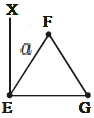 JEE Mains 2020 Medium
 - In a Young's double slit experiment, slits are separated by \(0.5\ mm\), and the screen is placed \(150\ cm\) away. A beam of light consisting of two wavelengths, \(650\ nm\) and \(520\ nm\), is used to obtain interference fringes on the screen. The least distance from the common central maximum to the point where the bright fringes due to both the wavelengths coincide is...... \(mm\)JEE Mains 2017 Medium