


Questions
16 questionsShowing 1–16 of 16 questions
-
- (A) \(K\)
- (B) \(Na\)
- (C) \(H\)
- (D) \(Li\)
Show answer and solution
Correct Answer: (A)
Greater the nuclear charge, stronger will be the attraction, hence lower will be energy of \(2s\) -
- (A) \(5:4\)
- (B) \(4:1\)
- (C) \(9:4\)
- (D) \(27:5\)
Show answer and solution
Correct Answer: (C)
\(\Delta {{\bar V}_{Lymann}} = \frac{{{R_H}}}{4}\)\(\Delta {{\bar V}_{Balmer}} = \frac{{{R_H}}}{9}\)
\( \Rightarrow \frac{{\Delta {{\bar V}_{Lymann}}}}{{\Delta {{\bar V}_{Balmer}}}} = \frac{9}{4}\)
Formula
\(\bar V = {R_H}\left[ {\frac{1}{{n_1^2}} - \frac{1}{{n_2^{2}}}} \right]\)
-
- (A) Linear with intercept \(- R_H\)
- (B) Non linear
- (C) Linear with slope \(R_H\)
- (D) Linear with slope \(-R_H\)
Show answer and solution
Correct Answer: (D)
For emission line \(n_f < n_i\)\(\therefore \,\bar v = R{Z^2}\left[ {\frac{1}{{n_i^2}} - \frac{1}{{n_f^2}}} \right] = R\left[ {\frac{1}{{{8^2}}} - \frac{1}{{{n^2}}}} \right]\)
or, \(\bar v = {R_H}\left( {\frac{1}{{64}} - \frac{1}{{{n^2}}}} \right)\)
\( = \frac{{{R_H}}}{{64}} - \frac{{{R_H}}}{{{n^2}}}\)
\(\bar v = - {R_H}\left( {\frac{1}{n^2}} \right) + \frac{{{R_H}}}{{64}}\)
\(\therefore \,y = mx + c\)
Slope \(= -R_H\)
-
- (A) Paschen, \(\infty \, \to \,3\)
- (B) Paschen, \(5 \to 3\)
- (C) Balmer, \(\infty \, \to \,2\)
- (D) Lyman, \(\infty \, \to \,1\)
Show answer and solution
Correct Answer: (A)
\([i]\,\,900\,nm = 9000\,\mathop A\limits^o \)
It is in far infra red region hence paschen. -
- (A) \(\frac{3}{4}\lambda \)
- (B) \(\frac{1}{2}\lambda \)
- (C) \(\frac{4}{9}\lambda \)
- (D) \(\frac{2}{3}\lambda \)
Show answer and solution
Correct Answer: (C)
\(K.E = \frac{1}{2}m{u^2} = \frac{1}{2}\frac{{{m^2}{u^2}}}{m} = \frac{1}{2}\frac{{{P^2}}}{m}\)\(\frac{{hc}}{{{\lambda _1}}} = Wo + {(K.E)_1} = Wo + \frac{1}{2}\frac{{{P^2}}}{m}\)
\(\frac{{hc}}{{{\lambda _2}}} = Wo + {(K.E)_2} = Wo + \frac{1}{2}\frac{{{{(1.5P)}^2}}}{m}\)
On solving
\({\lambda _2} = \frac{4}{9}{\lambda _1}\)
Since the \(K.E\) is very high is comparison to work function, then we can assume that \(K.E+Wo = K.E\)
-
- (A) \(0.40\)
- (B) \(1.50\)
- (C) \(1.0\)
- (D) \(0.75\)
Show answer and solution
Correct Answer: (D)
\(2\pi r = n\lambda \)\(\lambda = \frac{{2\pi r}}{n} = \frac{{2\pi {n^2}{a_0}}}{{n \times Z}} = 2\pi \frac{n}{Z}{a_0}\)
\(\lambda = 1.5\pi {a_0}\)
\(\therefore \,2\pi \frac{n}{Z}{a_0} = 1.5\pi {a_0}\)
\(\therefore \frac{n}{Z} = \frac{{1.5}}{2} = 0.75\)
-
- (A) \(\lambda \propto \frac{1}{{\left( {v - {v_0}} \right)}}\)
- (B) \(\lambda \propto \frac{1}{{{{\left( {v - {v_0}} \right)}^{\frac{1}{4}}}}}\)
- (C) \(\lambda \propto \frac{1}{{{{\left( {v - {v_0}} \right)}^{\frac{3}{2}}}}}\)
- (D) \(\lambda \propto \frac{1}{{{{\left( {v - {v_0}} \right)}^{\frac{1}{2}}}}}\)
Show answer and solution
Correct Answer: (D)
\(\lambda = \frac{h}{{mv}}\)According to Einstein's theory of photoelectric effect:
\(hv = h{v_0} + KE\)
\(hv = h{v_0} + \frac{1}{2}m{v^2}\)
\(2h(v - {v_0}) = m{v^2}\)
\(\frac{{2h(v - {v_0})}}{m} = {v^2}\)
\(v \propto {(v - {v_0})^{\frac{1}{2}}}\)
\(\lambda \propto \frac{h}{{m{{(v - {v_0})}^{\frac{1}{2}}}}}\)
\(\lambda \propto \frac{1}{{{{(v - {v_0})}^{\frac{1}{2}}}}}\)
-
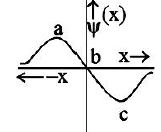
- (A) in the region \(a\) and \(b\)
- (B) in the region \(a\) and \(c\)
- (C) only in the region \(a\)
- (D) only in the region \(c\)
Show answer and solution
Correct Answer: (B)
At \(a\) & \(c\), probability of finding electron is maximum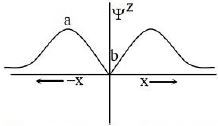
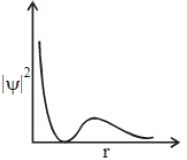
- 9. The graph between \({\left| \psi \right|^2}\) and \(r\)(radial distance) is shown below. This represents
 2019 Medium
- (A) \(1s\) orbital
- (B) \(3s\) orbital
- (C) \(2s\) orbital
- (D) \(2p\) orbital
Show answer and solution
Correct Answer: (C)
As we know that for \(s-\) orbital graph start from top and no. of radial node \(= n-l-1\) For \(2s\) orbital it will \(= 2-0-1=1\)\(\therefore \) The graph is of \(2s\)
- 10. The ground state energy of hydrogen atom is \(-13.6\, eV\). The energy of second excited state of \(He^+\) ion in \(eV\) is 2019 Medium
- (A) \(-54.4\)
- (B) \(-3.4\)
- (C) \(-6.04\)
- (D) \(-27.2\)
Show answer and solution
Correct Answer: (C)
\(E = - 13.6\frac{{{z^2}}}{{{n^2}}}\,eV\)\(E_{He}^ + = - 13.6\frac{4}{9}\)
-
- (A) \(Li^, Na^+, O^{2-}\) and \(F^-\)
- (B) \(F^-, Li^+, Na^+\) and \(Mg^{2+}\)
- (C) \(N^{3-}, O^{2-}, F^-\) and \(Na^+\)
- (D) \(N^{3-}, Li^+, Mg^{2+}\) and \(O^{2-}\)
Show answer and solution
Correct Answer: (C)
In this we have to choose isoelectronic set of ions: Isoelectronic species are those which have same no. of electron in total, so option \(3\) is correct -
- (A) \(I < III < II < IV\)
- (B) \(I < II < III < IV\)
- (C) \(IV < II < III < I\)
- (D) \(IV < III < II < I\)
Show answer and solution
Correct Answer: (C)
According to Aufbau principle, the energy sequence is
\(3p < 3d < 4p < 4d\) - 13. The ratio of the shortest wavelength of two spectral series of hydrogen spectrum is found to be about \(9\). The spectral series are 2019 Medium
- (A) Lyman and Paschen
- (B) Brackett and Pfund
- (C) Paschen and Pfund
- (D) Balmer and Brackett
Show answer and solution
Correct Answer: (A)
\(\frac{{\frac{1}{{{\lambda _2}}} = {R_H}\left( {\frac{1}{{n_1^2}} - \frac{1}{{n_2^2}}} \right){Z^2}}}{{\frac{1}{{{\lambda _1}}} = {R_H}\left( {\frac{1}{{n_1^2}} - \frac{1}{{n_2^2}}} \right){Z^2}}}\)As for shortest wavelength both \(n_1\) and \(n_2^1\) are \(\infty \)
\(\therefore \,\frac{{{\lambda _1}}}{{{\lambda _2}}} = \frac{9}{1} = \frac{{n_1^1}}{{n_1^2}}\)
Now if \(n_1^1=3\) and \(n_1\) is \(1\) it will justify the statement hence Lyman and Paschen is correct.
-
- (A) \(0.9\)
- (B) \(3.1\)
- (C) \(2.1\)
- (D) \(4\)
Show answer and solution
Correct Answer: (C)
\(hv = \phi + h{v^o}\)\(\frac{1}{2}m{v^2} = hc\left( {\frac{1}{\lambda } - \frac{1}{{{\lambda _0}}}} \right)\)
\(hv = \phi + \frac{1}{2}m{v^2}\)
\(\phi = \frac{{6.626 \times {{10}^{ - 34}} \times 3 \times {{10}^8}}}{{4000 \times {{10}^{ - 10}}}}\) \( - \frac{1}{2} \times 9 \times {10^{ - 31}} \times {(6 \times {10^5})^2}\)
\(\phi = 3.35 \times {10^{ - 19}}\,J\)
\( \Rightarrow \phi \simeq 2.1\,eV\)
-
- (A) \((1), (3)\)
- (B) \((1), (2)\)
- (C) \((1), (4)\)
- (D) \((2), (3)\)
Show answer and solution
Correct Answer: (C)
(1) True. Higher angular momentum orbitals (e.g., d vs s for the same n) are less penetrating and have their electron density further from the nucleus on average.
(2) False. The size of the orbit is primarily determined by n, not inversely proportional to l.
(3) False. According to wave mechanics, for the ground state (1s orbital, l=0), the angular momentum \(L = \sqrt{l(l+1)}\frac{h}{2\pi} = 0\).
(4) True. For a given n, as l increases, the most probable distance (peak of radial probability distribution) shifts to higher r values.
Statements (1) and (4) are true.
-
- (A) The electron can be found at a distance \(2a_0\) from the nucleus
- (B) The probability density of finding the electron is maximum at the nucleus
- (C) The magnitude of potential energy is double that of its kinetic energy on an average
- (D) The total energy of the electron is maximum when it is at a distance \(a_0\) from the nucleus
Show answer and solution
Correct Answer: (D)
\(T.E = - K.E = \frac{{PE}}{2}\)The energy of electrons increases as they are away from the nucleus. The probability of finding the \(1s\) electron may be higher at \(a_0\) but the energy is not. The probability density of finding the electron is not zero at any place in the atom. So, the energy may be higher when it is far from \(a_0\)
No questions on this page match these filters.