


JEE Mains · Chemistry · STD 12 - 3. Chemical kinetics
For a reaction scheme. \(A\xrightarrow{{{k_1}}}B\xrightarrow{{{k_2}}}C\) if the rate of formation of \(B\) is set to be zero then the concentration of \(B\) is given by
- A \(\left( {\frac{{{k_1}}}{{{k_2}}}} \right)\left[ A \right]\)
- B \(\left( {{k_1} - {k_2}} \right)\left[ A \right]\)
- C \({k_1}{k_2}\left[ A \right]\)
- D \(\left( {{k_1} + {k_2}} \right)\left[ A \right]\)
Answer & Solution
Correct Answer
(A) \(\left( {\frac{{{k_1}}}{{{k_2}}}} \right)\left[ A \right]\)
Step-by-step Solution
Detailed explanation
Applying steady state of approximation \(\frac{d}{{dt}}[B]\, = \,{K_1}[A]\, - \,{K_2}[B]\) \(O\, = \,{K_1}[A]\, - \,{K_2}[B]\) \(\frac{{{K_1}}}{{{K_2}}}[A]\, = \,[B]\)
See the Complete Solution
Get step-by-step explanations for this and 2.5 Lakh+ more JEE, NEET & CET questions.
- Unlock all solutions
- Practice the full chapter
- Track accuracy across PYQs
4.8 rated on Google Play · 14,000+ reviews
More questions from Chemistry
- \(3 \;g\) of acetic acid is added to \(250\; \mathrm{mL}\) of \(0.1\; \mathrm{M} \mathrm{HCl}\) and the solution made up to \(500\; \mathrm{mL}\) To \(20 \;\mathrm{mL}\) of this solution \(\frac{1}{2}\; \mathrm{mL}\) of \(5\; \mathrm{M\;NaOH}\) is added. The \(\mathrm{pH}\) of the solution is [Given : \(\mathrm{pK}_{\mathrm{a}}\) of acetic acid \(=4.75,\) molar mass of acetic acid \(=60 \mathrm{g} / \mathrm{mol}, \log 3=0.4771]\) Neglect any changes in volumeJEE Mains 2020 Hard
- \(20\,mL\) of calcium hydroxide was consumed when it was reacted with \(10\,mL\) of unknown solution of \(H _2 SO _4\). Also \(20 mL\) standard solution of \(0.5\,M\) \(HCl\) containing \(2\) drops of phenolphthalein was titrated with calcium hydroxide the mixture showed pink colour when burette displayed the value of \(35.5\,mL\) whereas the burette showed \(25.5\,mL\) initially. The concentration of \(H _2 SO _4\) is \(..........M\) (Nearest integer)JEE Mains 2023 Hard
- The disproportionation of \(MnO _{4}^{2-}\) in acidic medium resulted in the formation of two manganese compounds \(A\) and \(B\). If the oxidation state of \(Mn\) in \(B\) is smaller than that of \(A\), then the spin-only magnetic moment \((\mu)\) value of \(B\) in \(BM\) is \(.........\) (Nearest integer)JEE Mains 2022 Medium
- At \(25°C\), \(20.0\) mL of \(0.2\) M weak monoprotic acid HX is titrated against \(0.2\) M NaOH. The pH of the solution (a) at the start of the titration (when NaOH has not been added) and (b) when \(10\) mL of NaOH is added respectively, are:
Given: \(K_a = 5 \times 10^{-4}\), \(pK_a = 3.3\), \(\alpha << 1\)(a) (b) JEE Mains 2026 Medium - The reaction \(\mathrm{A}_2+\mathrm{B}_2 \rightarrow 2 \mathrm{AB}\) follows the mechanism
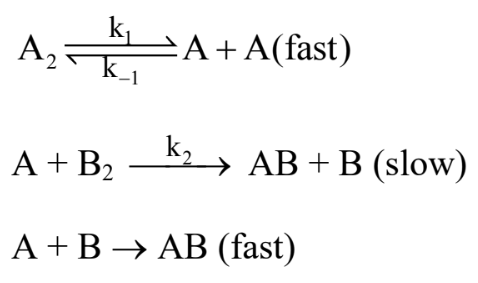
The overall order of the reaction is :JEE Mains 2025 Hard - Incorrect method of preparation for alcohols from the following is:JEE Mains 2023 Medium
More PYQs from JEE Mains
- Let \(z_{1}\) and \(z_{2}\) be two complex numbers such that \(\arg \left(\mathrm{z}_{1}-\mathrm{z}_{2}\right)=\frac{\pi}{4}\) and \(\mathrm{z}_{1}, \mathrm{z}_{2}\) satisfy the equation \(|z-3|=\operatorname{Re}(z) .\) Then the imaginary part of \(z_{1}+z_{2}\) is equal to ..... .JEE Mains 2021 Hard
- Let \(\vec a = 2\hat i + {\lambda _1}\hat j + 3\hat k\), \(\vec b = 4\hat i + \left( {3 - {\lambda _2}} \right)\hat j + 6\hat k\) \(\vec c = 3\hat i + 6\hat j + \left( {{\lambda _3} - 1} \right)\hat k\) be three vectors such that \(\vec b = 2\vec a\) and \(\vec a\) is perpendicular to \(\vec c\). Then a possible value of \(\left( {{\lambda _1},{\lambda _2},{\lambda _3}} \right)\) isJEE Mains 2019 Hard
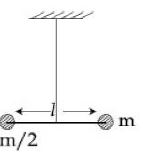
- Two masses \(m\) and \(\frac{m}{2}\) are connected at the two ends of a massless rigid rod of length \(l\). The rod is suspended by a thin wire of torsional constant \(k\) at the centre of mass of the rodmass system (see figure). Because of torsional constant \(k\), the restoring torque is \(\tau = k\,\theta \) for angular displacement \(\theta \). If the rod is rotated by \(\theta _0\) and released, the tension in it when it passes through its mean position will be
 JEE Mains 2019 Hard
 - The increasing order of \(pK _{ a }\) for the following phenols is \((A)\) \(2, 4-\)Dinitrophenol \((B)\) \(4 -\) Nitrophenol \((C)\) \(2, 4, 5-\)Trimethylphenol \((D)\) Phenol \((E)\) \(3-\)ChlorophenolJEE Mains 2023 Hard
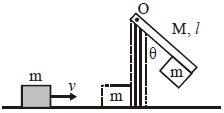
- A block of mass \(m =1\, kg\) slides with velocity \(v=6\, m / s\) on a frictionless horizontal surface and collides with a uniform vertical rod and sticks to it as shown. The rod is pivoted about \(O\) and swings as a result of the collision making angle \(\theta\) before momentarily coming to rest. If the rod has mass \(M =2 \,kg \) and length \(l=1\, m\) the value of \(\theta\) is approximately (Take \(\left.g=10 \,m / s ^{2}\right)\)
 JEE Mains 2020 Hard
 - The disintegration energy \(Q\) for the nuclear fission of \({ }^{235} \mathrm{U} \rightarrow{ }^{140} \mathrm{Ce}+{ }^{94} \mathrm{Zr}+\mathrm{n}\) is _______ \(\mathrm{MeV}\). Given atomic masses of \({ }^{235} \mathrm{U}: 235.0439 \mathrm{u},{ }^{140} \mathrm{Ce} ; 139.9054 \mathrm{u},\) \({ }^{94} \mathrm{Zr}: 93.9063 \mathrm{u} ; \mathrm{n}: 1.0086 \mathrm{u},\) Given Value of \(\mathrm{c}^2=931 \mathrm{MeV} / \mathrm{u}\)JEE Mains 2024 Hard