


Questions
3 questionsShowing 1–3 of 3 questions
-
- (A) Both \((A)\) and \((R)\) are correct statements but \((R)\) is not the correct explanation of \((A)\)
- (B) Both \((A)\) and \((R)\) are wrong statements
- (C) Both \((A)\) and \((R)\) are correct statements and \((R)\) is the correct explanation of \((A)\)
- (D) \((A)\) is a correct statement but \((R)\) is a wrong statement.
Show answer and solution
Correct Answer: (D)
Due to resonance there is partial double bond character between carbon and chlorine, hence it do not undergoes nucleophilic substitution reaction -
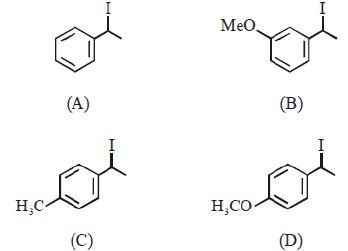
- (A) \((A) < (B) < (C) < (D)\)
- (B) \((A) < (B) < (D) < (C)\)
- (C) \((B) < (A) < (D) < (C)\)
- (D) \((B) < (A) < (C) < (D)\)
Show answer and solution
Correct Answer: (D)
Rate of \(S_N1\) reaction \(\alpha \) stability of \({C^ \oplus } - I.M\) -
- (A) \(CH_2 = CH -Cl\)
- (B) \(CHCl_3\)
- (C) \((CH_3)_3CCl\)
- (D) \(CCl_4\)
Show answer and solution
Correct Answer: (C)
\((CH_3)_3CCl\) will give \(Cl^-\) and most stable carbocation. Hence \((CH_3)_3CCl\) likely to give a precipitate with \(AgNO_3\) solution
No questions on this page match these filters.