


All JEE Mains 2019 Chemistry questions
26 chaptersShowing 51–100 of 248 questions
-
- (A) \(72\)
- (B) \(166\)
- (C) \(150\)
- (D) \(59\)
Show answer and solution
Correct Answer: (B)
\({H_2}(g)\, + \,{I_2}(g)\, \to \,2HI\,(g)\)Apply Arrhenius equation
\(\log \,\frac{{{K_2}}}{{{K_1}}}\, = \,\frac{{{E_a}}}{{2.303\,R}}\left( {\frac{1}{{600}} - \frac{1}{{800}}} \right)\)
\(\log \,\frac{1}{{2.5 \times {{10}^{ - 4}}}}\, = \,\frac{{{E_a}}}{{2.303 \times 8.31}}\,\left( {\frac{{200}}{{600 \times 800}}} \right)\)
\(\therefore \,\,{E_a}\, \approx \,166\,\,kJ\,/\,mol\)
-
- (A) \(y/R\,\)unit
- (B) \(y\,\)unit
- (C) \(yR\,\)unit
- (D) \(-y\,\)unit
Show answer and solution
Correct Answer: (B)
\(\ln \,k = - \frac{{{E_a}}}{{RT}} + \ln \,A\)\(\therefore \) Slope \(= - E_a = -y\)
-
- (A) \(C_2H_2\) and \(C_6H_6\)
- (B) \(n-\) Butane and Iso-butane
- (C) \(N_2O_4\) and \(NO_2\)
- (D) \(C_2H_4\) and \(C_4H_8\)
Show answer and solution
Correct Answer: (D)
The correct option is \(B C _2 H _4\) and \(C _4 H _8\)\(\log \frac{- d [ A ]}{ dt }=\log \frac{ d [ B ]}{ dt }+0.3010 \)
\(\frac{- d [ A ]}{ dt }=2 \times \frac{ d [ B ]}{ dt } \)
\(\frac{1}{2} \times \frac{- d [ A ]}{ dt }=\frac{ d [ B ]}{ dt } \)
\(2 A \rightarrow B \)
\(2 C _2 H _4 \rightarrow C _4 H _8\)
-
- (A) \(1.667\times10^{-2}\)
- (B) \(4.167\times10^{-3}\)
- (C) \(8.333\times10^{-3}\)
- (D) \(2.083\times10^{-3}\)
Show answer and solution
Correct Answer: (A)
\(2N_2O_5 (g) \to 4NO_2 (g) + O_2 (g)\)\(t=0\) \(3.0\,M\)
\(t=30\) \(2.75\,M\)
\(\frac{{ - \,\Delta \,[{N_2}{O_5}]}}{{\Delta t}}\, = \,\frac{{0.25}}{{30}}\)
\(\frac{1}{2}\, \times \frac{{ - \,\Delta \,[{N_2}{O_5}]}}{{\Delta t}}\, = \frac{1}{4}\, \times \frac{{ - \,\Delta \,[N{O_2}]}}{{\Delta t}}\)
\(\frac{{\Delta \,[N{O_2}]}}{{\Delta t}}\, = \,\frac{{0.25}}{{30}}\, \times \,2\, = \,1.66\, \times \,{10^{ - 2}}\,M/\min \)
-
- (A) \(5\)
- (B) \(10\)
- (C) \(1\)
- (D) \(100\)
Show answer and solution
Correct Answer: (B)
\(R\,\, = \,k{[A]^x}\,{[B]^y}\)\(6.93\, \times \,{10^{ - 3}}\, = \,k\,{(0.1)^x}\,{(0.2)^y}\) ...... \((i)\)
\(6.93\, \times \,{10^{ - 3}}\, = \,k\,{(0.1)^x}\,{(0.25)^y}\) ...... \((ii)\)
\(1.386 \times \,{10^{ - 2}}\, = \,k\,{(0.2)^x}\,{(0.3)^y}\) . .... \((iii)\)
\( \Rightarrow \,y = 0\) (from \((i)\) and \((ii)\)), zero order w.r.t. \(B\)
\(x=1\) (from \((i)\) and \((ii)\))
\( \Rightarrow \,\) First order wrt \(A\)
\( \Rightarrow 6.93\times 10^{-3}\,=\,k(0.1)\)
\( \Rightarrow k=6.93\times 10^{-3}\,min^{-1}\)
-
- (A) \(1,1\)
- (B) \(0,2\)
- (C) \(0,1\)
- (D) \(1,0\)
Show answer and solution
Correct Answer: (D)
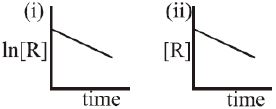
For first order reaction\(\ln \,{[R]_t}\, = \, - \,Kt\, + \,\ln \,{[R]_0}\)
For zero oeder reaction
\({[R]_t}\, = \, - \,Kt\, + \,{[R]_0}\)
Where \('R'\) is reactant.
-
- (A) \(9.0\)
- (B) \(12.0\)
- (C) \(18.0\)
- (D) \(7.2\)
Show answer and solution
Correct Answer: (C)
For zero order reaction\({C_o}\, - \,{C_t}\, = \,Kt\)
\(0.5M\, - \,0.2M\, = \,Kt\)
\(0.3\, = \,Kt\) ....... \((1)\)
\('K'\) can be calculated by
\({t_{1/2}}\, = \,\frac{{{C_o}}}{{2K}}\)
\(6\, = \,\frac{{0.2}}{{2K}}\)
\(K\, = \,\frac{{0.2}}{{12}}\, = \,\frac{{2 \times {{10}^{ - 1}}}}{{12}}\, = \,\frac{1}{{60}}\)
Putting the value of \(K\) in eq \((1)\)
\(t\, = \,\frac{{0.3}}{K}\, = \,\frac{{0.3}}{{1/60}}\, = \,60\, \times \,0.3\, = \,18\,Hr\)
- 58. The correct order for acid strength of compounds \(CH \equiv CH,\,C{H_3} - C \equiv CH,\,C{H_2} = C{H_2}\) is as follows 2019 Medium
- (A) \(CH \equiv CH > C{H_2} = C{H_2} > C{H_3} - C \equiv CH\)
- (B) \(C{H_3} - C \equiv CH > CH \equiv CH > C{H_2} = C{H_2}\)
- (C) \(C{H_3} - C \equiv CH > C{H_2} = C{H_2} > CH \equiv CH\)
- (D) \(CH \equiv CH > \,C{H_3} - C \equiv CH > \,C{H_2} = C{H_2}\)
Show answer and solution
Correct Answer: (D)
Acidic strength \( \propto \) Stability of conjugate base \(E.N. \to sp\, carbon > sp^2\, carbon > sp^3\, carbon\) -
- (A) \((b) < (c) < (a) < (d)\)
- (B) \((a) < (d) < (c) < (b)\)
- (C) \((d) < (a) < (c) < (b)\)
- (D) \((b) < (c) < (d) < (a)\)
Show answer and solution
Correct Answer: (A)
\(\underset{Ch\arg ed\,ion}{\mathop{\underset{\_\_\_\_\_\_\_\_\_\_\_\_\_\_\_\_\_\_\_\_\_\_\_\_\_\_\_\_\_\_\_\_\_\_\_\_\_\_\_\_\_\_\_\_\_\_\_\_\_\_\_\_\_\_\_\_\_}{\mathop{O{{H}^{-}}>\begin{matrix}
C{{H}_{3}}-C-{{O}^{-}} \\
\,\,\,|| \\
\,\,\,O \\
\end{matrix}>\begin{matrix}
\,\,\,\,O \\
\,\,\,\,|| \\
C{{H}_{3}}-S-{{O}^{-}} \\
\,\,\,\,|| \\
\,\,\,\,O \\
\end{matrix}>}}\,}}\,\) \(\underset{\begin{smallmatrix}
neutral \\
system
\end{smallmatrix}}{\mathop{\underset{\_\_\_\_\_\_\_}{\mathop{{{H}_{2}}O}}\,}}\,\)ione pair donating tendency on oxygen is reduced, nucleophilicity reduced \(b < c < a < d\)
-
- (A) \((c) < (a) < (d) < (b)\)
- (B) \((b) < (d) < (a) < (c)\)
- (C) \((a) < (c) < (d) < (b)\)
- (D) \((b) < (d) < (c) < (a)\)
Show answer and solution
Correct Answer: (C)
\(CH_3O-, CH_3-, H\) is electron donating, But \(-NO_2\) is electron withdrawing group. -
- (A) \(CHBr_3\)
- (B) \(CHI_3\)
- (C) \(CH(CN)_3\)
- (D) \(CHCl_3\)
Show answer and solution
Correct Answer: (C)
\(CH{\left( {CN} \right)_3} \rightleftharpoons \mathop C\limits^ - {\left( {CN} \right)_3} + {H^ + }\)Negative charge of the conjugate base \(\mathop C\limits^ - {\left( {CN} \right)_3}\) in extensively delocalized through the \(C \equiv N\) group.
-
- (A) \(CH_3COCH_2NHCH_3\)
- (B) \(CH_3CH_2COCH_2NH_2\)
- (C) \(CH_3CH_2CH_2CONH_2\)
- (D) \(CH_3CON(CH_3)_2\)
Show answer and solution
Correct Answer: (C)
\(Br_2/NaOH\) converts amide into primary amine having one carbon atom less, which gives carbylamine test. -
- (A) \(a\) and \(e\)
- (B) \(b,c\) and \(d\)
- (C) \(a\) and \(d\)
- (D) \(a\)
Show answer and solution
Correct Answer: (B)
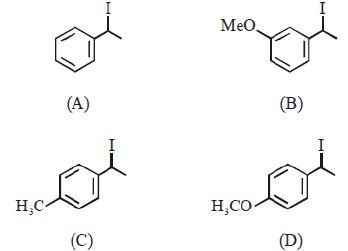
After protonation at \(b\) or \(c\) or \(d\) the conjugate acid is stabilized by resonance. -
- (A) \(C_2H_5NH_2 > NH_3 > (C_2H_5)_2\, NH\)
- (B) \(NH_3 > C_2H_5 NH_2 > (C_2H_5)_2\, NH\)
- (C) \((C_2H_ 5)_2 NH > C_2H_5NH_2 > NH_3\)
- (D) \((C_2H_ 5)_2 NH > NH_3 >C_2H_5 NH_2\)
Show answer and solution
Correct Answer: (C)
Basic strength order
\((CH_3CH_2)_2NH > CH_3CH_2NH_2 > NH_3\)
More the number of \(+I\) groups, higher is the basic strength. -
- (A) \(I > II > III\)
- (B) \(III > I > II\)
- (C) \(III > I > I\)
- (D) \(I > III > II\)
Show answer and solution
Correct Answer: (B)
\(In(III)\), nitrogen atom undergoes \(sp^3\), in\((I)\) \(sp^2\) hybridization. \(In(II)\), the lone pair participate in resonance -
- (A) \((4) < (3) < (2) < (1)\)
- (B) \((4) < (3) < (1) < (2)\)
- (C) \((1) < (2) < (3) < (4)\)
- (D) \((1) < (2) < (4) < (3)\)
Show answer and solution
Correct Answer: (B)
Correct order of basic strength is\(NH_2(Et)_2 > EtNH_2 > NMC_3 > Ph -NH -CH_3\)
- 67. The increasing order of reactivity of the following compounds towards reaction with alkyl halide directly is
 2019 Hard
- (A) \((b) < (a) < (c) < (d)\)
- (B) \((a) < (b) < (c) < (d)\)
- (C) \((b) < (a) < (d) < (c)\)
- (D) \((a) < (c) < (d) < (b)\)
Show answer and solution
Correct Answer: (A)
Lone pair over nitrogen will act as the reacting centre. So, more nucleophilic nitrogen will be more reactive towards alkyl halide. - 68. Which of the following is \(NOT\) a correct method of the preparation of benzylamine from cyanobenzene? 2019 Hard
- (A) \((i)\,\,HCl/H_2O\) \((ii)\,\, NaBH_4\)
- (B) \((i)\,\,LiAlH_4\) \((ii)\,\,H_3O^+\)
- (C) \((i) SnCl_2 + HCl(gas)\) \((ii)\,\,NaBH_4\)
- (D) \(H_2/Ni\)
Show answer and solution
Correct Answer: (A)
Benzylamine will not give cyanobenzene with \(HCl/H_2O\) and \(NaBH_4.\) - 69. But \(-2-\) ene on reaction with alkaline \(KMnO_4\) at elevated temperature followed by acidification will give 2019 Hard
- (A) One molecule of \(CH_3CHO\) and one molecule of \(CH_3COOH\)
- (B) \(2\) molecules of \(CH_3CHO\)
- (C) \(2\) molecules of \(CH_3COOH\)
- (D) \(\begin{array}{*{20}{c}}
{C{H_3} - CH - CH - C{H_3}}\\
{\,\,\,\,\,\,|\,\,\,\,\,\,\,\,\,\,\,\,\,\,\,\,\,\,\,|\,\,\,\,\,\,\,\,\,}\\
{OH\,\,\,\,\,\,\,\,OH}
\end{array}\)
Show answer and solution
Correct Answer: (C)
\(C{H_3} - CH = CH - C{H_3}\xrightarrow[\Delta ]{{KMn{O_4}}}\) \(Images\) \( \to \,2C{H_3} - CHO\,\xrightarrow{{[O]}}2C{H_3} - COOH\)
-
- (A) \(NO_2CH_2COOH > FCH_2COOH >\) \( CNCH_2COOH > ClCH_2COOH\)
- (B) \(FCH_2COOH > NCCH_2COOH >\) \(NO_2CH_2COOH > ClCH_2COOH\)
- (C) \(CNCH_2COOH > O_2NCH_2COOH >\) \(FCH_2COOH > ClCH_2COOH\)
- (D) \(NO_2CH_2COOH > NCCH_2COOH >\) \(FCH_2COOH > ClCH_2COOH\)
Show answer and solution
Correct Answer: (D)
Acid strength in this case varies directly with the electron withdrawing power of the groups attached to the \(\alpha - \) carbon of \(CH_3COOH\). The order of electron withdrawing tendency is
\(NO_2 > CN > F > Cl\) -
- (A) \(III > II > IV > I\)
- (B) \(III > II > I > IV\)
- (C) \(IV > II > III > I\)
- (D) \(II > III > I > IV\)
Show answer and solution
Correct Answer: (B)
Electron withdrawing group enhances the rate of hydrolysis - 72. In the following reaction
Aldehyde \(+\) Alcohol \(\xrightarrow{{HCl}}\) Acetal
\(HCHO\) \(^tBuOH\)
\(CH_3CHO\) \(MeOH\) The best combination is 2019 Medium- (A) \(CH_3CHO\) and \(^tBuOH\)
- (B) \(HCHO\) and \(MeOH\)
- (C) \(CH_3CHO\) and \(MeOH\)
- (D) \(HCHO\) and \(^tBuOH\)
Show answer and solution
Correct Answer: (B)
\(Rate \propto \frac{1}{{{\text{Steric Crowding}}}}\) -
- (A) Acetone as substrate and methanol in stoichiometric amount
- (B) Proponal as substrate and methanol in stoichiometric amount
- (C) Acetone as substrate and methanol in excess
- (D) Propanal as substrate and methanol in excess
Show answer and solution
Correct Answer: (D)
Ketones \(<\) Aldehyde \(\longrightarrow\) Rate of Nucleophilic addition reaction
Only aldehydes are responsible for formation of acetals. Excess of \(MeOH\) is used to drive the reaction towards forward direction - 74. The aldehydes which will not form Grignard product with one equivalent Grignard reagents are
 2019 Hard
- (A) \((b),\,\,(d)\)
- (B) \((b),\,\,(c)\)
- (C) \((b)\,,\,(c)\,,\,(d)\)
- (D) \((c)\,\,(d)\)
Show answer and solution
Correct Answer: (A)
Each of \((b)\) and \((d)\) will react two moles of Grignard reagent. -
- (A) \((b) < (a) < (c) < (d)\)
- (B) \((b) < (a) < (d) < (c)\)
- (C) \((a) < (b) < (d) < (c)\)
- (D) \((a) < (b) < (c) < (d)\)
Show answer and solution
Correct Answer: (C)
The order is identical to nucleophilic substitution order:Acid chloride \(>\) Acid anhydride \(>\) Acid \(>\) Amide
-
- (A) \(CH_2 = CH_2\)
- (B) \(CH_3 -C \equiv CH\)
- (C) \(CH \equiv CH\)
- (D) \(CH_3 -C \equiv C -CH_3\)
Show answer and solution
Correct Answer: (B)
\(\mathop {C{H_3} - C = C - H}\limits_{(A)} \xrightarrow{{A{g_2}O}}\) \(\mathop {C{H_3} - C \equiv C - Ag}\limits_{Whiteppt.} \downarrow \)\(\mathop {C{H_3} - C = C - H}\limits_{(A)} \xrightarrow{{H{g^{2 + }}\,/{H^ + }}}\) \(\mathop {\begin{array}{*{20}{c}}
O \\
{||} \\
{{H_3}C - C - C{H_3}}
\end{array}}\limits_{(B)} \) \(\xrightarrow{{NaB{H_4}}}\) \(\mathop {\begin{array}{*{20}{c}}
{\begin{array}{*{20}{c}}
{\,\,\,OH} \\
|
\end{array}} \\
{C{H_3} - C - C{H_3}} \\
| \\
H
\end{array}}\limits_{(C)} \) \(\xrightarrow[{Conc.\,HCl}]{{ZnC{l_2}}}\) Turbidity within \(5\) minutes -
- (A) Oleic acid
- (B) \(o -\) Toluidine
- (C) Benzamide
- (D) \(m -\) Cresol
Show answer and solution
Correct Answer: (D)
Oletic acid is also soluble in \(NaHCO_3\)\(o\,-\) toluidine is not soluble in \(NaOH\) as well as \(NaHCO_3\)
Benzamide is also not soluble in \(NaOH\) and \(NaHCO_3\).
\(\therefore \) \(m\,-\) cresol is the right answer.

-
- (A) \(HCHO + PhCH(CH_3)CH_2MgX\)
- (B) \(PhCOCH_2CH_3 + CH_3MgX\)
- (C) \(PhCOCH_3 + CH_3CH_2MgX\)
- (D) \(CH_3CH_2COCH_3 + PhMgX\)
Show answer and solution
Correct Answer: (A)
The reaction in option \((A)\) will yield \(1^o-\) alcohol. -
- (A) \(C < B < A < D\)
- (B) \(B < C < D < A\)
- (C) \(D < A < C < B\)
- (D) \(B < C < A< D\)
Show answer and solution
Correct Answer: (D)
Higher the \(Ka\) value lower the \(pKa\) value -
- (A) \(\begin{array}{*{20}{c}}
{OH\,\,\,\,\,\,\,\,\,\,\,\,\,\,\,\,\,\,\,\,\,\,\,} \\
{|\,\,\,\,\,\,\,\,\,\,\,\,\,\,\,\,\,\,\,\,\,\,\,\,\,\,\,\,} \\
{C{H_3}CH - CH = C{H_2}}
\end{array}\) - (C) \(CH_3CH = CH -CH_2NH_2\)
- (D) \(\begin{array}{*{20}{c}}
{OH\,\,\,\,\,\,\,\,\,\,\,\,\,\,\,\,\,\,\,\,\,\,\,\,\,\,\,\,\,\,\,\,\,\,} \\
{|\,\,\,\,\,\,\,\,\,\,\,\,\,\,\,\,\,\,\,\,\,\,\,\,\,\,\,\,\,\,\,\,\,\,\,\,\,\,\,\,} \\
{C{H_3}CHC{H_2}C{H_2}NHCHO}
\end{array}\)
Show answer and solution
Correct Answer: (D)
\(\begin{matrix}
OH\,\,\,\,\,\,\,\,\,\,\,\,\,\,\,\,\,\,\,\,\,\,\,\,\,\,\,\,\,\,\,\,\,\,\, \\
|\,\,\,\,\,\,\,\,\,\,\,\,\,\,\,\,\,\,\,\,\,\,\,\,\,\,\,\,\,\,\,\,\,\,\,\,\,\,\, \\
C{{H}_{3}}-CH-C{{H}_{2}}-C{{H}_{2}}-N{{H}_{2}} \\
\end{matrix}\) \(\xrightarrow[triethyl\,\,amine]{ethyl\,\,formate\,\,(lequiv.)}\) \(\begin{matrix}
\,\,\,\,\,\,\,\,OH\,\,\,\,\,\,\,\,\,\,\,\,\,\,\,\,\,\,\,\,\,\,\,\,\,\,\,\,\,\,\,\,\,\,\,\,\,\,\,\,\,\,\,\,\,\,\,\,\,\,\,\,\,\,\,\,\,\,\,\,\,\,\,O \\
\,\,\,\,\,\,\,|\,\,\,\,\,\,\,\,\,\,\,\,\,\,\,\,\,\,\,\,\,\,\,\,\,\,\,\,\,\,\,\,\,\,\,\,\,\,\,\,\,\,\,\,\,\,\,\,\,\,\,\,\,\,\,\,\,\,\,\,\,\,\,\,\,\,\,\,\,|| \\
C{{H}_{3}}-CH-C{{H}_{2}}-C{{H}_{2}}-NH-C-H \\
\end{matrix}\)as \(NH_2\) is a better nucleophile than \(OH\).
- (A) \(\begin{array}{*{20}{c}}
- 81. The major product of the following reaction is \(C{H_3}CH = CHC{O_2}C{H_3}\,\xrightarrow{{LiAl{H_4}}}\) 2019 Hard
- (A) \(CH_3CH_2CH_2CHO\)
- (B) \(CH_3CH = CHCH_2OH\)
- (C) \(CH_3CH_2CH_2CO_2CH_3\)
- (D) \(CH_3CH_2CH_2CH_2OH\)
Show answer and solution
Correct Answer: (B)
\(LiAlH_4\) does not reduce double bond it reduces ester in alcohol. -
- (A) syn gas
- (B) natural gas
- (C) fuel gas
- (D) laughing gas
Show answer and solution
Correct Answer: (A)
The synonoyms for water gas is syn gas. -
- (A) Tollen’s reagent
- (B) \(I_2 / NaOH\)
- (C) \(CrO_2 Cl_2 / Cs_2\)
- (D) alkaline \(KMnO_4\)
Show answer and solution
Correct Answer: (B)
Iodoform reaction can be used for this transformation. -
- (A) Both \((A)\) and \((R)\) are correct statements but \((R)\) is not the correct explanation of \((A)\)
- (B) Both \((A)\) and \((R)\) are wrong statements
- (C) Both \((A)\) and \((R)\) are correct statements and \((R)\) is the correct explanation of \((A)\)
- (D) \((A)\) is a correct statement but \((R)\) is a wrong statement.
Show answer and solution
Correct Answer: (D)
Due to resonance there is partial double bond character between carbon and chlorine, hence it do not undergoes nucleophilic substitution reaction -
- (A) \((A) < (B) < (C) < (D)\)
- (B) \((A) < (B) < (D) < (C)\)
- (C) \((B) < (A) < (D) < (C)\)
- (D) \((B) < (A) < (C) < (D)\)
Show answer and solution
Correct Answer: (D)
Rate of \(S_N1\) reaction \(\alpha \) stability of \({C^ \oplus } - I.M\) -
- (A) \(CH_2 = CH -Cl\)
- (B) \(CHCl_3\)
- (C) \((CH_3)_3CCl\)
- (D) \(CCl_4\)
Show answer and solution
Correct Answer: (C)
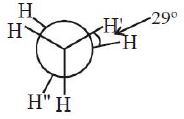
\((CH_3)_3CCl\) will give \(Cl^-\) and most stable carbocation. Hence \((CH_3)_3CCl\) likely to give a precipitate with \(AgNO_3\) solution - 87. In the following skew conformation of ethane, \(H'-C-C-H"\) dihedral angle is......\(^o\)
 2019 Hard
- (A) \(58\)
- (B) \(120\)
- (C) \(149\)
- (D) \(151\)
Show answer and solution
Correct Answer: (C)
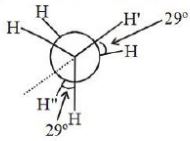
Dihedral angle is then angle between bond pairs present on adjacent atoms.\(H'-C-C-H''\)
Hence angle between
\(H' - C - C - H"\) is
\(({120^o} + {29^o}) = {149^o}\)
- 88. Which of these factors does not govern the stability of a conformation in acyclic compounds? 2019 Medium
- (A) Torsional strain
- (B) Angle strain
- (C) Steric interactions
- (D) Electrostatic forces of interaction
Show answer and solution
Correct Answer: (B)
Angle strain govern stability in cyclic compound. -
- (A) Geometrical isomers
- (B) Coordination isomers
- (C) Linkage isomers
- (D) Ionisation isomers
Show answer and solution
Correct Answer: (A)
Cobalt \((III)\) chloride on reaction with ethylenediemine in ratio \(1:22\) isomeric products complexes \(A\) and \(B\)
-
- (A) \(L_3 < L_1 < L_2\)
- (B) \(L_3 < L_2 < L_1\)
- (C) \(L_1 < L_2 < L_3\)
- (D) \(L_2 < L_1 < L_3\)
Show answer and solution
Correct Answer: (A)
\(\begin{array}{*{20}{c}}
{{L_1}}&{{L_2}}&{{L_3}} \\
{Green}&{Blue}&{\operatorname{Re} d}
\end{array}\)absorbed wave length order of \(\lambda \) \(Red > Green > Blue\) \(L_3 > L_1 > L_2\)
\(\therefore \) Strength of ligand \(\alpha \,\,\Delta \,\,\alpha \,\,1/\lambda\)
\(\therefore \) Strength of ligand \(L_2 > L_1 > L_3\)
-
- (A) \(a -iii,\,b -iv,\,c -i,\,d - ii\)
- (B) \(a -i,\,b -ii,\,c -iii,\,d - iv\)
- (C) \(a -ii,\,b -i,\,c -iv,\,d - iii\)
- (D) \(a -iv,\,b -iii,\,c -i,\,d - ii\)
Show answer and solution
Correct Answer: (A)
\(Co \to \) Vitamin \(B_{12}\)
\(Zn \to \) Carbonic anhydrase
\(Rh \to \) Wilkinson catalyst
\(Mg \to \) Chlorophyll -
- (A) \(Mn -C\) bond
- (B) \(Mn -Mn\) bond
- (C) \(Mn -O\) bond
- (D) \(C -O\) bond
Show answer and solution
Correct Answer: (A)
Organometalic compound contains at least one chemical bond between carbon and a metal. -
- (A) \(0\) and \(5.92\)
- (B) \(2.84\) and \(5.92\)
- (C) \(4.9\) and \(0\)
- (D) \(0\) and \(4.9\)
Show answer and solution
Correct Answer: (C)
\({[Fe{(CN)_6}]^{4 - }}\) \({[Fe{({H_2}O)_6}]^{2 + }}\)\(F{e^{2 + }}\, \to \,3{d^6}\) \(F{e^{2 + }}\, \to \,3{d^6}\)
\(t_{2g}^6\,e{g^0}\) \(t_{2g}^4\,e{g^2}\)
\(\mu \, = \,\sqrt {n(n + 2)} \) \(\mu \, = \,\sqrt {n(n + 2)} \,=\,\sqrt {24}\)
\(\mu \, =0\) \(\mu \, = \,4.9\,BM\)
-
- (A) \([Co(NH_3)_5(H_2O)]Cl_3\)
- (B) \(K_2[CoCl_4]\)
- (C) \([Co(NH_3)_5Cl]Cl_2\)
- (D) \(K_3[Co(CN)_6]\)
Show answer and solution
Correct Answer: (D)
As \(CN^-\) is a strong field ligand. \(K_3[Co(CN)_6]\) will have maximum \(‘\Delta ’.\) -
- (A) trans \(- \left[ {Pd{{\left( {Cl} \right)}_2}{{\left( {N{H_3}} \right)}_2}} \right]\)
- (B) trans \(\left[ {Pt{{\left( {Cl} \right)}_2}{{\left( {N{H_3}} \right)}_2}} \right]\)
- (C) cis \(- \left[ {Pd{{\left( {Cl} \right)}_2}{{\left( {N{H_3}} \right)}_2}} \right]\)
- (D) cis \(\left[ {Pt{{\left( {Cl} \right)}_2}{{\left( {N{H_3}} \right)}_2}} \right]\)
Show answer and solution
Correct Answer: (D)
cis \(-[PtCl_2(NH_3)_2]\) is used in chemotherapy to inhibits the growth of tumors -
- (A) \(EDTA\)
- (B) Cis-platin
- (C) \(D-\) penicillamine
- (D) desferrioxime \(B\)
Show answer and solution
Correct Answer: (A)
\((A)\) \(EDTA\) (ethylene diamine tetra acetate) is used for lead poisoning
\((B)\) Cis platin is used as a anti cancer drug
\((C)\) \(D-\) penicillamine is used for copper poisoning
\((D)\) desferrioxime \(B\) is used for iron poisoning -
- (A) \(6\) and \(6\)
- (B) \(5\) and \(3\)
- (C) \(3\) and \(3\)
- (D) \(5\) and \(6\)
Show answer and solution
Correct Answer: (D)
\(en\) and \(C_2 O_4^{2-}\) are a bidentate ligand. So coordination number of \([Co(Cl)(en)_2]Cl\) is \(5\) and \(K_3[Al(C_2O_4)_3]\) is \(6\) -
- (A) \(C{r^{2 + }} > R{u^{3 + }} > F{e^{2 + }} > {V^{2 + }}\)
- (B) \({V^{2 + }} > C{r^{2 + }} > R{u^{3 + }} > F{e^{2 + }}\)
- (C) \(C{r^{2 + }} > {V^{2 + }} > R{u^{3 + }} > F{e^{2 + }}\)
- (D) \({V^{2 + }} > R{u^{3 + }} > C{r^{2 + }} > F{e^{2 + }}\)
Show answer and solution
Correct Answer: (B)
Since \(CN^-\) and \(NH_3\) are strong field ligands, low spin complexes are formed.Complex Configuration No. of unpaired electrons \([V(CN)_6]^{4-}\) \(t_{2g}^3\,e_g^0\) \(3\) \({[Cr{(N{H_3})_6}]^{2 + }}\) \(t_{2g}^4\,e_g^0\) \(2\) \({[Ru{(N{H_3})_6}]^{3 + }}\) \(t_{2g}^5\,e_g^0\) \(1\) \({[Fe{(CN)_6}]^{4 - }}\) \(t_{2g}^6\,e_g^0\) \(0\) Magnetic moment is directly proportion to number of unpaired electrons.
- 99. The crystal field stabilization energy \((CFSE)\) of \([Fe(H_2O)_6]Cl_2\) and \(K_2[NiCl_4],\) respectively, are 2019 Hard
- (A) \( - \,0.4\,{\Delta _0}\) and \( - \,0.8\,{\Delta _t}\)
- (B) \( - \,0.4\,{\Delta _0}\) and \( - \,1.2\,{\Delta _t}\)
- (C) \( - \,2.4\,{\Delta _0}\) and \( - \,1.2\,{\Delta _t}\)
- (D) \( - \,0.6\,{\Delta _0}\) and \( - \,0.8\,{\Delta _t}\)
Show answer and solution
Correct Answer: (A)
\(CFSE = [-0.4\,n_{t2g} + 0.6\,n_{eg}]\, \Delta _o\) -
- (A) \(Ni^{2+}\)
- (B) \(Fe^{2+}\)
- (C) \(Co^{2+}\)
- (D) \(Mn^{2+}\)
Show answer and solution
Correct Answer: (C)
\(Co^{2+}\) high spin \(t_{2g}^5\, e_g^2\, ‘3’\) unpaired electrons \(Co^{2+}\) low spin \(t_{2g}^6\, e_g^1\, ‘1’\) unpaired electron Difference is \(3 -1 = 2\)


No questions on this page match these filters.