


Questions
4 questionsShowing 1–4 of 4 questions
- 1. The correct order for acid strength of compounds \(CH \equiv CH,\,C{H_3} - C \equiv CH,\,C{H_2} = C{H_2}\) is as follows 2019 Medium
- (A) \(CH \equiv CH > C{H_2} = C{H_2} > C{H_3} - C \equiv CH\)
- (B) \(C{H_3} - C \equiv CH > CH \equiv CH > C{H_2} = C{H_2}\)
- (C) \(C{H_3} - C \equiv CH > C{H_2} = C{H_2} > CH \equiv CH\)
- (D) \(CH \equiv CH > \,C{H_3} - C \equiv CH > \,C{H_2} = C{H_2}\)
Show answer and solution
Correct Answer: (D)
Acidic strength \( \propto \) Stability of conjugate base \(E.N. \to sp\, carbon > sp^2\, carbon > sp^3\, carbon\) -
- (A) \((b) < (c) < (a) < (d)\)
- (B) \((a) < (d) < (c) < (b)\)
- (C) \((d) < (a) < (c) < (b)\)
- (D) \((b) < (c) < (d) < (a)\)
Show answer and solution
Correct Answer: (A)
\(\underset{Ch\arg ed\,ion}{\mathop{\underset{\_\_\_\_\_\_\_\_\_\_\_\_\_\_\_\_\_\_\_\_\_\_\_\_\_\_\_\_\_\_\_\_\_\_\_\_\_\_\_\_\_\_\_\_\_\_\_\_\_\_\_\_\_\_\_\_\_}{\mathop{O{{H}^{-}}>\begin{matrix}
C{{H}_{3}}-C-{{O}^{-}} \\
\,\,\,|| \\
\,\,\,O \\
\end{matrix}>\begin{matrix}
\,\,\,\,O \\
\,\,\,\,|| \\
C{{H}_{3}}-S-{{O}^{-}} \\
\,\,\,\,|| \\
\,\,\,\,O \\
\end{matrix}>}}\,}}\,\) \(\underset{\begin{smallmatrix}
neutral \\
system
\end{smallmatrix}}{\mathop{\underset{\_\_\_\_\_\_\_}{\mathop{{{H}_{2}}O}}\,}}\,\)ione pair donating tendency on oxygen is reduced, nucleophilicity reduced \(b < c < a < d\)
-
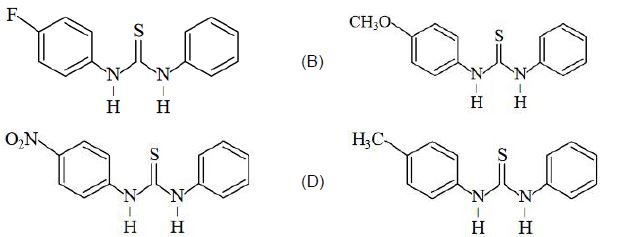
- (A) \((c) < (a) < (d) < (b)\)
- (B) \((b) < (d) < (a) < (c)\)
- (C) \((a) < (c) < (d) < (b)\)
- (D) \((b) < (d) < (c) < (a)\)
Show answer and solution
Correct Answer: (C)
\(CH_3O-, CH_3-, H\) is electron donating, But \(-NO_2\) is electron withdrawing group. -
- (A) \(CHBr_3\)
- (B) \(CHI_3\)
- (C) \(CH(CN)_3\)
- (D) \(CHCl_3\)
Show answer and solution
Correct Answer: (C)
\(CH{\left( {CN} \right)_3} \rightleftharpoons \mathop C\limits^ - {\left( {CN} \right)_3} + {H^ + }\)Negative charge of the conjugate base \(\mathop C\limits^ - {\left( {CN} \right)_3}\) in extensively delocalized through the \(C \equiv N\) group.
No questions on this page match these filters.