


JEE Mains · Physics · STD 12 - Ray optics and optical instruments
- JEE Mains 2026
- Hard
- MCQ
A thin biconvex lens is prepared from the glass (\(\mu=1.5\)) both curved surfaces of which have equal radii of \(20\) cm each. Left side surface of the lens is silvered from outside to make it reflecting. To have the position of image and object at the same place, the object should be placed, from the lens at a distance of ________ cm.
Pick an option to check your answer.
Answer & Solution
Correct Answer
(A) \(10\)
Step-by-step Solution
Detailed explanation
When one surface of a lens is silvered, the system behaves like an equivalent mirror. The light refracts through the lens, reflects off the silvered surface, and refracts through the lens again, so the equivalent power is:
\(P_{eq} = P_L + P_M + P_L = 2P_L + P_M\)
Power of the biconvex lens:
For a thin biconvex lens with \(R_1 = +20\text{ cm}\), \(R_2 = -20\text{ cm}\) and \(\mu = 1.5\), the lens maker's formula gives:
\(\dfrac{1}{f_L} = (\mu - 1)\left(\dfrac{1}{R_1} - \dfrac{1}{R_2}\right)\)
\(\dfrac{1}{f_L} = (1.5 - 1)\left(\dfrac{1}{20} - \dfrac{1}{-20}\right) = 0.5 \cdot \dfrac{2}{20} = \dfrac{1}{20}\text{ cm}^{-1}\)
So, \(P_L = \dfrac{1}{20}\text{ cm}^{-1}\).
Power of the silvered surface (acting as a concave mirror):
The back surface has radius of curvature \(R = 20\text{ cm}\), so its focal length is:
\(f_M = \dfrac{R}{2} = 10\text{ cm}\)
\(P_M = \dfrac{1}{f_M} = \dfrac{1}{10}\text{ cm}^{-1}\)
Equivalent focal length:
\(P_{eq} = 2P_L + P_M = 2 \cdot \dfrac{1}{20} + \dfrac{1}{10} = \dfrac{1}{10} + \dfrac{1}{10} = \dfrac{1}{5}\text{ cm}^{-1}\)
\(F_{eq} = \dfrac{1}{P_{eq}} = 5\text{ cm}\)
Since \(P_{eq} > 0\), the system behaves as a converging (concave) equivalent mirror of focal length \(5\text{ cm}\).
Object position for object and image to coincide:
For a concave mirror, the image coincides with the object when the object is placed at the centre of curvature, i.e., at a distance \(2F_{eq}\) from the mirror:
\(u = 2F_{eq} = 2 \times 5 = 10\text{ cm}\)
Hence, the correct option is \((1)\ 10\).
More questions from Physics
- Red light differs from blue light as they have :JEE Mains 2021 Medium
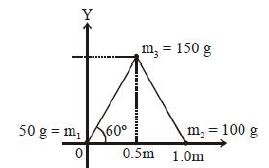
- Three particles of masses \(50\, g\), \(100\, g\) and \(150\, g\) are placed at the vertices of an equilateral triangle of side \(1\, m\) (as shown in the figure). The \((x, y)\) coordinates of the centre of mass will be
 JEE Mains 2019 Hard
- An aluminium and steel rods having same lengths and cross-sections are joined to make total length of 120 cm at \(30^{\circ} C\). The coefficient of linear expansion of aluminium and steel are \(24 \times 10^{-6} /{ }^{\circ} C\) and \(1.2 \times 10^{-5} /{ }^{\circ} C\), respectively. The length of this composite rod when its temperature is raised to \(100^{\circ} C\), is _________ cm .JEE Mains 2026 Medium
- An ac current is represented as
\(\mathrm{i}=5 \sqrt{2}+10 \cos \left(650 \pi \mathrm{t}+\frac{\pi}{6}\right) \mathrm{Amp}\)
The r.m.s value of the current isJEE Mains 2025 Easy - A monochromatic light is incident on a hydrogen sample in ground state. Hydrogen atoms absorb a fraction of light and subsequently emit radiation of six different wavelengths. The frequency of incident light is \(x \times 10^{15}\,Hz\). The value of \(x\) is (Given \(h =4.25 \times 10^{-15}\,eVs\) )JEE Mains 2023 Medium
- In a vernier calliper, when both jaws touch each other, zero of the vernier scale shifts towards left and its \(4^{\text {th }}\) division coincides exactly with a certain division on main scale. If \(50\) vernier scale divisions equal to \(49\) main scale divisions and zero error in the instrument is \(0.04 \mathrm{~mm}\) then how many main scale divisions are there in \(1 \mathrm{~cm}\) ?JEE Mains 2024 Hard
More PYQs from JEE Mains
- An object is placed beyond the centre of curvature \({C}\) of the given concave mirror. If the distance of the object is \({d}_{1}\) from \({C}\) and the distance of the image formed is \({d}_{2}\) from \({C}\), the radius of curvature of this mirror isJEE Mains 2021 Hard
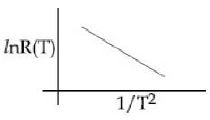
- In an experiment, the resistance of a material is plotted as a function of temperature (in some range). As shown in the figure, it is a straight line. One may conclude that:
 JEE Mains 2019 Hard
- Regarding self-inductance:
A. The self-inductance of the coil depends on its geometry.
B. Self-inductance does not depend on the permeability of the medium.
C. Self-induced e.m.f. opposes any change in the current in a circuit.
D. Self-inductance is electromagnetic analogue of mass in mechanics.
E. Work needs to be done against self-induced e.m.f. in establishing the current.
Choose the correct answer from the options given below:JEE Mains 2025 Easy - An alternating current is given by the equation \(i=i_{1} \sin \omega t+i_{2} \cos \omega t\). The rms current will beJEE Mains 2021 Hard
- Two equal positive point charges are separated by a distance \(2 a\). The distance of a point from the centre of the line joining two charges on the equatorial line (perpendicular bisector) at which force experienced by a test charge \(q_0\) becomes maximum is \(\frac{a}{\sqrt{x}}\). The value of \(x\) is \(................\)JEE Mains 2023 Hard
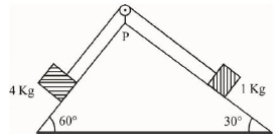
- As per given figure, a weightless pulley \(P\) is attached on a double inclined frictionless surface. The tension in the string (massless) will be (if \(g=\) \(10\,m / s ^2\) )
 JEE Mains 2023 Medium