


JEE Mains · Physics · STD 12 - Wave optics
- JEE Mains 2026
- Medium
- Numerical
Some distant star is to be observed by some telescope of diameter of objective lens \(a\), at an angular resolution of \(3.0\times 10^{-7}\) radian. If the wavelength of light from the star reaching the telescope is \(500\) nm, the minimum diameter of the objective lens of the telescope is ________ cm. (nearest integer)
Pick an option to check your answer.
Answer & Solution
Correct Answer
(B) 203
Step-by-step Solution
Detailed explanation
The angular resolution \(\Delta \theta\) of a telescope is given by the formula:
\(\Delta \theta = \dfrac{1.22 \lambda}{a}\)
where \(\lambda\) is the wavelength of light and \(a\) is the diameter of the objective lens.
Given:
\(\Delta \theta = 3.0 \times 10^{-7}\) rad
\(\lambda = 500 \text{ nm} = 500 \times 10^{-9}\) m \(= 5 \times 10^{-7}\) m
Substituting the values into the formula:
\(3.0 \times 10^{-7} = \dfrac{1.22 \times 5 \times 10^{-7}}{a}\)
\(a = \dfrac{1.22 \times 5 \times 10^{-7}}{3.0 \times 10^{-7}}\)
\(a = \dfrac{6.1}{3.0}\) m
\(a = 2.0333...\) m
Converting the diameter into centimeters:
\(a = 2.0333... \times 100\) cm \(= 203.33\) cm
Rounding to the nearest integer, we get \(203\) cm.
Answer: \(203\)
More questions from Physics
- An infinite plane sheet of charge having uniform surface charge density \(+\sigma_5 \mathrm{C} / \mathrm{m}^2\) is placed on \(\mathrm{x}-\mathrm{y}\) plane. Another infinitely long line charge having uniform linear charge density \(+\lambda_e \mathrm{C} / \mathrm{m}\) is placed at \(z=4 \mathrm{~m}\) plane and parallel to \(y\)-axis. If the magnitude values \(\left|\sigma_s\right|=2\left|\lambda_{\mathrm{e}}\right|\) then at point \((0,0,2)\), the ratio of magnitudes of electric field values due to sheet charge to that of line charge is \(\pi \sqrt{\mathrm{n}}: 1\). The value of \(n\) is _______.JEE Mains 2024 Hard
- \(\gamma_{\mathrm{A}}\) is the specific heat ratio of monoatomic gas A having 3 translational degrees of freedom. \(\gamma_B\) is the specific heat ratio of polyatomic gas B having 3 translational, 3 rotational degrees of freedom and 1 vibrational mode. If \(\frac{\gamma_{\mathrm{A}}}{\gamma_{\mathrm{B}}}=\left(1+\frac{1}{\mathrm{n}}\right)\), then the value of \(n\) is _______.JEE Mains 2025 Easy
- Consider two thin identical conducting wires covered with very thin insulating material. One of the wires is bent into a loop and produces magnetic field \(B_1,\) at its centre when a current \(I\) passes through it.The second wire is bent into a coil with three identical loops adjacent to each other and produces magnetic field \(B_2\) at the centre of the loops when current \(I/3\) passes through it. The ratio \(B_1 : B_2\) isJEE Mains 2014 Hard
- Consider a circular coil of wire carrying constant current \(I\), forming a magnetic dipole. The magnetic flux through an infinite plane that contains the circular coil and excluding the circular coil area is given by \(\phi_{i} .\) The magnetic flux through the area of the circular coil area is given by \(\phi_{0} .\) Which of the following option is correct?JEE Mains 2020 Easy
- Consider a tank made of glass (refractive index \(1.5\)) with a thick bottom. It is filled with a liquid of refractive index \(\mu \). A student finds that, irrespective of what the incident angle \(I\) (see figure) is for a beam of light entering the liquid, the light reflected from the liquid glass interface is never completely polarized. For this to happen, the minimum value of \(\mu \) is
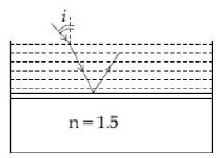 JEE Mains 2019 Hard
- A perfectly dimagnetic sphere has a small spherical cavity at its centre, which is filled with a paramagnetic substance. The whole system is placed in a uniform magnetic field \(\overrightarrow{ B }\). Then the field inside the paramagnetic substance is:
 JEE Mains 2020 Medium
More PYQs from JEE Mains
- The time period of a satellite of earth is \(24\) hours. If the separation between the earth and the satellite is decreased to one fourth of the previous value, then its new time period will become \(.......\,hours\)JEE Mains 2023 Easy
- A gas of certain mass filled in a closed cylinder at a pressure of 3.23 kPa has temperature \(50^{\circ} C\). The gas is now heated to double its temperature. The modified pressure is _________ Pa .JEE Mains 2026 Hard
- A body of mass \(2 \mathrm{~kg}\) begins to move under the action of a time dependent force given by \(\overrightarrow{\mathrm{F}}=\left(6 \mathrm{t} \hat{\mathrm{i}}+6 \mathrm{t}^2 \hat{\mathrm{j}}\right) \mathrm{N}\). The Power developed by the force at the time \(t\) is given by _______.JEE Mains 2024 Hard
- A parallel plate capacitor with plate area \(A\) and plate separation \(d =2 \,m\) has a capacitance of \(4 \,\mu F\). The new capacitance of the system if half of the space between them is filled with a dielectric material of dielectric constant \(K =3\) (as shown in figure) will be .........\( \mu \,F\)
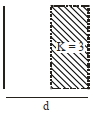 JEE Mains 2022 Hard
- An electron is allowed to move with constant velocity along the axis of current carrying straight solenoid. \(A.\) The electron will experience magnetic force along the axis of the solenoid. \(B.\) The electron will not experience magnetic force. \(C.\) The electron will continue to move along the axis of the solenoid. \(D.\) The electron will be accelerated along the axis of the solenoid. \(E.\) The electron will follow parabolic path-inside the solenoid. Choose the correct answer from the options given below:JEE Mains 2023 Medium
- A resistor dissipates \(192\, {J}\) of energy in \(1\, {s}\) when a current of \(4\, {A}\) is passed through it. Now, when the current is doubled, the amount of thermal energy dissipated in \(5 \,{s}\) in \(.....\,J.\)JEE Mains 2021 Medium