


JEE Mains · Physics · STD 12 - Wave optics
- JEE Mains 2026
- Hard
- MCQ
An unpolarized light of certain intensity passes through a combination of two polarizers whose transmission axes are at \(30°\) and \(90°\), respectively, with respect to the horizontal axis. A third polarizer with its transmission axis at \(60°\) with the horizontal axis is placed between the two existing polarizers. The ratio of the output intensities with and without the third polarizer is ______.
Pick an option to check your answer.
Answer & Solution
Correct Answer
(C) \(9/4\)
Step-by-step Solution
Detailed explanation
Let the intensity of the incident unpolarized light be \(I_0\).
After passing through the first polarizer, the intensity becomes \(I_1 = \dfrac{I_0}{2}\).
Without the third polarizer, the light passes directly from the first polarizer (at \(30^{\circ}\)) to the second polarizer (at \(90^{\circ}\)). The angle between their transmission axes is \(90^{\circ} - 30^{\circ} = 60^{\circ}\).
Using Malus's law, the output intensity without the third polarizer is:
\(I_{without} = I_1 \cos^2(60^{\circ}) = \dfrac{I_0}{2} \times \left(\dfrac{1}{2}\right)^2 = \dfrac{I_0}{8}\)
When the third polarizer (at \(60^{\circ}\)) is placed between them, the light first passes from the first polarizer to the third polarizer. The angle between their axes is \(60^{\circ} - 30^{\circ} = 30^{\circ}\).
The intensity after the third polarizer is:
\(I_3 = I_1 \cos^2(30^{\circ}) = \dfrac{I_0}{2} \times \left(\dfrac{\sqrt{3}}{2}\right)^2 = \dfrac{3I_0}{8}\)
The light then passes from the third polarizer to the second polarizer. The angle between their axes is \(90^{\circ} - 60^{\circ} = 30^{\circ}\).
The final output intensity with the third polarizer is:
\(I_{with} = I_3 \cos^2(30^{\circ}) = \dfrac{3I_0}{8} \times \left(\dfrac{\sqrt{3}}{2}\right)^2 = \dfrac{9I_0}{32}\)
The ratio of the output intensities with and without the third polarizer is:
\(\text{Ratio} = \dfrac{I_{with}}{I_{without}} = \dfrac{\dfrac{9I_0}{32}}{\dfrac{I_0}{8}} = \dfrac{9}{4}\)
Answer: \(9/4\)
More questions from Physics
- Match List \(I\) with List \(II\)
Choose the correct answer from the options given below :LIST\(-I\) LIST\(-II\) \((A)\) Surface tension \((I)\) \(Kg m ^{-1} s ^{-1}\) \((B)\) Pressure \((II)\) \(Kg ms^{-1 }\) \((C)\) Viscosity \((III)\) \(Kg m ^{-1} s ^{-2}\) \((D)\) Impulse \((IV)\) \(Kg s ^{-2}\) JEE Mains 2023 Medium - The half life of a radioactive substance is \(5\) years. After \(x\) years a given sample of the radioactive substance gest reduced to \(6.25 \%\) of its initial value of \(x\) is ...............JEE Mains 2022 Medium
- For plan electromagnetic waves propagating in the \(z-\) direction, which one of the following combination gives the correct possible direction for \(\vec E\) and \(\vec B\) field respectively?JEE Mains 2015 Medium
- What is the relative decrease in focal length of a lens for an increase in optical power by 0.1 D from 2.5D ? ['D' stands for dioptre]JEE Mains 2025 Medium
- The number density of free electrons in copper is nearly \(8 \times 10^{28}\,m ^{-3} . A\) copper wire has its area of cross section \(=2 \times 10^{-6}\,m ^2\) and is carrying a current of \(3.2\,A\). The drift speed of the electrons is \(.....\times 10^{-6}\,ms ^{-1}\).JEE Mains 2023 Easy
- When vector \(\overrightarrow{ A }=2 \hat{ i }+3 \hat{ j }+2 \hat{ k }\) is subtracted from vector \(\vec{B}\), it gives a vector equal to \(2 \hat{j}\). Then the magnitude of vector \(\vec{B}\) will be:JEE Mains 2023 Easy
More PYQs from JEE Mains
- If a semiconductor photodiode can detect a photon with a maximum wavelength of \(400\, nm ,\) then its band gap energy is Planck's constant \(h=6.63 \times 10^{-34}\, J . s\) Speed of ligh \(c =3 \times 10^{8}\, m / s\)JEE Mains 2020 Easy
-
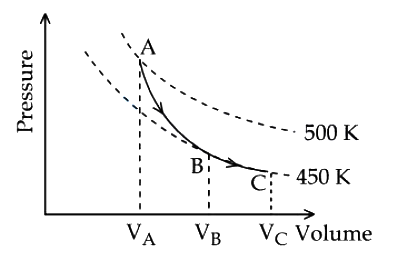
A poly-atomic molecule ( \(C_V=3 R, C_P=4 R\), where \(R\) is gas constant) goes from phase space point \(\mathrm{A}\left(\mathrm{P}_{\mathrm{A}}=10^5 \mathrm{~Pa}, \mathrm{~V}_{\mathrm{A}}=4 \times 10^{-6} \mathrm{~m}^3\right)\) to point \(\mathrm{B}\left(\mathrm{P}_{\mathrm{B}}=5 \times 10^4 \mathrm{~Pa}, \mathrm{~V}_{\mathrm{B}}=6 \times 10^{-6} \mathrm{~m}^3\right)\) to point \(\mathrm{C}\left(\mathrm{P}_{\mathrm{C}}=10^4\right.\) \(\left.\mathrm{Pa}, \mathrm{V}_{\mathrm{C}}=8 \times 10^{-6} \mathrm{~m}^3\right)\). A to B is an adiabatic path and \(B\) to \(C\) is an isothermal path. The net heat absorbed per unit mole by the system is :JEE Mains 2025 Hard - A person pushes a box on a rough horizontal platform surface. He applies a force of \(200\, N\) over a distance of \(15\, m .\) Thereafter, he gets progressively tired and his applied force reduces linearly with distance of \(100\, N\). The total distance through which the box has been moved is \(30\, m\). What is the work done by the person during the total movement of the box\(........J\)\(?\)JEE Mains 2020 Hard