


JEE Mains · Physics · STD 12 - Ray optics and optical instruments
- JEE Mains 2026
- Medium
- Numerical
A convex lens of refractive index 1.5 and focal length \(f=18 cm\) is immersed in water. The difference in focal lengths of the given lens when it is in water and in air is \(\alpha \times f\). The value of \(\alpha\) is ___________.
(refractive index of water \(=4 / 3\) )
Pick an option to check your answer.
Answer & Solution
Correct Answer
(C) 3
Step-by-step Solution
Detailed explanation
Explanation:
According to the Lens Maker's Formula, the focal length of a lens is given by:
\( \frac{1}{f} = (\mu_{rel} - 1)\left(\frac{1}{R_1} - \frac{1}{R_2}\right) \)
1. When the lens is in the air:
\( \frac{1}{f_{air}} = (\mu_g - 1)\left(\frac{1}{R_1} - \frac{1}{R_2}\right) \)
Substituting \( \mu_g = 1.5 \) and \( f_{air} = f \):
\( \frac{1}{f} = (1.5 - 1)\left(\frac{1}{R_1} - \frac{1}{R_2}\right) = 0.5 \left(\frac{1}{R_1} - \frac{1}{R_2}\right) \) --- (Equation 1)
2. When the lens is immersed in water:
The relative refractive index becomes \( \frac{\mu_g}{\mu_w} \).
\( \frac{1}{f_{water}} = \left(\frac{\mu_g}{\mu_w} - 1\right)\left(\frac{1}{R_1} - \frac{1}{R_2}\right) \)
Substituting \( \mu_g = 1.5 \) and \( \mu_w = \frac{4}{3} \):
\( \frac{1}{f_{water}} = \left(\frac{1.5}{4/3} - 1\right)\left(\frac{1}{R_1} - \frac{1}{R_2}\right) = \left(\frac{4.5}{4} - 1\right)\left(\frac{1}{R_1} - \frac{1}{R_2}\right) \)
\( \frac{1}{f_{water}} = \left(1.125 - 1\right)\left(\frac{1}{R_1} - \frac{1}{R_2}\right) = 0.125 \left(\frac{1}{R_1} - \frac{1}{R_2}\right) \) --- (Equation 2)
3. Taking the ratio of Equation 1 and Equation 2:
\( \frac{f_{water}}{f} = \frac{0.5}{0.125} = 4 \)
Therefore, \( f_{water} = 4f \)
4. Finding the difference:
Difference in focal lengths = \( f_{water} - f_{air} \)
Difference = \( 4f - f = 3f \)
Given that the difference is \( \alpha \times f \), we can clearly see that \( \alpha = 3 \).
Hence, Option C is the correct choice.
More questions from Physics
- An electric field \(\vec E\, = (25 \hat i + 30 \hat j)\,NC^{-1}\) exists in a region of space. If the potential at the origin is taken to be zero then the potential at \(x\, = 2\, m, y\, = 2\, m\) is......\(volt\)JEE Mains 2015 Medium
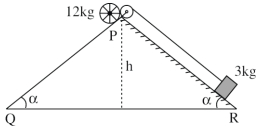
- A rolling wheel of \(12 \,kg\) is on an inclined plane at position \(P\) and connected to a mass of \(3 \,kg\) through a string of fixed length and pulley as shown in figure. Consider \(PR\) as friction free surface. The velocity of centre of mass of the wheel when it reaches at the bottom \(Q\) of the inclined plane \(P Q\) will be \(\frac{1}{2} \sqrt{ xgh } \,m / s\). The value of \(x\) is.............
 JEE Mains 2022 Hard
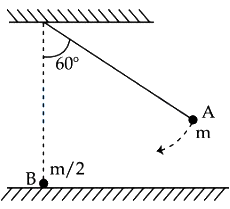
- As shown below, bob \(A\) of a pendulum having massless string of length ' \(R\) ' is released from \(60^{\circ}\) to the vertical. It hits another bob \(B\) of half the mass that is at rest on a friction less table in the center. Assuming elastic collision, the magnitude of the velocity of bob A after the collision will be (take g as acceleration due to gravity.)
 JEE Mains 2025 Hard
- A straight magnetic strip has a magnetic moment of \(44 \mathrm{Am}^2\). If the strip is bent in a semicircular shape, its magnetic moment will be _______\(\mathrm{Am}^2\) \(\left(\right.\) Given \(\left.\pi=\frac{22}{7}\right)\)JEE Mains 2024 Hard
- A wooden block floating in a bucket of water has \(\frac{4}{5}\) of its volume submerged. When certain amount of an oil is poured into the bucket, it is found that the block is just under the oil surface with half of its volume under water and half in oil. The density of oil relative to that of water isJEE Mains 2019 Hard
- Two ideal Carnot engines operate in cascade (all heat given up by one engine is used by the other engine to produce work) between temperatures, \(\mathrm{T}_{1}\) and \(\mathrm{T}_{2} .\) The temperature of the hot reservoir of the first engine is \(\mathrm{T}_{1}\) and the temperature of the cold reservoir of the second engine is \(\mathrm{T}_{2} . T\) is temperature of the sink of first engine which is also the source for the second engine. How is \(T\) related to \(\mathrm{T}_{1}\) and \(\mathrm{T}_{2}\), if both the engines perform equal amount of work?JEE Mains 2020 Medium
More PYQs from JEE Mains
- An ideal gas occupies a volume of \(2\, m^3\) at a pressure of \(3\times10^6\, Pa\). The energy of the gas isJEE Mains 2019 Medium
- At any instant the velocity of a particle of mass \(500\,g\) is \(\left(2 t \hat{ i }+3 t ^2 \hat{ j }\right)\,ms ^{-1}\). If the force acting on the particle at \(t=1 s\) is \((\hat{i}+x \hat{j}) N\). Then the value of \(x\) will be:JEE Mains 2023 Medium
- The temperature of a metal strip having coefficient of linear expansion \(\alpha\) is increased from \(T_1\) to \(T_2\) resulting in increase of its length by \(\Delta L_1\). The temperature is further increased from \(T_2\) to \(T_3\) such that the increase in its length is \(\Delta L_2\). Given \(T_3+T_1=2T_2\) and \(T_2-T_1=\Delta T\), the value of \(\Delta L_2\) is ______.JEE Mains 2026 Medium
- Consider a situation in which a ring, a solid cylinder and a solid sphere roll down on the same inclined plane without slipping. Assume that they start rolling from rest and having identical diameter. The correct statement for this situation is:-JEE Mains 2021 Medium
- A system consists of two identical spheres each of mass \(1.5\, {kg}\) and radius \(50\, {cm}\) at the end of light rod. The distance between the centres of the two spheres is \(5\, {m}\). What will be the moment of inertia of the system about an axis perpendicular to the rod passing through its midpoint ? (in \({kgm}^{2}\))JEE Mains 2021 Hard