


JEE Mains · Physics · STD 12 - Ray optics and optical instruments
- JEE Mains 2026
- Medium
- MCQ
A thin convex lens of focal length 5 cm and a thin concave lens of focal length 4 cm are combined together (without any gap) and this combination has magnification \( m_{1} \), when an object is placed 10 cm before the convex lens. Keeping the positions of convex lens and object undisturbed a gap of 1 cm is introduced between the lenses by moving the concave lens away, which lead to a change in magnification of total lens system to \( m_{2} \).
The value of \(\left|\frac{m_1}{m_2}\right|\) is __________ .
Pick an option to check your answer.
Answer & Solution
Correct Answer
(A) \( \frac{5}{6} \)
Step-by-step Solution
Detailed explanation
Explanation:
We determine the ratio of magnitudes of magnification by analyzing the system under two distinct configurations:
Case 1: Lenses in direct contact with no gap (\( d = 0 \))
1. Equivalent Focal Length Calculation:
The focal length of the convex lens is \( f_1 = +5\text{ cm} \) and the focal length of the concave lens is \( f_2 = -4\text{ cm} \). When two thin lenses are in contact, the net focal length (\( F \)) of the combination is:
\( \frac{1}{F} = \frac{1}{f_1} + \frac{1}{f_2} \)
\( \frac{1}{F} = \frac{1}{5} + \frac{1}{-4} = \frac{4 - 5}{20} = -\frac{1}{20} \implies F = -20\text{ cm} \)
2. Image Distance and Magnification (\( m_1 \)):
The object is situated at a distance of \( u = -10\text{ cm} \) from the combined lens system. Using the standard lens formula:
\( \frac{1}{v_1} - \frac{1}{u} = \frac{1}{F} \)
\( \frac{1}{v_1} - \frac{1}{-10} = \frac{1}{-20} \implies \frac{1}{v_1} = -\frac{1}{20} - \frac{1}{10} = -\frac{3}{20} \implies v_1 = -\frac{20}{3}\text{ cm} \)
The linear magnification \( m_1 \) for this combined case is:
\( m_1 = \frac{v_1}{u} = \frac{-20/3}{-10} = \frac{2}{3} \)
Case 2: Lenses separated by a distance (\( d = 1\text{ cm} \))
1. Refraction through the First Lens (Convex Lens):
For the convex lens alone, the object distance is \( u_1 = -10\text{ cm} \) and \( f_1 = +5\text{ cm} \):
\( \frac{1}{v'_1} - \frac{1}{u_1} = \frac{1}{f_1} \)
\( \frac{1}{v'_1} - \frac{1}{-10} = \frac{1}{5} \implies \frac{1}{v'_1} = \frac{1}{5} - \frac{1}{10} = \frac{1}{10} \implies v'_1 = +10\text{ cm} \)
The magnification produced by the first lens is:
\( m'_1 = \frac{v'_1}{u_1} = \frac{10}{-10} = -1 \)
2. Refraction through the Second Lens (Concave Lens):
The real image formed by the convex lens at a distance of \( 10\text{ cm} \) serves as a virtual object for the shifted concave lens. Since the concave lens is separated from the convex lens by a distance of \( 1\text{ cm} \), the virtual object distance (\( u_2 \)) measured from the concave lens is:
\( u_2 = +10\text{ cm} - 1\text{ cm} = +9\text{ cm} \)
Using the lens formula with \( f_2 = -4\text{ cm} \):
\( \frac{1}{v_2} - \frac{1}{u_2} = \frac{1}{f_2} \)
\( \frac{1}{v_2} - \frac{1}{9} = \frac{1}{-4} \implies \frac{1}{v_2} = \frac{1}{9} - \frac{1}{4} = \frac{4 - 9}{36} = -\frac{5}{36} \implies v_2 = -\frac{36}{5}\text{ cm} \)
The magnification produced by the second lens is:
\( m'_2 = \frac{v_2}{u_2} = \frac{-36/5}{9} = -\frac{4}{5} \)
3. Total Magnification (\( m_2 \)):
The net system magnification is the product of individual component magnifications:
\( m_2 = m'_1 \times m'_2 = (-1) \times \left(-\frac{4}{5}\right) = \frac{4}{5} \)
Finding the Ratio Magnitude:
Comparing the two calculated magnification parameters yields:
\( \left|\frac{m_1}{m_2}\right| = \frac{2/3}{4/5} = \frac{2}{3} \times \frac{5}{4} = \frac{5}{6} \)
Hence, Option A is the correct choice.
More questions from Physics
-

A tube of length \(L\) is shown in the figure. The radius of cross section at the point (1) is 2 cm and at the point (2) is 1 cm , respectively. If the velocity of water entering at point (1) is \(2 \mathrm{~m} / \mathrm{s}\), then velocity of water leaving the point (2) will beJEE Mains 2025 Easy - Two separate wires \(A\) and \(B\) are stretched by \(2 \,mm\) and \(4\, mm\) respectively, when they are subjected to a force of \(2\, N\). Assume that both the wires are made up of same material and the radius of wire \(B\) is 4 times that of the radius of wire \(A\). The length of the wires \(A\) and \(B\) are in the ratio of \(a : b\). Then \(a / b\) can be expressed as \(1 / x\) where \(x\) isJEE Mains 2021 Hard
- \(27\) similar drops of mercury are maintained at \(10 \,V\) each. All these spherical drops combine into a single big drop. The potential energy of the bigger drop is ....... times that of a smaller drop.JEE Mains 2021 Hard
- The value of power dissipated across the zener diode \(\left( V _{ z }=15 V \right)\) connected in the circuit as shown in the figure is \(x \times 10^{-1}\) watt. The value of \(x ,\) to the nearest integer, is ..............
 JEE Mains 2021 Medium
- A physical quantity \(p\) is described by the relation \(p\, = a^{1/2}\, b^2\, c^3\, d^{-4}\) If the relative errors in the measurement of \(a, b, c\) and \(d\) respectively, are \(2\% , 1\%, 3\%\) and \(5\%\), then the relative error in \(P\) will be ........... \(\%\)JEE Mains 2017 Medium
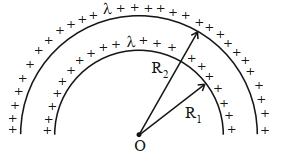
- The electric potential at the centre of two concentric half rings of radii \(R_1\) and \(R_2\), having same linear charge density \(\lambda\) is
 JEE Mains 2023 Hard
More PYQs from JEE Mains
- Given are statements for certain thermodynamic variables,
(A) Internal energy, volume (V) and mass (M) are extensive variables.
(B) Pressure (P), temperature (T) and density ( \(\rho\) ) are intensive variables.
(C) Volume (V), temperature (T) and density ( \(\rho\) ) are intensive variables.
(D) Mass (M), temperature (T) and internal energy are extensive variables.
Choose the correct answer from the options given below :JEE Mains 2025 Easy - Consider a situation in which a ring, a solid cylinder and a solid sphere roll down on the same inclined plane without slipping. Assume that they start rolling from rest and having identical diameter. The correct statement for this situation is:-JEE Mains 2021 Medium
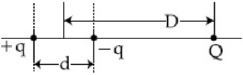
- A system of three charges are placed as shown in the figure. If \(D > > d,\) the potential energy of the system is best given \(b\)
 JEE Mains 2019 Hard
- In an ac generator, a rectangular coil of \(100\) turns each having area \(14 \times 10^{-2}\,m ^2\) is rotated at \(360\,rev / min\) about an axis perpendicular to a uniform magnetic field of magnitude \(3.0 T\). The maximum value of the emf produced will be \(............V\). \(\left(\right.\) Take \(\left.\pi=\frac{22}{7}\right)\)JEE Mains 2023 Easy
- Two identical thin rods of mass M kg and length L m are connected as shown in figure. Moment of inertia of the combined rod system about an axis passing through point P and perpendicular to the plane of the rods is \(\frac{x}{2} M L^2 kg m ^2\). The value of \(x\) is _________.
 JEE Mains 2026 Easy