


JEE Mains · Physics · STD 12 - Ray optics and optical instruments
- JEE Mains 2026
- Medium
- MCQ
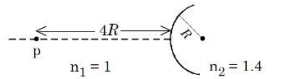
A spherical interface lens of radius \(R\) separates two media of refractive indices \(1\) and \(1.4\) respectively as shown in the figure below. A point source is placed at a distance of \(4R\) in front of spherical interface. The magnitude of the magnification of point source image is _______.
Pick an option to check your answer.
Answer & Solution
Correct Answer
(A) \(1.66\)
Step-by-step Solution
Detailed explanation
Given:
Refractive index of the first medium, \(n_1 = 1\)
Refractive index of the second medium, \(n_2 = 1.4 = \dfrac{7}{5}\)
Object distance, \(u = -4R\)
Radius of curvature of the spherical interface, \(R = +R\) (since the surface is convex towards the rarer medium)
Using the formula for refraction at a single spherical surface:
\(\dfrac{n_2}{v} - \dfrac{n_1}{u} = \dfrac{n_2 - n_1}{R}\)
Substituting the given values:
\(\dfrac{1.4}{v} - \dfrac{1}{-4R} = \dfrac{1.4 - 1}{R}\)
\(\dfrac{7}{5v} + \dfrac{1}{4R} = \dfrac{0.4}{R}\)
\(\dfrac{7}{5v} + \dfrac{1}{4R} = \dfrac{2}{5R}\)
\(\dfrac{7}{5v} = \dfrac{2}{5R} - \dfrac{1}{4R}\)
\(\dfrac{7}{5v} = \dfrac{8 - 5}{20R} = \dfrac{3}{20R}\)
\(v = \dfrac{7 \times 20R}{5 \times 3} = \dfrac{28R}{3}\)
The transverse magnification \(m\) for a spherical refracting surface is given by:
\(m = \dfrac{n_1 v}{n_2 u}\)
Substituting the values of \(n_1\), \(n_2\), \(u\), and \(v\):
\(m = \dfrac{1 \times \left(\dfrac{28R}{3}\right)}{1.4 \times (-4R)}\)
\(m = \dfrac{\dfrac{28R}{3}}{-\dfrac{28R}{5}}\)
\(m = -\dfrac{5}{3}\)
The magnitude of the magnification is:
\(|m| = \dfrac{5}{3} \approx 1.66\)
Answer: \(1.66\)
More questions from Physics
- Match List \(- I\) (Electromagnetic wave type) with List \(- II\) (Its association/application) and select the correct option from the choices given below the lists
\(a\) \(b\) \(c\) \(d\)લિસ્ટ\(-I\) લિસ્ટ\(-II\) \(a\). Infrared waves \(i\). To treat muscular strain \(b\). Radio waves \(ii\). For broadcasting \(c\). \(X-\)rays \(iii\). To detect fracture of bones \(d\). Ultraviolet rays \(iv\). Absorbed by the ozone layer of the atmosphere JEE Mains 2014 Medium - In the Bohr model an electron moves in a circular orbit around the proton . Considering the orbiting electron to be a circular current loop, the magnetic moment of the hydrogen atom; when the electron is in \(n^{th}\) excited state, isJEE Mains 2013 Hard
- The de Broglie wavelength of an electron having kinetic energy \(E\) is \(\lambda\). If the kinetic energy of electron becomes \(\frac{E}{4}\), then its de-Broglie wavelength will be :JEE Mains 2023 Easy
- When UV light of wavelength \(300 \mathrm{~nm}\) is incident on the metal surface having work function \(2.13 \mathrm{eV}\), electron emission takes place. The stopping potential is _______. (Given hc \(=1240 \mathrm{eV} \mathrm{nm}\) )JEE Mains 2024 Hard
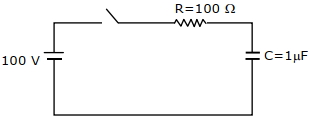
- A capacitor of capacitance \(C=1\, \mu \,{F}\) is suddenly connected to a battery of \(100\, volt\) through a resistance \({R}=100\, \Omega\). The time taken for the capacitor to be charged to get \(50 \,{V}\) is \(....\,\times \,10^{-4}\,s.\) [Take \(\ln 2=0.69]\)
 JEE Mains 2021 Medium
- A proton moving with a constant velocity passes through a region of space without any change in its velocity. If \(\vec{E}\) and \(\vec{B}\) represent the electric and magnetic fields respectively, then the region of space may have : (\(A\)) \(\mathrm{E}=0, \mathrm{~B}=0\) (\(B\)) \(\mathrm{E}=0, \mathrm{~B} \neq 0\) (\(C\)) \(\mathrm{E} \neq 0, \mathrm{~B}=0\) (\(D\)) \(\mathrm{E} \neq 0, \mathrm{~B} \neq 0\) Choose the most appropriate answer from the options given below :JEE Mains 2024 Hard
More PYQs from JEE Mains
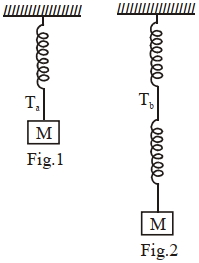
- Consider two identical springs each of spring constant \(k\) and negligible mass compared to the mass \(M\) as shown. Fig. \(1\) shows one of them and Fig. \(2\) shows their series combination. The ratios of time period of oscillation of the two \(SHM\) is \(\frac{ T _{ b }}{ T _{ a }}=\sqrt{ x },\) where value of \(x\) is (Round off to the Nearest Integer)
 JEE Mains 2021 Medium
- The frequency of oscillation of a mass \(m\) suspended by a spring is \(v_1\). If the length of the spring is cut to half, the same mass oscillates with frequency \(v_2\). The value of \(v_2/v_1\) is ________.JEE Mains 2026 Medium
- When photon of energy \(4.0\; eV\) strikes the surface of a metal \(\mathrm{A}\), the ejected photoelectrons have maximum kinetic energy \(\mathrm{T}_{\mathrm{A}}\; eV\) end de-Broglie wavelength \(\lambda_{\mathrm{A}} .\) The maximum kinetic energy of photoelectrons liberated from another metal \(\mathrm{B}\) by photon of energy \(4.50 \;eV\) is \(\mathrm{T}_{\mathrm{B}}=\left(\mathrm{T}_{\mathrm{A}}-1.5\right)\;eV\). If the de-Broglie wavelength of these photoelectrons \(\lambda_{B}=2 \lambda_{A}\) then the work function of metal \(\mathrm{B}\) is ............. \(eV\)JEE Mains 2020 Medium
- In two different experiments, an object of mass \(5\; kg\) moving with a speed of \(25\; ms ^{-1}\) hits two different walls and comes to rest within \((i)\) \(3\) second, \((ii)\) \(5\) seconds, respectively. Choose the correct option out of the following :JEE Mains 2022 Medium