


JEE Mains · Physics · STD 12 - Ray optics and optical instruments
- JEE Mains 2026
- Hard
- MCQ
A compound microscope is designed with two symmetric biconvex lenses. The objective lens is cut vertically, creating two identical plano-convex lenses. One of them is used in place of original objective lens. To retain same magnification keeping the object distance unchanged, the tube length has to be
Pick an option to check your answer.
Answer & Solution
Correct Answer
(A) increased two times
Step-by-step Solution
Detailed explanation
Focal length of the objective after cutting:
For a symmetric biconvex lens with both radii of magnitude \(R\):
\(\dfrac{1}{f_o} = (\mu - 1)\left(\dfrac{1}{R} - \dfrac{1}{-R}\right) = \dfrac{2(\mu - 1)}{R}\)
When the lens is cut vertically (perpendicular to the principal axis), each half becomes a plano-convex lens with one flat surface:
\(\dfrac{1}{f_o'} = (\mu - 1)\left(\dfrac{1}{R} - 0\right) = \dfrac{\mu - 1}{R}\)
Comparing the two: \(f_o' = 2f_o\), so the focal length of the objective doubles.
Magnification of a compound microscope:
\(M \approx \dfrac{L}{f_o} \cdot \dfrac{D}{f_e}\)
where \(L\) is the tube length, \(f_o\) is the objective focal length, \(f_e\) is the eyepiece focal length and \(D\) is the least distance of distinct vision.
Since the eyepiece and \(D\) are unchanged, equating the initial and final magnifications:
\(\dfrac{L_{\text{initial}}}{f_o} \cdot \dfrac{D}{f_e} = \dfrac{L_{\text{final}}}{2f_o} \cdot \dfrac{D}{f_e}\)
\(\dfrac{L_{\text{initial}}}{f_o} = \dfrac{L_{\text{final}}}{2f_o}\)
\(L_{\text{final}} = 2\,L_{\text{initial}}\)
Hence, to maintain the same magnification, the tube length must be doubled.
The correct option is \((1)\) increased two times.
More questions from Physics
- A particle is released on a vertical smooth semicircular track from point \(X\) so that \(OX\) makes angle \(\theta \) from the vertical ( see figure). The normal reaction of the track on the particle vanishes at point \(Y\) where \(OY\) makes angle \(\phi \) with the horizontal. Then
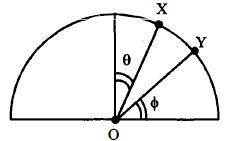 JEE Mains 2014 Hard
- A piece of wood of mass \(0.03\, kg\) is dropped from the top of a \(100\, m\) height building. At the same time, a bullet of mass \(0.02\, kg\) is fired vertically upward, with a velocity \(100\, ms^{- 1}\), from the ground. The bullet gets embedded in the wood. Then the maximum height to which the combined system reaches above the top of the building before falling below is ........ \(m\). \((g = 10\, ms^{-2})\)JEE Mains 2019 Hard
- Concentric metallic hollow spheres of radii \(R\) and \(4 R\) hold charges \(Q _{1}\) and \(Q _{2}\) respectively. Given that surface charge densities of the concentric spheres are equal, the potential difference \(V ( R )- V (4 R )\) isJEE Mains 2020 Medium
- In a Young's double slit experiment, two slits are located 1.5 mm apart. The distance of screen from slits is 2 m and the wavelength of the source is 400 nm. If the 20 maxima of the double slit pattern are contained within the centre maximum of the single slit diffraction pattern, then the width of each slit is \(\mathrm{x} \times 10^{-3} \mathrm{~cm}\), where x -value is ________.JEE Mains 2025 Easy
- A convex lens is made from glass material having refractive index of \(1.4\) with same radius of curvature on both sides. The ratio of its focal length and radius of curvature is ______.JEE Mains 2026 Medium
- Five equal resistances are connected in a network as shown in figure. The net resistance between the points \(A\) and \(B\) is
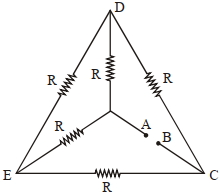 JEE Mains 2021 Medium
More PYQs from JEE Mains
- A capacitor of capacitance \(C=1\, \mu \,{F}\) is suddenly connected to a battery of \(100\, volt\) through a resistance \({R}=100\, \Omega\). The time taken for the capacitor to be charged to get \(50 \,{V}\) is \(....\,\times \,10^{-4}\,s.\) [Take \(\ln 2=0.69]\)
 JEE Mains 2021 Medium
- Solid sphere \(A\) is rotating about an axis \(PQ\). If the radius of the sphere is \(5\,cm\) then its radius of gyration about \(P Q\) will be \(\sqrt{x} \;cm\). The value of \(x\) is \(................\).
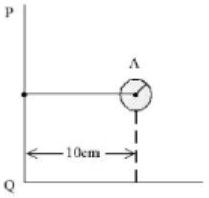 JEE Mains 2023 Medium
- When an object is kept at a distance of \(30\, cm\) from a concave mirror, the image is formed at a distance of \(10\, cm\) from the mirror. If the object is moved with a speed of \(9\, cms ^{-1}\), the speed (in \(cms ^{-1}\) ) with which image moves at that instant is\(....m/s\)JEE Mains 2020 Medium
- If the angular momentum of a planet of mass \(m\), moving a round the Sun in a circular orbit its \(L\), about the center of the Sun, its areal velocity isJEE Mains 2019 Easy