


JEE Mains · Physics · STD 12 - Wave optics
- JEE Mains 2026
- Hard
- MCQ
An unpolarized light is incident on the plane interface of air-dielectric medium shown in figure. If the incident angle is equal to Brewster angle, identify the expression representing reflected wave.

Pick an option to check your answer.
Answer & Solution
Correct Answer
(A) \((E_x\hat{i} + E_y\hat{j})\sin(kx - kz - \omega t)\)
Step-by-step Solution
Detailed explanation
From the given figure, the incident light rays lie in the \(xz\)-plane. Therefore, the plane of incidence is the \(xz\)-plane.
The incident wave travels from the air (\(z < 0\)) towards the medium (\(z > 0\)), so it propagates in the \(+x\) and \(+z\) directions. The reflected wave will travel back into the air, meaning it propagates in the \(+x\) and \(-z\) directions.
The wave vector for the reflected wave can be written as \(\vec{k}_r = k_x \hat{i} - k_z \hat{k}\).
The phase of the reflected wave is given by \(\vec{k}_r \cdot \vec{r} - \omega t = k_x x - k_z z - \omega t\). This phase matches the expression in option (1).
According to Brewster's law, when unpolarized light is incident at the Brewster angle, the reflected light is completely polarized perpendicular to the plane of incidence. Since the plane of incidence is the \(xz\)-plane, the reflected electric field must be entirely along the \(y\)-axis (\(\hat{j}\) direction).
Let us verify this with option (1), which gives the electric field as \(\vec{E} = E_x \hat{i} + E_y \hat{j}\).
For an electromagnetic wave, the electric field must be perpendicular to the direction of propagation, so \(\vec{k}_r \cdot \vec{E} = 0\).
\((k_x \hat{i} - k_z \hat{k}) \cdot (E_x \hat{i} + E_y \hat{j}) = 0\)
\(k_x E_x = 0\)
Since \(k_x \neq 0\), we must have \(E_x = 0\). This leaves \(\vec{E} = E_y \hat{j}\), which means the wave is purely polarized along the \(y\)-axis. This perfectly satisfies the condition for reflection at the Brewster angle.
Thus, the correct expression representing the reflected wave is \((E_x\hat{i} + E_y\hat{j})\sin(kx - kz - \omega t)\).
Answer: \((E_x\hat{i} + E_y\hat{j})\sin(kx - kz - \omega t)\)
More questions from Physics
- Two resistors of \(100 \Omega\) each are connected in series with a 9 V battery. A voltmeter of \(400 \Omega\) resistance is connected to measure the voltage drop across one of the resistors. The voltmeter reading is _________ V.JEE Mains 2026 Easy
- The trajectory of a projectile in a vertical plane is \(y =\alpha x -\beta x ^{2},\) where \(\alpha\) and \(\beta\) are constants and \(x \& y\) are respectively the horizontal and vertical distances of the projectile from the point of projection. The angle of projection \(\theta\) and the maximum height attained \(H\) are respectively given by :-JEE Mains 2021 Hard
- A hydraulic press containing water has two arms with diameters as mentioned in the figure. A force of \(10 \mathrm{~N}\) is applied on the surface of water in the thinner arm. The force required to be applied on the surface of water in the thicker arm to maintain equilibrium of water is _______ \({N}\).
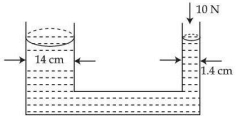 JEE Mains 2024 Hard
- Moment of inertia \((M.I.)\) of four bodies, having same mass and radius, are reported as; \(I _{1}= M\). of thin circular ring about its diameter. \(I _{2}=\) \(M.I.\) of circular disc about an axis perpendicular to the disc and going through the centre, \(I _{3}=\) \(M.I.\) of solid cylinder about its axis and \(I _{4}= M . I.\) of solid sphere about its diameter. ThenJEE Mains 2021 Medium
- A particle is moving in a circle of radius \(50 \mathrm{~cm}\) in such a way that at any instant the normal and tangential components of its acceleration are equal. If its speed at \(t=0\) is \(4 \mathrm{~m} / \mathrm{s}\), the time taken to complete the first revolution will be \(\frac{1}{\alpha}\left[1-\mathrm{e}^{-2 \pi}\right] \mathrm{s}\), where \(\alpha=\) _______.JEE Mains 2024 Hard
- A tuning fork \(A\) of unknown frequency produces \(5\, beats/s\) with a fork of known frequency \(340\, Hz\). When fork \(A\) is filed, the beat frequency decreases to \(2\, beats/s.\) What is the frequency of fork \(A\) ? (in \(Hz\))JEE Mains 2021 Hard
More PYQs from JEE Mains
- A quantity \(x\) is given by \(\left( IF v^{2} / WL ^{4}\right)\) in terms of moment of inertia \(I,\) force \(F\), velocity \(v\), work \(W\) and Length \(L\). The dimensional formula for \(x\) is same as that ofJEE Mains 2020 Hard
- A circuit connected to an \(ac\) source of \(emf\) \(e = e_0\, sin\, (1000t)\) with \(t\) in seconds, gives a phase difference of \(\frac{\pi }{4}\) between the \(emf\) \(e\) and current \(i\). Which of the following circuits will exhibit this?JEE Mains 2019 Hard
- In a Young’s double slit experiment the ratio of the slit’s width is \(4 : 1.\) The ratio of the intensity of maxima to minima, close to central fringe on the screen will beJEE Mains 2019 Medium