


JEE Mains · Physics · STD 12 - Ray optics and optical instruments
- JEE Mains 2026
- Medium
- MCQ
A thin convex lens and a thin concave lens are kept in contact and are co-axial. Which of the following statements is correct for this combination of two lenses ?
Pick an option to check your answer.
Answer & Solution
Correct Answer
(A) behaves as concave lens if \(|f_{\text{convex}}| > |f_{\text{concave}}|\)
Step-by-step Solution
Detailed explanation
The equivalent focal length \(F\) of two thin lenses in contact is given by \(\dfrac{1}{F} = \dfrac{1}{f_1} + \dfrac{1}{f_2}\)
For a convex lens, the focal length is positive, so \(f_1 = |f_{\text{convex}}|\)
For a concave lens, the focal length is negative, so \(f_2 = -|f_{\text{concave}}|\)
Substituting these values, we get \(\dfrac{1}{F} = \dfrac{1}{|f_{\text{convex}}|} - \dfrac{1}{|f_{\text{concave}}|}\)
If \(|f_{\text{convex}}| > |f_{\text{concave}}|\), then \(\dfrac{1}{|f_{\text{convex}}|} < \dfrac{1}{|f_{\text{concave}}|}\)
This implies \(\dfrac{1}{F} < 0\), so \(F\) is negative.
A negative equivalent focal length indicates that the combination behaves as a diverging or concave lens.
Interchanging the positions of the lenses does not change the equivalent focal length since \(\dfrac{1}{f_1} + \dfrac{1}{f_2} = \dfrac{1}{f_2} + \dfrac{1}{f_1}\).
Answer: behaves as concave lens if \(|f_{\text{convex}}| > |f_{\text{concave}}|\)
More questions from Physics
- An \(LCR\) circuit as shown in the figure is connected to a voltage source \(V_{ac}\) whose frequency can be varied. The frequency, at which the voltage across the resistor is maximum, is......\(Hz\)
 JEE Mains 2013 Easy
- Identify the correct statements :
A. Effective capacitance of a series combination of capacitors is always smaller than the smallest capacitance of the capacitor in the combination.
B. When a dielectric medium is placed between the charged plates of a capacitor, displacement of charges cannot occur due to insulation property of dielectric.
C. Increasing of area of capacitor plate or decreasing of thickness of dielectric is an alternate method to increase the capacitance.
D. For a point charge, concentric spherical shells centered at the location of the charge are equipotential surfaces.
Choose the correct answer from the options given below.JEE Mains 2026 Medium - If two glass plates have water between them and are separated by very small distance ( see figure), it is very difficult to pull them apart. It is because the water in between forms cylindrical surface on the side that gives rise to lower pressure in the water in comparison to atmosphere. If the radius of the cylindrical surface is \(R\) and surface tension of water is \(T\) then the pressure in water between the plates is lower by
 JEE Mains 2015 Medium
- In a microscope of tube length 10 cm two convex lenses are arranged with focal length of 2 cm and 5 cm . Total magnification obtained with this system for normal adjustment is \((5)^{ k }\). The value of k is _________JEE Mains 2026 Easy
- A monoatomic gas at pressure \(P\) and volume \(V\) is suddenly compressed to one eighth of its original volume. The final pressure at constant entropy will be \(.....P\)JEE Mains 2022 Hard
- Given below are two statements: Statement \(I\) : In hydrogen atom, the frequency of radiation emitted when an electron jumps from lower energy orbit \(\left( E _{1}\right)\) to higher energy orbit \(\left( E _{2}\right)\), is given as \(hf = E _{1}- E _{2}\). Statement \(II\) : The jumping of electron from higher energy orbit \(\left(E_{2}\right)\) to lower energy orbit \(\left(E_{1}\right)\) is associated with frequency of radiation given as \(f\) \(=\left( E _{2}- E _{1}\right) / h\) This condition is Bohr's frequency condition. In the light of the above statements, choose the correct answer from the options given belowJEE Mains 2022 Medium
More PYQs from JEE Mains
- The acceleration due to gravity at height \(h\) above the earth if \(h \ll R\) (radius of earth) is given byJEE Mains 2023 Medium
- Which of the following equations represents a travelling wave ?JEE Mains 2021 Easy
- A parallel-plate capacitor of capacitance \(40 \mu \mathrm{~F}\) is connected to a 100 V power supply. Now the intermediate space between the plates is filled with a dielectric material of dielectric constant \(\mathrm{K}=2\). Due to the introduction of dielectric material, the extra charge and the change in the electrostatic energy in the capacitor, respectively, areJEE Mains 2025 Medium
- A series \(LR\) circuit is connected to an ac source of frequency \(\omega \) and the inductive reactance is equal to \(2R\). A capacitance of capacitive reactance equal to \(R\) is added in series with \(L\) and \(R\). The ratio of the new power factor to the old one isJEE Mains 2013 Hard
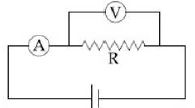
- The actual value of resistance \(R\), shown in the figure is \(30\,\Omega \). This is measured in an experiment as shown using the standard formula \(R = \frac{V}{I}\) where \(V\) and \(I\) are the readings of the voltmeter and ammeter, respectively. If the measured value of \(R\) is \(5\%\) less, then the internal resistance of the voltmeter is ................. \(\Omega\)
 JEE Mains 2019 Medium
- For particle \(P\) revolving round the centre \(O\) with radius of circular path \(r\) and angular velocity \(\omega\), as shown in below figure, the projection of \(OP\) on the \(x\)-axis at time \(t\) is \(.................\).
 JEE Mains 2023 Easy