


All JEE Mains 2021 Physics questions
32 chaptersShowing 501–550 of 685 questions
-
- (A) \(174\)
- (B) \(280\)
- (C) \(180.4\)
- (D) \(382\)
Show answer and solution
Correct Answer: (A)
\({T}_{2}=\) sink temperature\(\eta=1-\frac{{T}_{2}}{{T}_{1}}\)
\(\frac{1}{4}=1-\frac{{T}_{2}}{{T}_{1}}\)
\(\frac{{T}_{2}}{{T}_{1}}=\frac{3}{4} \ldots\) \((i)\)
\(\frac{1}{2}=1-\frac{{T}_{2}-58}{{T}_{1}}\)
\(\frac{{T}_{2}}{{T}_{1}}-\frac{58}{{T}_{1}}=\frac{1}{2}\)
\(\frac{3}{4}=\frac{58}{{T}_{1}}+\frac{1}{2}\)
\(\frac{1}{4}=\frac{58}{{T}_{1}} \Rightarrow {T}_{1}=232\)
\({T}_{2}=\frac{3}{4} \times 232\)
\({T}_{2}=174\, {K}\)
-
- (A) \(256\)
- (B) \(208\)
- (C) \(104\)
- (D) \(52\)
Show answer and solution
Correct Answer: (B)
\(\eta=\frac{1}{4}=1-\frac{ T _{2}}{ T _{1}}\)\(\frac{ T _{2}}{ T _{1}}=\frac{3}{4}\)
\(\frac{ T _{2}-52}{ T _{1}}=\frac{1}{2}\)
-
- (A) \(0.5\)
- (B) \(240\)
- (C) \(48\)
- (D) \(480\)
Show answer and solution
Correct Answer: (D)
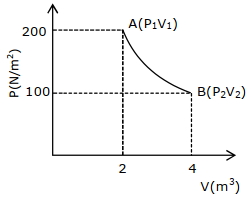
\(\gamma=1.5\)\(p_{1} v_{1}^{\gamma}=p_{2} v_{2}^{\gamma}\)
\((200)(1200)^{1.5}=P^{2}(300)^{1.5}\)
\(P_{2}=200[4]^{3 / 2}=1600 {kPa}\)
\(\mid\) W.D. \(\mid=\frac{{p}_{2} {v}_{2}-{p}_{1} {v}_{1}}{v-1}=\left(\frac{480-240}{0.5}\right)=480 {J}\)
-
- (A) \(250\)
- (B) \(410\)
- (C) \(300\)
- (D) \(150\)
Show answer and solution
Correct Answer: (A)
\(\Delta \mathrm{Q}=\Delta \mathrm{U}+\Delta \mathrm{W}\)\(\frac{\Delta \mathrm{Q}}{\Delta \mathrm{t}}=\frac{\Delta \mathrm{U}}{\Delta \mathrm{t}}+\frac{\Delta \mathrm{W}}{\Delta \mathrm{t}}\)
\(\frac{6000}{60} \frac{\mathrm{J}}{\mathrm{sec}}=\frac{2.5 \times 10^{3}}{\Delta \mathrm{t}}+90\)
\(\Delta \mathrm{t}=250 \,\mathrm{sec}\)
- 505. For an adiabatic expansion of an ideal gas, the fractional change in its pressure is equal to (where \(\gamma\) is the ratio of specific heats): 2021 Medium
- (A) \(-\gamma \frac{ dV }{ V }\)
- (B) \(-\gamma \frac{ V }{ dV }\)
- (C) \(-\frac{1}{\gamma} \frac{ dV }{ V }\)
- (D) \(\frac{ d V }{ V }\)
Show answer and solution
Correct Answer: (A)
\(PV ^{\gamma}=\) constantDifferentiating
\(\frac{ dP }{ dV }=-\frac{\gamma P }{ V }\)
\(\frac{ dP }{ P }=-\frac{\gamma dV }{ V }\)
-
- (A) \(-\,113\)
- (B) \(121\)
- (C) \(107\)
- (D) \(128\)
Show answer and solution
Correct Answer: (A)
\(n =0.60=1=\frac{ T _{ L }}{ T _{ H }}\)\(\frac{ T _{ L }}{ T _{ H }}=0.4 \Rightarrow T _{ L }=0.4 \times 400\)
\(=160\, K\)
\(=-113\,^{\circ} C\)
-
- (A) \(RT \left(\ln 2-\frac{1}{2(\gamma-1)}\right)\)
- (B) \(-\frac{ RT }{2(\gamma-1)}\)
- (C) \(0\)
- (D) \(RT \ln 2\)
Show answer and solution
Correct Answer: (A)
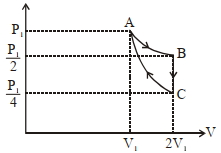
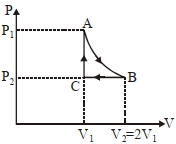
\(A-B=\) isothermal process\(W _{ AB }= P _{1} V _{1} \ln \left[\frac{2 V _{1}}{ V _{1}}\right]= P _{1} V _{1} \ln (2)\)
\(B - C \rightarrow\) Isochoric process
\(W _{ BC }=0\)
\(C - A \rightarrow\) Adiabatic process
\(W _{ CA }=\frac{ P _{1} V _{1}-\frac{ P _{1}}{4} \times 2 V _{1}}{1-\gamma}=\frac{ P _{1} V _{1}\left[1-\frac{1}{2}\right]}{1-\gamma}=\frac{ P _{1} V _{1}}{2(1-\gamma)}\)
\(W _{ net }= W _{ AB }+ W _{ BC }+ W _{ CA } \quad\left\{ P _{1} V _{1}= RT \right\}\)
\(= P _{1} V _{1} \ln (2)+0+\frac{ P _{1} V _{1}}{2(1-\gamma)}\)
\(W _{\text {net }}= RT \left[\ln (2)-\frac{1}{2(\gamma-1)}\right]\)
-
- (A) \(25\)
- (B) \(40\)
- (C) \(50\)
- (D) \(60\)
Show answer and solution
Correct Answer: (C)
\(P=k V^{3}\)\(T_{i}=100^{\circ} C \)
\(T _{ f }=300^{\circ} C\)
\(\Delta T =300-100\)
\(\Delta T =200^{\circ} C\)
\(P = kV ^{3}\)
now \(PV = nRT\)
\(\therefore kV ^{4}= nRT\)
now \(4 kV ^{3} dV = nRdT\)
\(\therefore PdV = nRdT / 4\)
\(\therefore\) Work \(=\int PdV =\int \frac{ nRdT }{4}=\frac{ nR }{4} \Delta T\)
\(=\frac{200}{4} \times nR =50 nR\)
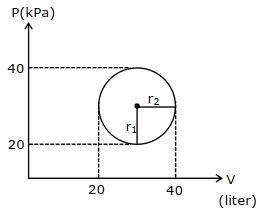
- 509. In the reported figure, heat energy absorbed by a system in going through a cyclic process is \(......\,\pi J\)
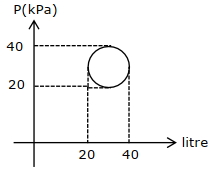 2021 Medium
- (A) \(50\)
- (B) \(150\)
- (C) \(100\)
- (D) \(200\)
Show answer and solution
Correct Answer: (C)
For complete cyclic process\(\Delta U=0\)
\(\therefore \text { from } \Delta Q=\Delta U+W\)
\(=0+W\)
\(\Delta Q=W\)
\(=\text { Area }\)
\(=\pi r_{1} \cdot r_{2}\)
\(=\pi \times\left(10 \times 10^{3}\right)\left(10 \times 10^{-3}\right)\)
\(\Delta Q=100 \pi\)
\(\therefore \text { Ans. }=100\)
-
- (A) \({W}_{{AB}}\,<\,{W}_{{CD}}\)
- (B) \({W}_{{AD}}={W}_{{BC}}\)
- (C) \({W}_{{BC}}+{W}_{{DA}}\,>\,0\)
- (D) \({W}_{{AB}}={W}_{{DC}}\)
Show answer and solution
Correct Answer: (B)
Work done in adiabatic process \(=\frac{-n R}{\gamma-1}\left(T_{f}-T_{i}\right)\)\(\therefore W _{ AD }=\frac{- nR }{\gamma-1}\left( T _{2}- T _{1}\right)\)
\(\text { and } W _{ BC }=\frac{- nR }{\gamma-1}\left( T _{2}- T _{1}\right)\)
\(\therefore W _{ AD }= W _{ BC }\)
-
- (A) Path functions
- (B) Intensive thermodynamic state variables
- (C) Extensive thermodynamic state variables
- (D) Point functions
Show answer and solution
Correct Answer: (A)
Heat and work are treated as path functions in thermodynamics.\(\Delta Q =\Delta U +\Delta W\)
Since work done by gas depends on type of
process i.e. path and \(\Delta U\) depends just on initial
and final states, so \(\Delta Q\) i.e. heat, also has to
depend on process is path.
-
- (A) \(( a ) \rightarrow( i ),( b ) \rightarrow( iii ),( c ) \rightarrow( ii ),( d ) \rightarrow( iv )\)
- (B) \(( a ) \rightarrow( ii ),( b ) \rightarrow( iii ),( c ) \rightarrow( iv ),( d ) \rightarrow( i )\)
- (C) \((a) \rightarrow (ii), (b) \rightarrow( iv ),( c ) \rightarrow( iii ),( d ) \rightarrow( i )\)
- (D) \((a) \rightarrow( iii ),( b ) \rightarrow( ii ),( c ) \rightarrow( i ),( d ) \rightarrow( iv )\)
Show answer and solution
Correct Answer: (B)
\((a)\) Isothermal \(\Rightarrow\) Temperature constant\((a)\) \(\rightarrow\) \((ii)\)
\((b)\) Isochoric \(\Rightarrow\) Volume constant
\((a)\) \(\rightarrow\) \((iii)\)
\((c)\) Adiabatic \(\Rightarrow \Delta Q=0\)
\(\Rightarrow\) Heat content is constant
\((c)\) \(\rightarrow\) \((iv)\)
\((d)\) Isobaric \(\Rightarrow\) Pressure constant
\((d)\) \(\rightarrow\) \((i)\)
-
- (A) \(0\)
- (B) \(nRT \left(\ln 2+\frac{1}{2}\right)\)
- (C) \(nRTIn2\)
- (D) \(nRT \left(\ln 2-\frac{1}{2}\right)\)
Show answer and solution
Correct Answer: (D)
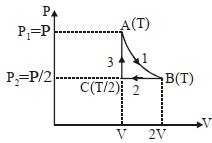
\(W _{\text {Isothermal }}= nRT \ln \left(\frac{ v _{2}}{ v _{1}}\right)\)\(W _{\text {Isobaric }}= P \Delta V = nR \Delta T\)
\(W _{\text {Isochoric }}=0\)
\(W _{1}= nRT \ln \left(\frac{2 V }{ V }\right)= nRT \ln 2\)
\(W _{2}= nR \left(\frac{ T }{2}- T \right)=- nR \frac{ T }{2}\)
\(W _{3}=0\)
\(\Rightarrow W _{ net }= W _{1}+ W _{2}+ W _{3}\)
\(W _{ net }= nRT \left(\ln 2-\frac{1}{2}\right)\)
-
- (A) \(30012\)
- (B) \(2147\)
- (C) \(834\)
- (D) \(17258\)
Show answer and solution
Correct Answer: (D)
Process of isothermal\(W=n R T \ln \left(\frac{V_{2}}{V_{1}}\right)\)
\(1 \times 8.3 \times 300 \times \ln 2\)
\(=17258 \times 10^{-1} {J}\)
-
- (A) Work done on the gas is close to \(582\, J\)
- (B) Work done by the gas is close to \(332\, J\)
- (C) Work done by the gas is close to \(582 \,{J}\)
- (D) Work done on the gas is close to \(332 \,J\)
Show answer and solution
Correct Answer: (A)
For an ideal gas, each vibrational mode, corresponds to two degrees of freedom, hence, \({f}=3\) (trans.) \(+3(\) rot. \()+8(\) vib. \()=14\)\(\gamma=1+\frac{2}{f}\)
\(\gamma =1+\frac{2}{14}=\frac{8}{7}\)
\(W =\frac{n R \Delta T}{\gamma-1}=-582\)
As \({W}\,<\,0\). Work is done on the gas.
-
- (A) \(750\)
- (B) \(175\)
- (C) \(500\)
- (D) \(250\)
Show answer and solution
Correct Answer: (C)
\(\Delta Q=\Delta U+\Delta W\)Here \(\Delta W=0\)
\(\Delta Q=\Delta {U}={nC}_{v} \Delta {T}\)
\(\Delta Q=4 \times \frac{5 R}{2}(50)=500 \,{R}\)
-
- (A) \(-500\)
- (B) \(-400\)
- (C) \(400\)
- (D) \(200\)
Show answer and solution
Correct Answer: (A)
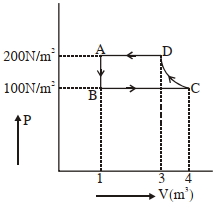
Adiabatic process is from \(C\) to \(D\)\(WD =\frac{ P _{2} V _{2}- P _{1} V _{1}}{1-\gamma}\)
\(=\frac{P_{D} V_{D}-P_{C} V_{C}}{1-\gamma}\)
\(=\frac{200(3)-(100)(4)}{1-1.4}\)
\(=-500\, J\)
-
- (A) \(25\)
- (B) \(2.5\)
- (C) \(125\)
- (D) \(250\)
Show answer and solution
Correct Answer: (A)
Pressure is not changing \(\Rightarrow\) isobaric process\(\Rightarrow \Delta {U}={n} {C}_{{v}} \Delta {T}=\frac{5 {nR} \Delta {T}}{2}\)
and \({W}={n} {R} \Delta {T}\)
\(\frac{\Delta {U}}{{W}}=\frac{5}{2}=\frac{{x}}{10} \Rightarrow {x}=25.00\)
-
- (A) \(50\)
- (B) \(60\)
- (C) \(48\)
- (D) \(72\)
Show answer and solution
Correct Answer: (B)
We know that work done is\(W =\int PdV\quad \ldots (1)\)
\(\Rightarrow P=\frac{ nRT }{ V }\quad \ldots (2)\)
\(\Rightarrow W =\int \frac{ nRT }{ V } dv\quad \ldots (3)\)
and \(V = KT ^{2 . / 3}\quad \ldots (4)\)
\(\Rightarrow W =\int \frac{ nRT }{ KT ^{2 / 3}} \cdot dv \quad \ldots (5)\)
\(\Rightarrow\) from (4)\(: dv =\frac{2}{3} KT ^{-1 / 3} dT\)
\(\Rightarrow W =\int_{ T _{1}}^{ T _{2}} \frac{ nRT }{ KT ^{2 / 3}} \frac{2}{3} K \frac{1}{ T ^{1 / 3}} dT\)
\(\Rightarrow W =\frac{2}{3} n R \times\left( T _{2}- T _{1}\right) \ldots(6)\)
\(\Rightarrow T _{2}- T _{1}=90 K \ldots(7)\)
\(\Rightarrow W=\frac{2}{3} n R \times 90\)
\(\Rightarrow W =60 nR\)
Assuming \(1\) mole of gas
\(n =1\)
So \(W =60 \,R\)
-
- (A) \(\frac{1}{2}\)
- (B) \(2\)
- (C) \(\sqrt{2}\)
- (D) \(\frac{1}{\sqrt{2}}\)
Show answer and solution
Correct Answer: (C)
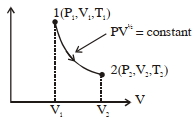
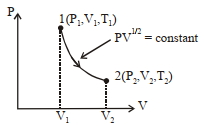
\(PV ^{1 / 2}= c\)\(\frac{ nRT }{ V } V ^{1 / 2}= c\)
\(T = c ^{1} V ^{1 / 2}\)
\(\frac{ T _{2}}{ T _{1}}=\left(\frac{ V _{2}}{ V _{1}}\right)^{1 / 2}=\left(\frac{2 V _{1}}{ V _{1}}\right)^{1 / 2}\)
\(\frac{ T _{2}}{ T _{1}}=\sqrt{2}\)
-
- (A) \(\frac{2}{3} {T}_{1}+\frac{1}{3} T_{3}\)
- (B) \(\frac{3}{2} {T}_{1}+\frac{1}{3} {T}_{3}\)
- (C) \(\frac{1}{3} {T}_{1}+\frac{2}{3} {T}_{3}\)
- (D) \(\frac{2}{3} {T}_{1}+\frac{3}{2} {T}_{3}\)
Show answer and solution
Correct Answer: (A)
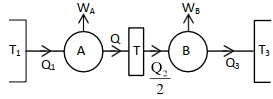
carnot engine is as shown\({W}_{{A}}=1-\frac{{Q}_{2}}{{Q}_{1}}=1-\frac{{T}}{{T}_{1}} \Rightarrow \frac{{Q}_{2}}{{Q}_{1}}=\frac{{T}}{{T}_{1}}\)
\({W}_{{B}}=1-\frac{{Q}_{3}}{\left({Q}_{2} / 2\right)}=1-\frac{{T}_{3}}{{T}} \Rightarrow \frac{2 {Q}_{3}}{{Q}_{2}}=\frac{{T}_{3}}{{T}}\)
Now, \({W}_{{A}}={W}_{{B}}\)
\({Q}_{1}-{Q}_{2}=\frac{{Q}_{2}}{2}-{Q}_{3}\)
\(\Rightarrow \frac{2 {Q}_{1}}{{Q}_{2}}+\frac{2 {Q}_{3}}{{Q}_{2}}=3\)
\(\Rightarrow \frac{2 {T}_{1}}{{T}}+\frac{{T}_{3}}{{T}}=3\)
\(\frac{2 {T}_{1}}{3}+\frac{{T}_{3}}{3}={T}\)
-
- (A) \((c)\) and \((a)\)
- (B) \((c)\) and \((d)\)
- (C) \((a)\) only
- (D) \((b)\) and \((c)\)
Show answer and solution
Correct Answer: (B)
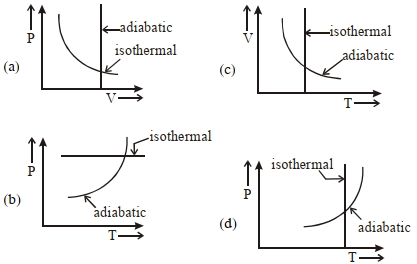
Option \((a)\) is wrong ; since in adiabatic process \(V \neq\) constantOption \((b)\) is wrong, since in isothermal process
\(T = constant\)
Option \((c)\) and \((d)\) matches isothermes and adiabatic formula :
\(TV ^{\gamma-1}=\) constant and \(\frac{ T ^{\gamma}}{ p ^{\gamma-1}}= constant\)
-
- (A) Bend towards the right
- (B) Not bend but shrink
- (C) Neither bend nor shrink
- (D) Bend towards the left
Show answer and solution
Correct Answer: (D)
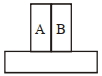
\(\alpha_{ A }>\alpha_{ B }\)Length of both strips will decrease
\(\Delta L _{ A }>\Delta L _{ B }\)

-
- (A) \(8\)
- (B) \(80\)
- (C) \(0.8\)
- (D) \(85\)
Show answer and solution
Correct Answer: (A)
Thermal force \({F}={Ay}\alpha \Delta {T}\)\(F=\left(10 \times 10^{-4}\right)\left(2 \times 10^{11}\right)\left(10^{-5}\right)(400)\)
\(F=8 \times 10^{5} {N}\)
\(\Rightarrow {x}=8\)
- 525. An ideal gas is expanding such that \({PT}^{3}=\) constant. The coefficient of volume expansion of the gas is: 2021 Hard
- (A) \(\frac{1}{{T}}\)
- (B) \(\frac{2}{{T}}\)
- (C) \(\frac{4}{{T}}\)
- (D) \(\frac{3}{{T}}\)
Show answer and solution
Correct Answer: (C)
\({PT}^{3}={constant}\)\(\left(\frac{{nRT}}{{v}}\right) {T}^{3}=\) constant
\({T}^{4} {V}^{-1}=\text { constant }\)
\({T}^{4}={kV}\)
\(\Rightarrow 4 \frac{\Delta {T}}{{T}}=\frac{\Delta {V}}{{V}} \ldots . .(1)\)
\(\Delta {V}={V} \gamma \Delta {T} . \ldots \ldots \ldots .(2)\)
comparing \((1)\) and \((2)\) we get
\(\gamma=\frac{4}{{T}}\)
-
- (A) \(0.353\)
- (B) \(35.3\)
- (C) \(3.53\)
- (D) \(70.6\)
Show answer and solution
Correct Answer: (B)
mass of ice \({m}=\rho {A} \ell=10^{3} \times 10^{-4} \times 1=10^{-1}\, {kg}\)Energy required to melt the ice
\({Q}={ms} \Delta {T}+{mL}\)
\(=10^{-1}\left(2 \times 10^{3} \times 10+3.33 \times 10^{5}\right)=3.53 \times 10^{4} {J}\)
\({Q}={i}^{2} {RT} \Rightarrow 3.53 \times 10^{4}=\left(\frac{1}{2}\right)^{2}\left(4 \times 10^{3}\right)({t})\)
\(\text { Time }=35.3 \,{sec}\)
-
- (A) \(3 a^{3} \alpha \Delta T\)
- (B) \(4 a ^{3} \alpha \Delta T\)
- (C) \(4 \pi a ^{3} \alpha \Delta T\)
- (D) \(\frac{4}{3} \pi a ^{3} \alpha \Delta T\)
Show answer and solution
Correct Answer: (A)
\(\Delta V = V \gamma \Delta T\)\(\Delta V =3 a ^{3} \alpha \Delta T\)
-
- (A) Both \(A\) and \(R\) are true but \(R\) is \(NOT\) the correct explanation of \(A\)
- (B) \(A\) is false but \(R\) is true
- (C) \(A\) is true but \(R\) is false
- (D) Both \(A\) and \(R\) are true and \(R\) is the correct explanation of \(A\)
Show answer and solution
Correct Answer: (A)
\(A\) and \(R\) are true but \(R\) is not the correct explanation of \(A\) - 529. If the length of the pendulum in pendulum clock increases by \(0.1\, \%\), then the error in time per day is: (in \(s\)) 2021 Hard
- (A) \(86.4\)
- (B) \(4.32\)
- (C) \(43.2\)
- (D) \(8.64\)
Show answer and solution
Correct Answer: (C)
\({T}=2 \pi \sqrt{\frac{\ell}{g}}\)\(\frac{\Delta {T}}{{T}}=\frac{1}{2} \frac{\Delta \ell}{\ell}\)
\(\Delta {T}=\frac{1}{2} \times \frac{0.1}{100} \times 24 \times 3600\)
\(\Delta {T}=43.2\)
-
- (A) \(0.147\)
- (B) \(14.76\)
- (C) \(1.476\)
- (D) \(0.014\)
Show answer and solution
Correct Answer: (A)
Change in \(P.E.\) \(=\) Heat energy\({mgh}={mS} \Delta {T}\)
\(\Delta {T} =\frac{g h}{S}\)
\(=\frac{10 \times 63}{4200\, {J} / {kgC}}\)
\(=0.147^{\circ} {C}\)
-
- (A) \(28.32\)
- (B) \(25.62\)
- (C) \(23.84\)
- (D) \(20.28\)
Show answer and solution
Correct Answer: (C)
\({X} \quad \quad\quad \quad \quad\quad {Y} \quad\quad \quad \quad \quad \quad {Z}\)\({m}_{1}={m}\quad\quad \quad {m}_{2}={m}\quad \quad \quad \quad {m}_{3}={m}\)
\({T}_{1}=10^{\circ} {C}\quad \quad {T}_{2}=20^{\circ} {C}\quad \quad {T}_{3}=30^{\circ} {C}\)
\({s}_{1}\quad \quad \quad \quad \quad \quad {s}_{2}\quad \quad \quad \quad \quad \quad \quad {s}_{3}\)
when \({x} \;and\; {y}\) are mixed, \({T}_{{f}_{{l}}}=16^{\circ} {C}\)
\({m}_{1} {S}_{1} {T}+{m}_{2} {s}_{2} {T}_{2}=\left({m}_{1} {S}_{1}+{m}_{2} {S}_{2}\right) {Tf}_{1}\)
\({s}_{1} \times 10+{s}_{2} \times 20=\left({s}_{1}+{s}_{2}\right) \times 16\)
\({s}_{1}=\frac{2}{3} {s}_{2}\)
When \(y \;and\; z\) are mixex, \(T_{f_{2}}=26^{\circ} {C}\)
\({m}_{2} {s}_{2} {T}+{m}_{3} {s}_{3} {T}_{3}=\left({m}_{3} {s}_{3}+{m}_{3} {s}_{3}\right) {T} {f}_{2}\)
\({s}_{2} \times 20+{s}_{3} \times 30=\left({s}_{2}+{s}_{3}\right) \times 26\)
\({s}_{3}=\frac{3}{2} {s}_{2} \quad \ldots . . \text { (ii) }\)
when \(x \;and\; z\) are mixex
\({m}_{1} {s}_{1} {T}_{1}+{m}_{3} {S}_{3} {T}_{3}=\left({m}_{1} {s}_{1}+{m}_{3} {S}_{3}\right) {Tf}\)
\(\frac{2}{3} {s}_{2} \times 10+\frac{2}{3} {s}_{2} \times 20=\left(\frac{2}{3} {s}_{2}+\frac{3}{2} {s}_{2}\right) {T}_{{f}}\)
\({T}_{{f}}=23.84^{\circ} {C}\)
-
- (A) \(\frac{8}{3}\)
- (B) \(\frac{3}{8}\)
- (C) \(\frac{3}{4}\)
- (D) \(\frac{4}{3}\)
Show answer and solution
Correct Answer: (B)
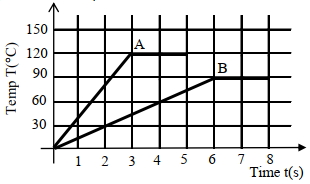
\(\left(\frac{\Delta Q }{\Delta t }\right)_{ A }=\left(\frac{\Delta Q }{\Delta t }\right)_{ B }\)\(mc _{ A }\left(\frac{\Delta T }{\Delta t }\right)_{ A }= mc _{ B }\left(\frac{\Delta T }{\Delta t }\right)_{ B }\)
\(\frac{c_{ A }}{c _{ B }}=\frac{\left(\frac{\Delta T }{\Delta t }\right)_{ A }}{\left(\frac{\Delta T }{\Delta t }\right)_{ B }}=\frac{90 / 6}{120 / 3}=\frac{15}{40}=\frac{3}{8}\)
-
- (A) \(10\)
- (B) \(15\)
- (C) \(25\)
- (D) \(20\)
Show answer and solution
Correct Answer: (D)
\(\frac{1}{2} \cdot k \cdot x ^{2}=\frac{1}{2} \cdot \frac{ YA }{ L }\cdot x ^{2}\)By energy conservation
\(\frac{1}{2} \cdot \frac{ YA }{ L } \cdot x ^{2}=\frac{1}{2} mv ^{2}\)
\(\frac{0.5 \times 10^{9} \times 10^{-6} \times(0.04)^{2}}{0.1}=\frac{20}{1000} v ^{2}\)
\(\therefore \quad v ^{2}=400\)
\( v =20 m / s\)
-
- (A) \(2\)
- (B) \(0\)
- (C) \(1\)
- (D) \(4\)
Show answer and solution
Correct Answer: (A)
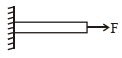
\(F = Y.A \frac{\Delta \ell}{\ell}\)\(\Delta \ell=\frac{ F }{ Y.A } \cdot \ell\)
\(\Delta \ell=\frac{ F \ell}{ Y \cdot \pi r ^{2}}\)
\(\Delta \ell \propto \frac{\ell}{ r ^{2}}\)
\(\frac{\Delta \ell_{2}}{\Delta \ell_{1}}=\left(\frac{\ell_{2}}{\ell_{1}}\right)\left(\frac{ r _{1}}{ r _{2}}\right)^{2}\)
\(=(2)(\frac{1}{2})^2\)
\(\frac{\Delta \ell_{2}}{\Delta \ell_{1}}=\frac{1}{2}\)
\(\Delta \ell_{2}=\frac{\Delta \ell_{1}}{2}\)
\(=\frac{0.04}{2}\)
\(=0.02\, m\)
\(\Delta \ell_{2}=2\, cm\)
-
- (A) \(3.60 \times 10^{-8}\)
- (B) \(2.60 \times 10^{-7}\)
- (C) \(1.87 \times 10^{-3}\)
- (D) \(7.07 \times 10^{-4}\)
Show answer and solution
Correct Answer: (B)
Force on each column \(=\frac{{mg}}{4}\)\(\text { Strain } =\frac{{mg}}{4 {AY}}\)
\(=\frac{50 \times 10^{3} \times 9.8}{4 \times \pi(1-0.25) \times 2 \times 10^{11}}\)
\(=2.6 \times 10^{-7}\)
-
- (A) \(Y =\frac{9 K \eta}{3 K -\eta} N / m ^{2}\)
- (B) \(\eta=\frac{3 YK }{9 K + Y } N / m ^{2}\)
- (C) \(Y =\frac{9 K \eta}{2 \eta+3 K } N / m ^{2}\)
- (D) \(K =\frac{ Y\eta }{9 \eta-3 Y } N / m ^{2}\)
Show answer and solution
Correct Answer: (D)
\(Y-\) Younge modulus, \(K\) - Bulk modulus,\(\eta\) - modulus of rigidity
We know that
\(y=3 k(1-2 \sigma)\)
\(\sigma=\frac{1}{2}\left(1-\frac{ y }{3 k }\right)\) \(.........(i)\)
\(y =2 \eta(1+\sigma)\)
\(\sigma=\frac{y}{2 \eta}-1\) \(........(ii)\)
From Eq.\((i)\) and Eq. \((ii)\)
\(\frac{1}{2}\left(1-\frac{ Y }{3 k }\right)=\frac{ y }{2 \eta}-1\)
\(1-\frac{y}{3 k}=\frac{y}{\eta}-2\)
\(\frac{y}{3 k}=3-\frac{y}{\eta}\)
\(\frac{y}{3 k}=\frac{3 \eta-y}{\eta}\)
\(\frac{\eta y }{3 k }=3 \eta- y\)
\(k =\frac{\eta y }{9 \eta-3 y }\)
-
- (A) \(4\)
- (B) \(5\)
- (C) \(6\)
- (D) \(7\)
Show answer and solution
Correct Answer: (B)
Elastic energy \(=\frac{Y}{2}(\text { strain })^{2} \times\) Area \(\times\) lengthElastic energy per unit length \(=\frac{Y}{2}(\text { strain })^{2} \times\) Area
\(\left(\text { strain }=\frac{\Delta \ell}{\ell}=\alpha \Delta T=10^{-5} \times 10=10^{-4}\right)\)
\(=\frac{10^{11}}{2} \times\left(10^{-4}\right)^{2} \times 10^{-2}=5\, {J} / {m}\)
-
- (A) \(\frac{\rho K }{ P }\)
- (B) \(\frac{\rho P }{ K }\)
- (C) \(\frac{ K }{\rho P }\)
- (D) \(\frac{ PK }{\rho}\)
Show answer and solution
Correct Answer: (B)
\(\rho=\frac{M}{V}\)\(\frac{ d \rho}{\rho}=-\frac{ dV }{ V }\)
\(K=-\frac{ P }{\frac{ d V }{ V }}\)
\(-\frac{ d V }{ V }=\frac{ P }{K}\)
\(\frac{ d \rho}{\rho}=\frac{ P }{ K } \Rightarrow d \rho=\frac{\rho P }{ K}\)
-
- (A) \(125\)
- (B) \(1250\)
- (C) \(12.5\)
- (D) \(1.25\)
Show answer and solution
Correct Answer: (C)
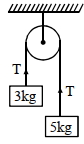
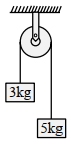
\({T}=\frac{2 {m}_{1} {m}_{2} {g}}{{m}_{1}+{m}_{2}}=\frac{2 \times 3 \times 5 \times 10}{8}\)\(=\frac{75}{2}\)
Stress \(=\frac{{T}}{{A}}\)
\(\frac{24}{\pi} \times 10^{2}=\frac{75}{2 \times \pi {R}^{2}}\)
\({R}^{2}=\frac{75}{2 \times 24 \times 100}=\frac{3}{8 \times 24}\)
\(\Rightarrow {R}=0.125\, {m}\)
\({R}=12.5\, {cm}\)
-
- (A) \(24\)
- (B) \(36\)
- (C) \(42\)
- (D) \(32\)
Show answer and solution
Correct Answer: (D)
For \(A \frac{ E }{\pi r ^{2}}= y \frac{2 mm }{ a }\) \(......(1)\)For B \(\frac{ E }{\pi \cdot 16 r ^{2}}= y \frac{4 mm }{ b }\) \(..........(2)\)
\(\therefore(1) /(2)\)
\(16=\frac{2 b }{4 a }\)
\(\frac{ a }{ b }=\frac{1}{32}\)
\(=32\)
-
- (A) \(y=\frac{Y_{1} Y_{2}}{Y_{1}+Y_{2}}\)
- (B) \(y=\frac{2 Y_{1} Y_{2}}{3\left(Y_{1}+Y_{2}\right)}\)
- (C) \(Y=\frac{2 Y_{1} Y_{2}}{Y_{1}+Y_{2}}\)
- (D) \({Y}=\frac{{Y}_{1} {Y}_{2}}{2\left({Y}_{1}+{Y}_{2}\right)}\)
Show answer and solution
Correct Answer: (C)
In series combination \(\Delta l =l_{1}+l_{2}\)\(Y =\frac{ F / A }{\Delta l / l} \Rightarrow \Delta l=\frac{ F l}{ AY }\)
\(\Rightarrow \Delta l \propto \frac{l}{ Y }\)
Equivalent length of rod after joining is \(=2 l\)
As, lengths are same and force is also same in series
\(\Delta l=\Delta l_{1}+\Delta l_{2}\)
\(\frac{l \text { eq }}{ Y _{\text {eq }}}=\frac{l}{ Y _{1}}+\frac{l}{ Y _{2}}\) \(\Rightarrow \frac{2 l}{ Y }=\frac{l}{ Y _{1}}+\frac{l}{ Y _{2}}\)
\(\therefore Y=\frac{2 Y_{1} Y_{2}}{Y_{1}+Y_{2}}\)
-
- (A) \(50\)
- (B) \(40\)
- (C) \(400\)
- (D) \(500\)
Show answer and solution
Correct Answer: (B)
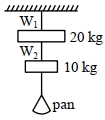
\({B} \cdot {S}_{1}=\frac{{T}_{\operatorname{lmax}}}{8 \times 10^{-7}} \Rightarrow {T}_{1 {max}}=8 \times 1.25 \times 100\)\(=1000\, {N}\)
\({B} \cdot {S}_{2}=\frac{{T}_{2 \max }}{4 \times 10^{-7}} \Rightarrow {T}_{2 \max }=4 \times 1.25 \times 100\)
\(=500\, {N}\)
\({m}=\frac{500-100}{10}=40\, {kg}\)
-
- (A) \(\frac{2 T }{ J }\left(\frac{1}{ r }-\frac{1}{ R }\right)\)
- (B) \(\frac{2 T }{ rJ }\)
- (C) \(\frac{3 T }{ rJ }\)
- (D) \(\frac{3 T }{ J }\left(\frac{1}{ r }-\frac{1}{ R }\right)\)
Show answer and solution
Correct Answer: (D)
\(n \times \frac{4}{3} \pi r ^{3}=\frac{4}{3} \pi R ^{3}\)\(\therefore n ^{1 / 3} r = R\)
\(\therefore\) Total change in surface energy
\(=\left(n\left(4 \pi r^{2}\right)-4 \pi R^{2}\right) T\)
\(\Rightarrow 4 \pi T \left( nr ^{2}- R ^{2}\right)\)
\(\therefore\) Heat energy
\(=\frac{4 \pi T \left( nr ^{2}- R ^{2}\right)}{ J \times \frac{4}{3} \pi R ^{3}}=\frac{3 T }{ J }\left(\frac{ nr ^{2}}{ R ^{3}}-\frac{1}{ R }\right)\)
Put \(nr ^{3}= R ^{3}\)
\(\therefore \frac{3 T }{ J }\left(\frac{1}{ r }-\frac{1}{ R }\right)\)
-
- (A) \(5\)
- (B) \(4\)
- (C) \(2\)
- (D) \(3\)
Show answer and solution
Correct Answer: (C)
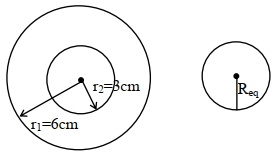
Excess pressure inside the smaller soap bubble\(\Delta {P}=\frac{4 {S}}{{r}_{1}}+\frac{4 {S}}{{r}_{2}}\ldots \text { (i) }\)
The excess pressure inside the equivalent soap bubble
\(\Delta {P}=\frac{4 {S}}{{R}_{{eq}}} \ldots \text { (ii) }\)
From \( (i) \,\& \,(ii)\)
\(\frac{4 {S}}{{R}_{{eq}}}=\frac{4 {S}}{{T}_{1}}+\frac{4 {S}}{{T}_{2}}\)
\(\frac{1}{{R}_{{eq}}}=\frac{1}{{T}_{1}}+\frac{1}{{I}_{2}}\)
\(=\frac{1}{6}+\frac{1}{3}\)
\({R}_{{eq}}=2 \,{cm}\)
-
- (A) \(\frac{r_{1} r_{2}}{r_{1}+r_{2}}\)
- (B) \(\sqrt{r_{1} r_{2}}\)
- (C) \(\sqrt{r_{1}^{2}+r_{2}^{2}}\)
- (D) \(\frac{r_{1}+r_{2}}{2}\)
Show answer and solution
Correct Answer: (C)
(c) \(8\pi r_1^2T + 8\pi r_2^2T = 8\pi {R^2}T\) \(⇒\) \({R^2} = r_1^2 + r_2^2\) -
- (A) \(3.62\)
- (B) \(2.19\)
- (C) \(5.34\)
- (D) \(4.97\)
Show answer and solution
Correct Answer: (B)
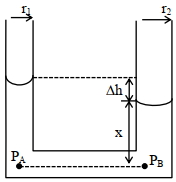
We have \(P_{A}=P_{B}\). [Points \(A\) \(\&\) \(B\) at same horizontal level]\(\therefore \mathrm{P}_{\mathrm{atm}}-\frac{2 \mathrm{~T}}{\mathrm{r}_{1}}+\rho \mathrm{g}(\mathrm{x}+\Delta \mathrm{h})=\mathrm{P}_{2 \mathrm{tm}}-\frac{2 \mathrm{~T}}{\mathrm{r}_{2}}+\rho g \mathrm{x}\)
\(\therefore \rho g \Delta \mathrm{h}=2 \mathrm{~T}\left[\frac{1}{\mathrm{r}_{1}}-\frac{1}{\mathrm{I}_{2}}\right]\)
\(=2 \times 7.3 \times 10^{-2}\left[\frac{1}{2.5 \times 10^{-3}}-\frac{1}{4 \times 10^{-3}}\right]\)
\(\therefore \Delta \mathrm{h}=\frac{2 \times 7.3 \times 10^{-2} \times 10^{3}}{10^{3} \times 10}\left[\frac{1}{2.5}-\frac{1}{4}\right]\)
\(=2.19 \times 10^{-3} \mathrm{~m}=2.19 \mathrm{~mm}\)
- 547. When two soap bubbles of radii \(a\) and \(b ( b > a )\) coalesce, the radius of curvature of common surface is 2021 Hard
- (A) \(\frac{a b}{b-a}\)
- (B) \(\frac{a+b}{a b}\)
- (C) \(\frac{ b - a }{ ab }\)
- (D) \(\frac{a b}{a+b}\)
Show answer and solution
Correct Answer: (A)
Let say \(P_{1}\) and \(P_{2}\) are the excess pressure on the two sides of the interface then the resultant excess pressure is \(P\)\(\Rightarrow P=P_{2}-P_{1}\)
\(\Rightarrow \frac{4 T}{r}=\frac{4 T}{r_{2}}-\frac{4 T}{r_{1}}\)
\(\Rightarrow \frac{1}{r}=\frac{1}{r_2}-\frac{1}{r_1}\)
\(\Rightarrow r=\frac{r_{1} r_{1}}{r_{1}-r_{2}}\)
-
- (A) \(22500\)
- (B) \(25600\)
- (C) \(28900\)
- (D) \(27225\)
Show answer and solution
Correct Answer: (B)
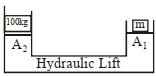
Using Pascals law\(\frac{100 \times g }{ A _{2}}=\frac{ mg }{ A _{1}}\) \(........(1)\)
Let \(m\) mass can lift \(M _{0}\) in second case then
\(\frac{ M _{0} g }{16 A _{2}}=\frac{ mg }{ A _{1} / 16}\) \(.........(2)\)
\(\left\{\right.\) Since \(\left.A=\frac{\pi d ^{2}}{4}\right\}\)
From equation \((1)\) and \((2)\) we get
\(\frac{ M _{0}}{16.100}=16\)
\(\Rightarrow M _{0}=25600 \,kg\)
-
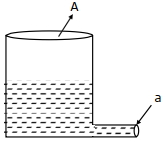
- (A) \(\frac{2 {a}}{{A}}\)
- (B) None of these
- (C) \(\frac{{a}}{{A}}\)
- (D) \(\frac{{A}}{2 {a}}\)
Show answer and solution
Correct Answer: (A)
For no sliding\(f \geq \rho av ^{2}\)
\(\mu mg \geq \rho av ^{2}\)
\(\mu \rho Ahg \geq \rho a 2 gh\)
\(\mu \geq \frac{2 a}{A}\)
-
- (A) \(14.4\)
- (B) \(2.47\)
- (C) \(43.56\)
- (D) \(4.94\)
Show answer and solution
Correct Answer: (D)
At terminal speed\({F}_{\text {net }} =0\)
\({Mg} ={F}_{{v}}=6 \pi {\eta} {Rv}\)
\({V} =\frac{{mg}}{6 \pi \eta {Rv}}\)
\({V} =\frac{\rho_{{w}} \frac{4 \pi}{3} {R}^{3} {g}}{6 \pi \eta {R}}\)
\(=\frac{2 p_{{w}} {R}^{2} {g}}{9 {\eta}}\)
\(=\frac{400}{81}\, {m} / {s}\)
\(=4.94\, {m} / {s}\)
No questions on this page match these filters.