


All JEE Mains 2021 Physics questions
32 chaptersShowing 301–350 of 685 questions
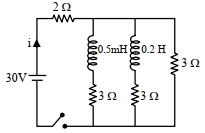
- 301. For the given circuit the current \(i\) through the battery when the key in closed and the steady state has been reached is .....\(A\)
 2021 Hard
- (A) \(6\)
- (B) \(25\)
- (C) \(10\)
- (D) \(0\)
Show answer and solution
Correct Answer: (C)
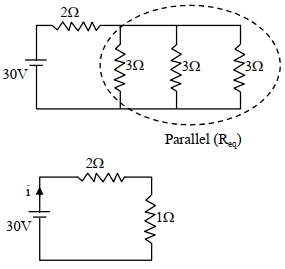
In steady state, inductor behaves as a conducting wire.So, equivalent circuit becomes
\(\frac{1}{{R}_{{eq}}}=\frac{1}{3}+\frac{1}{3}+\frac{1}{3}=1\)
\(\Rightarrow {R}_{{eq}}=1\, \Omega\)
\(\Rightarrow\) Circuit becomes
\(\Rightarrow {i}=\frac{30}{3}=10\, {A}\)
-
- (A) \(12\)
- (B) \(6\)
- (C) \(9\)
- (D) \(1\)
Show answer and solution
Correct Answer: (D)
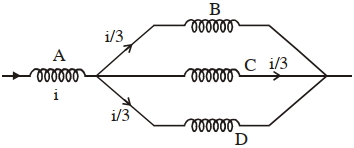
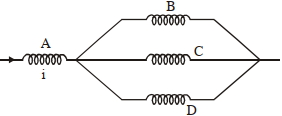
\(\phi \propto i\)\(\Rightarrow B \propto i\)
so, field at centre of \(C =\frac{3}{3}=1 T\)
-
- (A) \(10\)
- (B) \(60\)
- (C) \(180\)
- (D) \(120\)
Show answer and solution
Correct Answer: (B)
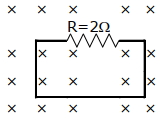
As we know induce emf\(|\epsilon|=\frac{{d} \phi}{{dt}}=20 {t}+20\, {mV}\)
\(|{i}|=\frac{|\epsilon|}{{R}}=10 {t}+10\, {mA}\)
\(\text { at } {t}=5\)
\(\mid {i} \mid=60\, {mA}\)
-
- (A) \(A-\)Flux, \(B-EMF, C-\)Power dissipated
- (B) \(A-\)Power dissipated, \(B-\)Flux, \(C-EMF\)
- (C) \(A-Flux, B-\)Power, dissipated, \(C-EMF\)
- (D) \(A-EMF, B-\)Power dissipeated, \(C-\)Flux
Show answer and solution
Correct Answer: (A)
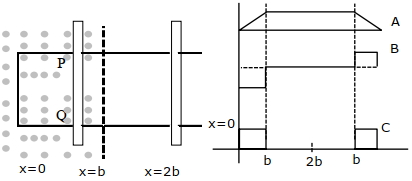
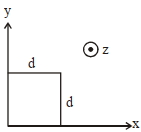
As rod moves in field area increases upto \(x=b\) then field is absent and again flux is generated on return journey from \(x=b\) to \(x=0\). Thus plot \(A\) for flux.\(\Rightarrow e=-\frac{d \phi}{d t} \Rightarrow\) curve \(B\) for \(e m f\)
\(\Rightarrow\) Power dissipated \(=v i \Rightarrow\) curve \(C\) for power dissipated
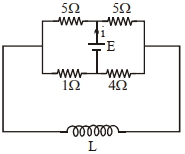
- 305. The current \((i)\) at time \(t =0\) and \(t =\infty\) respectively for the given circuit is
 2021 Hard
- (A) \(\frac{18 E }{55}, \frac{5 E }{18}\)
- (B) \(\frac{10 E }{33}, \frac{5 E }{18}\)
- (C) \(\frac{5 E }{18}, \frac{18 E }{55}\)
- (D) \(\frac{5 E }{18}, \frac{10 E }{33}\)
Show answer and solution
Correct Answer: (D)
At \(t=0,\) current through inductor is zero,hence \(R _{ eq }=(5+1) \|(5+4)=\frac{18}{5}\)
\(i _{1}=\frac{ E }{18 / 5}=\frac{5 E }{18}\)
At \(t=\infty\), inductor becomes a simple wire and now the circuit will be as shown in figure
hence \(R _{ eq }=(5 \| 5)+(4 \| 1)=\frac{33}{10} ; \quad(\| \Rightarrow\) parallel \()\)
\(i _{2}=\frac{ E }{33 / 10}=\frac{10 E }{33}\)

-
- (A) \(\frac{ B _{0} v _{0}^{2} d }{2 a }\)
- (B) \(\frac{ B _{0} v _{0} d }{2 a }\)
- (C) \(\frac{ B _{0} v _{0} d ^{2}}{ a }\)
- (D) \(\frac{ B _{0} v _{0} d ^{2}}{2 a }\)
Show answer and solution
Correct Answer: (C)
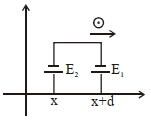
\(E _{1}=\frac{ B _{0}( x + d )}{ a } v _{0} d\)\(E _{2}=\frac{ B _{0}( x )}{ a } v _{0} d\)
\(E _{ net }= E _{1}- E _{2}\)
\(E _{ net }=\frac{ B _{0} v _{0} d ^{2}}{ a }\)
-
- (A) \(\frac{ L }{ R } \ell n 5\)
- (B) infinite
- (C) \(\frac{ L }{ R } \ell n 2\)
- (D) \(\frac{ L }{ R } \ln 10\)
Show answer and solution
Correct Answer: (C)
Magnetic energy \(=\frac{1}{2} Li ^{2}=25 \%\)\(ME \Rightarrow 25 \% \Rightarrow i =\frac{ i _{0}}{2}\)
\(i = i _{0}\left(1- R ^{- Rt / L }\right)\) for charging
\(t =\frac{ L }{ R } \ell n 2\)
-
- (A) \(2.880 \times 10^{3}\, J \,T ^{-1}\)
- (B) \(2.880 \times 10^{2}\, J\, T ^{-1}\)
- (C) \(2.880\, J\, T ^{-1}\)
- (D) \(28.80\, J\, T ^{-1}\)
Show answer and solution
Correct Answer: (C)
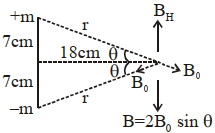
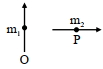
i.e. \(\frac{2 \mu_{0}}{4 \pi} \frac{ m }{ r ^{2}} \times \frac{7}{ r }=0.4 \times 10^{-4}\)\(\Rightarrow 2 \times 10^{-7} \times \frac{ m \times 7}{\left(7^{2}+18^{2}\right)^{3 / 2}} \times 10^{4}\)
\(=0.4 \times 10^{-4}\)
\(m =\frac{4 \times 10^{-2} \times(373)^{3 / 2}}{14}\)
\(M = m \times 14 cm = m \times \frac{14}{100}\)
\(=\frac{0.04 \times(373)^{3 / 2}}{14} \times \frac{14}{100}\)
\(=4 \times 10^{-4} \times 7203.82=2.88 J / T\)
-
- (A) \(500\)
- (B) \(2.5\)
- (C) \(25\)
- (D) \(250\)
Show answer and solution
Correct Answer: (D)
\(\frac{\Delta {M}}{{M}}=\frac{\Delta \mu}{\mu}=\frac{250}{500}=\frac{1}{2}\)\(\frac{1}{2}=\frac{{x}}{499} \Rightarrow {x} \simeq 250\)
- 310. A soft ferromagnetic material is placed in an external magnetic field. The magnetic domains: 2021 Medium
- (A) increase in size but no change in orientation.
- (B) have no relation with external magnetic field.
- (C) decrease in size and changes orientation.
- (D) may increase or decrease in size and change its orientation.
Show answer and solution
Correct Answer: (D)
Soft ferromagnetic materials are materials which can be easily magnetised and demagnetised by external magnetic field. When external field is applied, the domains experiences a net torque hence change its orientation. - 311. At an angle of \(30^{\circ}\) to the magnetic meridian, the apparent dip is \(45^{\circ} .\) Find the true dip : 2021 Medium
- (A) \(\tan ^{-1} \frac{1}{\sqrt{3}}\)
- (B) \(\tan ^{-1} \frac{\sqrt{3}}{2}\)
- (C) \(\tan ^{-1} \sqrt{3}\)
- (D) \(\tan ^{-1} \frac{2}{\sqrt{3}}\)
Show answer and solution
Correct Answer: (B)
\(A \tan \delta=\tan \delta^{\prime} \cos \theta\)\(=\tan 45^{\circ} \cos 30^{\circ}\)
\(\tan \delta=1 \times \frac{\sqrt{3}}{2}\)
\(\delta=\tan ^{-1}\left(\frac{\sqrt{3}}{2}\right)\)
-
- (A) True dip is not mathematically related to apparent dip.
- (B) True dip is less than apparent dip.
- (C) True dip is always greater than the apparent dip.
- (D) True dip is always equal to apparent dip.
Show answer and solution
Correct Answer: (B)
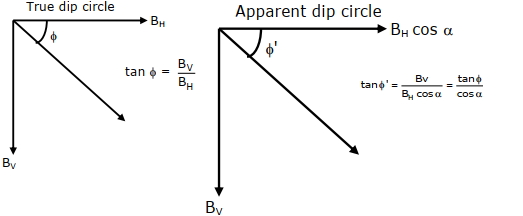
If apparent dip circle is at an angle \(\alpha\) with true dip circle thenTrue dip circle
\([Image]\)
Apparent dip circle
\([Image]\)
As \(\cos \alpha\,<1\)
Hence true \(\operatorname{dip}(\phi)\) is less than apparent \(\operatorname{dip}\left(\phi^{\prime}\right)\)
-
- (A) \((a), (c)\)
- (B) \(({a}),({d})\)
- (C) \(({b}),({d})\)
- (D) \(({b}),({c})\)
Show answer and solution
Correct Answer: (A)
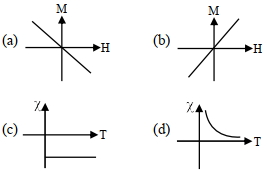
Conceptual question -
- (A) a macroscopic region with zero magnetization.
- (B) a macroscopic region with consecutive magnetic dipoles oriented in opposite direction.
- (C) a macroscopic region with randomly oriented magnetic dipoles.
- (D) a macroscopic region with saturation magnetization.
Show answer and solution
Correct Answer: (D)
conceptual -
- (A) \(8\)
- (B) \(10\)
- (C) \(12\)
- (D) \(14\)
Show answer and solution
Correct Answer: (A)
\(T =2 \pi \sqrt{\frac{ I }{ MB }}\)\(\frac{5}{10} =2 \pi \sqrt{\frac{5 \times 10^{-6}}{9.85 \times 10^{-2} \times B}}\)
\(B =8 \times 10^{-3} T\)
-
- (A) Statement \(I\) is true but Statement \(II\) is false
- (B) Both Statement \(I\) and Statement \(II\) are true
- (C) Both Statement \(I\) and Statement \(II\) are false
- (D) Statement \(I\) is false but Statement \(II\) is true
Show answer and solution
Correct Answer: (A)
As temperature increases, domains disintegrate so ferromagnetism decreases and above curie temperature it become paramagnet. -
- (A) \(4\)
- (B) \(1\)
- (C) \(2\)
- (D) \(3\)
Show answer and solution
Correct Answer: (C)
\(\mu=\mu_{o}\left(1+x_{m}\right)\)\(=4 \pi \times 10^{-7} \times 500\)
\(=2 \pi \times 10^{-4} \,{H} / {m}\)
-
- (A) \(22\)
- (B) \(44\)
- (C) \(66\)
- (D) \(2\)
Show answer and solution
Correct Answer: (A)
\(B=\mu .(H+I)\)\(B=\mu . H\left(1+\frac{I}{H}\right)\)
\(B=B_{0}(1+\chi )\)
\(B-B_{0}=B_{0} \chi\)
\(\frac{B-B_{0}}{B_{0}}=\chi\)
\(\frac{B-B_{0}}{B_{0}} \times 100=100 \chi\)
\(=2.2 \times 10^{-3}=\frac{22}{10^{4}}\)
-
- (A) \(1\)
- (B) \(5\)
- (C) \(7\)
- (D) \(8\)
Show answer and solution
Correct Answer: (A)
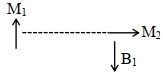
\(\vec{\tau}=\overrightarrow{{M}}_{2} \times \overrightarrow{{B}}_{1}\)\(\tau={M}_{2} {B}_{1} \sin 90^{\circ}\)
\(=1 \times \frac{\mu_{0}}{4 \pi} \frac{{M}_{1}}{(1)^{3}} 1\)
\(=10^{-7} {N} \cdot {m}\)
-
- (A) \((C)\) and \((E)\) only
- (B) \((B)\) and \((D)\) only
- (C) \((A)\) and \((B)\) only
- (D) \((B)\) and \((C)\) only
Show answer and solution
Correct Answer: (A)
Statement \(( C )\) is correct because, the magnetic field outside the toroid is zero and they form closed loops inside the toroid itself.Statement \(( E )\) is correct because we know that super conductors are materials inside which the net magnetic field is always zero and they are perfect diamagnetic.
\(\mu_{ r }=1+\chi\)
\(\chi=-1\)
\(\mu_{ r }=0\)
For superconductors.
-
- (A) \(45\)
- (B) \(40\)
- (C) \(12\)
- (D) \(33\)
Show answer and solution
Correct Answer: (A)
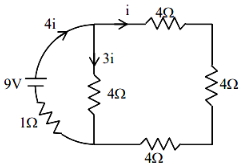
By KVL in outer loop\(9-12 i-4 i=0\)
\(16 i=9\)
\(8 i =\frac{9}{2}=4.5\)
\(=45 \times 10^{-1}\)
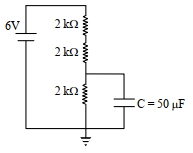
- 322. A capacitor of \(50 \,\mu {F}\) is connected in a circuit as shown in figure. The charge on the upper plate of the capacitor is \(......\,\mu {C} .\)
 2021 Medium
- (A) \(1\)
- (B) \(10\)
- (C) \(100\)
- (D) \(1000\)
Show answer and solution
Correct Answer: (C)
Pot. Diff. across each resistor \(=2\, {V}\)\({q}={CV}\)
\(=50 \times 10^{-6} \times 2=100 \times 10^{-6}=100\, \mu {C}\)
-
- (A) \(10.0\)
- (B) \(3.6\)
- (C) \(5.6\)
- (D) \(2.0\)
Show answer and solution
Correct Answer: (C)
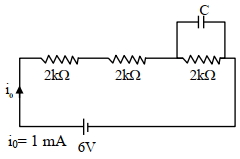
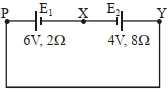
\(I =\frac{6-4}{10}=\frac{1}{5} A\)\(V _{ x }+4+8 \times \frac{1}{5}- V _{ y }=0\)
\(V _{ x }- V _{ y }=-5.6 \Rightarrow| Vx - Vy |=5.6 V\)
-
- (A) \(\frac{1}{4} \frac{ VA }{\rho l}\)
- (B) \(\frac{3}{4} \frac{ VA }{\rho l}\)
- (C) \(\frac{1}{4} \frac{\rho l}{ VA }\)
- (D) \(4 \frac{ VA }{\rho l}\)
Show answer and solution
Correct Answer: (A)
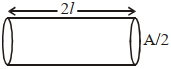
As per the questionResistance \(=\frac{\rho(2 l)}{( A / 2)}=\frac{4 \rho l}{ A }\)
\(\Rightarrow\) Current \(=\frac{ V }{ R }=\frac{ VA }{4 \rho l}\)
-
- (A) \(1.420\)
- (B) \(0.0858\)
- (C) \(2.170\)
- (D) \(0.858\)
Show answer and solution
Correct Answer: (D)
\(\frac{1}{R}=\frac{1}{R_{1}}+\frac{1}{R_{2}}\)\(R=\frac{R_{1} R_{2}}{R_{1}+R_{2}}=\frac{\ell}{A} \cdot \frac{\rho_{1} \rho_{2}}{\rho_{1}+\rho_{2}}\)
\(R=\frac{25 \times 10^{-2}}{3 \times 10^{-6}} \times \frac{1.7 \times 2.6 \times 10^{-16}}{4.3 \times 10^{-8}}\)
\(R=0.858\, {m}\, \Omega\)
-
- (A) \(2 \times 10^{6}\)
- (B) \(625 \times 10^{25}\)
- (C) \(2 \times 10^{25}\)
- (D) \(1 \times 10^{23}\)
Show answer and solution
Correct Answer: (B)
\(i =10 A , A =5 mm ^{2}=5 \times 10^{-6} m ^{2}\)and \(v _{ d }=2 \times 10^{-3} m / s\)
We know, \(i= neAvd\)
\(\therefore 10= n \times 1.6 \times 10^{-19} \times 5 \times 10^{-6} \times 2 \times 10^{-3}\)
\(\Rightarrow n =0.625 \times 10^{28}=625 \times 10^{25}\)
-
- (A) \(11 \times 10^{-3}\)
- (B) \(11 \times 10^{-5}\)
- (C) \(11 \times 10^{-7}\)
- (D) \(11 \times 10^{-2}\)
Show answer and solution
Correct Answer: (B)
\(I=\vec{J} \cdot \vec{A}=J A \cos (\theta)\)\(5=J\left(\frac{4}{100}\right) \times \cos (60)\)
\(J=5 \times 50=250\, {A} / {m}^{2}\)
Now, \(\vec{E}=\rho \cdot \vec{J}\)
\(=44 \times 10^{-8} \times 250=11 \times 10^{-5}\, {V} / {m}\)
-
- (A) \(2\)
- (B) \(1\)
- (C) \(3\)
- (D) \(5\)
Show answer and solution
Correct Answer: (A)
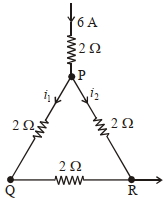
For parallel combination current devides in the inverse ratio of resistance.\(i _{ PQ }=\frac{2}{6} \times 6 \,A\)
-
- (A) \(2250\)
- (B) \(11250\)
- (C) \(2100\)
- (D) \(260\)
Show answer and solution
Correct Answer: (B)
\(i =20 t +8 t ^{2}\)\(i =\frac{ dq }{ dt } \Rightarrow \int d q =\int idt\)
\(\Rightarrow q =\int_{0}^{15}\left(20 t +8 t ^{2}\right) dt\)
\(q =\left(\frac{20 t ^{2}}{2}+\frac{8 t ^{3}}{3}\right)_{0}^{15}\)
\(q =10 \times(15)^{2}+\frac{8(15)^{3}}{3}\)
\(q =2250+9000\)
\(q =11250 C\)
-
- (A) \(5\)
- (B) \(10\)
- (C) \(8\)
- (D) \(15\)
Show answer and solution
Correct Answer: (A)
Conductivity \(\sigma=5 \times 10^{7} \,S / m\)Radius \(r =0.5 \,mm =5 \times 10^{-4}\, m\)
\(E =10 \times 10^{-3}\, \frac{ V }{ m }\)
\(J =\sigma E =10 \times 10^{-3} \times 5 \times 10^{7}\)
\(J =5 \times 10^{5}\)
\(\frac{ i }{ A }=5 \times 10^{5}\)
\(i =5 \times 10^{5} \times \pi r ^{2}\)
\(=5 \times 10^{5} \times \pi \times\left(5 \times 10^{-4}\right)^{2}\)
\(=125 \pi \times 10^{-3} \,Amp\)
\(i=125 \pi \, mA\)
\(x=5\)
-
- (A) \(1500\)
- (B) \(1000\)
- (C) \(500\)
- (D) \(2000\)
Show answer and solution
Correct Answer: (D)
\(500=(1.5)^{2} \times R \times 20\)\(E =(3)^{2} \times R \times 20\)
\(E =2000 \,J\)
-
- (A) \(8125\)
- (B) \(38400\)
- (C) \(384\)
- (D) \(3840\)
Show answer and solution
Correct Answer: (D)
\({E}={i}^{2} {Rt}\)\(192=16({R})(1)\)
\({R}=12\, \Omega\)
\({E}^{1}=(8)^{2}(12)(5)\)
\(=3840\, {J}\)
-
- (A) \(4\)
- (B) \(1\)
- (C) \(3\)
- (D) \(2\)
Show answer and solution
Correct Answer: (C)
\({R}_{e q}=3\, \Omega\)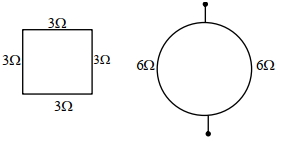
-
- (A) \(4\)
- (B) \(40\)
- (C) \(0.4\)
- (D) \(400\)
Show answer and solution
Correct Answer: (A)
First case \({P}_{1}=\frac{{V}^{2}}{{R}}=\frac{(240)^{2}}{36}\)Second case Resistance of each half \(=18 \,\Omega\)
\({P}_{2}=\frac{(240)^{2}}{18}+\frac{(240)^{2}}{18}=\frac{(240)^{2}}{9}\)
\(\frac{{P}_{1}}{{P}_{2}}=\frac{1}{4}\)
\({x}=4.00\)
-
- (A) \(56\)
- (B) \(25\)
- (C) \(12.5\)
- (D) \(76\)
Show answer and solution
Correct Answer: (A)
\(R _{0}=1\, \Omega\)\(\ell_{0}=1\, m\)
\(A _{0}= A\)
\(R _{1}=?\)
\(\ell_{1}=1.25\, m\)
As volume of wire remains constant so
\(A _{0} \ell_{0}= A _{1} \ell_{1} \Rightarrow A _{1}=\frac{\ell_{0} A _{0}}{\ell_{1}}\)
Now
Resistance \(( R )=\frac{\rho \ell}{ A }\)
\(\frac{ R _{0}}{ R _{1}}=\frac{\ell_{0} / A _{0}}{\rho \ell_{1} / A _{1}}\)
\(\frac{1}{ R _{1}}=\frac{\ell_{0}}{ A _{0}}\left(\frac{\ell_{0} A _{0}}{\ell_{1} \times \ell_{1}}\right) R _{1}=\frac{\ell_{1}^{2}}{\ell_{0}^{2}}=1.5625\, \Omega\)
So \% change in resistance
\(=\frac{ R _{1}- R _{0}}{ R _{0}} \times 100\, \%\)
\(=\frac{1.5625-1}{1} \times 100 \,\%\)
\(=56.25\, \%\)
-
- (A) \(20\)
- (B) \(30\)
- (C) \(5\)
- (D) \(10\)
Show answer and solution
Correct Answer: (A)
\({P}={Vi}\)\(500={Vi}\)
\({i}=5 {Amp}\)
\({V}={i} \times {R}\)
\({R}=20\)
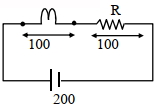
-
- (A) \(15\)
- (B) \(20\)
- (C) \(5\)
- (D) \(50\)
Show answer and solution
Correct Answer: (D)
Power, \(P =\frac{ V ^{2}}{ R _{ B }}\)\(R_{B}=\frac{V^{2}}{P}=\frac{100 \times 100}{200}\)
\(R_{B}=50 \Omega\)
To produce same power, same voltage should be across the bulb
Hence, \(R=R_{B}=50 \Omega\)
-
- (A) \(40\)
- (B) \(64\)
- (C) \(48\)
- (D) \(24\)
Show answer and solution
Correct Answer: (C)
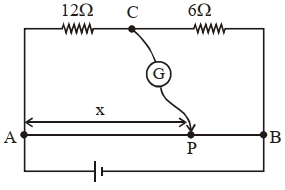
In \(B\) alanced conditions\(\frac{12}{6}=\frac{x}{72-x}\)
\(x=48\, cm\)
-
- (A) \(2\)
- (B) \(3\)
- (C) \(5\)
- (D) \(7\)
Show answer and solution
Correct Answer: (B)
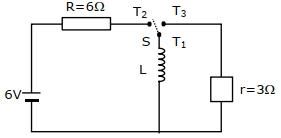
When \(T _{1}\) and \(T _{2}\) are connected, then the steady state current in the inductor \(I=\frac{6}{6}=1 A\)When \(T _{1}\) and \(T _{3}\) are connected then current through inductor remains same. So potential difference across \(3 \Omega\)
\(V = Ir =1 \times 3=3 \text { volt }\)
-
- (A) \(20\)
- (B) \(10\)
- (C) \(25\)
- (D) \(16\)
Show answer and solution
Correct Answer: (A)
In series\({R}_{{eq}}={nR}=10 {n}\)
\({i}_{{s}}=\frac{20}{10+10 {n}}=\frac{2}{1+{n}}\)
in parallel
\({R}_{{eq}}=\frac{10}{{n}}\)
\({i}_{{p}}=\frac{20}{\frac{10}{{n}}+10}=\frac{2 {n}}{1+{n}}\)
\(\frac{{i}_{{p}}}{{i}_{{s}}}=20\)
\(\frac{\left(\frac{2 {n}}{1+{n}}\right)}{\left(\frac{2}{1+{n}}\right)}=20\)
\({n}=20\)
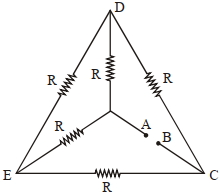
- 341. Five equal resistances are connected in a network as shown in figure. The net resistance between the points \(A\) and \(B\) is
 2021 Medium
- (A) \(2 R\)
- (B) \(\frac{ R }{2}\)
- (C) \(\frac{3 R }{2}\)
- (D) \(R\)
Show answer and solution
Correct Answer: (D)
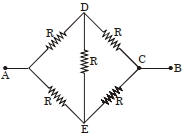
This diagram can be drawn likeIt is a wheat stone bridge
\(\therefore R _{ eq }=\frac{2 R \times 2 R }{2 R +2 R } \Rightarrow R\)
-
- (A) \(1\)
- (B) \(25\)
- (C) \(5\)
- (D) \(10\)
Show answer and solution
Correct Answer: (A)
\(i_{1}=\frac{25}{5+R}\)\(i_{2}=\frac{5}{R+\frac{1}{5}}\)
\(i_{1}=i_{2} \Rightarrow 5\left(R+\frac{1}{5}\right)=5+R\)
\(4 R=4\)
\(R=1\, \Omega\)
-
- (A) \(1\)
- (B) \(2\)
- (C) \(3\)
- (D) \(4\)
Show answer and solution
Correct Answer: (A)
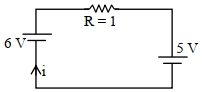
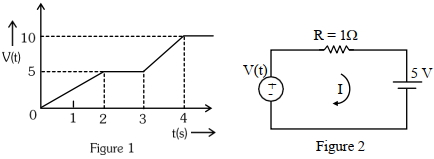
From graph voltage at \({t}=3.2 \,{sec}\) is \(6\, {volt} .\)\(i=\frac{6-5}{1}\)
\(i=1\, {A}\)
-
- (A) \(10\)
- (B) \(15\)
- (C) \(32\)
- (D) \(30\)
Show answer and solution
Correct Answer: (B)
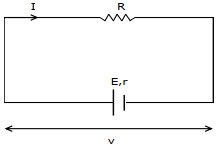
Terminal voltage \(v=i R=\frac{E R}{R+r}\)\(1^{s t} \rightarrow 1.25=\frac{E(5)}{5+r} . .(i)\)
\(2^{n d} \rightarrow 1=\frac{E(2)}{2+r}\, \cdots \text { (ii) }\)
By \((i)\) and \((ii)\)
\(r=1 \,\Omega, E=\frac{3}{2} \,V=\frac{15}{10}\, \text { volt }\)
\(\Rightarrow {x}=15\)
-
- (A) \(3.9\)
- (B) \(8.4\)
- (C) \(7.5\)
- (D) \(3.0\)
Show answer and solution
Correct Answer: (A)
\(R =\frac{\rho \ell}{ A }=\frac{ V }{ I }\)\(\rho=\frac{ AV }{ I \ell}=\frac{\pi d ^{2} V }{4 I \ell} \quad\left( A =\frac{\pi d ^{2}}{4}\right)\)
\(\therefore \frac{\Delta \rho}{\rho}=\frac{2 \Delta d }{ d }+\frac{\Delta V }{ V }+\frac{\Delta I }{ I }+\frac{\Delta \ell}{\ell}\)
\(\frac{\Delta \rho}{\rho}=2\left(\frac{0.01}{5.00}\right)+\frac{0.1}{5.0}+\frac{0.01}{2.00}+\frac{0.1}{10.0}\)
\(\frac{\Delta \rho}{\rho}=0.004+0.02+0.005+0.01\)
\(\frac{\Delta \rho}{\rho}=0.039\)
\(\%\) error \(=\frac{\Delta \rho}{\rho} \times 100=0.039 \times 100=3.90 \%\)
-
- (A) \(3\)
- (B) \(4\)
- (C) \(2\)
- (D) \(5\)
Show answer and solution
Correct Answer: (A)
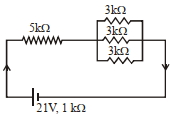
\(I=\frac{21}{5+1+1}=3 mA\)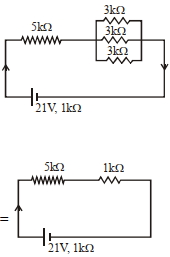
-
- (A) \(2\)
- (B) \(1\)
- (C) \(4\)
- (D) \(5\)
Show answer and solution
Correct Answer: (B)
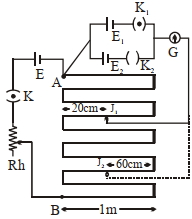
Length of \(AB =10 m\)For battery \(E _{1}\), balancing length is \(l_{1}\) \(l_{1}=380 cm [\) from end \(A ]\)
For battery \(E _{2}\), balancing length is \(l_{2}\) \(l_{2}=760 cm [\) [from end \(A ]\)
Now, we know that \(\frac{ E _{1}}{ E _{2}}=\frac{l_{1}}{l_{2}}\)
\(\Rightarrow \frac{E_{1}}{E_{2}}=\frac{380}{760}=\frac{1}{2}=\frac{a}{b}\)
\(\therefore a=1 \& b=2\)
\(a =1\)
-
- (A) Electric field decreases.
- (B) Drift velocity of electron increases.
- (C) Electron current decreases.
- (D) All of these
Show answer and solution
Correct Answer: (B)
Current is constant in conductor\(i=\) constant
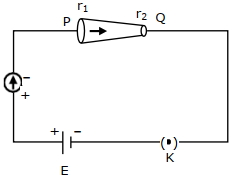
Resistance of element \(d R=\frac{\rho d x}{\pi r^{2}}\)
\(d V=i d R=\frac{i \rho d x}{\pi r^{2}}\)
\(E=\frac{d V}{d x}=\frac{i \rho}{\pi r^{2}}\)
\(V_{d}=\frac{e E \tau}{m}\)
\(\therefore V_{d} \propto E\)
\(\rightarrow E \propto \frac{1}{r^{2}}\)
if \(r\) decreases, \(E\) will increase \(: V_{d}\) will increase
-
- (A) \(5\)
- (B) \(63\)
- (C) \(10\)
- (D) \(4\)
Show answer and solution
Correct Answer: (C)
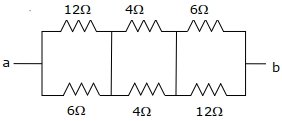
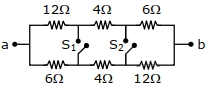
\(\frac{12 \times 6}{12+6}+2+\frac{6 \times 12}{6+12}\)\(\frac{72}{18}+2+\frac{72}{18}=4+2+4=10\, \Omega\)
-
- (A) \(1.32\)
- (B) \(0.65\)
- (C) \(2.2\)
- (D) \(4.4\)
Show answer and solution
Correct Answer: (C)
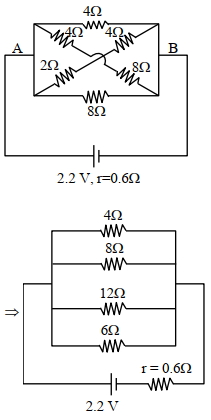
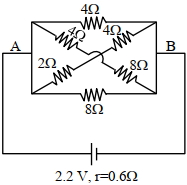
\(\frac{1}{R_{e q}}=\frac{1}{4}+\frac{1}{8}+\frac{1}{12}+\frac{1}{6}=\frac{6+3+2+4}{24}=\frac{15}{24}\)\(R_{e q}=\frac{24}{15}=1.6 \Rightarrow R_{T}=1.6+0.6=2.2 \,\Omega\)
\(P=\frac{V^{2}}{R_{T}}=\frac{(2.2)^{2}}{2.2}=2.2 \,{W}\)
No questions on this page match these filters.