


All JEE Mains 2021 Physics questions
32 chaptersShowing 601–650 of 685 questions
-
- (A) \(1.33 \times 10^{3} s\)
- (B) \(3.33 \times 10^{2} s\)
- (C) \(4.24 \times 10^{3} s\)
- (D) \(4.24 \times 10^{2} s\)
Show answer and solution
Correct Answer: (A)
\(T =2 \pi \sqrt{\frac{ r ^{3}}{ GM }}\)\(T _{ A }=2 \pi \sqrt{\frac{(6400+600) \times 10^{3}}{ GM }}\)
\(T _{ A }=2 \pi \times 10^{9} \sqrt{\frac{7^{3}}{ GM }}\)
\(T _{ B }=2 \pi \times 10^{9} \sqrt{\frac{8^{3}}{ GM }}\)
\(T _{ B }- T _{ A }=\frac{2 \pi 10^{9}}{\sqrt{ GM }}[8 \sqrt{8}-7 \sqrt{7}]\)
\(=314 \times 4.107\)
\(=1289.64\)
\(=1.289 \times 10^{3} s\)
-
- (A) \(3\)
- (B) \(30\)
- (C) \(0.3\)
- (D) \(4\)
Show answer and solution
Correct Answer: (A)
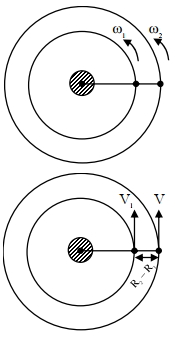
\({T}_{1}=1\) \(hour\)\(\Rightarrow \omega_{1}=2 \pi {rad} / {hour}\)
\({T}_{2}=8\) \(hours\)
\(\Rightarrow \omega_{2}=\frac{\pi}{4} {rad} /\) \(hour\)
\({R}_{1}=2 \times 10^{3} {km}\)
As \({T}^{2} \propto {R}^{3}\)
\(\Rightarrow\left(\frac{{R}_{2}}{{R}_{1}}\right)^{3}=\left(\frac{{T}_{2}}{{T}_{1}}\right)^{2}\)
\(\Rightarrow \frac{{R}_{2}}{{R}_{1}}=\left(\frac{8}{1}\right)^{2 / 3}=4 \Rightarrow {R}_{2}=8 \times 10^{3} {km}\)
\({V}_{1}=\omega_{1} {R}_{1}=4 \pi \times 10^{3} {km} / {h}\)
\({V}_{2}=\omega_{2} {R}_{2}=2 \pi \times 10^{3} {km} / {h}\)
Relative \(\omega=\frac{{V}_{1}-{V}_{2}}{{R}_{2}-{R}_{1}}=\frac{2 \pi \times 10^{3}}{6 \times 10^{3}}\)
\(=\frac{\pi}{3} {rad} /\) \(hour\)
\({x}=3\)
-
- (A) \(\frac{1}{2 \pi} \sqrt{\frac{ d ^{3}}{3 Gm }}\)
- (B) \(2 \pi \sqrt{\frac{ d ^{3}}{3 Gm }}\)
- (C) \(\frac{1}{2 \pi} \sqrt{\frac{3 Gm }{ d ^{3}}}\)
- (D) \(2 \pi \sqrt{\frac{3 Gm }{ d ^{3}}}\)
Show answer and solution
Correct Answer: (B)
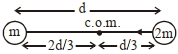
\(F=\frac{G(2 m) m }{ d ^{2}}=(2 m ) \omega^{2}( d / 3)\)\(\frac{ Gm }{ d ^{2}}=\omega^{2} \frac{ d }{3}\)
\(\Rightarrow \omega^{2}=\frac{3 Gm }{ d ^{3}}\)
\(\Rightarrow \omega=\sqrt{\frac{3 Gm }{ d ^{3}}}\)
\(\Rightarrow T =\frac{2 \pi}{\omega}=2 \pi \sqrt{\frac{ d ^{3}}{3 Gm }}\)
-
- (A) \(60\)
- (B) \(30\)
- (C) \(45\)
- (D) \(90\)
Show answer and solution
Correct Answer: (B)
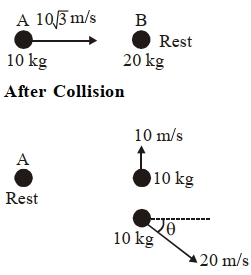
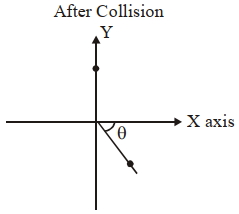
From conservation of momentum along \(x\) axis\(\overrightarrow{ P }_{ i }=\overrightarrow{ P }_{ f }\)
\(10 \times 10 \sqrt{3}=200 \cos \theta\)
\(\cos \theta=\frac{\sqrt{3}}{2}\)
\(\theta=30^{\circ}\)
-
- (A) \(15\)
- (B) \(24\)
- (C) \(20\)
- (D) \(30\)
Show answer and solution
Correct Answer: (C)
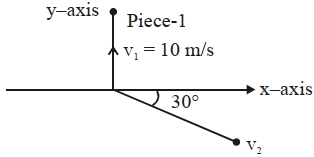
Let velocity of \(2^{\text {nd }}\) fragment is \(\vec{v}\) then by conservation of linear momentum\(10(10 \sqrt{3}) \hat{ i }=(10)(10 \hat{ j })+10 \overrightarrow{ v }\)
\(\Rightarrow \overrightarrow{ v }=10 \sqrt{3} \hat{ i }-10 \hat{ j }\)
\(|\overrightarrow{ v }|=\sqrt{300+100}=\sqrt{400}=20 m / s\)
-
- (A) \(4\)
- (B) \(9\)
- (C) \(6\)
- (D) \(12\)
Show answer and solution
Correct Answer: (C)
Let's say the compression in the spring by: \(y\).So, by work energy theorem we have
\(\Rightarrow \frac{1}{2} mv ^{2}=\frac{1}{2} ky ^{2}\)
\(\Rightarrow y =\sqrt{\frac{ m }{ k }} \cdot v\)
\(\Rightarrow y=\sqrt{\frac{4}{100}} \times 10\)
\(\Rightarrow y =2\, m\)
\(\Rightarrow\) final length of spring \(=8-2=6\, m\)
-
- (A) \(4\)
- (B) \(10\)
- (C) \(1\)
- (D) \(50\)
Show answer and solution
Correct Answer: (C)
\({P}_{{i}}={P}_{{f}}\)\({m} \times 40=\frac{{m}}{2} \times {v}+\frac{{m}}{2} \times 60\)
\(40=\frac{{v}}{2}+3\)
\(\Rightarrow {v}=20\)
\(({K} . {E} .)_{{I}}=\frac{1}{2} {m} \times(40)^{2}=800\, {m}\)
\(({K} . {E} .)_{{f}}=\frac{1}{2} \frac{{m}}{2} \cdot(20)^{2}+\frac{1}{2} \cdot \frac{{m}}{2}(60)^{2}=1000\, {m}\)
\(|\Delta {K} . {E} .|=|1000\, {m}-800 \,{m}|=200\, {m}\)
\(\frac{\Delta {K} . {E}}{({K} . {E} .)_{{i}}}=\frac{200 \,{m}}{800\, {m}}=\frac{1}{4}=\frac{{x}}{4}\)
\({x}=1\)

-
- (A) \(\frac{1}{3}\)
- (B) \(\frac{2}{3}\)
- (C) \(\frac{1}{8}\)
- (D) \(\frac{1}{4}\)
Show answer and solution
Correct Answer: (C)
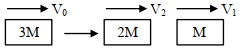
\(3 {MV}_{0}=2 {MV}_{2}+{MV}_{1}\)\(3 {V}_{0}=2 {V}_{2}+{V}_{1}\)
\(120=2 {V}_{2}+60 \Rightarrow {V}_{2}=30\, {m} / {s}\)
\(\frac{\Delta {K} {E}}{{K} . {E} .}=\frac{\frac{1}{2} {MV}_{1}^{2}+\frac{1}{2} 2 {M} V_{2}^{2}-\frac{1}{2} 3 {M} V_{0}^{2}}{\frac{1}{2} 3 {M} V_{0}^{2}}\)
\(=\frac{{V}_{1}^{2}+2 {V}_{2}^{2}-3 {V}_{0}^{2}}{3 {V}_{0}^{2}}\)
\(=\frac{3600+1800-4800}{4800}\)
\(=\frac{1}{8}\)
-
- (A) \(5\)
- (B) \(75\)
- (C) \(25\)
- (D) \(50\)
Show answer and solution
Correct Answer: (C)
\(p_{i}=p_{f}\)\(2 \times 4=2 \times 1+m_{2} \times v_{2}\)
\(m_{2} v_{2}=6\)
by coefficient of restitution
\(1=\frac{v_{2}-1}{4} \Rightarrow v_{2}=5 m / s\)
\(m _{2} \times 5=6\)
\(m _{2}=1.2 kg\)
\(v _{ cm }=\frac{ m _{1} v _{1}+ m _{2} v _{2}}{ m _{1}+ m _{2}}\)
\(v _{ cm }=\frac{2 \times 1+1.2 \times 5}{2+1.2}=\frac{8}{3.2}=\frac{25}{10}\)
\(x =25\)
-
- (A) \(0.68\)
- (B) \(1\)
- (C) \(1.64\)
- (D) \(0.64\)
Show answer and solution
Correct Answer: (A)
Work done \(=\) Change in kinetic energy\({W}_{{mg}}+{W}_{{air}-\text { fiction }}=\frac{1}{2} {m}(.8 \sqrt{{gh}})^{2}-\frac{1}{2} {m}(0)^{2}\)
\({W}_{\text {air - fiction }}=\frac{.64}{2} {mgh}-{mgh}=0.68 {mgh}\)
-
- (A) \(4\)
- (B) \(1\)
- (C) \(3\)
- (D) \(2\)
Show answer and solution
Correct Answer: (C)
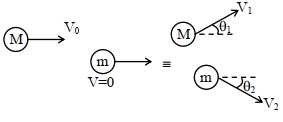
given \(\theta_{1}=\theta_{2}=\theta\)from momentum conservation
in \(x\)-direction \(M V_{0}=M V_{1} \cos \theta+m V_{2} \cos \theta\)
in \({y}\)-direction \(0={MV}_{1} \sin \theta-{m} {V}_{2} \sin \theta\)
Solving above equations
\({V}_{2}=\frac{{MV}_{1}}{{m}}, {V}_{0}=2 {V}_{1} \cos \theta\)
From energy conservation
\(\frac{1}{2} {MV}_{0}^{2}=\frac{1}{2} {MV}_{1}^{2}+\frac{1}{2} {MV}_{2}^{2}\)
Substituting value of \({V}_{2} \& {V}_{0}\), we will get
\(\frac{{M}}{{m}}+1=4 \cos ^{2} \theta \leq 4\)
\(\frac{{M}}{{m}} \leq 3\)
-
- (A) \(19.0\)
- (B) \(4.47\)
- (C) \(14.41\)
- (D) \(1.00\)
Show answer and solution
Correct Answer: (B)
Given, \(m =0.5 kg\) and \(u =20 m / s\)Initial kinetic energy \(\left( k _{ i }\right)=\frac{1}{2} mu ^{2}\)
\(=\frac{1}{2} \times 0.5 \times 20 \times 20=100 J\)
After deflection it moves with \(5 \%\) of \(k _{ i }\)
\(\therefore k _{ f }=\frac{5}{100} \times k _{ i } \Rightarrow \frac{5}{100} \times 100\)
\(\Rightarrow k_{ f }=5 J\)
Now, let the final speed be 'v' \(m / s\), then :
\(k_{ f }=5=\frac{1}{2} mv ^{2}\)
\(\Rightarrow v ^{2}=20\)
\(\Rightarrow v =\sqrt{20}=4.47 m / s\)
-
- (A) \(1000\)
- (B) \(400\)
- (C) \(100\)
- (D) \(10\)
Show answer and solution
Correct Answer: (B)
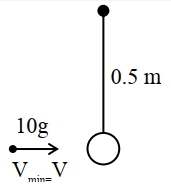
\({V}^{\prime}=\sqrt{5 {gR}}=\sqrt{5 \times 10 \times 0.5}\)\({V}^{\prime}=5\, {m} / {s}\)
\({m}_{1} {V}={m}_{2} \times 5-{m}_{1} \times 100\)
\(\frac{10}{1000} \times {V}=5-\frac{10}{1000} \times 100\)
\({V}=400\, {m} / {s}\)
-
- (A) \(t^{2 / 3}\)
- (B) \(t ^{3 / 2}\)
- (C) \(t\)
- (D) \(t ^{1 / 2}\)
Show answer and solution
Correct Answer: (B)
\(P=C\)\(F V=C\)
\(M \frac{d V}{d t} V=C\)
\(\frac{V^{2}}{2} \propto t\)
\(V \propto t^{1 / 2}\)
\(\frac{d x}{d t} \propto t^{1 / 2}\)
\(x \propto t^{3 / 2}\)
-
- (A) \(300\)
- (B) \(75\)
- (C) \(150\)
- (D) \(450\)
Show answer and solution
Correct Answer: (D)
\(F=(5 y+20) \hat{j}\)\(W=\int F d y=\int_{0}^{10}(5 y+20) d y\)
\(=\left(\frac{5 y^{2}}{2}+20 y\right)_{0}^{10}\)
\(=\frac{5}{2} \times 100+20 \times 10\)
\(W=250+200=450 J\)
-
- (A) \(846.5\)
- (B) \(821.5\)
- (C) \(831.5\)
- (D) \(886.4\)
Show answer and solution
Correct Answer: (C)
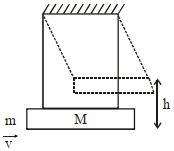
From energy conservation,\([\) after bullet gets embedded till the system comes momentarily at rest \(]\)
\(( M + m ) g h =\frac{1}{2}( M + m ) v _{1}^{2}\)
\(\left[ v _{1}\right.\) is velocity after collision]
\(\therefore v _{1}=\sqrt{2 gh }\)
Applying momentum conservation, (just before and just after collision)
\(mv =( M + m ) v _{1}\)
\(v =\left(\frac{ M + m }{ m }\right) v _{1}=\frac{6}{10 \times 10^{-3}} \times \sqrt{2 \times 9.8 \times 9.8 \times 10^{-2}}\)
\(\approx 831.55\, m / s\)
-
- (A) \(+627.2 {J}\)
- (B) \(-62720.0 {J}\)
- (C) \(784.0 {J}\)
- (D) \(-627.2 {J}\)
Show answer and solution
Correct Answer: (D)
\(W_{\text {Porter }}+W_{m g}=\Delta K . E_{.}=0\)\(W_{\text {Porter }}=-W_{{mg}}=-m g h\)
\(=-80 \times 9.8 \times 0.8=-627.2\, {J}\)
-
- (A) \(3.0\)
- (B) \(3.50\)
- (C) \(2.0\)
- (D) \(2.50\)
Show answer and solution
Correct Answer: (D)
\(v _{0}=\sqrt{2 gh }\)\(v = e \sqrt{2 gh }=\sqrt{2 gh }\)
\(\Rightarrow e =0.9\)
\(S = h +2 e ^{2} h +2 e ^{4} h +\ldots \ldots \ldots\)
\(t =\sqrt{\frac{2 h }{ g }}+2 e \sqrt{\frac{2 h }{ g }}+2 e ^{2} \sqrt{\frac{2 h }{ g }}+\ldots \ldots \ldots\)
\(v _{ av }=\frac{ s }{ t }=2.5\, m / s\)
-
- (A) \(1\)
- (B) \(2\)
- (C) \(3\)
- (D) \(4\)
Show answer and solution
Correct Answer: (B)
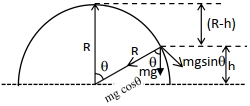
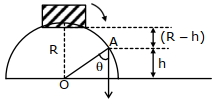
on balancing\(m g \cos \theta=\frac{m v^{2}}{R}....(1)\)
\(\cos \theta=\frac{h}{R}\)
Energy conservation
\(m g\{R-h\}=\frac{1}{2} m v^{2}....(2)\)
From \((1)\) and \((2) \Rightarrow m g\left\{\frac{h}{R}\right\}=\frac{2 m g\{R-h\}}{R}\)
\(h=\frac{2 R}{3}=2\, m\)
-
- (A) \(0\)
- (B) \(10\)
- (C) \(5\)
- (D) \(8\)
Show answer and solution
Correct Answer: (C)
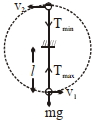
Let the speed of bob at lowest position be \(v _{1}\) and at the highest position be \(v _{2}\).Maximum tension is at lowest position and minimum tension is at the highest position. Now, using, conservation of mechanical energy,
\(\frac{1}{2} mv _{1}^{2}=\frac{1}{2} mv _{2}^{2}+ mg 2 l\)
\(\Rightarrow v _{1}^{2}= v _{2}^{2}+4 g l\) \(......(1)\)
Now \(T _{\max }- mg =\frac{ mv _{1}^{2}}{l}\)
\(\Rightarrow T _{\max }= mg +\frac{ mv _{1}^{2}}{l}\)
and \(T _{\min }+ mg =\frac{ mv _{2}^{2}}{l}\)
\(\Rightarrow T _{\min }=\frac{ mv _{2}^{2}}{l}- mg\)
\(\frac{ T _{\max }}{ T _{\min }}=\frac{5}{1}\)
\(\Rightarrow \frac{ mg +\frac{ mv _{1}^{2}}{l}}{\frac{ mv _{2}^{2}}{l}- mg }=\frac{5}{1}\)
\(\Rightarrow mg +\frac{ mv _{1}^{2}}{l}=\left[\frac{ mv _{2}^{2}}{l}- mg \right] 5\)
\(\Rightarrow mg +\frac{ m }{l}\left[ v _{2}^{2}+4 g l\right]=\frac{5 mv _{2}^{2}}{l}-5 mg\)
\(\Rightarrow mg +\frac{ mv _{2}^{2}}{l}+4 mg =\frac{5 mv _{2}^{2}}{l}-5 mg\)
\(\Rightarrow 10 mg =\frac{4 mv _{2}^{2}}{l}\)
\(v _{2}{ }^{2}=\frac{10 \times 10 \times 1}{4}\)
\(\Rightarrow v _{2}^{2}=25 \Rightarrow v _{2}=5 m / s\)
Thus, velocity of bob at highest position is \(5 m / s\)
-
- (A) \(40\)
- (B) \(60\)
- (C) \(400\)
- (D) \(10\)
Show answer and solution
Correct Answer: (A)
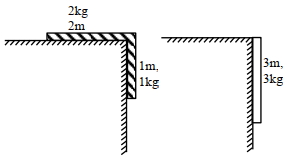
From energy conservation\({K}_{{i}}+{U}_{{i}}={k}_{{f}}+{U}_{{f}}\)
\(0+\left(-1 \times 10 \times \frac{1}{2}\right)={k}_{{f}}+\left(-3 \times 10 \times \frac{3}{2}\right)\)
\(-5={k}_{{f}}-45\)
\({k}_{{f}}=40 \,{J}\)
-
- (A) \(\left(\frac{8 {P}}{9 {m}}\right)^{\frac{1}{2}} {t}^{\frac{3}{2}}\)
- (B) \(\left(\frac{8 {P}}{9 {m}}\right)^{\frac{1}{2}} {t}^{\frac{2}{3}}\)
- (C) \(\left(\frac{9 {m}}{8 {P}}\right)^{\frac{1}{2}} {t}^{\frac{3}{2}}\)
- (D) \(\left(\frac{9 {P}}{8 {m}}\right)^{\frac{1}{2}} {t}^{\frac{3}{2}}\)
Show answer and solution
Correct Answer: (A)
If 10.Power is constant\(P=\text { const. }\)
\(P=F v=\frac{m v^{2} d v}{d x}\)
\(\int_{0}^{x} \frac{P}{m} d x=\int_{0}^{v} v^{2} d v\)
\(\frac{P x}{m}=\frac{v^{3}}{3}\)
\(\left(\frac{3 P x}{m}\right)^{1 / 3}=v=\frac{d x}{d t}\)
\(\left(\frac{3 P}{m}\right)^{1 / 3} \int_{0}^{t} d t=\int_{0}^{x} x^{-1 / 3} d x\)
\(\Rightarrow x=\left(\frac{8 P}{9 m}\right)^{1 / 2} t^{3 / 2}\)
-
- (A) \(16\)
- (B) \(400\)
- (C) \(1.6\)
- (D) \(160\)
Show answer and solution
Correct Answer: (A)
\(\text { Work }=\Delta K . E\)\(W_{\text {friction }}+W_{\text {spring }}=0-\frac{1}{2} m v^{2}\)
\(-\frac{90}{100}\left(\frac{1}{2} m v^{2}\right)+W_{\text {Spring }}=-\frac{1}{2} m v^{2}\)
\({W}_{\text {spring }}=-\frac{10}{100} \times \frac{1}{2} {mv}^{2}\)
\(-\frac{1}{2} {kx}^{2}=-\frac{1}{20} {mv}^{2}\)
\(\Rightarrow {k}=\frac{40000 \times(20)^{2}}{10 \times(1)^{2}}=16 \times 10^{5}\)
-
- (A) \(3:1\)
- (B) \(2:1\)
- (C) \(1:2\)
- (D) \(1:1\)
Show answer and solution
Correct Answer: (A)
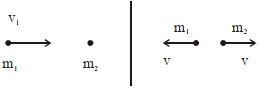
\(m _{1} v _{1}=- m _{1} v + m _{2} v\)\(v _{1}=- v +\frac{ m _{2}}{ m _{1}} v\)
\(\frac{\left( v _{1}+ v \right)}{ v }=\frac{ m _{2}}{ m _{1}}\)
\(e =\frac{2 v }{ v _{1}}=1\)
\(v =\frac{ v _{1}}{2}\)
\(\frac{ v _{1}+ v _{1} / 2}{ v _{1} / 2}=\frac{ m _{2}}{ m _{1}}\)
\(3=\frac{ m _{2}}{ m _{1}}\)
-
- (A) \(5\)
- (B) \(8\)
- (C) \(12\)
- (D) \(10\)
Show answer and solution
Correct Answer: (D)
Using work energy theorem,\(W _{ g }=\Delta K . E\)
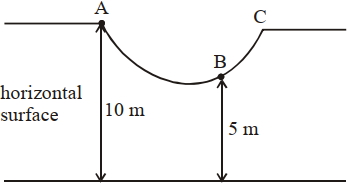
\((10)(g)(5)=\frac{1}{2}(10) v^{2}-0\)
\(v =10 m / s\)
-
- (A) \(A\) is not correct but \(R\) is correct.
- (B) Both \(A\) and \(R\) are correct but \(R\) is \(NOT\) the correct explanation of \(A\).
- (C) Both \(A\) and \(R\) are correct and \(R\) is the correct explanation of \(A\).
- (D) \(A\) is correct but \(R\) is not correct.
Show answer and solution
Correct Answer: (C)
For \(e =1\) and second body at rest\(V_{2}=\frac{2 m_{1} u_{1}}{m_{1}+m_{2}}=\frac{2 u(M)}{M+m} \simeq 2 u\)
Since \(M > >m\)
-
- (A) at \(x=x_{3}\), \(K.E.=4\;J\)
- (B) at \(x=x_{2}\), \(K.E.\) is greatest and the particle is moving at the fastest speed.
- (C) at \(x\,<\,x_{1}\), \(K.E.\) is smallest and the particle is moving at the slowed speed.
- (D) at \(x\,>\,x_{4}\), \(K.E.\) is constant throughout the region.
Show answer and solution
Correct Answer: (C)
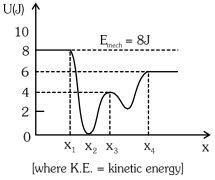
Given\(\left.E_{\text {mech. }}=8\right]\)
\((A)\) at \(x\,>\,x_{4}, \quad U=\) constant \(\left.=6\right]\)
\({K}={E}_{{mech} .}-{U}=2\, {J}=\) constant
\((B)\) at \(x\,<\,x_{1}, \quad U=\) constant \(\left.=8\right]\)
\({K}={E}_{\text {mech. }}-{U}=8-8=0 \,{J}\)
Particle is at rest.
\((C)\) At \(x=x_{2}, U=0 \Rightarrow E_{\text {mech. }}=K=8\) ]
\({KE}\) is greatest, and particle is moving at fastest speed.
\((C)\) \((D)\) At \(\left.x=x_{3}, \quad U=4\right]\)
\({U}+{K} =8\, {J}\)
\({K} =4\, {J}\)
- 628. If the kinetic energy of a moving body becomes four times its initial kinetic energy, then the percentage change in its momentum will be \(...\%\) 2021 Medium
- (A) \(100\)
- (B) \(300\)
- (C) \(400\)
- (D) \(200\)
Show answer and solution
Correct Answer: (A)
\({K}_{2}=4 {K}_{1}\)\(\frac{1}{2} m v_{2}^{2}=4 \frac{1}{2} m v_{1}^{2}\)
\(v_{2}=2 v_{1}\)
\(P=m v\)
\(P_{2}=m v_{2}=2 m v_{1}\)
\(P_{1}=m v_{1}\)
\(\% \,\text { change }=\frac{\Delta P}{P_{1}} \times 100=\frac{2 m v_{1}-m v_{1}}{m v_{1}} \times 100=100\, \%\)
-
- (A) \(51\)
- (B) \(212\)
- (C) \(1\)
- (D) \(9\)
Show answer and solution
Correct Answer: (C)
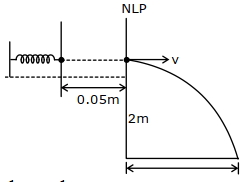
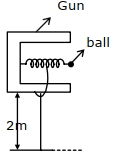
\(\frac{1}{2} k x^{2}=\frac{1}{2} m v^{2}\)\(k x^{2}=m v^{2}\)
\(V=x \sqrt{\frac{k}{m}}=0.05 \sqrt{\frac{100}{1}}=0.05 \times 10 \sqrt{10}\)
\(v=0.5 \sqrt{10}\)
From \(h=\frac{1}{2} g t^{2}\)
\(t=\sqrt{\frac{2 h}{g}}=\sqrt{\frac{2 \times 2}{10}}=\frac{2}{\sqrt{10}}\)
\(\therefore d=v t=0.5 \sqrt{10} \times \frac{2}{\sqrt{10}}=1\, {m}\)
-
- (A) \(2\)
- (B) \(1\)
- (C) \(3\)
- (D) \(0\)
Show answer and solution
Correct Answer: (B)
For equilibrium\(\frac{ dU }{ dr }=0\)
\(\frac{-10 \alpha}{r^{11}}+\frac{5 \beta}{r^{6}}=0\)
\(\frac{5 \beta}{r^{6}}=\frac{10 \alpha}{r^{11}}\)
\(r ^{3}=\frac{2 \alpha}{\beta}\)
\(r=\left(\frac{2 \alpha}{\beta}\right)^{\frac{1}{3}}\)
\(a=1\)
-
- (A) \(4\)
- (B) \(6\)
- (C) \(9\)
- (D) \(3\)
Show answer and solution
Correct Answer: (A)
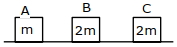
After \(1^{st}\) collision\(m v_{A}=m v_{A}^{\prime}+2 m v_{B}^{\prime}\)
\(-1=\frac{v_{B}^{\prime}-v_{A}^{\prime}}{0-v_{A}} \Rightarrow v_{B}^{\prime}=6 m / s\)
After the \(2^{nd}\) collision
\(2 mv _{ B }^{\prime}=(2 m + m )_{ V _{ C }}\)
\(\Rightarrow v _{ C }=\frac{2}{3} v _{ B }^{\prime} \Rightarrow v _{ C }=4 m / s\)
-
- (A) \(v\sqrt{\frac{ M }{2 K }}\)
- (B) \(\sqrt{\frac{ mv }{2 K }}\)
- (C) \(\sqrt{\frac{ mv }{ K }}\)
- (D) \({\sqrt{\frac{ m }{2 K }}}\)
Show answer and solution
Correct Answer: (A)
\(C\) comes to rest\(V_{c m}\) of \(A \& B=\frac{v}{2}\)
\(\Rightarrow \frac{1}{2}\) is \(v _{ ret }^{2}=\frac{1}{2} kx ^{2}\)
\(x=\sqrt{\frac{\mu \times v^{2}}{k}}=\sqrt{\frac{m}{2 k}} v\)
-
- (A) \(1\)
- (B) \(2\)
- (C) \(3\)
- (D) \(4\)
Show answer and solution
Correct Answer: (A)
\(\frac{ p _{1}^{2}}{2 \times 4}=\frac{ p _{2}^{2}}{2 \times 16}\)\(\frac{ p _{1}}{ p _{2}}=\frac{1}{2}\)
-
- (A) \(2\)
- (B) \(3\)
- (C) \(1\)
- (D) \(4\)
Show answer and solution
Correct Answer: (A)
\(\text { Given } {W}_{{A}}={W}_{{B}}\)\({F}_{{A}} {d} \cos 45^{\circ}={F}_{{B}} {d} \cos 60^{\circ}\)
\({F}_{A} \times \frac{1}{\sqrt{2}}={F}_{{B}} \times \frac{1}{2}\)
\(\frac{{F}_{{A}}}{{F}_{{B}}}=\frac{\sqrt{2}}{2}=\frac{1}{\sqrt{2}}\)
\({x}=2\)
-
- (A) \(1\)
- (B) \(2\)
- (C) \(3\)
- (D) \(4\)
Show answer and solution
Correct Answer: (B)
Kinetic energy \(K =\frac{ P ^{2}}{2 m },\left( P _{ A }= P _{ B }\right)\)\(K \propto \frac{1}{ m }\)
\(\frac{ K _{ A }}{ K _{ B }}=\frac{ m _{ B }}{ m _{ A }}\)
\(=\frac{2}{1}\)
-
- (A) \(20\)
- (B) \(25\)
- (C) \(16\)
- (D) \(30\)
Show answer and solution
Correct Answer: (B)
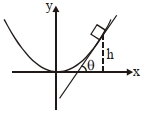
At maximum ht. block will experience maximum friction force. Therefore if at this height slope of the tangent is \(\tan \theta,\) then \(\theta=\) Angle of repose.\(\therefore \tan \theta=\frac{d y}{d x}=\frac{2 x}{4}=\frac{x}{2}=0.5\)
\(\Rightarrow x=1\) and therefore \(y=\frac{x^{2}}{4}=0.25 m\)
-
- (A) \(20\)
- (B) \(10\)
- (C) \(40\)
- (D) \(25\)
Show answer and solution
Correct Answer: (B)
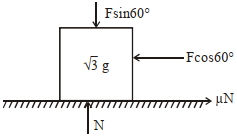
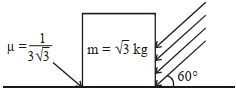
\(F \cos 60^{\circ}=\mu N\) or \(\frac{ F }{2}=\frac{1}{3 \sqrt{3}} N\) \(\ldots\) (1)\(\& N=\sin 60^{\circ}+\sqrt{3} g\) \(\ldots(2)\)
From equation
\((1)\;and\;(2)\)
\(\frac{F}{2}=\frac{1}{3 \sqrt{3}}\left(\frac{F \sqrt{3}}{2}+\sqrt{3} g\right)\)
\(\Rightarrow F = g =10\) Newton \(=3 x\)
So \(x=\frac{10}{3}=3.33\)
-
- (A) \(25\)
- (B) \(30\)
- (C) \(30\)
- (D) \(20\)
Show answer and solution
Correct Answer: (A)
\(F.B.D.\) of the block is shown in the diagramSince block is at rest therefore
\(fr - mg =0\) \(........(1)\)
\(F- N =0\) \(..........(2)\)
\(fr \leq \mu N\)
In limiting case
\(fr =\mu N =\mu F\) \(........(3)\)
Using eq. \((1)\) and \((3)\)
\(\therefore \mu F = mg\)
\(\Rightarrow F=\frac{0.5 \times 10}{0.2}=25 N\)

- 639. A bomb is dropped by fighter plane flying horizontally. To an observer sitting in the plane, the trajectory of the bomb is a : 2021 Medium
- (A) hyperbola
- (B) parabola in the direction of motion of plane
- (C) straight line vertically down the plane
- (D) parabola in a direction opposite to the motion of plane
Show answer and solution
Correct Answer: (C)
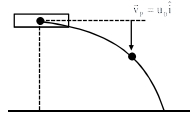
\({v}_{{B}}={u}_{0} \hat{{i}}-{gt} \hat{{j}} \)\(\overrightarrow{{v}}_{{B} / {P}}=\overrightarrow{{v}}_{{B}}-\overrightarrow{{v}}_{{P}}\)
\(\overrightarrow{{v}}_{{B} / {P}}=-8 \hat{{t}} \hat{{j}}\)
straight line vertically down
-
- (A) \(15\)
- (B) \(122\)
- (C) \(3\)
- (D) \(20\)
Show answer and solution
Correct Answer: (A)
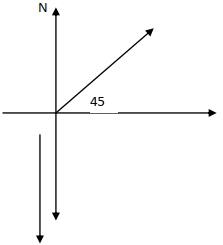
\(\overrightarrow{{V}}_{{BW}}=4 \sqrt{2} \cos 45 \hat{{i}}+4 \sqrt{2} \sin 45 \hat{{j}}\)\(=4 \hat{{i}}+4 \hat{{j}}\)
\(\overrightarrow{{V}}_{{w}}=-\hat{{j}}\)
\(\overrightarrow{{V}}_{{B}}=\overrightarrow{{V}}_{{Bw}}+\overrightarrow{{V}}_{{T}}=4 \hat{{i}}+3 \hat{{j}}\)
\(\overrightarrow{{S}}_{{B}}=\overrightarrow{{V}}_{{B}} \times {t}=(4 \hat{{i}}+3 \hat{{j}}) \times 3=12 \hat{{i}}+9 \hat{{j}}\)
\(\left|\overrightarrow{{S}}_{{B}}\right|=\sqrt{(12)^{2}+(9)^{2}}=15\, {m}\)
-
- (A) \(\sqrt{\frac{2 {ghv}^{2}+1}{{h}^{2}}}\)
- (B) \(\sqrt{2 {ghv}^{2}+{h}^{2}}\)
- (C) \(\sqrt{\frac{2 {v}^{2} {h}}{{g}}+{h}^{2}}\)
- (D) \(\sqrt{\frac{2 {gh}}{{v}^{2}}}+{h}^{2}\)
Show answer and solution
Correct Answer: (C)
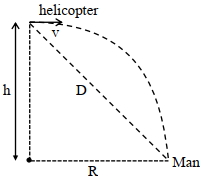
\({R}=\sqrt{\frac{2 {h}}{{g}}} \cdot {v}\)\({D}=\sqrt{{R}^{2}+{h}^{2}}\)
\(=\sqrt{\left(\sqrt{\frac{2 {h}}{{g}}} \cdot {v}\right)^{2}+{h}^{2}}\)
\({D}=\sqrt{\frac{2 {hv}^{2}}{{g}}+{h}^{2}}\)
-
- (A) \(4.1 \times 10^{8} \,{s}\)
- (B) \(4.5 \times 10^{10} \,{s}\)
- (C) \(3.5 \times 10^{6}\, {s}\)
- (D) \(7.2 \times 10^{8} \,{s}\)
Show answer and solution
Correct Answer: (B)
\({R}=\frac{\ell}{\theta}\)\(\text { Time }=\frac{4 \times 2 \pi {R}}{{v}}=\frac{4 \times 2 \pi}{{v}}\left(\frac{\ell}{\theta}\right)\)
\(\text { put } \ell=4.4 \times 9.46 \times 10^{15}\)
\({v}=8 \times 1.5 \times 10^{11}\)
\(\theta=\frac{4}{3600} \times \frac{\pi}{180} {rad}\)
\(\text { we get time }=4.5 \times 10^{10} {sec}\)
-
- (A) \(\tan ^{-1}\left(\frac{2}{3}\right)\) from \(x-\) axis
- (B) \(\tan ^{-1}\left(\frac{2}{3}\right)\) from \(y\) -axis
- (C) \(\tan ^{-1}\left(\frac{5}{2}\right)\) from \(y\) -axis
- (D) \(\tan ^{-1}\left(\frac{5}{2}\right)\) from \(x\) -axis
Show answer and solution
Correct Answer: (B)
Given :\(\overrightarrow{ v }=0.5 t ^{2} \hat{ i }+3 t \hat{ j }+9 \hat{ k }\)
\(\overrightarrow{ v }_{ at\,t =2}=2 \hat{ i }+6 \hat{ j }+9 \hat{ k }\)
\(\therefore\) Angle made by direction of motion of mosquito will be,
\(\cos ^{-1} \frac{2}{11}(\) from \(x\) -axis \()=\tan ^{-1} \frac{\sqrt{117}}{2}\)
\(\cos ^{-1} \frac{6}{11}(\) from \(y\) -axis \()=\tan ^{-1} \frac{\sqrt{85}}{6}\)
\(\cos ^{-1} \frac{9}{11}(\) from \(z\) -axis \()=\tan ^{-1} \frac{\sqrt{40}}{9}\)
None of the option is matching.
Hence this question should be bonus.
-
- (A) \(T \propto R ^{2}\)
- (B) \(T \propto R ^{\frac{3}{2}}\)
- (C) \(T \propto R ^{\frac{5}{2}}\)
- (D) \(T \propto R ^{\frac{4}{3}}\)
Show answer and solution
Correct Answer: (A)
\(F \propto \frac{1}{R^{3}}\)\(\frac{K}{R^{3}}=m \omega^{2} R\)
\(\omega^{2}=\frac{K}{m} \times \frac{1}{R^{4}}\)
\(\left(\frac{2 \pi}{T}\right)^{2}=\frac{K}{m} \times \frac{1}{R^{4}}\)
\(T^{2} \propto R^{4}\)
\(T \propto R^{2}\)
-
- (A) \(\sqrt{{rg}}\)
- (B) \(\sqrt{2 {rg}}\)
- (C) \(2 \sqrt{{rg}}\)
- (D) \(\sqrt{\frac{r g}{2}}\)
Show answer and solution
Correct Answer: (A)
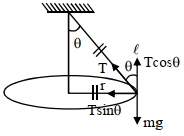
Conical pendulum\({r}=\frac{\ell}{\sqrt{2}}\)
\(\sin \theta=\frac{{r}}{\ell}=\frac{1}{\sqrt{2}}\)
\(\theta=45^{\circ}\)
\({T} \sin \theta=\frac{{mv}^{2}}{{r}}\)
\({T} \cos \theta={mg}\)
\(\tan \theta=\frac{{v}^{2}}{{rg}} \Rightarrow {v}=\sqrt{{rg}}\)
-
- (A) \(5\)
- (B) \(4\)
- (C) \(10\)
- (D) \(8\)
Show answer and solution
Correct Answer: (A)
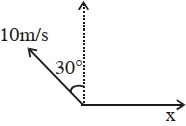
\(10 \sin 30^{\circ}=x\)\(x=5 m / s\)
-
- (A) \({h}_{\max }=10\, {m} \quad {T}=2.5\, {s}\)
- (B) \({h}_{\max }=15.625\, {m} \quad {T}=3.54 \,{s}\)
- (C) \({h}_{\max }=15.625\, {m} \quad {T}=1.77 \,{s}\)
- (D) \({h}_{\max }=3.54 \,{m} \quad {T}=0.125 \,{s}\)
Show answer and solution
Correct Answer: (C)
\({H} =\frac{{U}^{2} \sin ^{2} \theta}{2 {g}}\)\(=\frac{(25)^{2} \cdot(\sin 45)^{2}}{2 \times 10}\)
\(=15.625 {m}\)
\({T} =\frac{{U} \sin \theta}{{g}}\)
\(=\frac{25 \times \sin 45^{\circ}}{10}\)
\(=2.5 \times 0.7\)
\(=1.77\, {s}\)
-
- (A) \(30\)
- (B) \(120\)
- (C) \(60\)
- (D) \(150\)
Show answer and solution
Correct Answer: (B)
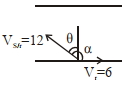
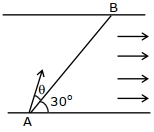
\(V_{sw} \sin \theta= v _{ r }\)\(12 \sin \theta= 6\)
\(\sin \theta=\frac{1}{2}\)
\(\theta=30^{\circ}\)
\(\therefore \quad \alpha=120^{\circ}\)
-
- (A) \(30\)
- (B) \(60\)
- (C) \(90\)
- (D) \(120\)
Show answer and solution
Correct Answer: (A)
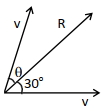
As we knowBoth velocity vectors are of same magnitude therefore resultant would pass exactly midway through them
\(\theta=30^{\circ}\)
-
- (A) \(10\)
- (B) \(8\)
- (C) \(3\)
- (D) \(5\)
Show answer and solution
Correct Answer: (D)
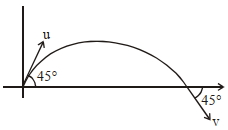
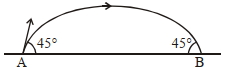
\(|\overrightarrow{ u }|=|\overrightarrow{ v }|.....(1)\)\(\overrightarrow{ u }=u \cos 45 \hat{ i }+ u \sin 45 \hat{ j }.....(2)\)
\(\overrightarrow{ v }= v \cos 45 \hat{ i }- v \sin 45 \hat{ j }.....(3)\)
\(|\overrightarrow{\Delta P }|=| m (\overrightarrow{ v }-\overrightarrow{ u })|.....(4)\)
\(\Delta P =2 mu \sin 45^{\circ}\)
\(=2 \times 5 \times 10^{-3} \times 5 \sqrt{2} \times \frac{1}{\sqrt{2}}\)
\(=50 \times 10^{-3}\)
\(=5 \times 10^{-2}\)



No questions on this page match these filters.