


All JEE Mains 2021 Physics questions
32 chaptersShowing 201–250 of 685 questions
-
- (A) \(10\)
- (B) \(15\)
- (C) \(20\)
- (D) \(30\)
Show answer and solution
Correct Answer: (B)
\(m =\frac{ f }{ u + f }\)\(+ m =\frac{ f }{-10+ f } \quad \cdots\)
\(- m =\frac{ f }{-20+ f } \ldots\)
(1) / (2)
\(-1=\frac{ f -20}{ f -10}\)
\(10- f = f -20\)
\(30=2 f\)
\(f =15 cm\)
-
- (A) green
- (B) red
- (C) blue and green
- (D) blue
Show answer and solution
Correct Answer: (B)
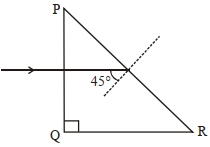
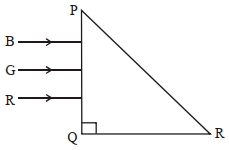
Assuming that the right angled prism is an isoceles prism, so the other angles will be \(45^{\circ}\) each.\(\Rightarrow\) Each incident ray will make an angle of \(45^{\circ}\) with the normal at face \(PR\).
\(\Rightarrow\) The wavelength corresponding to which the incidence angle is less than the critical angle, will pass through \(PR\). \(\Rightarrow \theta_{ C }=\) critical angle
\(\Rightarrow \theta_{c}=\sin ^{-1}\left(\frac{1}{\mu}\right)\)
\(\Rightarrow\) If \(\theta_{ C } \geq 45^{\circ}\)
the light ray will pass
\(\Rightarrow\left(\theta_{ C }\right)_{ Red }=\sin ^{-1}\left(\frac{1}{1.27}\right)=51.94^{\circ}\)
Red will pass.
\(\Rightarrow\left(\theta_{ C }\right)_{ Green }=\sin ^{-1}\left(\frac{1}{1.42}\right)=44.76^{\circ}\)
Green will not pass
\(\Rightarrow\left(\theta_{ C }\right)_{ Blue }=\sin ^{-1}\left(\frac{1}{1.49}\right)=42.15^{\circ}\)
Blue will not pass
\(\Rightarrow\) So only red will pass through \(PR.\)
-
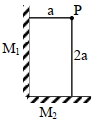
- (A) \(3 {a}\)
- (B) \(4.6 {a}\)
- (C) \(2.3 {a}\)
- (D) \(2 \sqrt{10} {a}\)
Show answer and solution
Correct Answer: (B)
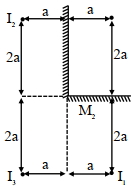
Shortest distance is \(2 {a}\) between \({I}_{1} \& {I}_{3}\)But answer given is for \({I}_{1} \& {I}_{2}\)
\(\sqrt{(4 a)^{2}+(2 a)^{2}}\)
\(a \sqrt{20}\)
\(4.47 {a}\)
-
- (A) Astigmatism
- (B) Myopia with Astigmatism
- (C) Presbyopia with Astigmatism
- (D) Myopia and hypermetropia
Show answer and solution
Correct Answer: (B)
If distant objects are blurry then problem is Myopia.If objects are distorted then problem is Astigmatism
-
- (A) \(88\, {A}\) and \(\tan ^{-1}\left(\frac{11}{6}\right)\)
- (B) \(0.88\, {A}\) and \(\tan ^{-1}\left(\frac{11}{6}\right)\)
- (C) \(8.8 \,{A}\) and \(\tan ^{-1}\left(\frac{11}{6}\right)\)
- (D) \(8.8 \,{A}\) and \(\tan ^{-1}\left(\frac{6}{11}\right)\)
Show answer and solution
Correct Answer: (C)
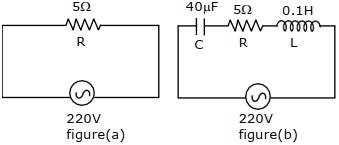
Inductive reactance, \(X_{L}=\omega L\)\(=100 \pi \times 0.07\)
\(=100 \times \frac{22}{7} \times \frac{7}{100}\)
\(=22 \Omega\)
\(\therefore \quad \text { Impedance, } Z =\sqrt{R^{2}+X_{L}^{2}}\)
\(=\sqrt{12^{2}+22^{2}}\)
\(=\sqrt{144+484}\)
\(=\sqrt{628}\)
\( \approx 25 \Omega\)
\(\therefore \text { Current, } I=\frac{V}{Z}=\frac{220}{25} =8.8 A\)
\(\Rightarrow \quad I=8.8 \Lambda\)
Also, phase angle between current and source voltage can be given as
\(\tan \phi =\left(\frac{X_{L}}{R}\right) \Rightarrow \tan \phi=\frac{22}{12}\)
\(\Rightarrow \quad \phi =\tan ^{-1}\left(\frac{11}{6}\right)\)
-
- (A) \(703\)
- (B) \(700\)
- (C) \(730\)
- (D) \(70.3\)
Show answer and solution
Correct Answer: (D)
\(C=0.1\, \mu {F}=10^{-7}\, {F}\)Resonant frequency \(=60\, {Hz}\)
at resonance
\(\omega_{0}=\frac{1}{\sqrt{L C}}\)
\(2 \pi f_{0}=\frac{1}{\sqrt{L C}} \Rightarrow \frac{1}{4 \pi^{2} f_{0}^{2} C}\)
By putting values \({L}=70.3\, {Hz}\)
-
- (A) \(2000\)
- (B) \(2500\)
- (C) \(1600\)
- (D) \(1800\)
Show answer and solution
Correct Answer: (A)
Given : \(\quad L =2 \times 10^{-4} H\)\(R =6.28 \Omega\)
\(f =10 MHz =10^{7} Hz\)
Since quality factor,
\(Q =\omega_{0} \frac{ L }{ R }=2 \pi f \frac{ L }{ R }\)
\(\therefore Q =2 \pi \times 10^{7} \times \frac{2 \times 10^{-4}}{6.28}\)
\(Q =2 \times 10^{3}=2000\)
\(\therefore\) Ans. is 2000
-
- (A) \(4\)
- (B) \(25\)
- (C) \(400\)
- (D) \(40\)
Show answer and solution
Correct Answer: (A)
For maximum average power\(X_{\mathrm{L}}=\mathrm{X}_{\mathrm{C}}\)
\(250 \pi=\frac{1}{2 \pi(50) \mathrm{C}}\)
\(\mathrm{C}=4 \times 10^{-6}\)
-
- (A) \(1200\)
- (B) \(600\)
- (C) \(800\)
- (D) \(900\)
Show answer and solution
Correct Answer: (D)
At resonance\(P =\frac{ V ^{2}}{ R }\)
\(R =\frac{ V ^{2}}{ P } =\frac{(120)^{2}}{16}\)
\(=900 \,\Omega\)
-
- (A) \(150\)
- (B) \(125\)
- (C) \(160\)
- (D) \(200\)
Show answer and solution
Correct Answer: (B)
\(X_{L}=X_{c}\) (due to resonance)\(Z=R \text { So } i_{m s}=\frac{V}{Z}=\frac{V}{R}\)
\(\frac{V^{2}}{R}=\frac{250 \times 250}{5}=125 \times 10^{2} \,W\)
-
- (A) \(3\)
- (B) \(4\)
- (C) \(5\)
- (D) \(6\)
Show answer and solution
Correct Answer: (B)
At resonance power \((P)\)\(P=\frac{\left(V_{ rms }\right)^{2}}{ R }\)
\(P=\frac{(250 / \sqrt{2})^{2}}{8}=3906.25 W\)
\(\approx 4 kW\)
-
- (A) \(5\)
- (B) \(15\)
- (C) \(20\)
- (D) \(10\)
Show answer and solution
Correct Answer: (D)
\(\lambda=960 m\)\(C =2.56 \mu F =2.56 \times 10^{-6} F\)
\(c=3 \times 10^{8} m / s\)
\(L =?\)
Now at resonance, \(\omega_{0}=\frac{1}{\sqrt{L C}}\)
[Resoant frequency]
\(2 \pi f _{0}=\frac{1}{\sqrt{ LC }}\)
On substituting \(f _{0}=\frac{ c }{\lambda},\) we have \(2 \pi \frac{ c }{\lambda}=\frac{1}{\sqrt{ LC }}\)
Squaring both sides : \(4 \pi^{2} \frac{ c ^{2}}{\lambda^{2}}=\frac{1}{ LC }\)
\(=\frac{4 \times 10 \times\left(3 \times 10^{8}\right)^{2}}{(960)^{2}}=\frac{1}{ L \times 2.56 \times 10^{-6}}\)
\(\Rightarrow \frac{1}{L}=\frac{4 \times 10 \times 9 \times 10^{16} \times 2.56 \times 10^{-6}}{960 \times 960}\)
\(\Rightarrow L =10 \times 10^{-8} H\)
-
- (A) \(2\)
- (B) \(1\)
- (C) \(3\)
- (D) \(4\)
Show answer and solution
Correct Answer: (B)
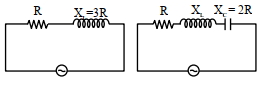
\(\cos \phi=\frac{{R}}{\sqrt{{R}^{2}+3 {R}^{2}}}\)\(=\frac{1}{\sqrt{10}}\)
\(\cos \phi^{\prime}=\frac{{R}}{\sqrt{{R}^{2}+{R}^{2}}}\)
\(=\frac{1}{\sqrt{2}}\)
\(\frac{\cos \phi^{\prime}}{\cos \phi}=\frac{\sqrt{10}}{\sqrt{2}}=\frac{\sqrt{5}}{1}\)
\(\therefore {x}=1\)
- 214. An \(AC\) current is given by \(I = I _{1} \sin \omega t + I _{2} \cos \omega t\). A hot wire ammeter will give a reading 2021 Hard
- (A) \(\sqrt{\frac{I_{1}^{2}-I_{2}^{2}}{2}}\)
- (B) \(\sqrt{\frac{ I _{1}^{2}+ I _{2}^{2}}{2}}\)
- (C) \(\frac{ I _{1}+ I _{2}}{\sqrt{2}}\)
- (D) \(\frac{ I _{1}+ I _{2}}{2 \sqrt{2}}\)
Show answer and solution
Correct Answer: (B)
\(I=I_{1} \sin \omega t+I_{2} \cos \omega t\)\(\therefore I_{0}=\sqrt{I_{1}^{2}+I_{2}^{2}}\)
\(\therefore I_{ rms }=\frac{I_{0}}{\sqrt{2}}=\sqrt{\frac{I_{1}^{2}+I_{2}^{2}}{2}}\)
- 215. An \(AC\) source rated \(220\, V , 50\, Hz\) is connected to a resistor. The time taken by the current to change from its maximum to the rms value is 2021 Medium
- (A) \(2.5\, ms\)
- (B) \(25\, ms\)
- (C) \(2.5\, s\)
- (D) \(0.25\, ms\)
Show answer and solution
Correct Answer: (A)
\(i = i _{0} \cos (\omega t )\)\(i = i _{0}\) at \(t =0\)
\(i =\frac{ i _{0}}{\sqrt{2}}\) at \(\omega t =\frac{\pi}{4}\)
\(t =\frac{\pi}{4 \omega}=\frac{\pi}{4(2 \pi f )}=\frac{1}{8 f }\)
\(t =\frac{1}{400}=2.5 ms\)
- 216. An alternating current is given by the equation \(i=i_{1} \sin \omega t+i_{2} \cos \omega t\). The rms current will be 2021 Hard
- (A) \(\frac{1}{\sqrt{2}}\left(i_{1}^{2}+i_{2}^{2}\right)^{\frac{1}{2}}\)
- (B) \(\frac{1}{\sqrt{2}}\left( i _{1}+ i _{2}\right)^{2}\)
- (C) \(\frac{1}{2}\left( i _{1}^{2}+ i _{2}^{2}\right)^{\frac{1}{2}}\)
- (D) \(\frac{1}{\sqrt{2}}\left( i _{1}+ i _{2}\right)\)
Show answer and solution
Correct Answer: (A)
\(i = i _{1} \sin \omega t + i _{2} \sin (\omega t +90)\)\(i_0 =\sqrt{ i _{1}^{2}+ i _{2}^{2}}\)
\(i _{ rms }=\frac{ i _{0}}{\sqrt{2}}=\frac{\sqrt{ i _{1}^{2}+ i _{2}^{2}}}{\sqrt{2}}\)
-
- (A) \(1\)
- (B) \(2.5\)
- (C) \(1.5\)
- (D) \(2\)
Show answer and solution
Correct Answer: (D)
\(\tan 45^{\circ}=\frac{1}{\omega C R}=\frac{\omega L}{R} \Rightarrow X_{L}=X_{C}\)\(\Rightarrow\) resonance
\(i =\frac{ V }{ R }\)
\(=\frac{220}{110}=2 \,A\)
- 218. At very high frequencies, the effective impendance of the given circuit will be \(....\Omega\)
 2021 Hard
- (A) \(0.2\)
- (B) \(20\)
- (C) \(2.2\)
- (D) \(2\)
Show answer and solution
Correct Answer: (D)
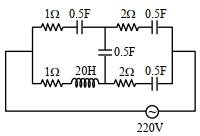
\({X}_{{L}}=2 \pi {fL}\)\({f}\) is very large
\(\therefore {X}_{{L}}\) is very large hence open circuit.
\({X}_{{C}}=\frac{1}{2 \pi {fC}}\)
\({f}\) is very large.
\(\therefore {X}_{{c}}\) is very small, hence short circuit.
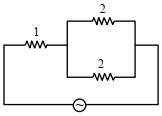
Final circuit
\(Z_{e q}=1+\frac{2 \times 2}{2+2}=2\)
-
- (A) \(2.25\)
- (B) \(3.0\)
- (C) \(3.37\)
- (D) \(9.0\)
Show answer and solution
Correct Answer: (A)
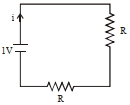
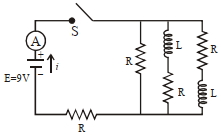
Just after the switch is closed, inductor will behave like infinite resistance (open circuit) so the circuit will look like\(i=\frac{9}{R+R}=\frac{9}{4}=2.25\)
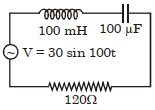
- 220. Find the peak current and resonant frequency of the following circuit (as shown in figure).
 2021 Hard
- (A) \(0.2\, A\) and \(50 \,Hz\)
- (B) \(0.2\, A\) and \(100\, Hz\)
- (C) \(2\, A\) and \(100\, Hz\)
- (D) \(2\, A\) and \(50\, Hz\)
Show answer and solution
Correct Answer: (A)
as given \(z=\sqrt{\left(x_{L}-x_{C}\right)^{2}+R^{2}}\)\(x _{ L }=\omega_{ L }=100 \times 100 \times 10^{-3}=10 \, \Omega\)
\(x _{ C }=\frac{1}{\omega_{ C }}=\frac{1}{100 \times 100 \times 10^{-6}}=10\, \Omega\)
\(z=\sqrt{(10-100)^{2}+R^{2}}=\sqrt{90^{2}+120^{2}}\)
\(=30 \times 5=150\, \Omega\)
\(i _{ peal }=\frac{\Delta v }{ z }=\frac{30}{150}=\frac{1}{5} amp =0.2\,amp\)
And For resonant frequency
\(\Rightarrow \omega L =\frac{1}{\omega C } \Rightarrow \omega^{2}=\frac{1}{ LC } \Rightarrow \omega=\frac{1}{\sqrt{ LC }}\)
And \(f=\frac{1}{2 \pi \sqrt{L C}} \Rightarrow \frac{1}{2 \pi \sqrt{100 \times 10^{-3} \times 100 \times 10^{-6}}}\)
\(=\frac{100 \sqrt{10}}{2 \pi}=\frac{100 \pi}{2 \pi}=50\, Hz\)
as \(\sqrt{10} \approx \pi\)
-
- (A) \(\approx 90^{\circ}\), predominantly inductive circuit
- (B) \(0^{\circ}\), resistive circuit
- (C) \(0^{\circ}\), resonance circuit
- (D) \(\approx 90^{\circ}\), predominantly capacitive circuit
Show answer and solution
Correct Answer: (D)
\(R=100\, \Omega\)\(X_{L}=\omega L=50 \pi \times 10^{-3}\)
\(X_{c}=\frac{1}{\omega C}=\frac{10^{11}}{100 \pi}\)
\(X_{c} \gg X_{L}\)
\(\&\,\left|X_{c}-X_{L}\right| \gg R\)
- 222. In a scries \(LCR\) resonance circuit, if we change the resistance only, from a lower to higher value 2021 Medium
- (A) The bandwidth of resonance circuit will increase.
- (B) The resonance frequency will increase.
- (C) The quality factor will increase.
- (D) The quality factor and the resonance frequency will remain constant.
Show answer and solution
Correct Answer: (A)
Bandwidth \(= R / L\)Bandwidth \(\propto R\)
So bandwidth will increase
-
- (A) \(\frac{1}{2}\)
- (B) \(\frac{1}{2 \sqrt{2}}\)
- (C) \(\frac{1}{\sqrt{2}}\)
- (D) \(\frac{\sqrt{3}}{2}\)
Show answer and solution
Correct Answer: (C)
We know that power factor is \(\cos \phi\)\(\cos \phi=\frac{ R }{ Z }\)
\(Z=\sqrt{R^{2}+\left(X_{L}-X_{C}\right)^{2}} \quad \ldots\)
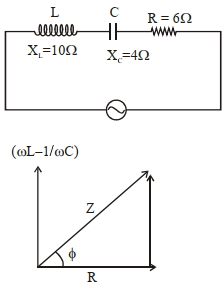
\(\Rightarrow Z =\sqrt{6^{2}+(10-4)^{2}}\)
\(\Rightarrow Z =6 \sqrt{2} \mid \cos \phi=\frac{6}{6 \sqrt{2}}\)
\(\cos \phi=\frac{1}{\sqrt{2}}\)
-
- (A) \(200\)
- (B) \(100\)
- (C) \(300\)
- (D) \(400\)
Show answer and solution
Correct Answer: (D)
\(Q =\frac{ X _{ L }}{ R }=\frac{\omega L }{ R }=\frac{1}{\sqrt{ LC }} \frac{ L }{ R }=\frac{\sqrt{ L }}{ R \sqrt{ C }}\)\(Q ^{\prime}=\frac{\sqrt{2 L }}{\left(\frac{ R }{2}\right) \sqrt{ C }}=2 \sqrt{2} Q =2 \sqrt{2}(100)\)
\(=282.84\)
-
- (A) \(2 {R}^{2}\)
- (B) Zero
- (C) \({R}\)
- (D) \({R} \sqrt{2}\)
Show answer and solution
Correct Answer: (C)
\(Z=\sqrt{\left(X_{L}-X_{C}\right)^{2}+R^{2}}=R: \because X_{L}=X_{C}\) -
- (A) \(3\)
- (B) \(5\)
- (C) \(7\)
- (D) \(9\)
Show answer and solution
Correct Answer: (A)
\(\tan \phi=\frac{x_{C}-x_{L}}{R}\)\(\tan 45=\frac{x_{C}-x_{L}}{R}\)
\(X_{C}-X_{L}=R\)
\(\frac{1}{\omega C}-\omega L=R\)
\(\frac{1}{\omega C}-300 \times 0.03=1\)
\(\frac{1}{\omega C}=10\)
\(C=\frac{1}{10 \omega}=\frac{1}{10 \times 300}\)
\(C=\frac{1}{3} \times 10^{-3}\)
\(X=3\)
-
- (A) \(5.9\)
- (B) \(3.16\)
- (C) \(0.94\)
- (D) \(6\)
Show answer and solution
Correct Answer: (B)
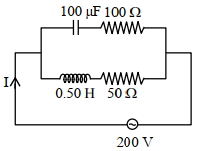
\(Z_{{c}}=\sqrt{\left(\frac{1}{\omega {C}}\right)^{2}+{R}^{2}}\)\(=\sqrt{\left(\frac{1}{100 \times 100 \times 10^{-6}}\right)^{2}+100^{2}}\)
\({Z}_{{C}}=\sqrt{(100)^{2}+(100)^{2}}\)
\(=100 \sqrt{2}\)
\({Z}_{{L}}=\sqrt{(\omega {L})^{2}+{R}^{2}}\)
\(\sqrt{(100 \times 0.5)^{2}+50^{2}}\)
\(=50 \sqrt{2}\)
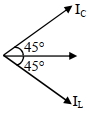
\({i}_{{C}}=\frac{200}{{z}_{{c}}}=\frac{200}{100 \sqrt{2}}=\sqrt{2}\)
\({i}_{{L}}=\frac{200}{{z}_{{L}}}=\frac{200}{50 \sqrt{2}}=2 \sqrt{2}\)
\(\cos \phi_{1}=\frac{100}{10 \sqrt{2}}=\frac{1}{\sqrt{2}} \Rightarrow \phi_{1}=45^{\circ}\)
\(\cos \phi_{2}=\frac{50}{50 \sqrt{2}}=\frac{1}{\sqrt{2}} \Rightarrow \phi_{2}=45^{\circ}\)
\({I}=\sqrt{{I}_{{C}}^{2}+{I}_{{L}}^{2}}\)
\(=\sqrt{2+8}\)
\(=\sqrt{10}\)
\({I}=3.16 \,{A}\)
-
- (A) \((a) - (iv) ; (b) - (iii) ; (c) - (ii) ; (d) - (i)\)
- (B) \((a) - (iii) ; (b) - (i) ; (c) - (iv) ; (d) - (ii)\)
- (C) \((a) - (ii) ; (b) - (i) ; (c) - (iv) ; (d) - (iii)\)
- (D) \((a) - (ii) ; (b) - (i) ; (c) - (iii) ; (d) - (iv)\)
Show answer and solution
Correct Answer: (C)
\((a)\) For \({x}_{{L}}\,>\,{x}_{{C}}\), voltage leads the current\((ii)\)
\((b)\) For \(x_{L}=x_{C}\), voltage \(\&\) current are in same phase
\((i)\)
\((c)\) For \({x}_{{L}}\, < \,{x}_{{C}}\), current leads the voltage
\((iv)\)
\((d)\) For resonant frequency \({x}_{{L}}={x}_{{C}}\), current is maximum
\((iii)\)
-
- (A) \((a) -( i ),( b )-( iii ),( c )-( iv ),( d )-( ii )\)
- (B) \((a) -( ii ),( b )-( iv ),( c )-( iii ),( d )-( i )\)
- (C) \((a)-(ii),(b)-(iii),(c)-(iv),(d)-(i)\)
- (D) \((a)-(ii),(b)-(iii), (c)-(i), ( d )-( iv )\)
Show answer and solution
Correct Answer: (D)
\(\tan \phi=\frac{ V _{ L }- V _{ C }}{ V _{ R }}=\frac{ X _{ L }- X _{ C }}{ R }\)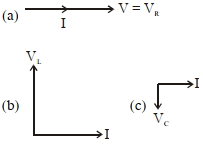
-
- (A) \(11\)
- (B) \(13\)
- (C) \(9\)
- (D) \(15\)
Show answer and solution
Correct Answer: (A)
\({f}_{{rms}}^{2}={f}_{1 {m} {m}}^{2}+{f}_{2 {rms}}^{2}\)\(=\left(\frac{\sqrt{42}}{\sqrt{2}}\right)^{2}+10^{2}\)
\(=121 \Rightarrow {f}_{{rms}}=11\, {A}\)
-
- (A) \(0.8\, H\) and \(150\, \mu F\)
- (B) \(0.8\, H\) and \(250\, \mu F\)
- (C) \(1.33\, H\) and \(250\, \mu F\)
- (D) \(1.33\, H\) and \(150\, \mu F\)
Show answer and solution
Correct Answer: (B)
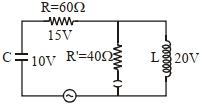
Current through \(60 \Omega\) resistance \(=\frac{15}{60}=\frac{1}{4} A\)thus capacitor current \(=\frac{1}{4} A\)
\(\because V _{ C }= I X _{ C }\)
\(10=\frac{1}{4} \times \frac{1}{\omega C}\)
\(\therefore C =\frac{1}{40 \omega}=\frac{1}{4000}=250 \mu F\)
Now,
current through \(40 \Omega\) resistance \(=\frac{20}{40}=\frac{1}{2} A\)
thus current through inductor \(=\frac{1}{2}-\frac{1}{4}=\frac{1}{4} A\)
\(V _{ L }= IX _{ L }=\frac{1}{4} \times \omega L\)
\(20=\frac{1}{4} \times 100 \times L\)
\(\Rightarrow L =0.8 H\)
-
- (A) \(1000\)
- (B) \(200\)
- (C) \(500\)
- (D) \(5\)
Show answer and solution
Correct Answer: (C)
\(P_{\text {avg }}=\frac{v_{\text {rms }}^{2}}{R}\)\(\frac{v_{ rms }^{2}}{Z^{2}} \times R=\frac{v_{r m s}^{2}}{R} \times 1\)
\(R^{2}=Z^{2}\)
\(25=\left(\sqrt{\left(x_{C}-x_{L}\right)^{2}+5^{2}}\right)^{2}\)
\(25=\left(x_{c}-x_{L}\right)^{2}+25\)
\(x_{c}=x_{L} \Rightarrow \frac{1}{\omega C}=\omega L\)
\(\omega^{2}=\frac{1}{L C}=\frac{10^{6}}{0.1 \times 40}\)
\(\omega=500\)
- 233. What happens to the inductive reactance and the current in a purely inductive circuit if the frequency is halved ? 2021 Medium
- (A) Both, inductive reactance and current will be halved.
- (B) Inductive reactance will be halved and current will be doubled.
- (C) Inductive reactance will be doubled and current will be halved.
- (D) Both, inducting reactance and current will be doubled.
Show answer and solution
Correct Answer: (B)
\(X _{ L }=\omega L\)\(i =\frac{ v _{0}}{\omega L }\)
-
- (A) \(6\)
- (B) \(60\)
- (C) \(0.6\)
- (D) \(3600\)
Show answer and solution
Correct Answer: (A)
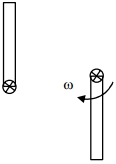
by energy conservation \({mg} \ell=\frac{1}{2} {I} \omega^{2}=\frac{1}{2} \frac{{m} \ell^{2} \omega^{2}}{3}\)\(\Rightarrow \omega=\sqrt{\frac{6 {g}}{\ell}}\)
Speed \({v}=\omega {r}=\omega \ell=\sqrt{6 {g} \ell}\)
\({v}=\sqrt{6 \times 10 \times .6}=6\, {m} / {s}\)
- 235. A body rolls down an inclined plane without slipping. The kinetic energy of rotation is \(50 \,\%\) of its translational kinetic energy. The body is : 2021 Medium
- (A) Solid sphere
- (B) Solid cylinder
- (C) Hollow cylinder
- (D) Ring
Show answer and solution
Correct Answer: (B)
\(\frac{1}{2} I \omega^{2}=\frac{1}{2} \times \frac{1}{2} m v^{2}\)\(v=\omega R\)
\(I=\frac{1}{2} m R^{2}\)
Body is solid cylinder
-
- (A) \(100\)
- (B) \(500\)
- (C) \(300\)
- (D) \(200\)
Show answer and solution
Correct Answer: (D)
\(\omega_{r}=\omega_{0}+\alpha t\)\(\alpha=\frac{1200}{10} \times 60 {rev} / {min}^{2}=1200 \times 6\)
\(\theta=\omega_{0} t+\frac{1}{2} \alpha t^{2}\)
\(=600 \times \frac{10}{60}+\frac{1}{2} \times 1200 \times 6 \times \frac{1}{36}\,({rev})\)
\(\theta=200\)
-
- (A) \(8\)
- (B) \(6\)
- (C) \(4\)
- (D) \(2\)
Show answer and solution
Correct Answer: (D)
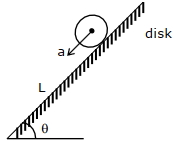
If disk slips on inclined plane, then it's aceleration\(a_{1}=g \sin \theta\)
\(L=\frac{1}{2} a_{1} t_{1}^{2}\)
\(\Rightarrow t_{1}=\sqrt{\frac{2 L}{a_{1}}}\ldots \ldots({i} )\)
If disk rols on inclined plane, its acceleration,
\(a_{2} =\frac{g \sin \theta}{1+\frac{I}{m R^{2}}}\)
\(a_{2} =\frac{g \sin \theta}{1+\frac{m R^{2}}{2 m R^{2}}}\)
\(a_{2} =\frac{2}{3} g \sin \theta\)
Now \({L}=\frac{1}{2} {a}_{2} \cdot {t}_{2}^{2}\)
\(\Rightarrow {t}_{2}=\sqrt{\frac{2 {L}}{{a}_{2}}} \quad \ldots \ldots({ii} )\)
Now \(\frac{t_{2}}{t_{1}}=\sqrt{\frac{a_{1}}{a_{2}}}=\sqrt{\frac{3}{2}}\)
\(\Rightarrow {x}=2\)
-
- (A) \(\frac{1}{6} a\)
- (B) \(\frac{10}{11} a\)
- (C) \(\frac{5}{6} a\)
- (D) \(\frac{2}{3} a\)
Show answer and solution
Correct Answer: (C)
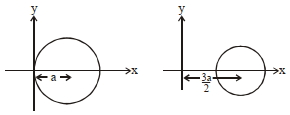
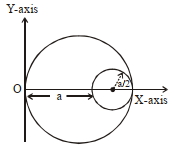
Let \(\sigma\) be the uniform mass density of disc then\(x _{ COM }=\frac{\left(\sigma \pi a ^{2}\right) a -\sigma \pi\left(\frac{ a ^{2}}{4}\right) \times \frac{3 a }{2}}{\sigma \pi a ^{2}-\frac{\sigma \pi a ^{2}}{4}}\)
\(=\frac{a-\frac{3 a}{8}}{1-\frac{1}{4}}=\frac{5 a}{6}\)
-
- (A) \(\sqrt {\frac{{2gh}}{{I + mr}}} \)
- (B) \(\sqrt {\frac{{2mgh}}{{I + m{r^2}}}} \)
- (C) \(\sqrt {\frac{{2mgh}}{{I + 2m{r^2}}}} \)
- (D) \(\sqrt {2gh} \)
Show answer and solution
Correct Answer: (B)
According to law of conservation of energy\(mgh = \frac{1}{2}(I + m{r^2}){\omega ^2}\)
\( \Rightarrow \) \(\omega = \sqrt {\frac{{2mgh}}{{I + m{r^2}}}} \).
-
- (A) \(\frac{2 mgh }{ I +2 mr ^{2}}\)
- (B) \(\frac{2 mgh }{ I + mr ^{2}}\)
- (C) \(2 gh\)
- (D) \(\frac{2 gh }{ I + mr ^{2}}\)
Show answer and solution
Correct Answer: (B)
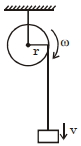
\(mgh =\frac{1}{2} I \omega^{2}+\frac{1}{2} mv ^{2}\)\(v =\omega r\)
\(mgh =\frac{1}{2} I \omega^{2}+\frac{1}{2} m \omega^{2} r ^{2}\)
\(\frac{2 mgh }{\left( I + mr ^{2}\right)}=\omega^{2}\)
-
- (A) \(16\)
- (B) \(20\)
- (C) \(25\)
- (D) \(12\)
Show answer and solution
Correct Answer: (B)
\(\vec{\tau}=\overrightarrow{ r } \times \overrightarrow{ F }\)\(\overrightarrow{ r }=(2 \hat{ i })-(2 \hat{ i }+3 \hat{ j }+4 \hat{ k })=-3 \hat{ j }-4 \hat{ k }\)
\( \overrightarrow{ F }=4 \hat{ i }+3 \hat{ j }+4 \hat{ k }\)
\(\vec{\tau}=\overrightarrow{ r } \times \overrightarrow{ F }=\left|\begin{array}{ccc}\hat{i} & \hat{ j } & \hat{ k } \\ 0 & -3 & -4 \\ 4 & 3 & 4\end{array}\right|\)
\(\quad=\hat{ i }(-12+12)-\hat{ j }(0+16)+\hat{ k }(0+12)\)
\(=-16 \hat{ i }+12 \hat{ k }\)
\(\therefore \quad|\vec{\tau}|=\sqrt{16^{2}+12^{2}}=20\)
-
- (A) \(L _{ A }\) and \(L _{ B }\) are both constant in magnitude and direction
- (B) \(L _{ B }\) is constant in direction with varying magnitude
- (C) \(L _{ B }\) is constant, both in magnitude and direction
- (D) \(L _{ A }\) is constant, both in magnitude and direction
Show answer and solution
Correct Answer: (D)
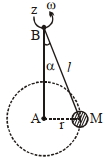
We know, \(\overrightarrow{ L }= m (\overrightarrow{ r } \times \overrightarrow{ v })\)Now with respect to \(A ,\) we always get direction of \(\overrightarrow{ L }\) along \(+ve z-\)axis and also constant magnitude as mvr. But with respect to \(B ,\) we get constant magnitude but continuously changing direction.
-
- (A) \(15\)
- (B) \(10\)
- (C) \(20\)
- (D) \(25\)
Show answer and solution
Correct Answer: (B)
\(\overrightarrow{ r }=10 \alpha t ^{2} \hat{ i }+5 \beta( t -5) \hat{ j }\)\(\overrightarrow{ v }=20 \alpha t \hat{ i }+5 \beta \hat{ j }\)
\(\overrightarrow{ L }= m (\overrightarrow{ r } \times \overrightarrow{ v })\)
\(=m\left[10 \alpha t ^{2} \hat{ i }+5 \beta( t -5) \hat{ j }\right] \times[20 \alpha t \hat{ i }+5 \beta \hat{ j }]\)
\(\overrightarrow{ L }= m \left[50 \alpha \beta t ^{2} \hat{ k }-100 \alpha \beta\left( t ^{2}-5 t \right) \hat{ k }\right]\)
At \(t =0, \overrightarrow{ L }=\overrightarrow{0}\)
\(50 \alpha \beta t ^{2}-100 \alpha \beta\left( t ^{2}-5 t \right)=0\)
\(t -2( t -5)=0\)
\(t=10 \sec\)
-
- (A) \(5\)
- (B) \(4\)
- (C) \(14\)
- (D) \(23\)
Show answer and solution
Correct Answer: (B)
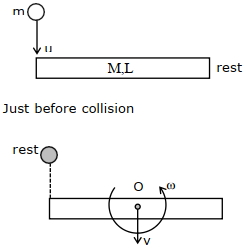
Just after collisionFrom momentum conservation, \({P}_{{i}}^{\circ}={p}_{{F}}\)
\(m u=M v \ldots \ldots(i)\)
From angular momentum conservation about \(O,\)
\(mu. \,l\frac{L}{2}=\frac{M L^{2}}{12} \omega\)
\(\Rightarrow \omega=\frac{6 {mu}}{{ML}} \quad \cdots . . (ii)\)
From \(e=\frac{\text { R.V.S }}{\text { R.V.A }}\)
\(1=\frac{V+\frac{\omega L}{2}}{{u}}\)
\({v}+\frac{\omega {L}}{2}={u}\)
\({v}+\frac{3 {mu}}{{M}}={u}\)
\(\frac{{mu}}{{M}}+\frac{3 {mu}}{{M}}={u}\)
\(\frac{4 {mu}}{{M}}={u}\)
\(\frac{{m}}{{M}}=\frac{1}{4}\)
\({X}=4\)
-
- (A) \(\frac{7}{2}\, mg\)
- (B) \(5\, mg\)
- (C) \(\frac{ mg }{5}\)
- (D) \(0\)
Show answer and solution
Correct Answer: (C)
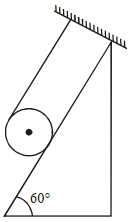
Let's take solid cylinder is in equilibrium\(T + f = mg \sin 60......(i)\)
\(TR - fR =0......(ii)\)
Solving we get
\(T = f _{ seq }=\frac{ mg \sin \theta}{2}\)
But limiting friction \( < \) required friction
\(\mu mg \cos 60^{\circ} < \frac{ mg \sin 60^{\circ}}{2}\)
\(\therefore\) Hence cylinder will not remain in equilibrium
Hence \(f =\) kinetic
\(=\mu_{ k } N\)
\(=\mu_{ k } mg \cos 60^{\circ}\)
\(=\frac{ mg }{5}\)
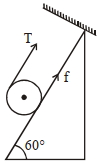
-
- (A) \(1\)
- (B) \(2\)
- (C) \(3\)
- (D) \(4\)
Show answer and solution
Correct Answer: (D)
\(\tau=\frac{\Delta L}{\Delta t}=\frac{I\left(\omega_{f}-\omega_{i}\right)}{\Delta t}\)\(\tau=\frac{\frac{m R^{2}}{2} \times[0-\omega]}{\Delta t}\)
\(=\frac{10 \times\left(20 \times 10^{-2}\right)^{2}}{2} \times \frac{600 \times \pi}{30 \times 10}\)
\(=0.4 \pi=4 \pi \times 10^{-2}\)
-
- (A) \(2\)
- (B) \(5\)
- (C) \(3\)
- (D) \(6\)
Show answer and solution
Correct Answer: (C)
\(a=\frac{g \sin \theta}{1+\frac{K^2}{R^{2}}}=\frac{g \sin \theta}{1+\frac{1}{2}}=\frac{2}{3} g \sin \theta\)\(b=3\)
-
- (A) \(0.60\)
- (B) \(0.52\)
- (C) \(0.57\)
- (D) \(0.80\)
Show answer and solution
Correct Answer: (C)
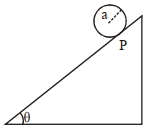
\(a =\frac{ g \sin \theta}{1+\frac{ I }{ mR ^{2}}}=\frac{5}{7} \times \frac{10}{2}=\frac{25}{7}\)\(t =\frac{2 v _{0}}{ a }=\frac{2 \times 1 \times 7}{25}\)
\(=0.56\)
-
- (A) \(\frac{10 v_{0}^{2}}{7 g \sin \theta}\)
- (B) \(\frac{v_{0}^{2}}{5 g \sin \theta}\)
- (C) \(\frac{2}{5} \frac{v_{0}^{2}}{ g \sin \theta}\)
- (D) \(\frac{v_{0}^{2}}{2 g \sin \theta}\)
Show answer and solution
Correct Answer: (A)
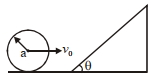
Angular momentum conservation about A\(mv _{0} a \cos \theta+\frac{2}{5} ma ^{2} \omega\)
\(= mva +\frac{2}{5} ma ^{2} \omega^{1}\)
\(mv _{0} a \left[\frac{2}{5}+\cos \theta\right]=\frac{7}{5} mva\)
\(v =\frac{5}{7}= v _{0}\left[\frac{2}{5}+\cos \theta\right]\)
\(\frac{1}{2} mv ^{2}+\frac{1}{2} I \omega^{2}=\frac{7}{10} mv ^{2}= mgh\)
\(d=\frac{10 v_{0}^{2}}{7 g \sin \theta}\)
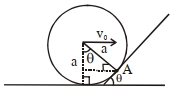
-
- (A) \(18.75\)
- (B) \(1.905\)
- (C) \(19.05\)
- (D) \(1.875\)
Show answer and solution
Correct Answer: (C)
\({M}=1.5\, {kg}, {r}=0.5 \,{m}, {d}=\frac{5}{2}\, {m}\)\({I}=2\left(\frac{2}{5} {Mr}^{2}+{Md}^{2}\right)\)
\(=19.05\, {kgm}^{2}\)
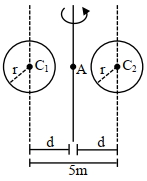
No questions on this page match these filters.