


All JEE Mains 2021 Physics questions
32 chaptersShowing 101–150 of 685 questions
- 101. The atomic hydrogen emits a line spectrum consisting of various series. Which series of hydrogen atomic spectra is lying in the visible region? 2021 Medium
- (A) Brackett series
- (B) Paschen series
- (C) Lyman series
- (D) Balmer series
Show answer and solution
Correct Answer: (D)
Conceptual -
- (A) \(20\)
- (B) \(22\)
- (C) \(25\)
- (D) \(15\)
Show answer and solution
Correct Answer: (D)
For 1 st line\(\frac{1}{\lambda_{1}}= R z^{2}\left(\frac{1}{2^{2}}-\frac{1}{3^{2}}\right)\)
\(\frac{1}{\lambda_{1}}= R z^{2} \frac{5}{36}\) ........\((i)\)
For \(3^{\text {rd }}\) line
\(\frac{1}{\lambda_{3}}= Rz ^{2}\left(\frac{1}{2^{2}}-\frac{1}{5^{2}}\right)\)
\(\frac{1}{\lambda_{3}}= Rz ^{2} \frac{21}{100}\) \(.........(ii)\)
(ii) \(+( i )\)
\(\frac{\lambda_{1}}{\lambda_{3}}=\frac{21}{100} \times \frac{36}{5}=1.512=15.12 \times 10^{-1}\)
\(x \approx 15\)
-
- (A) \(27.5\)
- (B) \(17.5\)
- (C) \(13.6\)
- (D) \(10\)
Show answer and solution
Correct Answer: (D)
As we know\({E}_{k_{a}}=E_{k}-E_{L}\)
\(\frac{h c}{\lambda_{k_{a}}}=E_{k}-E_{L}\)
\(E_{L}= E_{k}-\frac{h c}{\lambda_{k_{a}}}\)
\(=27.5 {KeV}-\frac{12.42 \times 10^{-7}\, {eV\,m}}{0.071 \times 10^{-9}\, {m}}\)
\(E_{L}=(27.5-17.5)\, {keV}\)
\(=10\,{keV}\)
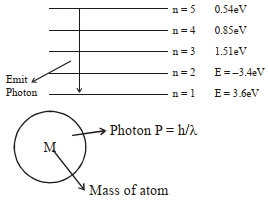
- 104. The recoil speed of a hydrogen atom after it emits a photon in going from \(n =5\) state to \(n =1\) state will be ..... \(m/s\) 2021 Hard
- (A) \(4.17\)
- (B) \(2.19\)
- (C) \(3.25\)
- (D) \(4.34\)
Show answer and solution
Correct Answer: (A)
\((\Delta E )\) Releases when photon going from \(n =5\) to \(n =\Delta E =(13.6-0.54)\, eV =13.06\, eV\)\(P _{ i }= P _{ f }\) (By linear momentum conservation)
\(0=\frac{ h }{\lambda}- Mv = V _{ Recoil }=\frac{ h }{\lambda M }.....(i)\)
And \(\Delta E =\frac{ hc }{\lambda}=\frac{ hc }{\lambda M } \times M \Rightarrow McV _{ Recoil }\)
\(V _{ Recoil }=\frac{\Delta E }{ Mc }=\frac{13.06 \times 1.6 \times 10^{-19}}{1.67 \times 10^{-27} \times 3 \times 10^{8}}=4.17 \,m / sec\)
-
- (A) \(25\)
- (B) \(16\)
- (C) \(10\)
- (D) \(6\)
Show answer and solution
Correct Answer: (C)
\(\frac{ hc }{\lambda}= mc ^{2}\)\(m =\frac{ h }{ c \lambda}\)
- 106. The wavelength of the photon emitted by a hydrogen atom when an electron makes a transition from \(n =2\) to \(n =1\) state is ...... \(nm.\) 2021 Medium
- (A) \(194.8\)
- (B) \(913.3\)
- (C) \(490.7\)
- (D) \(121.8\)
Show answer and solution
Correct Answer: (D)
\(\frac{1}{\lambda}= R \left(\frac{1}{1^{2}}-\frac{1}{2^{2}}\right)\)\(\lambda=121.8\, nm\)
- 107. Which level of the single ionized carbon has the same energy as the ground state energy of hydrogen atom ? 2021 Medium
- (A) \(1\)
- (B) \(6\)
- (C) \(4\)
- (D) \(8\)
Show answer and solution
Correct Answer: (B)
Energy of \(H\) -atom is \(E =-13.6 Z ^{2} / n ^{2}\)for \(H\) -atom \(Z =1 \&\) for ground state, \(n =1\)
\(\Rightarrow E =-13.6 \times \frac{1^{2}}{1^{2}}=-13.6 eV\)
Now for carbon atom (single ionised), \(Z=6\)
\(E=-13.6 \frac{ Z ^{2}}{ n ^{2}}=-13.6 \quad\) (given)
\(\Rightarrow n ^{2}=6^{2} \Rightarrow n =6\)
-
- (A) \(11\)
- (B) \(15\)
- (C) \(10\)
- (D) \(8\)
Show answer and solution
Correct Answer: (B)
No. of different wavelengths \(=\frac{{n}({n}-1)}{2}\)\(=\frac{6 \times(6-1)}{2}=\frac{6 \times 5}{2}=15\)
-
- (A) \(150\)
- (B) \(125\)
- (C) \(250\)
- (D) \(175\)
Show answer and solution
Correct Answer: (B)
\(\frac{h c}{\lambda}-\phi=k_{\max }\)\(k_{\max }=\frac{1240}{500}-1.25 \approx 1.25\)
\(r=\frac{\sqrt{2 m k}}{e B}\)
\(B=\frac{\sqrt{2 m k}}{e r}\)
\(=125 \times 10^{-7} T\)
-
- (A) \(0.96\)
- (B) \(1.25\)
- (C) \(0.24\)
- (D) \(1.5\)
Show answer and solution
Correct Answer: (B)
\({k} {E}_{\max }=\frac{{hc}}{\lambda_{{i}}}+\phi\)or \({eV}_{{o}}=\frac{{hc}}{\lambda_{{i}}}+\phi\)
\(\text { when } \lambda_{{i}}=670.5\, {nm} ; \quad {V}_{0}=0.48\)
\(\text { when } \lambda_{{i}}=474.6\, {nm} ; \quad {V}_{0}=?\)
So, \({e}(0.48)=\frac{1240}{670.5}+\phi...(1)\)
\({e}\left({V}_{{o}}\right)=\frac{1240}{474.6}+\phi...(2)\)
\((2)-(1)\)
\({e}\left({V}_{0}-0.48\right)=1240\left(\frac{1}{474.6}-\frac{1}{670.5}\right) \,{eV}\)
\({V}_{0}=0.48+1240\left(\frac{670.5-474.6}{474.6 \times 670.5}\right) {Volts}\)
\({V}_{0}=0.48+0.76\)
\({V}_{0}=1.24 {V} \simeq 1.25\, {V}\)
-
- (A) \({K}_{{p}}<{K}_{{q}}\) and \({P}_{{p}}={P}_{{e}}\)
- (B) \({K}_{{p}}={K}_{{q}}\) and \({P}_{{p}}={P}_{{e}}\)
- (C) \({K}_{{p}}<{K}_{{q}}\) and \({P}_{{p}}<{P}_{{e}}\)
- (D) \({K}_{{p}}>{K}_{{a}}\) and \({P}_{{p}}={P}_{{e}}\)
Show answer and solution
Correct Answer: (A)
\(\lambda_{{p}}=\frac{{h}}{{P}_{{p}}} \quad \lambda_{{e}}=\frac{{h}}{{P}_{{e}}}\)\(\because \lambda_{{p}}=\lambda_{{e}}\)
\(\Rightarrow {P}_{{p}}={P}_{{e}}\)
\(({K})_{{p}}=\frac{{P}_{{p}}^{2}}{2 {m}_{{p}}}\)
\(({K})_{{e}}=\frac{{P}_{{e}}^{2}}{2 {m}_{{e}}}\)
\({K}_{{D}}<{K}_{{e}} \text { as } {m}_{{p}}>{m}_{{e}}\)
-
- (A) \(\frac{1}{16}\) times the mass of \(e ^{-}\)
- (B) \(8\) times the mass of \(e ^{-}\)
- (C) \(16\) times the mass of \(e ^{-}\)
- (D) \(\frac{1}{8}\) times the mass of \(e ^{-}\)
Show answer and solution
Correct Answer: (D)
\(\lambda=\frac{ h }{ p }\)\(\frac{\lambda_{ p }}{\lambda_{ e }}=\frac{ p _{ e }}{ p _{ p }}=\frac{ m _{ e } v _{ e }}{ m _{ p } v _{ p }}\)
\(2=\frac{ m _{ e }}{ m _{ p }}\left(\frac{ v _{ e }}{4 v _{ e }}\right)\)
\(\therefore m _{ p }=\frac{ m _{ e }}{8}\)
-
- (A) \(1: 3\)
- (B) \(3: 1\)
- (C) \(1: \sqrt3\)
- (D) \(1: 1\)
Show answer and solution
Correct Answer: (D)
According to law of conservation of linear momentum, two particles will have equal and opposite momentum.The de Broglie wavelength is given by
\(\lambda=\frac{ h }{ p } \quad \therefore \frac{\lambda_{1}}{\lambda_{2}}=1\)
-
- (A) \(730\)
- (B) \(880\)
- (C) \(840\)
- (D) \(910\)
Show answer and solution
Correct Answer: (D)
\(\because\) We know that, de-Broglie wavelength can be given as \(\lambda=\frac{h}{m v}\)\(\therefore\) For particle,
\(\lambda_{ pa }=\frac{h}{m v}=\frac{6.6 \times 10^{-34}}{9.1 \times 10^{-31} \times 10^{6}}\)
and for photon,
\(\lambda_{ ph }=\frac{h}{p}=\frac{6.6 \times 10^{-34}}{10^{-27}}\)
From Eqs. (i) and (ii), we get
\(\Rightarrow \quad \frac{\lambda_{ ph }}{\lambda_{ pa }}=\frac{\frac{6.6 \times 10^{-34}}{10^{-27}}}{\frac{6.6 \times 10^{-34}}{9.1 \times 10^{-31} \times 10^{6}}}\)
\(\Rightarrow \quad \frac{\lambda_{ ph }}{\lambda_{ pa }}=910\)
\(\Rightarrow \quad \lambda_{ ph }=910\left(\lambda_{ pa }\right)\)
-
- (A) \(1.99\)
- (B) \(3.3\)
- (C) \(1.41\)
- (D) \(7.61\)
Show answer and solution
Correct Answer: (C)
Initially, energy of electron \(=+3 {eV}\)Finally, in \(2^{\text {nd }}\) excited state,
\(E=-\frac{(13.6\, {eV})}{3^{2}}\)
\(=-1.51 \,{eV}\)
Loss in energy is emitted as photon,
So, photon energy \(\frac{{hc}}{\lambda}=4.51\, {eV}\)
No, photoelectric effect equation
\({KE}_{\max }=\frac{{hc}}{\lambda}-\phi=4.512-\left(\frac{{hc}}{\lambda_{{m}}}\right)\)
\(=4.51\, {eV}-\frac{12400\, {eV} \stackrel{\circ}{{A}}}{4000\, \stackrel{\circ}{{A}}}\)
\(=1.41\, {eV}\)
-
- (A) \(\frac{3 {c}}{{v}}\)
- (B) \(\frac{2 c}{v}\)
- (C) \(\frac{v}{2 c}\)
- (D) \(\frac{v}{3 c}\)
Show answer and solution
Correct Answer: (C)
\(\lambda_{ e }=\lambda_{ Ph }\)\(\frac{ h }{ p _{ e }}=\frac{ h }{ p _{ ph }}\)
\(\sqrt{2 mk _{ e }}=\frac{ E _{ ph }}{ c }\)
\(2 mk _{ e }=\frac{\left( E _{ ph }\right)^{2}}{ c ^{2}}\)
\(\frac{ k _{ e }}{ E _{ ph }}=\frac{ E _{ ph }}{ c ^{2}}\left(\frac{1}{2 m }\right)\)
\(=\frac{ p _{ ph }}{ c }\left(\frac{1}{2 m }\right)\)
\(=\frac{ p _{ e }}{ c }\left(\frac{1}{2 m }\right)\)
\(=\frac{ mv }{ c } \frac{1}{2 m }\)
\(=\frac{V}{2 c}\)
- 117. An electron of mass \(m\) and a photon have same energy \(E.\) The ratio of de-Broglie wavelengths associated with them is 2021 Medium
- (A) \({\left( {\frac{E}{{2m}}} \right)^{\frac{1}{2}}}\)
- (B) \(\;C{\left( {2mE} \right)^{\frac{1}{2}}}\)
- (C) \(\;\frac{1}{C}{\left( {\frac{{2m}}{E}} \right)^{\frac{1}{2}}}\)
- (D) \(\;\frac{1}{C}{\left( {\frac{E}{{2m}}} \right)^{\frac{1}{2}}}\)
Show answer and solution
Correct Answer: (D)
For electron of energy \(E\)de-Broglie wavelength, \(\lambda_{e}=\frac{h}{p}=\frac{h}{\sqrt{2 m E}}\)
For photon of energy, \(E=h v=\frac{h c}{\lambda_{p}}\)
\({\Rightarrow \lambda_{p}=\frac{h c}{E}}\)
\({\therefore \frac{\lambda_{e}}{\lambda_{p}}=\frac{h}{\sqrt{2 m E}} \times \frac{E}{h c}=\frac{1}{c}\left(\frac{E}{2 m}\right)^{1 / 2}}\)
-
- (A) \(1836\)
- (B) \(1\)
- (C) \(918\)
- (D) \(\frac{1}{1836}\)
Show answer and solution
Correct Answer: (A)
\(\frac{\lambda_{ e }}{\lambda_{ p }}=\frac{\frac{ h }{ m _{ e } v }}{\frac{ h }{ m _{ p } v }}=1836\) -
- (A) \(\sqrt{\frac{m_{p}}{m_{E}}}\)
- (B) \(\frac{m_{p}}{m_{E}}\)
- (C) \(1\)
- (D) \(\frac{m_{e}}{m_{p}}\)
Show answer and solution
Correct Answer: (A)
\(\text { Kinetic Energy }=e \Delta \,V\)\(\lambda_{e}=\frac{h}{\sqrt{2 m_{e}(e \Delta V)}}\)
\(\lambda_{p}=\frac{h}{\sqrt{2 m_{p}(e \Delta V)}}\)
\(\Rightarrow \frac{\lambda_{e}}{\lambda_{p}}=\sqrt{\frac{m_{p}}{m_{e}}}\)
-
- (A) \(3.8\)
- (B) \(8\)
- (C) \(7.8\)
- (D) \(2.8\)
Show answer and solution
Correct Answer: (D)
\(\lambda=\frac{ h }{ p }=\frac{ h }{\sqrt{2 m q V }}\)\(\frac{\lambda_{ p }}{\lambda_{\alpha}}=\sqrt{\frac{ m _{\alpha} q _{a}}{ m _{ p } q _{ p }}}=\sqrt{\frac{4 m _{ p } \times 2 e }{ m _{ p } \times e }}=\sqrt{8}=2 \sqrt{2}\)
\(=2 \sqrt{2}\)
\(\frac{\lambda_{ p }}{\lambda_{\alpha}}=2 \times 1.4=2.8\)
-
- (A) \(\left(\frac{{m}_{{p}}}{{m}_{{e}}}\right)^{3 / 2}\)
- (B) \(\sqrt{\frac{{m}_{{e}}}{{m}_{{p}}}}\)
- (C) \(\sqrt{\frac{m_{p}}{m_{e}}}\)
- (D) \(\frac{{m}_{{p}}}{{m}_{{e}}}\)
Show answer and solution
Correct Answer: (C)
\(\Delta {x} \cdot \Delta {p} \geq \frac{{h}}{4 \pi}\)\(\Delta {x}=\frac{{h}}{4 \pi {m} \Delta {v}} \quad {v}=\sqrt{\frac{3 {KT}}{{m}}}\)
\(\frac{\Delta {x}_{{e}}}{\Delta {x}_{{p}}}=\sqrt{\frac{{m}_{{p}}}{{m}_{{e}}}}\)
-
- (A) Both Statement \(I\) and Statement \(II\) are true
- (B) Statement \(I\) is false but Statement \(II\) is true
- (C) Both Statement \(I\) and Statement \(II\) are false
- (D) Statement \(I\) is true but Statement \(II\) is false
Show answer and solution
Correct Answer: (D)
If linear momentum are equal then wavelength also equal\(p=\frac{h}{\lambda}, E=\frac{h c}{\lambda}\)
On decreasing wavelength, momentum and energy of photon increases.
-
- (A) \(36\)
- (B) \(16\)
- (C) \(30\)
- (D) \(25\)
Show answer and solution
Correct Answer: (D)
\(F=\frac{I A}{C}\)\(I=\frac{F C}{A}=\frac{2.5 \times 10^{-6} \times 3 \times 10^{8}}{30}=25 W / cm ^{2}\)
-
- (A) increases the number of photons incident and also increases the \(K.E.\) of the ejected electrons
- (B) increases the frequency of photons incident and increases the \(K.E.\) of the ejected electrons
- (C) increases the frequency of photons incident and the \(K.E.\) of the ejected electrons remains unchanged
- (D) increases the number of photons incident and the \({KE}\). of the ejected electrons remains unchanged
Show answer and solution
Correct Answer: (D)
\(\rightarrow\) Increasing intensity means number of incident photons are increased.\(\rightarrow\) Kinetic energy of ejected electrons depend on the frequency of incident photons, not the intensity.
-
- (A) \(1.3\)
- (B) \(1.1\)
- (C) \(1.9\)
- (D) \(0.6\)
Show answer and solution
Correct Answer: (A)
\({KE}_{\max }={eV}_{{S}}=\frac{{h} {c}}{\lambda}-\phi\)\(\Rightarrow {eV}_{{S}}=\frac{1240}{280}-2.5=1.93\, {eV}\)
\(\rightarrow {V}_{{S}_{1}}=1.93\, {V} \ldots\) (i)
\(\rightarrow {eV}_{{S}_{2}}=\frac{1240}{400}-2.5=0.6 \,{eV}\)
\(\Rightarrow {V}_{{S}_{2}}=0.6 \,{V} \ldots\) (ii)
\(\Delta {V}={V}_{{S}_{1}}-{V}_{{S}_{2}}=1.93-0.6=1.33\, {V}\)
-
- (A) \(1860: 1\)
- (B) \((1860)^{2}: 1\)
- (C) \(41.4: 1\)
- (D) \(43: 1\)
Show answer and solution
Correct Answer: (D)
\(\lambda=\frac{ h }{ mv }=\frac{ h }{\sqrt{2 mK }}=\frac{ h }{\sqrt{2 mqV }}\)\(\frac{\lambda_{1}}{\lambda_{2}}=\sqrt{\frac{ m _{2}}{ m _{1}}}\)
\(\frac{\lambda_{ e }}{\lambda_{ P }}=\sqrt{\frac{ m _{ P }}{ m _{ e }}}=\sqrt{1831.4}=42.79\)
-
- (A) \(\frac{1}{9} {E}\)
- (B) \(\frac{7}{9} {E}\)
- (C) \({E}\)
- (D) \(\frac{16}{9} {E}\)
Show answer and solution
Correct Answer: (B)
\(\lambda=\frac{{h}}{{mv}}=\frac{{h}}{\sqrt{2 {mE}}}, {mv}=\sqrt{2 {mE}}\)\(\lambda \propto \frac{1}{\sqrt{{E}}}\) \(\frac{\lambda_{2}}{\lambda_{1}}=\sqrt{\frac{{E}_{1}}{{E}_{2}}}=\frac{3}{4}, \lambda_{2}=0.75 \lambda_{1}\)
\(\frac{{E}_{1}}{{E}_{2}}=\left(\frac{3}{4}\right)^{2}\)
\({E}_{2}=\frac{16}{9} {E}_{1}=\frac{16}{9} {E} \quad\left({E}_{1}={E}\right)\)
Extra energy given \(=\frac{16}{9} {E}-{E}=\frac{7}{9} {E}\)
- 128. The de Broglie wavelength of a proton and \(\alpha\) -particle are equal. The ratio of their velocities is ...... . 2021 Medium
- (A) \(4:3\)
- (B) \(4:1\)
- (C) \(4:2\)
- (D) \(1:4\)
Show answer and solution
Correct Answer: (B)
\(\lambda=\frac{ h }{ mv }\)\(\lambda_{ P }=\lambda_{\alpha}\)
\(m _{ P } v _{ P }= m _{\alpha} v _{\alpha}\)
\(m _{ P } v _{ P }=4 m _{ p } v _{\alpha} \quad\left( m _{\alpha}=4 m _{ P }\right)\)
\(\frac{ v _{ P }}{ v _{\alpha}}=4\)
-
- (A) \(0.82\)
- (B) \(0.16\)
- (C) \(1.88\)
- (D) \(1.36\)
Show answer and solution
Correct Answer: (A)
\(1.51 \longrightarrow {N}=3\)\(3.4 \longrightarrow {N}=2\)
\(13.6 \longrightarrow {N}=1\)
\(3 \rightarrow 2 \Rightarrow 1.89\, {eV}\)
\(5 \times 10^{-4}\, {T}\)
\({r}=7 \,{mm}\)
\(r=\frac{m v}{q B} \Rightarrow m v=q r B\)
\(\Rightarrow E=\frac{p^{2}}{2 m}=\frac{(q R B)^{2}}{2 m}\)
\(=\frac{\left(1.6 \times 10^{-19} \times 7 \times 10^{-3} \times 5 \times 10^{-1}\right)^{2}}{2 \times 9.1 \times 10^{-31} \text { Joule }}\)
\(=\frac{3136 \times 10^{-52}}{18.2 \times 10^{-31} \times 1.6 \times 10^{-19}} \,{eV}\)
\(=1.077\, {eV}\)
We know work function = energy incident \(-(K E)_{\text {electron }}\)
\(\Phi=1.89-1.077=0.813\, {eV}\)
-
- (A) \(329\)
- (B) \(309\)
- (C) \(382\)
- (D) \(400\)
Show answer and solution
Correct Answer: (C)
\(\frac{ hc }{\lambda}=\phi+ eV _{ s }\)\(\frac{1240}{491}=\phi+0.71\)
\(\frac{1240}{\lambda}=\phi+1.43 \)
\(\therefore \lambda=382\, nm\)
- 131. The stopping potential in the context of photoelectric effect depends on the following property of incident electromagnetic radiation 2021 Easy
- (A) Phase
- (B) Intensity
- (C) Amplitude
- (D) Frequency
Show answer and solution
Correct Answer: (D)
Stopping potential changes linearly with frequency of incident radiation. -
- (A) \(6.26\)
- (B) \(8.46\)
- (C) \(2.26\)
- (D) \(3.25\)
Show answer and solution
Correct Answer: (A)
De-Broglie wavelength\(\lambda=\frac{{h}}{{mv}}=\frac{{h}}{\sqrt{2 {mE}}}\)
Where \({E}\) is kinetic energy
\({E}=\frac{3 {kT}}{2} \text { for gas }\)
\(\lambda=\frac{{h}}{\sqrt{3 {mkT}}}=\frac{6.6 \times 10^{-34}}{\sqrt{3 \times 9 \times 10^{-31} \times 1.38 \times 10^{-23} \times 300}}\)
\(\lambda=6.26 \times 10^{-9}\, {m}=6.26\, {nm}\)
-
- (A) \(0\)
- (B) \(2\)
- (C) \(1\)
- (D) \(4\)
Show answer and solution
Correct Answer: (C)
\(KE _{\max }= hv -\phi\)\(\frac{1}{2} mv ^{2}= h v-\phi\)
\(v =\sqrt{\frac{2( hv -\phi)}{ m }}\)
\(\quad\) Given \(hv _{1}=2 \phi\)
\(hv _{2}=10 \phi\)
\(\therefore \frac{ v _{1}}{ v _{2}}=\sqrt{\frac{ hv _{1}-\phi}{ hv _{2}-\phi}}\)
\(\frac{ v _{1}}{ v _{2}}=\sqrt{\frac{2 \phi-\phi}{10 \phi-\phi}}=\frac{1}{3}\)
-
- (A) \(\lambda_{{e}}\,=\,\lambda_{{p}}\,>\,\lambda_{\alpha}\)
- (B) \(\lambda_{{e}}\,=\,\lambda_{{p}}\,=\,\lambda_{\alpha}\)
- (C) \(\lambda_{{e}}\,>\,\lambda_{{p}}\,>\,\lambda_{\alpha}\)
- (D) \(\lambda_{{e}}\,<\,\lambda_{{p}}\,<\,\lambda_{\alpha}\)
Show answer and solution
Correct Answer: (C)
\(\lambda=\frac{ h }{ p }=\frac{ h }{\sqrt{2 mE }} \propto \frac{1}{\sqrt{ m }}\)\(m _{\alpha}> m _{ p }> m _{e}\)
\(\lambda_{e}>\lambda_{p}>\lambda_{\alpha}\)
-
- (A) \(2\lambda \)
- (B) \(4\lambda \)
- (C) \(6\lambda \)
- (D) \(8\lambda \)
Show answer and solution
Correct Answer: (B)
(b)By using \(\frac{{hc}}{e}\left( {\frac{1}{\lambda } - \frac{1}{{{\lambda _0}}}} \right) = {V_0}\)\( \Rightarrow \frac{{hc}}{e}\left( {\frac{1}{\lambda } - \frac{1}{{{\lambda _0}}}} \right) = 4.8\)….\(.(i)\)
and \(\frac{{hc}}{e}\left( {\frac{1}{{2\lambda }} - \frac{1}{{{\lambda _0}}}} \right) = 1.6\)….\(.(ii)\)
From equation \((i)\) by \((ii),\) \(\frac{{\left( {\frac{1}{\lambda } - \frac{1}{{{\lambda _0}}}} \right)}}{{\left( {\frac{1}{{2\lambda }} - \frac{1}{{{\lambda _0}}}} \right)}} = \frac{{4.8}}{{1.6}} \)
\(\Rightarrow {\lambda _0} = 4\lambda \).
-
- (A) \(1.28 \times 10^{-18}\, {N}\)
- (B) \(1.28 \times 10^{-21}\, {N}\)
- (C) \(12.8 \times 10^{-17} \,{N}\)
- (D) \(12.8 \times 10^{-18} \,{N}\)
Show answer and solution
Correct Answer: (D)
\(\frac{{E}_{0}}{{C}}={B}_{0}\)\({F}_{\max }={eB}_{0} {V}\)
\(=1.6 \times 10^{-19} \times \frac{800}{3 \times 10^{8}} \times 3 \times 10^{7}\)
\(=12.8 \times 10^{-18}\, {N}\)
-
- (A) The wavelength is \(5.4\, {m}\)
- (B) The frequency of electromagnetic wave is \(54 \times 10^{4}\, {Hz}\).
- (C) The transmitted wave will be \(3.1 \cos \left[(1.8) z-\left(5.4 \times 10^{6}\right) {t}\right] \hat{i}\, {N} / {C}\)
- (D) The reflected wave will be \(3.1 \cos \left[(1.8) {z}+\left(5.4 \times 10^{6}\right) {t}\right] \hat{{i}}\, {N} / {C}\)
Show answer and solution
Correct Answer: (D)
Reflected wave will have direction opposite to incident wave. -
- (A) \(0.6 \hat{j}\, V / m\)
- (B) \(6.0 \hat{ k }\, V / m\)
- (C) \(6.0 \hat{ j }\, V / m\)
- (D) \(0.6 \hat{ k }\, V / m\)
Show answer and solution
Correct Answer: (C)
\(E = BC =6\)(Dir. of wave) \(\|(\overrightarrow{ E } \times \overrightarrow{ B })\)
\(\hat{ i }=\hat{ j } \times \hat{ k }\)
\(\overrightarrow{ E }=6 \hat{ j } V / m\)
-
- (A) \(-24 \hat{ x }\, V / m\)
- (B) \(2.6 \hat{ x }\, V / m\)
- (C) \(24 \hat{ x }\, V / m\)
- (D) \(-2.6 \hat{ y }\, V / m\)
Show answer and solution
Correct Answer: (A)
\(f =5 \times 10^{8} Hz\)EM wave is travelling towards \(+\hat{j}\)
\(\overrightarrow{ B }=8.0 \times 10^{-8} \hat{ z } T\)
\(\overrightarrow{ E }=\overrightarrow{ B } \times \overrightarrow{ C }=\left(8 \times 10^{-8} \hat{ z }\right) \times\left(3 \times 10^{8} \hat{ y }\right)\)
\(=-24 \hat{ x } V / m\)
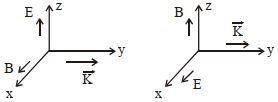
-
- (A) \(E_{y}, B_{y}\) or \(E_{z}, B_{z}\)
- (B) \(E _{ y }, B _{ x }\) or \(E _{ x }, B _{ y }\)
- (C) \(E _{ x }, B _{ z }\) or \(E _{ z }, B _{ x }\)
- (D) \(E _{ x }, B _{ y }\) or \(E _{ y }, B _{ x }\)
Show answer and solution
Correct Answer: (C)
\(\,\)
-
- (A) \(1\)
- (B) \(2\)
- (C) \(4\)
- (D) \(20\)
Show answer and solution
Correct Answer: (B)
\(|B|=\frac{|E|}{C}=\frac{6}{3 \times 10^{8}}\)\(=2 \times 10^{-8} {T}\)
\(\therefore x=2\)
-
- (A) \(137\)
- (B) \(149\)
- (C) \(164\)
- (D) \(121\)
Show answer and solution
Correct Answer: (A)
\(I _{ avg }=\frac{1}{2} \varepsilon_{0} E _{0}^{2} C\)\(\frac{1.25}{100} \times \frac{1000}{4 \pi(2)^{2}}=\frac{1}{2} \times 8.85 \times 10^{-12} \times 3\times 10^{8} \times E _{0}^{2}\)
\(E _{0}^{2}=187.4\)
\(\therefore E _{0}=13.689 V / m\)
\(=136.89 \times 10^{-1} V / m\)
\(\therefore x =136.89\)
Rounding off to nearest integer \(x =137\)
-
- (A) \(21.14\)
- (B) \(83.57\)
- (C) \(55.58\)
- (D) \(27.79\)
Show answer and solution
Correct Answer: (D)
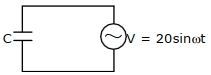
From the given information,\({C}=\frac{\epsilon_{0} {A}}{{d}}={k} \frac{\epsilon_{0} \times 1}{2 \times 10^{-3}} {F}\)
\(\therefore {X}_{{c}}=\frac{1}{\omega {C}}=\frac{2 \times 10^{-3}}{2 \times 50 \pi {\epsilon}_{0}}=\frac{2 \times 10^{-3}}{25 \times 4 \pi \epsilon_{0}} \Omega\)
\(\therefore {X}_{{c}}=\frac{2 \times 10^{-3}}{25} \times 9 \times 10^{9}=\frac{18}{25} \times 10^{6} \Omega\)
\(\therefore {i}_{0}=\frac{{V}_{0}}{{X}_{{c}}}=\frac{20 \times 25}{18} \times 10^{-6} {A}=27.47 \mu {A}\)
The value of amplitude of displacement current will be same as value of amplitude of conventional current.
-
- (A) \(667\)
- (B) \(577\)
- (C) \(627\)
- (D) \(747\)
Show answer and solution
Correct Answer: (A)
\(\lambda\) in vacuum \(=\frac{c}{f}=\frac{3 \times 10^{8}}{3 \times 10^{9}}=0.1\, m\)\(\therefore \lambda\) in medium \(=\frac{0.1}{\mu}\)
Where refractive index
\(\mu=\sqrt{\mu_{z} \varepsilon_{z}}\)
Assuming non-magnetic material \(\mu_{ r }=1\)
\(\therefore \quad \mu=\sqrt{2.25}=1.5\)
\(\lambda_{ m }=\frac{0.1}{1.5}=\frac{1}{15} m =6.67 \,cm\)
\(=667 \times 10^{-2}\, cm\)
-
- (A) \(12\)
- (B) \(18\)
- (C) \(15\)
- (D) \(20\)
Show answer and solution
Correct Answer: (C)
Given : Frequency of wave \(f =5 GHz\)\(=5 \times 10^{9} Hz\)
Relative permittivity, \(\epsilon_{ r }=2\)
and Relative permeability, \(\mu_{ r }=2\)
Since speed of light in a medium is given by,
\(v =\frac{1}{\sqrt{\mu \in}}=\frac{1}{\sqrt{\mu_{ s } \mu_{0} \cdot \epsilon_{ s } \epsilon_{0}}}\)
\(v =\frac{1}{\sqrt{\mu_{ s } \epsilon_{ x }}} \frac{1}{\sqrt{\mu_{0} \epsilon_{0}}}=\frac{ C }{\sqrt{\mu_{ s } \epsilon_{ r }}}\)
Where \(C\) is speed of light is vacuum.
\(\therefore v =\frac{3 \times 10^{8}}{\sqrt{4}}=\frac{30 \times 10^{7}}{2} m / s\)
\(=15 \times 10^{7} m / s\)
\(\therefore\) Ans. is \(15\)
-
- (A) \(\frac{3}{2} {C}\)
- (B) \(C\)
- (C) \(\frac{2}{3} C\)
- (D) \(\frac{{C}}{2}\)
Show answer and solution
Correct Answer: (C)
\({V}=\frac{\omega}{{K}}=\frac{10 \times 10^{10}}{500}=2 \times 10^{8}\)\(V=\frac{2 {C}}{3}\)
-
- (A) \(9\)
- (B) \(2\)
- (C) \(\frac{1}{3}\)
- (D) \(3\)
Show answer and solution
Correct Answer: (A)
Speed of wave \(=\frac{2 \times 10^{10}}{200}=10^{8}\, {m} / {s}\)Refractive index \(=\frac{3 \times 10^{8}}{10^{8}}=3\)
Now refractive index \(=\sqrt{\varepsilon_{{r}} \mu_{{r}}}\)
\(3=\sqrt{\varepsilon_{{r}}(1)}\)
\(\Rightarrow \varepsilon_{{r}}=9\)
-
- (A) \(U _{ e }= U _{ m }\)
- (B) \(U _{ e }> U _{ m }\)
- (C) \(U _{ e }< U _{ m }\)
- (D) \(U _{ e } \neq U _{ m }\)
Show answer and solution
Correct Answer: (A)
In \(EMW\), Average energy density due to electric \(\left( U _{ e }\right)\) and magnetic \(\left( U _{ m }\right)\) fields is same. -
- (A) \(\hat{j}\)
- (B) \((\hat{k})\)
- (C) \((-\hat{k})\)
- (D) \((-\hat{j})\)
Show answer and solution
Correct Answer: (D)
Direct of propagation \(=\vec{E} \times \vec{B}=\hat{i} \times \hat{k}=-\hat{j}\) -
- (A) \(8.31\, {T}\)
- (B) \(5.88 \,{T}\)
- (C) \(1.96 \,\times 10^{-8} {T}\)
- (D) \(2.77 \,\times 10^{-8} {T}\)
Show answer and solution
Correct Answer: (D)
\(I_{\text {avg }}=\frac{B_{0}^{2} C}{2 \mu_{0}} \& \frac{1}{\mu_{0}}=\epsilon_{0} C^{2}\)\(I=\frac{B_{0}^{2}}{2} \in_{0} C^{3}\)
\(B_{0}=\sqrt{\frac{2 I}{\epsilon_{0} C^{3}}}\)
\(B_{0}=2.77 \times 10^{-8}\, {T}\)
No questions on this page match these filters.