


All JEE Mains 2021 Physics questions
32 chaptersShowing 551–600 of 685 questions
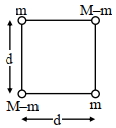
-
- (A) \(1.96 \times 10^{7}\, Nm ^{-2}\)
- (B) \(1.44 \times 10^{7}\, Nm ^{-2}\)
- (C) \(2.26 \times 10^{9} Nm ^{-2}\)
- (D) \(1.44 \times 10^{9} \,Nm ^{-2}\)
Show answer and solution
Correct Answer: (D)
\(P=h \rho g\)\(\beta=\frac{ p }{\frac{\Delta V }{ V }}=\frac{2 \times 10^{3} \times 10^{3} \times 9.8}{1.36 \times 10^{-2}}\)
\(=1.44 \times 10^{9}\, N / m ^{2}\)
-
- (A) \(3\)
- (B) \(6\)
- (C) \(9\)
- (D) \(1\)
Show answer and solution
Correct Answer: (A)
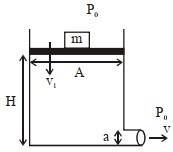
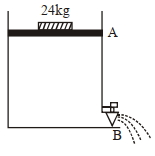
\(m =24 \,kg\)\(A =0.4\, m ^{2}\)
\(a =1 \,cm ^{2}\)
\(H =40 \,cm\)
Using Bernoulli's equation
\(\Rightarrow\left( P _{0}+\frac{ mg }{ A }\right)+\rho gH + \frac{1}{2} \rho V _{1}^{2}\)
\(=P_{0}+0+\frac{1}{2} \rho v^{2}.....(1)\)
\(\Rightarrow\) Neglecting \(v _{1}\)
\(\Rightarrow v =\sqrt{2 gH +\frac{2 mg }{ A \rho}}\)
\(\Rightarrow v =\sqrt{8+1.2}\)
\(\Rightarrow v =3.033\, m / s\)
\(\Rightarrow v \simeq 3 \,m / s\)
-
- (A) \(3.8 \times 10^{-11}\, {N}\)
- (B) \(3.9 \times 10^{-10}\, {N}\)
- (C) \(1.8 \times 10^{-10} \,{N}\)
- (D) \(5.8 \times 10^{-10} \,{N}\)
Show answer and solution
Correct Answer: (B)
Viscous force \(=\) Weight\(=\rho \times\left(\frac{4}{3} \pi^{3}\right) \,g\)
\(=3.9 \times 10^{-10}\)
-
- (A) \(30\)
- (B) \(25\)
- (C) \(20\)
- (D) \(36\)
Show answer and solution
Correct Answer: (B)
\(4 t _{ T }=100 \times \frac{4}{3} \pi r ^{3}\)\(=100 \times \frac{4 \pi}{3} \times \frac{3}{40 \pi} \times 10^{-9}=10^{-8}\, cm ^{3}\)
\(t _{ T }=25 \times 10^{-10}\, cm\)
\(=25 \times 10^{-12} \,m\)
\(t _{0}=0.01 t _{ T }=25 \times 10^{-14}\, m\)
\(=25\)
-
- (A) \(\frac{200}{3} \%\)
- (B) \(\frac{200}{5} \%\)
- (C) \(\frac{5}{200} \%\)
- (D) \(\frac{3}{200} \%\)
Show answer and solution
Correct Answer: (A)
\(P _{1}=\rho gd + P _{0}=3 \times 10^{5} Pa\)\(\therefore \rho gd =2 \times 10^{5} Pa\)
\(P _{2}=2 \rho gd + P _{0}\)
\(=4 \times 10^{5}+10^{5}=5 \times 10^{5} Pa\)
\(\%\)increase \(=\frac{ P _{2}- P _{1}}{ P _{1}} \times 100\)
\(=\frac{5 \times 10^{5}-3 \times 10^{5}}{3 \times 10^{5}} \times 100=\frac{200}{3} \%\)
-
- (A) \(12\)
- (B) \(8\)
- (C) \(3\)
- (D) \(6\)
Show answer and solution
Correct Answer: (D)
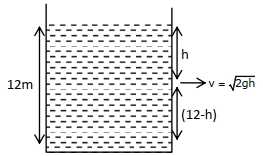
\(R =\sqrt{2 gh } \times \sqrt{\frac{(12- h ) \times 2}{ g }}\)\(\sqrt{4 h (12- h )}= R\)
For maximum \(R\)
\(\frac{ d R }{ dh }=0\)
\(\Rightarrow h =6 \;m\)
-
- (A) Unsteady to steady flow
- (B) Remains steady flow
- (C) Remains turbulent flow
- (D) Steady flow to unsteady flow
Show answer and solution
Correct Answer: (D)
The nature of flow is determined by Reynolds Number.\(R _{ e }=\frac{\rho vD }{\eta}\)
\([\rho \rightarrow\) density of fluid ;
\(\eta \rightarrow\) coefficient of ;
\(v \rightarrow\) velocity of flow ;
\(D \rightarrow\) Diameter of pipe\(]\)
From NCERT
If \(R _{ e }<1000 \quad \rightarrow\) flow is steady
\(1000< R _{ e }<2000 \rightarrow\) flow becomes unsteady
\(R _{ e }>2000 \rightarrow\) flow is turbulent
\(R _{ e \text { initial }}=10^{3} \times \frac{0.18 \times 10^{-3}}{\pi \times\left(0.5 \times 10^{-2}\right)^{2} \times 60} \times \frac{1 \times 10^{-2}}{10^{-3}}\)
\(=382.16\)
\(R _{ efinal }=10^{3} \times \frac{0.48 \times 10^{-3}}{\pi \times\left(0.5 \times 10^{-2}\right)^{2} \times 60} \times \frac{1 \times 10^{-2}}{10^{-3}}\)
\(=1019.09\)
-
- (A) \(800\)
- (B) \(5000\)
- (C) \(500\)
- (D) \(100\)
Show answer and solution
Correct Answer: (C)
\(B=-\frac{\Delta P}{\left(\frac{\Delta V}{V}\right)}=-\frac{\rho g h}{\left(\frac{\Delta V}{V}\right)}\)\(-\frac{B \frac{\Delta V}{V}}{\rho g}=h\)
\(\frac{9.8 \times 10^{8} \times 0.5}{100 \times 10^{3} \times 9.8}=h\)
\(h=500\)
-
- (A) \(3\)
- (B) \(2\)
- (C) \(0\)
- (D) \(1\)
Show answer and solution
Correct Answer: (D)
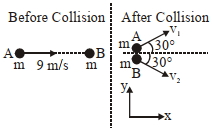
From conservation of momentum along y-axis.\(\overrightarrow{ P }_{ iy }=\overrightarrow{ P }_{ fy }\)
\(0+0=m v_{1} \sin 30^{\circ} \hat{j}+m v_{2} \sin 30^{\circ}(-\hat{j})\)
\(mv _{2} \sin 30^{\circ}= mv _{1} \sin 30^{\circ}\)
\(v _{2}= v _{1}\) or \(\frac{ v _{1}}{ v _{2}}=1\)
-
- (A) \(\frac{4}{3} {g}\)
- (B) \(\frac{6}{5} g\)
- (C) \(\frac{3}{5} {g}\)
- (D) \(\frac{2}{3} g\)
Show answer and solution
Correct Answer: (D)
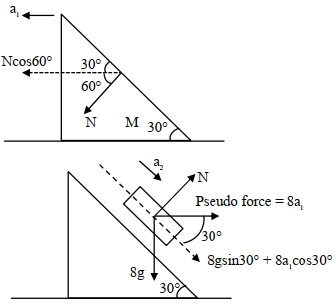
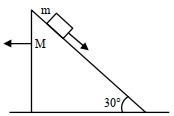
Let acceleration of wedge is \(a_{1}\) and acceleration of block w.r.t. wedge is \(a_{2}\)\({N} \cos 60^{\circ}={Ma}_{1}=16 {a}_{1}\)
\(\Rightarrow {N}=32 {a}_{1}\)
F.B.D. of block w.r.t wedge
\(\perp\) to incline
\({N}=8 {g} \cos 30^{\circ}-8 {a}_{1} \sin 30^{\circ} \Rightarrow 32 {a}_{1}=4 \sqrt{3} {g}-4 {a}_{1}\)
\(\Rightarrow {a}_{1}=\frac{\sqrt{3}}{9} {g}\)
Along incline
\(8 g \sin 30^{\circ}+8 a_{1} \cos 30^{\circ}=m a_{2}=8 a_{2}\)
\(a_{2}=g \times \frac{1}{2}+\frac{\sqrt{3}}{9} g \cdot \frac{\sqrt{3}}{2}=\frac{2 g}{3}\)
-
- (A) \(16\)
- (B) \(8\)
- (C) \(12\)
- (D) \(20\)
Show answer and solution
Correct Answer: (C)
\(\overrightarrow{ a } =\frac{\overrightarrow{ F }}{ m }=\frac{2 \hat{ i }+3 \hat{ j }+5 \hat{ k }}{2}\)\(=\hat{ i }+1.5 \hat{ j }+2.5 \hat{ k }\)
\(\vec{r} =\overrightarrow{ u } t +\frac{1}{2} \overrightarrow{ a } t ^{2}\)
\(=0+\frac{1}{2}(\hat{ i }+1.5 \hat{ j }+2.5 \hat{ k })(16)\)
\(=8 \hat{ i }+12 \hat{ j }+20 \hat{ k }\)
\(b=12\)
-
- (A) \(400\)
- (B) \(500\)
- (C) \(800\)
- (D) \(1200\)
Show answer and solution
Correct Answer: (B)
\(\overrightarrow{ F }=20 \hat{ i }+10 \hat{ j }\)\(\overrightarrow{ a }=\frac{\overrightarrow{ F }}{ m }=\frac{20 \hat{ i }+10 \hat{ j }}{2} \Rightarrow 10 \hat{ i }+5 \hat{ j }\)
\(\therefore \overrightarrow{ s }=\frac{1}{2} \overrightarrow{ a } t ^{2}=\frac{1}{2}(10 \hat{ i }+5 \hat{ j }) \times(10)^{2}\)
\(\Rightarrow 50(10 \hat{ i }+5 \hat{ j }) m\)
\(\therefore\) Displacement along \(x\) -axis
\(\Rightarrow 50 \times 10 \Rightarrow 500 m\)
-
- (A) \(0.4\, {kg} \,{ms}^{-1}, 0.1\, {ms}^{-1}\)
- (B) \(0.2 \,{kg} \,{ms}^{-1}, 0.1\, {ms}^{-1}\)
- (C) \(0.2 \,{kg} \,{ms}^{-1}, 0.05\, {ms}^{-1}\)
- (D) \(0.4 \,{kg}\, {ms}^{-1}, 0.05 \,{ms}^{-1}\)
Show answer and solution
Correct Answer: (C)
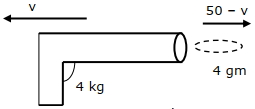
By momentum conservation\(4 \times 10^{-3}(50-v)-4 v=0\)
\(v=\frac{4 \times 10^{-3} \times 50}{4+4 \times 10^{-3}} \approx 0.05\, m s^{-1}\)
Impulse \(=J=m v=4 \times 0.05=0.2 \,{kgms}^{-1}\)
-
- (A) \(7\)
- (B) \(8\)
- (C) \(10\)
- (D) \(12\)
Show answer and solution
Correct Answer: (C)
\(v ^{2}= u ^{2}+2 as\)\(0=(10)^{2}+2(- a )\left(\frac{1}{2}\right)\)
\(a =100 m / s ^{2}\)
\(F = ma =(0.1)(100)=10\, N\)
-
- (A) \((100 \hat{i}+400 \hat{j}) \,m\)
- (B) \((400 \hat{i}+100 \hat{j})\, m\)
- (C) \((100 \hat{i}+100 \hat{j})\, m\)
- (D) \((400 \hat{i}+400 \hat{j}) \,{m}\)
Show answer and solution
Correct Answer: (B)
\(\frac{ d \overrightarrow{ v }}{ dt }=\overrightarrow{ a }=\frac{\overrightarrow{ F }}{ m }=(8 \hat{ i }+2 \hat{ j }) m / s ^{2}\)\(\frac{ d \overrightarrow{ r }}{ dt }=\overrightarrow{ v }=(8 t \hat{ i }+2 t \hat{ j }) m / s\)
\(\overrightarrow{ r }=(8 \hat{ i }+2 \hat{ j }) \frac{ t ^{2}}{2} m\)
At \(t =10 sec\)
\(\overrightarrow{ r }=[(8 \hat{ i }+2 \hat{ j }) 50] m\)
\(\Rightarrow \overrightarrow{ r }=(400 \hat{ i }+100 \hat{ j }) m\)
-
- (A) \(\frac{{F}_{0} {T}}{3 {M}}\)
- (B) \(\frac{{F}_{0} {T}}{2 {M}}\)
- (C) \(\frac{2{F}_{0} {T}}{{M}}\)
- (D) \(\frac{4 {F}_{0} {T}}{3 {M}}\)
Show answer and solution
Correct Answer: (D)
\({t}=0, {u}=0\)As given
\({a}=\frac{{F}_{0}}{{M}}-\frac{{F}_{{o}}}{{MT}^{2}}({t}-{T})^{2}=\frac{{dv}}{{dt}}\)
\(\int_{0}^{v} {d} v=\int_{t=0}^{2 T}\left(\frac{F_{o}}{M}-\frac{F_{0}}{M T^{2}}(t-T)^{2}\right) d t\)
\(V=\left[\frac{F_{0}}{M} t\right]_{0}^{2 T}-\frac{F_{0}}{M T^{2}}\left[\frac{t^{3}}{3}-t^{2} T+T^{2} t\right]_{0}^{2 T}\)
\({V}=\frac{4 {F}_{0} {T}}{3 {M}}\)
-
- (A) \(486\)
- (B) \(492\)
- (C) \(512\)
- (D) \(456\)
Show answer and solution
Correct Answer: (B)
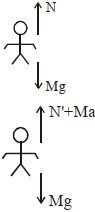
When lift is at rest\(N = mg\)
\(\Rightarrow 60 \times 10=600 N\)
When lift moves with downward acceleration.
In frame of lift pseudo force will be in upward direction.
\(N^{\prime}=M(g-a)\)
\(\Rightarrow 60(10-1.8)\)
\(N^{\prime} \Rightarrow 492 N\)
-
- (A) \(82\)
- (B) \(72\)
- (C) \(87\)
- (D) \(78\)
Show answer and solution
Correct Answer: (A)
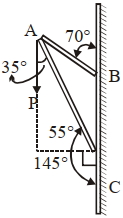
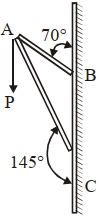
Component along \(AC\)\(=100 \cos 35^{\circ} N\)
\(=100 \times 0.819 N\)
\(=81.9 N\)
\(\approx 82 N\)
-
- (A) \(0.34\)
- (B) \(0.2\)
- (C) \(0.25\)
- (D) \(0.4\)
Show answer and solution
Correct Answer: (D)
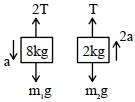
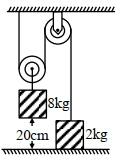
\(\left({m}_{1} {g}-2 {T}\right)={m}_{1} {a}.....(1)\)\({T}-{m}_{2} {g}={m}_{2}(2 {a})\)
\(2 {T}-2 {m}_{2} {g}=4 {m}_{2} {a}.....(2)\)
\({m}_{1} {g}-2 {m}_{2} {g}=\left({m}_{1}+4 {m}_{2}\right) {a}\)
\({S}=\frac{1}{2} {at}^{2}\)
\(\frac{0.2 \times 2 \times 4}{10}={t}^{2}\)
\({t}=0.4\, {sec}\)
-
- (A) \(600\)
- (B) \(500\)
- (C) \(10\)
- (D) \(60\)
Show answer and solution
Correct Answer: (D)
\(F_{\text {thrust }}=\left(\frac{{dm}}{{dt}} \cdot {V}_{{rel}}\right)\)\(\left(\frac{{dm}}{{dt}} {V}_{{rel}}-{mg}\right)={ma}\)
\(\Rightarrow\left(\frac{{dm}}{{dt}}\right) \times 500-10^{3} \times 10=10^{3} \times 20\)
\(\frac{{d} {m}}{{dt}}=(60 \,{kg} / {s})\)

-
- (A) \(1: 1\)
- (B) \(\sqrt{2}: 1\)
- (C) \(1: \sqrt{2}\)
- (D) \(2: 1\)
Show answer and solution
Correct Answer: (B)
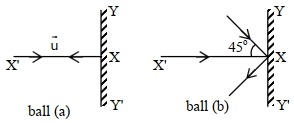
Ball (a) \(|\overrightarrow{\Delta p }|=2 mu = J _{1}\)Ball (b) \(|\overrightarrow{\Delta p }|=2 mu \cos 45^{\circ}= J _{2}\)
\(\frac{J_{1}}{J_{2}}=\frac{1}{\cos 45^{\circ}}=\sqrt{2}\)
-
- (A) \(\frac{1}{3} \sqrt{\frac{2 R_{e}}{g}}\left[\left(1+\frac{h}{R_{e}}\right)^{3 / 2}-1\right]\)
- (B) \(\sqrt{\frac{2 R_{e}}{g}}\left[\left(1+\frac{h}{R_{e}}\right)^{3 / 2}-1\right]\)
- (C) \(\frac{1}{3} \sqrt{\frac{R_{e}}{g}}\left[\left(1+\frac{h}{R_{e}}\right)^{3 / 2}-1\right]\)
- (D) \(\sqrt{\frac{R_{e}}{g}}\left[\left(1+\frac{h}{R_{e}}\right)^{3 / 2}-1\right]\)
Show answer and solution
Correct Answer: (A)
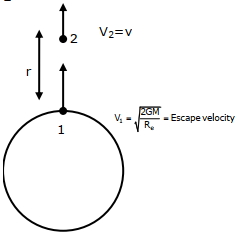
Applying energy conservation from \((1)\) to \((2)\)\(\frac{1}{2} m_{.}\left(\frac{2 G M}{R_{e}}\right)-\frac{G M m}{R_{e}}=\frac{1}{2} m v^{2}-\frac{G M m}{R+r}\)
\(\Rightarrow \frac{1}{2} m v^{2}=\frac{G M m}{R+r}\)
\(\Rightarrow v=\sqrt{\frac{2 G M}{R+r}}=\frac{d r}{d t}\)
\(\Rightarrow \sqrt{2 G M} \int_{0}^{t} d t=\int_{R_{e}}^{R_{e}+h}(\sqrt{R+r}) d r\)
\(\sqrt{2 G M} \cdot t=\frac{2}{3}\left[(R+r)^{3 / 2}\right]_{R_{e}}^{R_{e}+h}\)
\(t=\frac{2}{3} \sqrt{\frac{R_{e}^{3}}{2 G M}}\left[\left(1+\frac{h}{R_{e}}\right)^{3 / 2}-1\right]\)
\(\frac{G M}{R_{e}^{2}}=g\)
\(t=\frac{1}{3} \sqrt{\frac{2 R_{e}}{g}}\left[\left(1+\frac{h}{R_{e}}\right)^{3 / 2}-1\right]\)
-
- (A) \(2\)
- (B) \(3\)
- (C) \(1\)
- (D) \(4\)
Show answer and solution
Correct Answer: (A)
Energy is maximum when mass is split equally so\(\frac{{M}}{{m}}=2\)
-
- (A) \(49\)
- (B) \(48.83\)
- (C) \(49.83\)
- (D) \(49.17\)
Show answer and solution
Correct Answer: (B)
Weight of pole \(= mg =49 \,N\)At equator due to rotation \(= g _{ e }= g - R \omega^{2}\)
so \(W = mg _{ e }= m \left( g - R \omega^{2}\right)\)
\(\therefore W _{ P } > W _{ e } \quad W _{ P }=49 \,N\)
So, \(W _{ e }=48.83\, N . \quad W _{ e }<49 \,N\)
-
- (A) \(6 \sqrt{2}\)
- (B) \(\frac{6}{\sqrt{2}}\)
- (C) \(3\)
- (D) \(5\)
Show answer and solution
Correct Answer: (C)
\(T \propto R ^{3 / 2}\)\(\frac{24}{ T }=\left(\frac{12 R }{3 R }\right)^{3 / 2} \Rightarrow T =3\, hr\)
-
- (A) \(-\,60G\)
- (B) \(+\,2G\)
- (C) \(-\,20G\)
- (D) \(-\,4G\)
Show answer and solution
Correct Answer: (D)
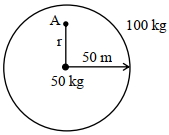
\({V}_{{A}} =\left[-\frac{{GM}_{1}}{{r}}-\frac{{GM}_{2}}{{R}}\right]\)\(=\left[-\frac{50}{25} {G}-\frac{100}{50} {G}\right]\)
\(=-4\, {G}\)
-
- (A) \((b)\)
- (B) \((a)\)
- (C) \((c)\)
- (D) \((d)\)
Show answer and solution
Correct Answer: (C)
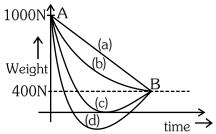
At neutral point \(g=0\) -
- (A) \(A\) only
- (B) \(D\) only
- (C) \(C\) only
- (D) \(E\) only
Show answer and solution
Correct Answer: (D)
As per Keppler's \(2^{\text {nd }}\) law, Areal velocity is constant. -
- (A) \(0.7\)
- (B) \(1\)
- (C) \(1.5\)
- (D) \(3\)
Show answer and solution
Correct Answer: (D)
(d) \(\%\) change in \(T = \frac{3}{2}\) (\(\%\) change in \(R\))\(= \frac{3}{2} \times (2)\% = 3\% \)
-
- (A) \(25: 36\)
- (B) \(36: 25\)
- (C) \(50: 41\)
- (D) \(41: 50\)
Show answer and solution
Correct Answer: (C)
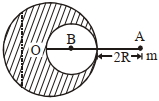
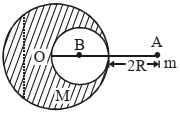
Let initial mass of sphere is \(m ^{\prime} .\) Hence mass of removed portion will be \(m ^{\prime} / 8\)\(F _{1}= m . E .=\frac{ m \cdot Gm ^{\prime}}{9 R ^{2}}\)
\(F_{2}=m\left[\frac{G \cdot m^{\prime}}{(3 R)^{2}}-\frac{G \cdot m^{\prime} / 8}{(5 R / 2)^{2}}\right]\)
\(=\frac{G m^{\prime}}{9 R^{2}}-\frac{G m^{\prime} \times 4}{8 \times 25}\)
\(=\left(\frac{1}{9}-\frac{1}{50}\right) \frac{G m^{\prime}}{R^{2}}\)
\(F_{2}=\frac{41}{50 \times 9} \cdot \frac{G m^{\prime}}{R^{2}}\)
\(\frac{F_{1}}{F_{2}}=\frac{1}{9} \times \frac{50 \times 9}{41}=\frac{50}{41}\)
-
- (A) \(T_{A}=T_{B}\)
- (B) \(T_{A}\,>\,T_{B}\) (if \(\left.m_{A}\,>\,m_{B}\right)\)
- (C) \({T}_{{A}}\,>\,{T}_{{B}}\) (if \(\left.{r}_{{A}}\,>\,{r}_{{B}}\right)\)
- (D) \(\frac{T_{A}}{T_{B}}=\left(\frac{r_{A}}{r_{B}}\right)^{3 / 2}\)
Show answer and solution
Correct Answer: (A)
\({T}_{{A}}={T}_{{B}}\left(\text { Since } \omega_{{A}}=\omega_{{B}}\right)\) -
- (A) \(\sqrt{2}\, {W}\)
- (B) \(2\, {W}\)
- (C) \(W\)
- (D) \(2^{\frac{1}{3}}\, {W}\)
Show answer and solution
Correct Answer: (D)
Since the density of planet is same as that of earth.\(\rho_{ p }=\rho_{ e }\)
\(\Rightarrow \frac{ M _{ p }}{\frac{4}{3}}\pi R _{ p }^{3}=\frac{ M _{ e }}{\frac{4}{3}}\)
\(\pi R _{ e }^{3}\)
\(\Rightarrow \frac{ R _{ p }}{ R _{ e }}=\left(\frac{ M _{ p }}{ M _{ e }}\right)^{1 / 3}\)
The value of gravitational acceleration \(=g=\frac{G M}{R^{2}}\)
\(\Rightarrow \frac{W_{p}}{W_{e}}=\frac{m g_{p}}{m g_{e}}\)
\(\Rightarrow \frac{g_{p}}{g_{e}}=\frac{M_{p}}{M_{e}} \frac{R_{e}^{2}}{R_{p}^{2}}\)
\(=\frac{M_{p}}{M_{e}}\left(\frac{M_{e}}{M_{p}}\right)^{2 / 3}=\left(\frac{M_{p}}{M_{e}}\right)^{1 / 3}=2^{1 / 3}\)
\(\Rightarrow W_{p}=2^{1 / 3}\; W\)
-
- (A) \(2: 1\)
- (B) \(1: 4\)
- (C) \(8: 1\)
- (D) \(1: 8\)
Show answer and solution
Correct Answer: (C)
\(\frac{ T _{1}}{ T _{2}}=\frac{1}{8}\)\(\frac{2 \pi / \omega_{1}}{2 \pi / \omega_{2}}=\frac{1}{8}\)
\(\frac{\omega_{1}}{\omega_{2}}=\frac{8}{1}\)
-
- (A) \(\frac{\sqrt{8}}{9} \cdot \frac{ GmM }{ R }\)
- (B) \(\frac{2 \sqrt{2}}{3} \cdot \frac{ GMm }{ R ^{2}}\)
- (C) \(\frac{1}{3 \sqrt{8}} \cdot \frac{ GMm }{ R ^{2}}\)
- (D) \(\frac{\sqrt{8}}{27} \cdot \frac{ GmM }{ R ^{2}}\)
Show answer and solution
Correct Answer: (D)
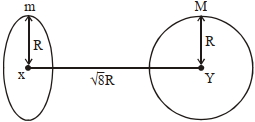
Gravitational field of ring\(=-\frac{\text { Gmx }}{\left(R^{2}+x^{2}\right)^{3 / 2}}\)
Force between sphere and ring
\(=\frac{\operatorname{GmM}(\sqrt{8} R )}{\left( R ^{2}+8 R ^{2}\right)^{3 / 2}}\)
\(=\frac{ GmM }{ R ^{2}} \times \frac{\sqrt{8}}{27}\)
-
- (A) Both \(A\) and \(R\) are correct but \(R\) is \(NOT\) the correct explanation of \(A\)
- (B) \(A\) is correct but \(R\) is not correct
- (C) Both \(A\) and \(R\) are correct and \(R\) is the correct explanation of \(A\)
- (D) \(A\) is not correct but \(R\) is correct
Show answer and solution
Correct Answer: (B)
\(V _{ e }=\sqrt{\frac{2 GM }{ R }}\)\(\frac{ M _{1}}{ R _{1}}=\frac{ M _{2}}{ R _{2}}\)
\(M _{1} R _{2}= M _{2} R _{1}\)
Hence reason \(R\) is not correct.
-
- (A) \(3\)
- (B) \(6\)
- (C) \(4\)
- (D) \(9\)
Show answer and solution
Correct Answer: (A)
Energy given \(= U _{ f }- U _{ i }\)\(=0-\left(-\frac{3}{5} \frac{ GM ^{2}}{ R }\right)\)
\(=\frac{3}{5} \frac{ GM ^{2}}{ R }\)
\(x =3\)
-
- (A) \(1-\frac{{r}}{{R}_{{E}}}-\frac{{r}^{2}}{{R}_{{E}}^{2}}-\frac{{r}^{3}}{{R}_{{E}}^{3}}\)
- (B) \(1+\frac{{r}}{{R}_{{E}}}+\frac{{r}^{2}}{{R}_{{E}}^{2}}+\frac{{r}^{3}}{{R}_{{E}}^{3}}\)
- (C) \(1+\frac{{r}}{{R}_{{E}}}-\frac{{r}^{2}}{{R}_{{E}}^{2}}+\frac{{r}^{3}}{{R}_{{E}}^{3}}\)
- (D) \(1+\frac{{r}}{{R}_{{E}}}-\frac{{r}^{2}}{{R}_{{E}}^{2}}-\frac{{r}^{3}}{{R}_{{E}}^{3}}\)
Show answer and solution
Correct Answer: (D)
\(g_{u p}=\frac{g}{\left(1+\frac{r}{R}\right)^{2}}\)\(g_{d o w n}=g\left(1-\frac{r}{R}\right)\)
\(\frac{{g}_{\text {down }}}{{g}_{{up}}}=\left(1-\frac{{r}}{{R}}\right)\left(1+\frac{{r}}{{R}}\right)^{2}\)
\(=\left(1-\frac{{r}}{{R}}\right)\left(1+\frac{2 {r}}{{R}}+\frac{{r}^{2}}{{R}^{2}}\right)\)
\(=1+\frac{{r}}{{R}}-\frac{{r}^{2}}{{R}^{2}}-\frac{{r}^{3}}{{R}^{3}}\)
-
- (A) \(60\)
- (B) \(480\)
- (C) \(1200\)
- (D) \(84\)
Show answer and solution
Correct Answer: (D)
For objects to float\(mg = m \omega^{2} R\)
\(\omega=\) angular velocity of earth.
\(R =\) Radius of earth
\(\omega=\sqrt{\frac{g}{R}}\)
Duration of day \(= T\)
\(T =\frac{2 \pi}{\omega}\)
\(\Rightarrow T =2 \pi \sqrt{\frac{ R }{ g }}\)
\(=2 \pi \sqrt{\frac{6400 \times 10^{3}}{10}}\)
\(\Rightarrow \frac{ T }{60}=83.775\) minutes
\(\simeq 84\) minutes
-
- (A) \(3\)
- (B) \(5\)
- (C) \(4\)
- (D) \(6\)
Show answer and solution
Correct Answer: (C)
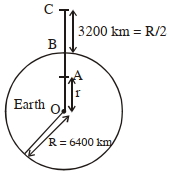
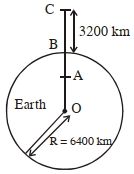
\(g_{A}=\frac{G M(r)}{R^{3}}\)\(g_{c}=\frac{G M}{\left(R+\frac{R}{2}\right)^{2}}\)
\(g_{A}=g_{C}\)
\(\frac{ r }{ R ^{3}}=\frac{1}{\frac{9}{4} R ^{2}} \Rightarrow r =\frac{4 R }{9}\)
so \(OA =\frac{4 R }{9} ; AB = R - r =\frac{5 R }{9}\)
\(OA : AB =4: 5\)
-
- (A) \((a), (c)\) and \((d)\) only
- (B) \((e)\) only
- (C) \((a), (b)\) and \((c)\) only
- (D) \(({b}),({c})\) and \(({d})\) only
Show answer and solution
Correct Answer: (A)
Inside a spherical shell, gravitational field is zero and hence potential remains same everywhere -
- (A) \(4\)
- (B) \(8\)
- (C) \(16\)
- (D) \(64\)
Show answer and solution
Correct Answer: (A)
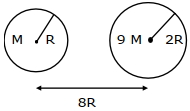
Assume that at a distance x from the planet of mass M, the net gravitational field becomes zero.\(\frac{G M}{x^{2}}=\frac{G 9 M}{(8 R-x)^{2}}\)
\(8 R-x=3 x\)
\(x=2 R\)
Apply conservation of energy and consider velocity at \(P\) is zero.
\(\frac{1}{2} m v^{2}-\frac{G M m}{R}-\frac{G 9 M m}{7 R}=0-\frac{G M m}{2 R}-\frac{G 9 M m}{6 R}\)
\(\frac{1}{2} v^{2}=\frac{2 G M}{7 R} \Rightarrow v=\sqrt{\frac{4}{7} \frac{G M}{R}}\)
\(a=4\)
-
- (A) \(85\)
- (B) \(31\)
- (C) \(24\)
- (D) \(14\)
Show answer and solution
Correct Answer: (D)
\({T}=2 \pi \sqrt{\frac{\ell}{{g}}} \Rightarrow \ell=\frac{{T}^{2} {g}}{4 \pi^{2}}\)\({E}={mg} \ell \frac{\theta^{2}}{2}={mg}^{2} \frac{{T}^{2} \theta^{2}}{8 \pi^{2}}\)
\(\frac{{dE}}{{E}}=2\left(\frac{{dg}}{{g}}+\frac{{dT}}{{T}}\right)\)
\(=(4+3)=14\, \%\)
-
- (A) \(\frac{4 L }{ M }\)
- (B) \(\frac{L }{ M }\)
- (C) \(\frac{2L }{ M }\)
- (D) \(\frac{L }{2M }\)
Show answer and solution
Correct Answer: (D)
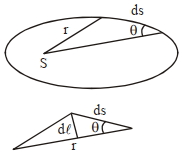
For small displacement ds of the planet its area can be written as\(d A =\frac{1}{2} rd \ell\)
\(=\frac{1}{2} r d s \sin \theta\)
A.vel \(=\frac{ d A }{ dt }=\frac{1}{2} r \sin \theta \frac{ ds }{ dt }=\frac{ Vr \sin \theta}{2}\)
\(\frac{ d A }{ dt }=\frac{1}{2} \frac{ mVr \sin \theta}{ m }=\frac{ L }{2 m }\)
-
- (A) \(20\)
- (B) \(40\)
- (C) \(10\)
- (D) \(25\)
Show answer and solution
Correct Answer: (C)
\(\frac{- GMm }{11 R }=\frac{- GMm }{ R }+\frac{1}{2} mv ^{2}\)\(v =\sqrt{\frac{20 GM }{11 R }}\)
-
- (A) \({V}=\frac{1}{2} \sqrt{\frac{4 {G}\left({M}_{1}+{M}_{2}\right)}{{r}}}\)
- (B) \({V}=\sqrt{\frac{4 {G}\left({M}_{1}+{M}_{2}\right)}{{r}}}\)
- (C) \({V}=\frac{1}{2} \sqrt{\frac{2 {G}\left({M}_{1}+{M}_{2}\right)}{{r}}}\)
- (D) \({V}=\frac{\sqrt{2 {G}}\left({M}_{1}+{M}_{2}\right)}{{r}}\)
Show answer and solution
Correct Answer: (B)
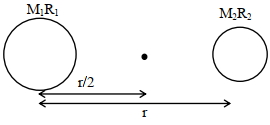
\(\frac{1}{2} {mV}^{2}-\frac{{GM}_{1} {m}}{{r} / 2}-\frac{{GM}_{2} {m}}{{r} / 2}=0\)\(\frac{1}{2} {mV}^{2}=\frac{2 {Gm}}{{r}}\left({M}_{1}+{M}_{2}\right)\)
\({V}=\sqrt{\frac{4 {G}\left({M}_{1}+{M}_{2}\right)}{{r}}}\)
-
- (A) \(1.5\)
- (B) \(6.0\)
- (C) \(3.0\)
- (D) \(4.5\)
Show answer and solution
Correct Answer: (C)
By angular momentum conservation\(mv _{1} r _{1}= mv _{2} r _{2}\)
\(v _{1}=\frac{48 \times 10^{14}}{1.6 \times 10^{12}}=3000 m / sec\)
\(=3 \times 10^{3} m / sec\)
-
- (A) \(3.25 \times 10^{21}\, {kg}\)
- (B) \(5.96 \times 10^{19} \,{kg}\)
- (C) \(7.02 \times 10^{25} \,{kg}\)
- (D) \(6.00 \times 10^{23} \,{kg}\)
Show answer and solution
Correct Answer: (D)
Using kepler's law\(T^{2}=\frac{4 \pi^{2}}{G M} \cdot r^{3}\)
\(M=\frac{4 \pi^{2}}{G} \cdot \frac{r^{3}}{T^{2}}\)
by putting values
\({M}=6 \times 10^{23}\)
-
- (A) \(64\)
- (B) \(36\)
- (C) \(72\)
- (D) \(81\)
Show answer and solution
Correct Answer: (A)
\(V _{ e }=\sqrt{\frac{2 Gm }{ R }}\)\(10 V _{ e }=\sqrt{\frac{2 Gm }{ R ^{\prime}}}\)
\(\therefore 10=\sqrt{\frac{ R }{ R ^{\prime}}}\)
\(\Rightarrow R ^{\prime}=\frac{ R }{100}=\frac{6400}{100}=64 km\)
-
- (A) \(9\)
- (B) \(27\)
- (C) \(12\)
- (D) \(3\)
Show answer and solution
Correct Answer: (B)
\(T ^{2} \propto R ^{3}\)\(\left(\frac{ T ^{\prime}}{ T }\right)^{2}=\left(\frac{9 R }{ R }\right)^{3}\)
\(T ^{2}= T ^{2} \times 9^{3}\)
\(T ^{\prime}= T \times 3^{3}\)
\(T ^{\prime}=27 T\)
-
- (A) \(\frac{1}{2 R} \sqrt{\frac{1}{G}}\)
- (B) \(\frac{1}{2} \sqrt{\frac{G}{R^{3}}}\)
- (C) \(\sqrt{\frac{2 G}{R^{3}}}\)
- (D) \(\sqrt{\frac{G}{2 R^{3}}}\)
Show answer and solution
Correct Answer: (B)
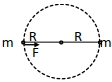
Using newtons law of gravitation\(F=\frac{G m^{2}}{(2 R)^{2}}=m R \omega^{2}\)
\(\omega=\frac{1}{2} \sqrt{\frac{G}{R^{3}}}\)
No questions on this page match these filters.