


All JEE Mains 2021 Physics questions
32 chaptersShowing 51–100 of 685 questions
- 51. If an emitter current is changed by \(4\, mA ,\) the collector current changes by \(3.5\, mA\). The value of \(\beta\) will be 2021 Medium
- (A) \(7\)
- (B) \(0.5\)
- (C) \(0.875\)
- (D) \(3.5\)
Show answer and solution
Correct Answer: (A)
\(I _{\varepsilon}= I _{ C }+ I _{ B }\)\(\Rightarrow \Delta I _{\varepsilon}=\Delta I _{ C }+\Delta I _{ B }\)
\(4 mA =3.5 mA +\Delta I _{ B }\)
\(\Rightarrow \Delta I _{ B }=0.5 mA\)
\(\Rightarrow \beta=\frac{\Delta I _{ C }}{\Delta I _{ B }}\)
\(\beta=\frac{3.5}{0.5}\)
\(\Rightarrow \beta=7\)
-
- (A) \(AND\) and \(OR\) Gate
- (B) \(OR\) and \(NOT\) Gate
- (C) \(NAND\) and \(NOR\) Gate
- (D) \(AND\) and \(NOT\) Gate
Show answer and solution
Correct Answer: (B)
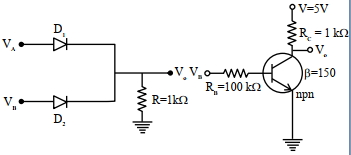
\({V}_{{A}}=5 {V} \Rightarrow {A}=1\)\({V}_{{A}}=0 {V} \Rightarrow {A}=0\)
\({V}_{{B}}=5 {V} \Rightarrow {B}=1\)
\({V}_{{B}}=0 {V} \Rightarrow {B}=0\)
If \({A}={B}=0\), there is no potential anywhere here \({V}_{0}=0\)
If \({A}=1, {B}=0\), Diode \({D}_{1}\) is forward biased, here \({V}_{0}=5 {V}\)
If \({A}=0, {B}=1\), Diode \({D}_{2}\) is forward biased hence \({V}_{0}=5 {V}\)
If \({A}=1, {B}=1\), Both diodes are forward biased hence \({V}_{0}=5 {V}\)
Truth table for \({I}^{{st}}\)
\(A\) \(B\) Output \(0\) \(0\) \(0\) \(0\) \(1\) \(1\) \(1\) \(0\) \(1\) \(1\) \(1\) \(1\) \(\therefore\) Given circuit is \(OR\) gate
For \(\mathbb{I}^{{Id}}\) circuit
\({V}_{{B}}=5 {V}, {A}=1\)
\({V}_{{B}}=0 {V}, {A}=0\)
When \({A}=0, {E}-{B}\) junction is unbiased there is no current through it
\(\therefore {V}_{0}=1\)
When \({A}=1, {E}-{B}\) junction is forward biased
\({V}_{0}=0\)
\(\therefore\) Hence this circuit is not gate.
-
- (A) \(100\)
- (B) \(1000\)
- (C) \(500\)
- (D) \(50\)
Show answer and solution
Correct Answer: (C)
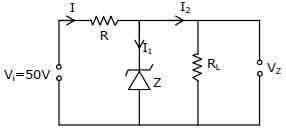
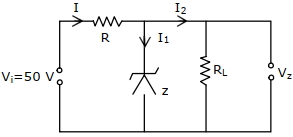
Voltage across \({R}_{{L}}=5\, {V}\)\(\Rightarrow {i}_{2}=\frac{5}{{R}_{{L}}}\)
Also voltage across \({R}=50-5=45\) \(volt\)
By \(v=i R \Rightarrow R=\frac{v}{i}=\frac{45}{i_{1}+i_{2}}\)
\({R}=\frac{45}{90 {m} {A}+\frac{5}{{R}_{{L}}}}\)
Current in zener diode is maximum when \({R}_{{L}} \rightarrow \infty\)
\(\left(i_{2} \rightarrow 0\right.\) and \(\left.i_{i}=i\right)\)
So \({R}=\frac{45}{90 {mA}}=500 \,\Omega\)
-
- (A) \(5\)
- (B) \(10\)
- (C) \(15\)
- (D) \(20\)
Show answer and solution
Correct Answer: (A)
\(n _{ e } n _{ h }= n _{ i }^{2}\)\(n _{ e }=\frac{ n _{ i }^{2}}{ n _{ h }}=\frac{\left(1.5 \times 10^{16}\right)^{2}}{4.5 \times 10^{22}}\)
\(=\frac{1.5 \times 1.5 \times 10^{32}}{4.5 \times 10^{22}}\)
\(5 \times 10^{9} / m ^{3}\)
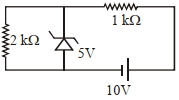
- 55. In connection with the circuit drawn below, the value of current flowing through \(2\, k \Omega\) resistor is ............. \(\times 10^{-4} A\)
 2021 Medium
- (A) \(30\)
- (B) \(15\)
- (C) \(25\)
- (D) \(12\)
Show answer and solution
Correct Answer: (C)
Current through \(2 k \Omega\) resistance\(I=\frac{5}{2 \times 10^{3}}=2.5 \times 10^{-3} A\)
\(I =25 \times 10^{-4} A\)
Ans. \(25\)
-
- (A) \(1,0,1,0\)
- (B) \(0,1,0,1\)
- (C) \(1,1,1,0\)
- (D) \(0,0,1,1\)
Show answer and solution
Correct Answer: (C)
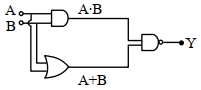
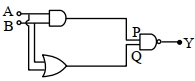
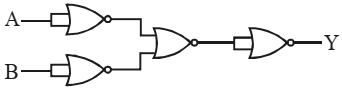
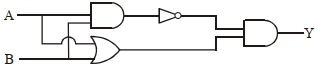
\({Y}=\overline{({A} \cdot {B}) \cdot({A}+{B})}\)\({Y}_{(0,0)}=1\)
\({Y}_{(0,1)}=1\)
\({Y}_{(1,0)}=1\)
\({Y}_{(1,1)}=0\)
-
- (A) \(3.75\)
- (B) \(2.35\)
- (C) \(2\)
- (D) \(2.73\)
Show answer and solution
Correct Answer: (C)
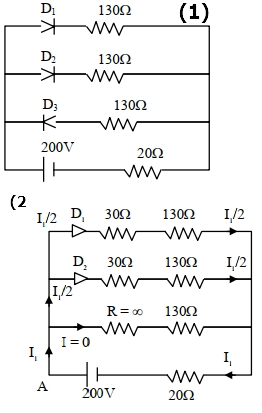
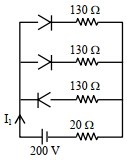
As per diagram,Diode \({D}_{1} \& {D}_{2}\) are in forward bias i.e. \({R}=30 \,\Omega\)
whereas diode \({D}_{3}\) is in reverse bias i.e. \({R}=\) infinite
\(\Rightarrow\) Equivalent circuit will be
Applying \(KVL\) starting from point \(A\)
\(-\left(\frac{{I}_{1}}{2}\right) \times 30-\left(\frac{{I}_{1}}{2}\right) \times 130-{I}_{1} \times 20+200=0\)
\(\Rightarrow-100 {I}_{1}+200=0\)
\({I}_{1}=2\)
-
- (A) \(1046\, nm\) and red colour
- (B) \(654\, nm\) and orange colour
- (C) \(1046\, nm\) and blue colour
- (D) \(654\, nm\) and red colour
Show answer and solution
Correct Answer: (D)
\(\lambda=\frac{ hc }{ E }=\frac{6.6 \times 10^{-34} \times 3 \times 10^{8}}{1.9 \times 1.6 \times 10^{-19}}=6.54 \times 10^{-7}\)\(=654 nm\)
Red color
-
- (A) \((a)-(ii), (b)-(iv), (c)-(i), (d)-(iii)\)
- (B) \((a)-(iii), (b)-(iv), (c)-(i), (d)-(ii)\)
- (C) \((a)-(ii), (b)-(i), (c)-(iv), (d)-(iii)\)
- (D) \((a)-(ii), (b)-(i), (c)-(iii), (d)-(iv)\)
Show answer and solution
Correct Answer: (A)
\((a)\) Rectifier \(\rightarrow AC\) to \(DC\)\((b)\) Stabilizer \(\rightarrow\) used for constant output voltage even when input voltage or current change.
\((c)\) Transformer \(\rightarrow\) Step - up or step - down ac voltage.
\((d)\) Filter \(\rightarrow\) used to remove any ripple in the rectified output voltage.
-
- (A) Statement\(-I\) is true but Statement\(-II\) is false.
- (B) Statement\(-I\) is false but Statement\(-II\) is true.
- (C) Both Statement\(-I\) and Statement\(-II\) are true.
- (D) Both Statement\(-I\) and Statement\(-II\) are false.
Show answer and solution
Correct Answer: (A)
Pentavalent activities have excess free \({e}^{-}\)So \({e}^{-}\)density increases but overall semiconductor is neutral.
-
- (A) Statement \(I\) is true but Statement \(II\) is false
- (B) Statement \(I\) is false but Statement \(II\) is true
- (C) Both Statement \(I\) and Statement \(II\) are false
- (D) Both Statement \(I\) and Statement \(II\) are true
Show answer and solution
Correct Answer: (D)
To convert pulsating de into steady dc both of mentioned method are correct. -
- (A) \(20\)
- (B) \(40\)
- (C) \(10\)
- (D) \(16\)
Show answer and solution
Correct Answer: (A)
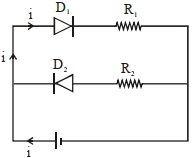
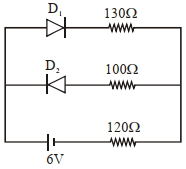
In this circuit \(D _{1}\) will be forward bias and \(D _{2}\) will be revers bias.\(\therefore\) There will be no current through \(D _{2}\) and \(R _{2}\)
Apply \(KVL\) in circuit we get \(+6-50 i -130 i -120 i =0\)
\(i =\frac{6}{300} A =\frac{6}{300} \times 1000 mA\)
\(\Rightarrow 20 mA\)
-
- (A) \(NOR\) Gate
- (B) \(OR\) Gate
- (C) \(AND\) Gate
- (D) \(NAND\) Gate
Show answer and solution
Correct Answer: (A)
Truth table for the given logic gate :\(A\) \(B\) \(Y\) \(0\) \(0\) \(1\) \(0\) \(1\) \(1\) \(1\) \(0\) \(1\) \(1\) \(1\) \(0\) The truth table is similar to that of a NOR gate.
-
- (A) \(XOR\) Gate
- (B) \(NAND\) Gate
- (C) \(AND\) Gate
- (D) \(NOR\) Gate
Show answer and solution
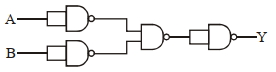
Correct Answer: (B)
By De Morgan's theorem, we have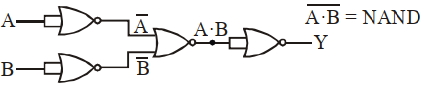
-
- (A)
\(A\) \(B\) \(Y\) \(0\) \(0\) \(0\) \(0\) \(1\) \(1\) \(1\) \(0\) \(1\) \(1\) \(1\) \(0\) - (B)
\(A\) \(B\) \(Y\) \(0\) \(0\) \(1\) \(0\) \(1\) \(0\) \(1\) \(0\) \(0\) \(1\) \(1\) \(1\) - (C)
\(A\) \(B\) \(Y\) \(0\) \(0\) \(1\) \(0\) \(1\) \(0\) \(1\) \(0\) \(1\) \(1\) \(1\) \(0\) - (D)
\(A\) \(B\) \(Y\) \(0\) \(0\) \(0\) \(0\) \(1\) \(1\) \(1\) \(0\) \(0\) \(1\) \(1\) \(1\)
Show answer and solution
Correct Answer: (B)
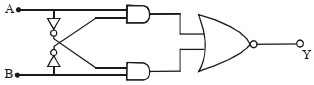
\(y=\overline{(A \bar{B}+\bar{A} B)}\)\(y=\overline{A \bar{B}} \cdot \overline{\bar{A} B}\)
\(y=(\bar{A}+B) \cdot(A+\bar{B})\)
\(y=\bar{A} \cdot A+\bar{A} \bar{B}+A \cdot B+B \bar{B}\)
\(y=A B+\bar{A} \bar{B}\)
\(A\) \(B\) \(Y = AB +\overline{ A } \overline{ B }\) \(0\) \(0\) \(1\) \(0\) \(1\) \(0\) \(1\) \(0\) \(0\) \(1\) \(1\) \(1\) - (A)
-
- (A) \(200\)
- (B) \(400\)
- (C) \(100\)
- (D) \(169\)
Show answer and solution
Correct Answer: (A)
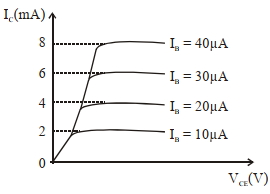
\(\beta=\frac{\Delta I _{ C }}{\Delta I _{ B }}=\frac{2 \times 10^{-3}}{10 \times 10^{-6}}\)\(\beta=\frac{1}{5} \times 10^{3}\)
\(\beta=2 \times 10^{2}\)
\(\beta=200\)
-
- (A) \(5\)
- (B) \(4\)
- (C) \(2\)
- (D) \(6\)
Show answer and solution
Correct Answer: (A)
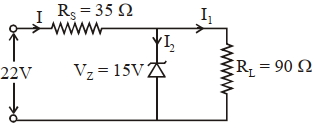
Voltage across \(R _{ S }=22-15=7 V\)Current through \(R _{ S }= I =\frac{7}{35}=\frac{1}{5} A\)
Current through \(90 \Omega= I _{2}=\frac{15}{90}=\frac{1}{6} A\)
Current through zener \(=\frac{1}{5}-\frac{1}{6}=\frac{1}{30} A\)
Power through zener diode
\(P = VI\)
\(P =15 \times \frac{1}{30}=0.5 watt\)
\(P =5 \times 10^{-1} watt\)
-
- (A) \(3\)
- (B) \(9\)
- (C) \(12\)
- (D) \(18\)
Show answer and solution
Correct Answer: (B)
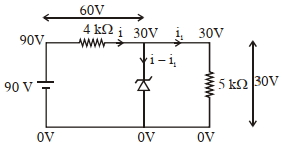
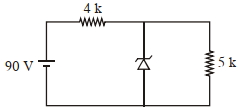
\(i =\frac{60}{4000} \,A\)\(i _{1}=\frac{30}{5000} \,A\)
\(i - i _{1}=\frac{60}{4000}-\frac{30}{5000}=\frac{9}{1000}\, A\)
current from zener diode
\(i _{z}= i - i _{1}=9\, m A\)
-
- (A) \(NOR\) Gate
- (B) \(NAND\) Gate
- (C) \(AND\) Gate
- (D) \(XOR\) Gate
Show answer and solution
Correct Answer: (D)
Conceptual -
- (A) lightly doped and have wide depletion layer.
- (B) heavily doped and have narrow depletion layer.
- (C) lightly doped and have narrow depletion layer.
- (D) heavily doped and have wide depletion layer.
Show answer and solution
Correct Answer: (B)
Zener diode is heavily doped and have narrow depletion layer. - 71. A nucleus of masss \(M\) emits \(\gamma\)-ray photon of frequency \('v'.\) The loss of internal energy by the nucleus is: 2021 Hard
- (A) \(0\)
- (B) \({hv}\left[1+\frac{{hv}}{2 {Mc}^{2}}\right]\)
- (C) \(hv\)
- (D) \({hv}\left[1-\frac{{hv}}{2 {Mc}^{2}}\right]\)
Show answer and solution
Correct Answer: (B)
Energy of \(\gamma\, \operatorname{ray}\left[E_{\gamma}\right]=h v\)Momentum of \(\gamma\) ray \(\left[P_{\gamma}\right]=\frac{h}{\gamma}=\frac{h v}{C}\)
Total momentum is conserved
\(\vec{P}_{\gamma}+\vec{P}_{N u}=0\)
Where \(\vec{P}_{N u}=\) Momentum of decayed nuclei
\(\Rightarrow P_{\gamma}=P_{N u} \Rightarrow \frac{h v}{C}=P_{N u}\)
\(\Rightarrow \text { K.E of nuclei }\)
\(=\frac{1}{2} M v^{2}=\frac{\left(P_{N u}\right)^{2}}{2 M}=\frac{1}{2 M}\left[\frac{h v}{C}\right]^{22}\)
Loss in internal energy \(=E_{\gamma}+K \cdot E_{N u}\)
\(=h v+\frac{1}{2 M}\left[\frac{h v}{C}\right]^{2}=h v\left[1+\frac{h v}{2 M C^{2}}\right]\)
-
- (A) \(5.0\)
- (B) \(5.5\)
- (C) \(0.12\)
- (D) \(5.38\)
Show answer and solution
Correct Answer: (D)
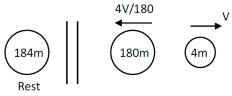
\(\frac{1}{2}(4\, m) v^{2}+\frac{1}{2}(180\, m)\left(\frac{4\, v}{180}\right)^{2}=5.5\, {MeV}\)\(\Rightarrow \frac{1}{2} 4 m v^{2}\left[1+45\left(\frac{4}{180}\right)^{2}\right]=5.5\, {MeV}\)
\({K} . E._{a}=\frac{5.5}{1+45 \cdot\left(\frac{4}{180}\right)^{2}}\, {MeV}\)
\({K} \cdot {E} \cdot_{A}=5.38\, {MeV}\)
-
- (A) \(1110\)
- (B) \(340\)
- (C) \(740\)
- (D) \(700\)
Show answer and solution
Correct Answer: (C)
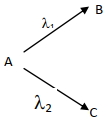
\(\text { Given } \lambda_{1}=\frac{\ell {n} 2}{700} / \text { year }, \lambda_{2}=\frac{\ell {n} 2}{1400} / \text { year }\)\(\therefore \lambda_{\text {net }}=\lambda_{1}+\lambda_{2}=\ell n 2\left[\frac{1}{700}+\frac{1}{1400}\right]=\frac{3 \ell {n} 2}{1400} / \text { year }\)
Now, Let initial no. of radioactive nuclei be No
\(\therefore \frac{{N}_{0}}{3}={N}_{0} {e}^{-\lambda_{{mt}} {t}}\)
\(\Rightarrow \ell {n} \frac{1}{3}=-\lambda_{\text {net }} {t}\)
\(\Rightarrow 1.1 \frac{3 \times 0.693}{1400} {t} \Rightarrow {t} \approx 740 \text { year }\)
-
- (A) None of the above
- (B) \(T _{1 / 2}= T _{1 / 2}^{(1)}+ T _{1 / 2}^{(2)}\)
- (C) \(T _{1 / 2}=\frac{ T _{1 / 2}^{(1)} T _{1 / 2}^{(2)}}{ T _{1 / 2}^{(1)}+ T _{1 / 2}^{(2)}}\)
- (D) \(T _{1 / 2}=\frac{ T _{1 / 2}^{(1)}+ T _{1 / 2}^{(2)}}{ T _{1 / 2}^{(1)}- T _{1 / 2}^{(2)}}\)
Show answer and solution
Correct Answer: (C)
\(\lambda_{ eq }=\lambda_{1}+\lambda_{2}\)\(\frac{1}{ T _{1 / 2}}=\frac{1}{ T _{1 / 2}^{(1)}}+\frac{1}{ T _{1 / 2}^{(2)}}\)
\(T _{1 / 2}=\frac{ T _{1 / 2}^{(1)} T _{1 / 2}^{(2)}}{ T _{1 / 2}^{(1)}+ T _{1 / 2}^{(2)}}\)
-
- (A) \(100\)
- (B) \(200\)
- (C) \(150\)
- (D) \(250\)
Show answer and solution
Correct Answer: (C)
\(q=q_{0} e^{-\frac{t}{R C}}\)where, \(R C\) is the time constant of \(R C\) - circuit.
At time \(t\), activity \(A\) is given by
\(A=A_{0} e ^{-\lambda t} \) where, \(A_{0}=\) initial activity and \(\quad \lambda=\) decay constant. On dividing Eqs. (i) and (ii), we get
\(\frac{q}{A} =\frac{q_{0} e^{-\frac{t}{R C}}}{A_{0} e^{-\lambda t}}\)
\(1=\frac{e^{-\frac{t}{R C}}}{e^{-\lambda t}}\)
\(e^{-\lambda t} =e^{-\frac{t}{R C}}\)
\(\Rightarrow\) Taking log on both sides of above equation, we get
\(\ln \left(e^{-\lambda t}\right) =\ln \left(e^{-\frac{t}{R C}}\right)\)
\(-\lambda t =-\frac{t}{R C}\)
\(\lambda =\frac{1}{R C}\)
\(R =\frac{1}{\lambda C}\)
\(R =\frac{30 \times 10^{-3}}{200 \times 10^{-6}}\)
\(R =150 \Omega\)
\(\Rightarrow \lambda=\frac{1}{R C}\)
\(\Rightarrow R=\frac{1}{\lambda C}\)
\(\Rightarrow R=\frac{30 \times 10^{-3}}{200 \times 10^{-6}}\)
\(\Rightarrow R=150 \Omega\)
-
- (A) \(\frac{\ell n 5}{ t _{2}- t _{1}}\)
- (B) \(\frac{ t _{1}- t _{2}}{\ell n 5}\)
- (C) \(\frac{ t _{2}- t _{1}}{\ell n 5}\)
- (D) \(\frac{\ell n \left( t _{2}+ t _{1}\right)}{2}\)
Show answer and solution
Correct Answer: (C)
Let initial activity be \(A _{0}\)\(A = A _{0} e ^{-\lambda t_{2}}....(i)\)
\(\frac{ A }{5}= A _{0} e ^{-\lambda t_{2}}....(ii)\)
\(( i ) \div ( ii )\)
\(5= e ^{\lambda\left(t_{2}-t_{1}\right)}\)
\(\lambda=\frac{\ell n 5}{t_{2}-t_{1}}=\frac{1}{\tau}\)
\(\tau=\frac{t_{2}-t_{1}}{\ell n \cdot 5}\)
-
- (A) \(20\)
- (B) \(200\)
- (C) \(2\)
- (D) \(4\)
Show answer and solution
Correct Answer: (A)
\(N_{o} \stackrel{t_{\frac{1}{2}}}{\longrightarrow} \frac{N_{o}}{2} \stackrel{t_{\frac{1}{2}}}{\longrightarrow} \frac{N_{o}}{4} \stackrel{t_{\frac{1}{2}}}{\longrightarrow} \frac{N_{o}}{8} \stackrel{t_{\frac{1}{2}}}{\longrightarrow} \frac{N_{o}}{16}\)\(4 \times t_{1 / 2}=80\)
\(t_{1 / 2}=20 \text { days }\)
-
- (A) \(60\)
- (B) \(20\)
- (C) \(40\)
- (D) \(13\)
Show answer and solution
Correct Answer: (B)
\(N _{1}= N _{0} e ^{-\lambda t_{1}}\)\(\frac{ N _{1}}{ N _{0}}= e ^{-\lambda t _{1}}\)
\(0.67= e ^{-\lambda t _{1}}\)
\(\ln (0.67)=-\lambda t _{1}\)
\(N _{2}= N _{0} e ^{-\lambda t _{2}}\)
\(\frac{ N _{2}}{ N _{0}}= e ^{-\lambda t _{2}}\)
\(0.33= e ^{-\lambda t _{2}}\)
\(\ln (0.33)=-\lambda t _{2}\)
\(\ln (0.67)-\ln (0.33)=\lambda t _{1}-\lambda t _{2}\)
\(\lambda\left( t _{1}- t _{2}\right)=\ln \left(\frac{0.67}{0.33}\right)\)
\(\lambda\left( t _{1}- t _{2}\right) \cong \ln 2\)
\(t _{1}- t _{2} \simeq \frac{\ln 2}{\lambda}= t _{1 / 2}\)
Half life \(= t _{1 / 2}=20\,minutes.\)
-
- (A) \(A,B\) and \(E\) only
- (B) \(B\) and \(D\) only
- (C) \(A, C\) and \(E\) only
- (D) \(A,B, C,D\) and \(E\)
Show answer and solution
Correct Answer: (A)
\((A)\) True, atom of each element emits characteristic spectrum.\((B)\) True, according to Bohr's postulates \(m v r=\frac{n h}{2 \pi}\) and hence electron resides into orbits of specific radius called stationary orbits.
\((C)\) False, Density of nucleus is constant
\((D)\) False, \(A\) free neutron is unstable decays into proton and electron and antineutrino.
\((E)\) True unstable uncleus show radioactivity.
-
- (A) \(6.93\)
- (B) \(4.62\)
- (C) \(2.62\)
- (D) \(9.15\)
Show answer and solution
Correct Answer: (B)
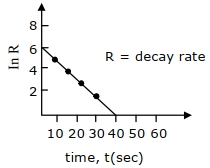
\({R}=R_{o} e^{-\lambda t}\)\(\ell n R=\ell n R_{o}-\lambda t\)
\(-\lambda\) is slope of straight line
\(\lambda=\frac{3}{20}\)
\(t_{1 / 2}=\frac{\ell n 2}{\lambda}=4.62\)
-
- (A) \(25\)
- (B) \(26\)
- (C) \(27\)
- (D) \(31\)
Show answer and solution
Correct Answer: (C)
\(\Delta m =\left( Zm m _{ P }+( A - Z ) m _{ n }\right)- M _{ Al}\)\(=(13 \times 1.00726+14 \times 1.00866)-27.18846\)
\(=27.21562-27.18846\)
\(=0.02716 u\)
\(E =27.16 \times 10^{-3} J\)
-
- (A) \(\lambda\left(1-{e}^{-\lambda t}\right)\)
- (B) \(-\lambda e^{-\lambda t}\)
- (C) \(\lambda e^{-\lambda t}\)
- (D) \(-\lambda\left(1-{e}^{-\lambda . t}\right)\)
Show answer and solution
Correct Answer: (C)
\(N = N _{0} e ^{-\lambda t}\)\(N _{ d }= N _{0}- N\)
\(N _{ d }= N _{0}\left(1- e ^{-\lambda t }\right)\)
\(\frac{ N _{ d }}{ N _{0}}= f =1- e ^{-\lambda t }\)
\(\frac{ df }{ dt }=\lambda e ^{-\lambda t }\)
-
- (A) \(\frac{2 \ln 2}{\lambda}\)
- (B) \(\frac{1}{2} \frac{\ln 2}{\lambda}\)
- (C) \(\frac{\ln \frac{3}{2}}{\lambda}\)
- (D) \(\frac{\ln 2}{\lambda}\)
Show answer and solution
Correct Answer: (C)
\(\frac{3 N _{0}}{4}= N _{0} e ^{-\lambda t _{1}}\)\(\frac{ N _{0}}{2}= N _{0} e ^{-\lambda t _{2}}\)
\(\ln (\frac 34)=-\lambda t _{1}\)
\(\ln (\frac 12)=-\lambda t _{2}\)
\(\ln (\frac 34)-\ln (\frac 12)=\lambda\left( t _{2}- t _{1}\right)\)
\(\Delta t =\frac{\ln (\frac 32)}{\lambda}\)
-
- (A) not possible as proton mass is less than the neutron mass
- (B) possible only inside the nucleus
- (C) not possible but neutron to proton conversion is possible
- (D) always possible as it is associated only with \(\beta^{+}\) decay
Show answer and solution
Correct Answer: (B)
It is possible only inside the nucleus and not otherwise. -
- (A) \(2.67\)
- (B) \(16.18\)
- (C) \(6.06\)
- (D) \(32.36\)
Show answer and solution
Correct Answer: (B)
\(A =\lambda N\)\(\lambda=\frac{\ln 2}{ t _{1 / 2}}=\frac{\ln 2}{3 \times 24 \times 60 \times 60} sec ^{-1}=2.67 \times 10^{-6} sec ^{-1}\)
\(N =\) Number of atoms in \(2 \;mg \;Au\)
\(=\frac{2 \times 10^{-3}}{198} \times 6 \times 10^{23}=6.06 \times 10^{15}\)
\(A=\lambda N =1.618 \times 10^{13}=16.18 \times 10^{12} dps\)
-
- (A) \(240\)
- (B) \(357\)
- (C) \(535\)
- (D) \(252\)
Show answer and solution
Correct Answer: (B)
\(A =\lambda N\)\(N = nN _{ A }\)\(\quad\left( t _{1 / 2}=\frac{\ln 2}{\lambda}\right)\)
\(N =\left(\frac{1.5 \times 10^{-3}}{198}\right) N _{ A }\)
\(A=\left(\frac{\ln 2}{t_{1 / 2}}\right) N\)
\(1\) Curie \(=3.7 \times 10^{10}\, Bq\)
\(A =365\, Bq\)
-
- (A) \({x}\)-will decay faster than \({y}\).
- (B) \({y}\) - will decay faster than \({x}\).
- (C) \({x}\) and \({y}\) have same decay rate initially and later on different decay rate.
- (D) \({x}\) and \({y}\) decay at the same rate always.
Show answer and solution
Correct Answer: (B)
\(\left(t_{1 / 2}\right)_{x}=(\tau)_{y}\)\(\Rightarrow \frac{\ell n 2}{\lambda_{x}}=\frac{1}{\lambda_{y}} \Rightarrow \lambda_{x}=0.693 \lambda_{y}\)
Also initially \({N}_{{x}}={N}_{{y}}={N}_{0}\)
Activity \({A}=\lambda {N}\)
As \(\lambda_{{x}}<\lambda_{{y}} \Rightarrow {A}_{{x}}<{A}_{{y}}\)
\(\Rightarrow {y}\) will decay faster than \({x}\)
-
- (A) \(15\)
- (B) \(10\)
- (C) \(20\)
- (D) \(25\)
Show answer and solution
Correct Answer: (B)
\(A = A _{0} e ^{-\lambda t }\)\(\frac{ A _{0}}{8}= A _{0} e ^{-\lambda t } \Rightarrow \lambda t =\ln 8\)
\(\lambda t =3 \ln 2\)
\(\frac{\ln 2}{\lambda}=\frac{ t }{3}=\frac{30}{3}\)
\(10\;years\)
-
- (A) \(2 \times 10^{10}\)
- (B) \(7 \times 10^{9}\)
- (C) \(10^{5}\)
- (D) \(4 \times 10^{10}\)
Show answer and solution
Correct Answer: (B)
\(\frac{{N}}{{N}_{0}}=\left(\frac{1}{2}\right)^{\frac{{t}}{t_{\frac{1}{2}}}}\)\(\frac{{N}}{10^{10}}=\left(\frac{1}{2}\right)^{\frac{30}{60}}\)
\({N}=10^{10} \times\left(\frac{1}{2}\right)^{\frac{1}{2}}=\frac{10^{10}}{\sqrt{2}} \approx 7 \times 10^{9}\)
-
- (A) \(\frac{1}{8}\)
- (B) \(\frac{3}{1}\)
- (C) \(\frac{8}{1}\)
- (D) \(\frac{1}{3}\)
Show answer and solution
Correct Answer: (C)
\(T _{ x }= t ; T _{ y }=2 t\)\(3 T _{ y }=6 t\)
\(N _{1}^{\prime}= N _{2}^{\prime}\)
\(N _{1} e ^{-\lambda_{1} 6 t }= N _{2} e ^{-\lambda_{2} 6 t }\)
\(\frac{ N _{1}}{ N _{2}}= e ^{\left(\lambda_{1}-\lambda_{2}\right) 6 t }= e ^{\ln 2\left(\frac{1}{t}-\frac{1}{2 t }\right) \times 6 t }= e ^{(1 n 2) \times 3}= e ^{ ln 8}=8\)
\(\frac{ N _{1}}{ N _{2}}=\frac{8}{1}\)
-
- (A) \(1.45 \times 10^{16}\, {MHz}\)
- (B) \(0.19 \times 10^{15} \,{MHz}\)
- (C) \(1.45 \times 10^{9}\, {MHz}\)
- (D) \(9.0 \times 10^{27} \,{MHz}\)
Show answer and solution
Correct Answer: (C)
For every large distance \(P.E.\) \(=0\)\(\&\) total energy \(=2.6+0=2.6\, {eV}\)
Finally in first excited state of \({H}\) atom total energy \(=-3.4 \,{eV}\)
Loss in total energy \(=2.6-(-3.4)\)
\(\quad\quad\quad\quad\quad\quad\quad\quad=6\,eV\)
It is emitted as photon
\(\lambda=\frac{1240}{6}=206\, {nm}\)
\({f}=\frac{3 \times 10^{8}}{206 \times 10^{-9}}=1.45 \times 10^{15} \,{Hz}\)
\(=1.45 \times 10^{9}\, {Hz}\)
-
- (A) \(6\)
- (B) \(9\)
- (C) \(3\)
- (D) \(4\)
Show answer and solution
Correct Answer: (C)
\(F =\frac{- d U }{ dr }=-4 U _{0} r ^{3}=\frac{ mv ^{2}}{ r }\)\(mv ^{2}=4 U _{0} r ^{4}\)
\(v \propto r ^{2}\)
\(mvr =\frac{ nh }{2 \pi}\)
\(r ^{3} \propto n\)
\(r \propto n^{1 / 3}\)
\(\alpha=3\)
-
- (A) \(0.44\)
- (B) \(6.57\)
- (C) \(4.38\)
- (D) \(2.46\)
Show answer and solution
Correct Answer: (D)
\(\mathrm{nf}_{1}=\mathrm{k}\left(\frac{1}{1}-\frac{1}{3^{2}}\right)\)\(\mathrm{nf}_{2}=\mathrm{k}\left(1-\frac{1}{2^{2}}\right)\)
\(\frac{\mathrm{f}_{1}}{\mathrm{f}_{2}}=\frac{8 / 9}{3 / 4} \Rightarrow \mathrm{f}_{2}=2.46 \times 10^{15}\)
- 94. According to Bohr atom model, in which of the following transitions will the frequency be maximum ? 2021 Hard
- (A) \(n =4\) to \(n =3\)
- (B) \(n =2\) to \(n =1\)
- (C) \(n =5\) to \(n =4\)
- (D) \(n =3\) to \(n =2\)
Show answer and solution
Correct Answer: (B)
\(\Delta E =13.6\left[\frac{1}{ n _{1}^{2}}-\frac{1}{ n _{2}^{2}}\right]= hv\)It is maximum if \(n _{1}=1\) and \(n _{2}=2\)
\(n =5 \ldots \ldots \ldots \ldots \ldots \ldots \ldots \ldots \ldots \ldots \ldots \ldots .-0.544\, eV\)
\(n=4 \ldots \ldots \ldots \ldots \ldots \ldots \ldots \ldots \ldots \ldots \ldots \ldots -0.850\, eV\)
\(n =3 \ldots \ldots \ldots \ldots \ldots \ldots \ldots \ldots \ldots \ldots \ldots \ldots -1.511 \,eV\)
\(n =2 \ldots \ldots \ldots \ldots \ldots \ldots \ldots \ldots \ldots \ldots \ldots \ldots -3.4\, eV\)
\(n =1 \ldots \ldots \ldots \ldots \ldots \ldots \ldots \ldots \ldots \ldots \ldots \ldots -13.6\, eV\)
- 95. An \(X-\)ray tube is operated at \(1.24\) million volt. The shortest wavelength of the produced photon will be ..... \(nm\) 2021 Medium
- (A) \(10^{-3}\)
- (B) \(10^{-1}\)
- (C) \(10^{-2}\)
- (D) \(10^{-4}\)
Show answer and solution
Correct Answer: (A)
\(\lambda_{\min }=\frac{1240}{\Delta V }( nm )\)\(=\frac{1240}{1.24 \times 10^{6}}=10^{-3} \,nm\)
-
- (A) \(1: 9\)
- (B) \(7: 108\)
- (C) \(7: 135\)
- (D) \(1: 3\)
Show answer and solution
Correct Answer: (C)
\(\frac{1}{\lambda_{1}}= R \left[\frac{1}{1^{2}}-\frac{1}{4^{2}}\right]\)\(\frac{1}{\lambda_{2}}= R \left[\frac{1}{3^{2}}-\frac{1}{4^{2}}\right]\)
\(\frac{\lambda_{1}}{\lambda_{2}}=\frac{\left[\frac{1}{9}-\frac{1}{16}\right]}{\left[1-\frac{1}{16}\right]}=\frac{7}{9 \times 15}\)
\(\frac{\lambda_{1}}{\lambda_{2}}=\frac{7}{135}\)
-
- (A) \(v _{ n } \propto n\)
- (B) \(v _{ n } \propto \frac{1}{ n }\)
- (C) \(v _{ n } \propto n ^{2}\)
- (D) \(v _{ n } \propto \frac{1}{ n ^{2}}\)
Show answer and solution
Correct Answer: (B)
We know velocity of electron in \(n ^{\text {th }}\) shell ofhydrogen atom is given by
\(v =\frac{2 \pi k Ze ^{2}}{ nh }\)
\(\therefore v \propto \frac{1}{ n }\)
-
- (A) \(13.6\)
- (B) \(2815.2\)
- (C) \(331.2\)
- (D) \(27.2\)
Show answer and solution
Correct Answer: (B)
\(E \propto \frac{1}{ r } \quad r \propto \frac{1}{ m }\)\(E \propto m\)
Ionization potential \(=13.6 \times \frac{\left(\text { Mass }_{\mu}\right) eV }{\left(\text { Mass }_{e}\right)}\)
\(=13.6 \times 207 eV =2815.2 eV\)
-
- (A) \(112\)
- (B) \(224\)
- (C) \(336\)
- (D) \(741\)
Show answer and solution
Correct Answer: (A)
time taken \(=\frac{2 \pi r }{\text { speed }}\)\(=\frac{2 \times \pi \times 5 \times 10^{-11}}{2.2 \times 10^{6}}\)
\(=\frac{2 \times 22 \times 10 \times 5 \times 10^{-11}}{7 \times 22 \times 10^{6}}\)
\(=\frac{10}{7} \times 10^{-16}\)
Current \(\frac{ q }{ t }\left(1 e =1.6 \times 10^{-19} C \right)\)
\(=\frac{1.6 \times 10^{-19}}{10 \times 10^{-16}} \times 7\)
\(=\frac{1.6}{100} \times 10^{-3} \times 7\)
\(=112 \times 10^{-5} A\)
\(=112 \times 10^{-5} \times 1000 m A\)
\(=1.12 mA\)
-
- (A) The ionization potential of hydrogen, second member of Balmer series and third member of Paschen series.
- (B) The first member of the Lyman series, third member of Balmer series and second member of Paschen series.
- (C) The series limit of Lyman series, third member of Balmer series and second member of Paschen series.
- (D) The series limit of Lyman series, second member of Balmer series and second member of Paschen series.
Show answer and solution
Correct Answer: (C)
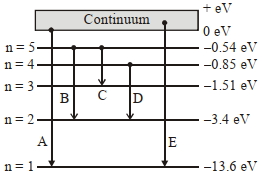
\(A \rightarrow\) Series limit of Lymen series.\(B \rightarrow\) Third member of Balmer series.
\(C \rightarrow\) Second member of Paschen series.
No questions on this page match these filters.