


All JEE Mains 2021 Physics questions
32 chaptersShowing 251–300 of 685 questions
-
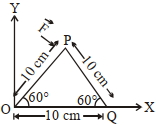
- (A) \(-15-20 \sqrt{3}, 15-20 \sqrt{3}\)
- (B) \(15+20 \sqrt{3}, 15-20 \sqrt{3}\)
- (C) \(15-20 \sqrt{3}, 15+20 \sqrt{3}\)
- (D) \(-15+20 \sqrt{3}, 15+20 \sqrt{3}\)
Show answer and solution
Correct Answer: (A)
\(\overrightarrow{ F }=4 \hat{ i }-3 \hat{ j }\)\(\overrightarrow{ r }_{1}=5 \hat{ i }+5 \sqrt{3} \hat{ j } \& \overrightarrow{ r }_{2}=-5 \hat{ i }+5 \sqrt{3} \hat{j}\)
Torque about \('O'\)
\(\vec{\tau}_{0}=\overrightarrow{ r }_{1} \times \overrightarrow{ F }=(-15-20 \sqrt{3}) \hat{ k }=(15+20 \sqrt{3})(-\hat{ k })\)
Torque about \('Q'\)
\(\vec{\tau}_{Q}=\overrightarrow{ r }_{2} \times \overrightarrow{ F }=(-15+20 \sqrt{3}) \hat{ k }=(15-20 \sqrt{3})(-\hat{ k })\)
-
- (A) \(16\)
- (B) \(8\)
- (C) \(24\)
- (D) \(4\)
Show answer and solution
Correct Answer: (B)
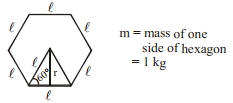
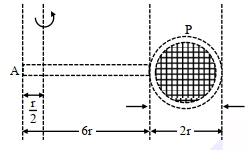
\(6 \ell=2.4 \quad \ell=0.4 \,m\)\(\sin 60^{\circ}=\frac{ r }{\ell}\)
\(r =\ell \sin 60^{\circ}=\frac{\ell \sqrt{3}}{2}\)
MOI, \(\quad I=\left[\frac{m \ell^{2}}{12}+\operatorname{mr}^{2}\right] 6\)
\(=\left[\frac{ m \ell^{2}}{12}+ m \left(\frac{\ell \sqrt{3}}{2}\right)^{2}\right] 6\)
\(=5 \,m l ^{2}\)
\(=5 \times 1 \times 0.16\)
\(=0.8\)
\(I=8 \times 10^{-1}\, kg m ^{2}\)
- 253. Angular momentum of a single particle moving with constant speed along circular path: 2021 Medium
- (A) changes in magnitude but remains same in the direction
- (B) remains same in magnitude and direction
- (C) remains same in magnitude but changes in the direction
- (D) is zero
Show answer and solution
Correct Answer: (B)
\(|\overrightarrow{{L}}|={mvr}\)And direction will be upward \(\&\) remain constant

-
- (A) \(520\)
- (B) \(12\)
- (C) \(42\)
- (D) \(52\)
Show answer and solution
Correct Answer: (D)
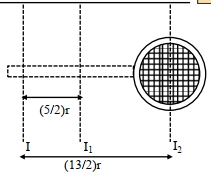
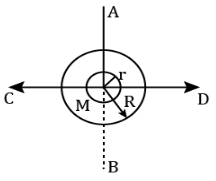
\({I}=\left[{I}_{1}+{M}\left(\frac{5}{2} {r}\right)^{2}\right]+\left[{I}_{2}+{M}\left(\frac{13 {r}}{2}\right)^{2}\right]\)\(=\left[\frac{{M}\left(36 {r}^{2}\right)}{12}+\frac{{M}\left(25 {r}^{2}\right)}{4}\right]+\left[\frac{{Mr}^{2}}{2}+\frac{169 {Mr}^{2}}{4}\right]\)
\(=52\, {Mr}^{2}\)
-
- (A) The sphere has the greatest and the ring has the least velocity of the centre of mass at the bottom of the inclined plane.
- (B) The ring has the greatest and the cylinder has the least velocity of the centre of mass at the bottom of the inclined plane.
- (C) All of them will have same velocity.
- (D) The cylinder has the greatest and the sphere has the least velocity of the centre of mass at the bottom of the inclined plane.
Show answer and solution
Correct Answer: (A)
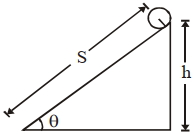
\(a=\frac{g \sin \theta}{1+\frac{I}{m R^{2}}}\)\(I_{\text {ring }}\,>\,I_{\text {solid cylinder }}\,>\,I_{\text {solid sphere }}\)
\(\Rightarrow a_{\text {ring }}\,<\,a_{\text {solidcylinder }}\,>\,a_{\text {solidsphere }}\)
\(\Rightarrow v_{\text {ring }}\,<\,v_{\text {solid cylinder }}\,<\,v_{\text {solid sphere }}\)
-
- (A) \(\frac{1}{4} \frac{ ML ^{2}}{\pi^{2}}\)
- (B) \(\frac{2}{5} \frac{ ML ^{2}}{\pi^{2}}\)
- (C) \(\frac{ ML ^{2}}{\pi^{2}}\)
- (D) \(\frac{1}{2} \frac{ ML ^{2}}{\pi^{2}}\)
Show answer and solution
Correct Answer: (C)
\(\pi L \Rightarrow r =\frac{ L }{\pi}\)\(I = Mr ^{2}=\frac{ ML ^{2}}{\pi^{2}}\)
-
- (A) \(\frac{4}{5} ma ^{2}+2 mb ^{2}\)
- (B) \(\frac{8}{5} m a^{2}+m b^{2}\)
- (C) \(\frac{8}{5} m a^{2}+2 m b^{2}\)
- (D) \(\frac{4}{5} ma ^{2}\)
Show answer and solution
Correct Answer: (C)
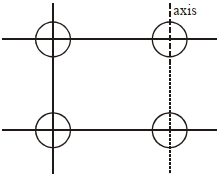
\(I =2 \times\left(\frac{2}{5} ma ^{2}\right)+2 \times\left(\frac{2}{5} ma ^{2}+ mb ^{2}\right)\)\(I =\frac{8}{5} ma ^{2}+2 mb ^{2}\)
-
- (A) Both \(A\) and \(R\) are correct but \(R\) is NOT the correct explanation of \(A\).
- (B) \(A\) is not correct but \(R\) is correct.
- (C) \(A\) is correct but \(R\) is not correct.
- (D) Both \(A\) and \(R\) are correct and \(R\) is the correct explanation of \(A\).
Show answer and solution
Correct Answer: (B)
\(I_{z}=I_{x}+I_{y}\) (using perpendicular axls theorem)\(l = mk ^{2}\) (K: radius of gyratlon)
so \(m K_{z}^{2}=m K_{x}^{2}+m K_{y}^{2}\)
\(K_{z}^{2}=K_{x}^{2}+K_{y}^{2}\)
so radius of gyration about axes \(x, y\) and \(z\) won't be same hense asseration \(A\) is not correct reason \(R\) is correct statement (property of a rlgid body)
-
- (A) \(91\)
- (B) \(81\)
- (C) \(9\)
- (D) \(3\)
Show answer and solution
Correct Answer: (C)
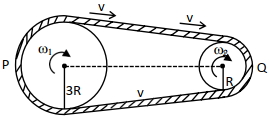
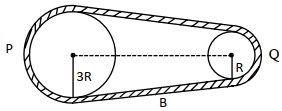
\(\frac{1}{2} I_{1}\left(\omega_{1}\right)^{2}=\frac{1}{2} I_{2}\left(\omega_{2}\right)^{2}\)\(I_{1}\left(\frac{V}{3 R}\right)^{2}=I_{2}\left(\frac{v}{R}\right)^{2}\)
\(\frac{I_{1}}{I_{2}}=\frac{9}{1}\)
-
- (A) \(I _{1}+ I _{3}< I _{2}+ I _{4}\)
- (B) \(I _{1}+ I _{2}= I _{3}+\frac{5}{2} I _{4}\)
- (C) \(I _{1}= I _{2}= I _{3}> I _{4}\)
- (D) \(I _{1}= I _{2}= I _{3}< I _{4}\)
Show answer and solution
Correct Answer: (C)
Ring \(I _{1}=\frac{ MR ^{2}}{2}\) about diameterDisc \(I_{2}=\frac{M R^{2}}{2}\)
Solid cylinder \(I _{3}=\frac{ MR ^{2}}{2}\)
Solid sphere \(I _{4}=\frac{2}{5} MR ^{2}\)
\(I _{1}= I _{2}= I _{3}> I _{4}\)
-
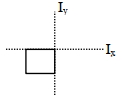
- (A) \(\frac{{M} l^{2}}{6}\)
- (B) \({M} l^{2}\)
- (C) \(\frac{{M} l^{2}}{12}\)
- (D) \(\frac{2}{3} {M} l^{2}\)
Show answer and solution
Correct Answer: (D)
According to perpendicular Axis theorem.\({I}_{{x}}+{I}_{{y}}={I}_{z}\)
\({I}_{z} \Rightarrow \frac{{m} \ell^{2}}{3}+\frac{{m} \ell^{2}}{3}\)
\(=\frac{2 {m} \ell^{2}}{3}\)
-
- (A) \(1456\)
- (B) \(728\)
- (C) \(810\)
- (D) \(368\)
Show answer and solution
Correct Answer: (B)
We know, \(\theta=\left(\frac{\omega_{1}+\omega_{2}}{2}\right)\) tLet number of revolutions be \(N\)
\(\therefore 2 \pi N =2 \pi\left(\frac{900+2460}{60 \times 2}\right) \times 26\)
\(N =728\)
-
- (A) \(9\)
- (B) \(2\)
- (C) \(4\)
- (D) \(81\)
Show answer and solution
Correct Answer: (B)
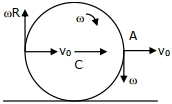
For no slipping \({v}_{0}=\omega {R}\)Now \(v_{A}=v_{B}=\sqrt{v_{0}^{2}+(\omega R)^{2}}\)
\(=\sqrt{2} v_{0}\)
\(x=2\)
-
- (A) \(4\)
- (B) \(2\)
- (C) \(1\)
- (D) \(8\)
Show answer and solution
Correct Answer: (A)
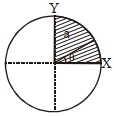
\(C.O.M.\) of quarter disc is at \(\frac{4 a}{3 \pi}, \frac{4 a}{3 \pi}\)\(=4\)
-
- (A) \(2 r^{4}: R^{4}\)
- (B) \(2 {R}^{2}: {r}^{2}\)
- (C) \(2 {R}^{4}: {r}^{4}\)
- (D) \({R}^{2}: r^{2}\)
Show answer and solution
Correct Answer: (C)
Ratio of moment of inertia \(=\frac{\frac{1}{2} MR ^{2}}{\frac{1}{4} mr ^{2}}\)\(=\frac{2 \sigma \pi R^{2} R^{2}}{\sigma \pi r^{2} r^{2}}=\frac{2 R^{4}}{r^{4}}\)
-
- (A) \(2\)
- (B) \(3\)
- (C) \(4\)
- (D) \(1\)
Show answer and solution
Correct Answer: (C)
\(Mg \sin \theta R =\left( mk ^{2}+ mR ^{2}\right) \alpha\)\(\alpha=\frac{ Rg \sin \theta}{ k ^{2}+ R ^{2}} \Rightarrow a =\frac{ g \sin \theta}{1+\frac{ k ^{2}}{ R ^{2}}}\)
\(t =\sqrt{\frac{2 s }{ a }}=\sqrt{\frac{2 s }{ g \sin \theta}\left(1+\frac{ k ^{2}}{ R ^{2}}\right)}\)
for least time, \(k\) should be least \(\&\) we know \(k\) is least for solid sphere.
-
- (A) \(2\)
- (B) \(4\)
- (C) \(36\)
- (D) \(8\)
Show answer and solution
Correct Answer: (A)
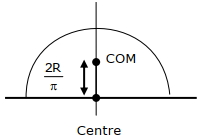
\(COM\) of semi-circular ring is at \(\frac{2 R}{\pi}\)Distance from centre \(\Rightarrow x=2\)
-
- (A) \(14.9\)
- (B) \(75\)
- (C) \(750\)
- (D) \(149\)
Show answer and solution
Correct Answer: (D)
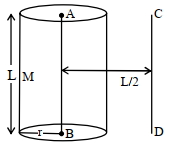
Parallel axis theorem\({I}={I}_{{CM}}+{Md}^{2}\)
\({I}=\frac{{Mr}^{2}}{2}+{M}\left(\frac{{L}}{2}\right)^{2}\)
\(2.7={M} \frac{(0.2)^{2}}{2}+{M}\left(\frac{0.8}{2}\right)^{2}\)
\(2.7={M}\left[\frac{2}{100}+\frac{16}{100}\right]\)
\({M}=15\, {kg}\)
\(\Rightarrow \rho=\frac{{M}}{\pi {r}^{2} {L}}=\frac{15}{\pi(0.2)^{2} \times 0.8}\)
\(=0.1492 \times 10^{3}\)
-
- (A) \(1\)
- (B) \(3\)
- (C) \(9\)
- (D) \(10\)
Show answer and solution
Correct Answer: (B)
\({I}\) in both cases is about point of contact \(IAOR,\)Ring,
\(m g h=\frac{1}{2} I \omega^{2}\)
\(m g h=\frac{1}{2}\left(2 m R^{2}\right) \frac{v_{R}^{2}}{R^{2}}\)
\(V_{R}=\sqrt{g h}\)
Solid, cylinder
\(m g h=\frac{1}{2} I \omega^{2}\)
\(m g h=\frac{1}{2}\left(\frac{3}{2} m R^{2}\right) \frac{v_{c}^{2}}{R^{2}}\)
\(V_{R}=\sqrt{\frac{4 g h}{3}}\)
\(\frac{v_{R}}{v_{c}}=\frac{\sqrt{3}}{2}\)
-
- (A) \(\frac{{I}_{1} {I}_{2}}{\left({I}_{1}+{I}_{2}\right)}\left(\omega_{1}-\omega_{2}\right)^{2}\)
- (B) \(\frac{\left({I}_{1}-{I}_{2}\right)^{2} \omega_{1} \omega_{2}}{2\left({I}_{1}+{I}_{2}\right)}\)
- (C) \(\frac{{I}_{1} {I}_{2}}{2\left({I}_{1}+{I}_{2}\right)}\left(\omega_{1}-\omega_{2}\right)^{2}\)
- (D) \(\frac{\left(\omega_{1}-\omega_{2}\right)^{2}}{2\left({I}_{1}+{I}_{2}\right)}\)
Show answer and solution
Correct Answer: (C)
From conservation of angular momentum we get\({I}_{1} \omega_{1}+{I}_{2} \omega_{2}=\left({I}_{1}+{I}_{2}\right) \omega\)
\(\omega=\frac{{I}_{1} \omega_{1}+{I}_{2} \omega_{2}}{{I}_{1}+{I}_{2}}\)
\({k}_{{i}}=\frac{1}{2} {I}_{1} \omega_{1}^{2}+\frac{1}{2} {I}_{2} \omega_{2}^{2}\)
\({k}_{{f}}=\frac{1}{2}\left({I}_{1}+{I}_{2}\right) \omega^{2}\)
\({k}_{{i}}-{k}_{{f}}=\frac{1}{2}\left[{I}_{1} \omega_{1}^{2}+{I}_{2} \omega_{2}^{2}-\frac{\left({I}_{1} \omega_{1}+{I}_{2} \omega_{2}\right)^{2}}{{I}_{1}+{I}_{2}}\right]\)
Solving above we get
\({k}_{{i}}-{k}_{{f}}=\frac{1}{2}\left(\frac{{I}_{1} {I}_{2}}{{I}_{1}+{I}_{2}}\right)\left(\omega_{1}-\omega_{2}\right)^{2}\)
-
- (A) \(\frac{ Ma - F }{ M }\)
- (B) \(\frac{ MF }{ F + Ma }\)
- (C) \(\frac{ F + Ma }{ M }\)
- (D) \(\frac{ F - Ma }{ M }\)
Show answer and solution
Correct Answer: (D)
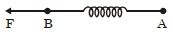
\(a _{ cm }=\frac{ m _{1} a _{1}+ m _{2} a _{2}}{ m _{1}+ m _{2}}\)\(\frac{ F }{2 M }=\frac{ Ma + Ma _{ B }}{2 M }\)
\(a _{ B }=\frac{ F - Ma }{ M }\)
-
- (A) \(1\)
- (B) Infinite
- (C) \(0\)
- (D) \(-1\)
Show answer and solution
Correct Answer: (C)
Since force on a point charge by magnetic field is always perpendicular to \(\overrightarrow{ v }[\overrightarrow{ F }= q \overrightarrow{ V } \times \overrightarrow{ B }]\)\(\therefore\) Work by magnetic force on the point charge is zero.
-
- (A) \(\frac{{x}^{2}}{{a}^{2}}\)
- (B) \(\frac{{a}^{2}}{{x}^{2}}\)
- (C) \(\frac{x^{2}}{b^{2}-a^{2}}\)
- (D) \(\frac{{b}^{2}-{a}^{2}}{{x}^{2}}\)
Show answer and solution
Correct Answer: (A)
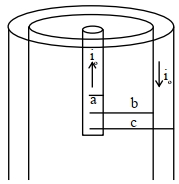
when \({x}<{a}\)\({B}_{1}(2 \pi {x})=\mu_{\circ}\left(\frac{{i}_{\circ}}{\pi {a}^{2}}\right) \pi {x}^{2}\)
\({B}(2 \pi {x})=\frac{\mu_{\circ} {i}_{\circ} {x}^{2}}{{a}^{2}}\)
\({B}_{1}=\frac{\mu_{\circ} {i}_{\circ} {x}}{2 \pi {a}^{2}}...(1)\)
when \({a}<{x}<{b}\)
\({B}_{2}(2 \pi {x})=\mu_{0} {i}_{0}\)
\({B}_{2}=\frac{\mu_{{o}} {i}_{\circ}}{2 \pi {x}}...(2)\)
\(\frac{{B}_{1}}{{B}_{2}}=\frac{\mu_{\circ} {i}_{\circ} \frac{{x}}{2 \pi {a}^{2}}}{\frac{\mu_{\circ} {i}_{\circ}}{2 \pi {x}}}=\frac{{x}^{2}}{{a}^{2}}\)
-
- (A) \(3\)
- (B) \(7\)
- (C) \(10\)
- (D) \(13\)
Show answer and solution
Correct Answer: (A)
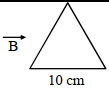
\(\vec{\tau}=\vec{M} \times \vec{B}=M B \sin 90^{\circ}\)\(=M B=\frac{i \sqrt{3} \ell^{2}}{4} B\)
\(=\sqrt{3} \times 10^{-5} {N}-{m}\)
-
- (A) \(\sqrt{2}\)
- (B) \(1\)
- (C) \(2\)
- (D) \(\frac{1}{\sqrt{2}}\)
Show answer and solution
Correct Answer: (A)
\({I}=\frac{{m} v}{{qB}}=\frac{\sqrt{2 {mk}}}{{qB}}\)\(\frac{{r}_{{d}}}{{r}_{\alpha}}=\sqrt{\frac{{m}_{{d}}}{{m}_{\alpha}}} \frac{{q}_{a}}{{q}_{\hat{\imath}}}=\sqrt{\frac{2}{4}}\left(\frac{2}{1}\right)=\sqrt{2}\)
-
- (A) \(\frac{\mu_{0} I }{4 \pi r }(2-\pi)\)
- (B) \(\frac{\mu_{0} I }{4 \pi r }(2+\pi)\)
- (C) \(\frac{\mu_{0} I }{2 \pi r }(2+\pi)\)
- (D) \(\frac{\mu_{0} I }{2 \pi r }(2-\pi)\)
Show answer and solution
Correct Answer: (B)
\(B =2 \times B _{ \text { straight.wire }}+ B _{\text {loop }}\)\(B =2 \times \frac{\mu_{0} i }{4 \pi r }+\frac{\mu_{0} i }{2 r }\left(\frac{\pi}{2 \pi}\right)\)
\(B =\frac{\mu_{0} i }{4 \pi r }(2+\pi)\)
- 277. A loop of flexible wire of irregular shape carrying current is placed in an external magnetic field. Identify the effect of the field on the wire. 2021 Medium
- (A) Loop assumes circular shape with its plane normal to the field.
- (B) Loop assumes circular shape with its plane parallel to the field.
- (C) Wire gets stretched to become straight.
- (D) Shape of the loop remains unchanged.
Show answer and solution
Correct Answer: (A)
Every part \(( d \ell)\) of the wire is pulled by force \(i ( d \ell) B\) acting perpendicular to current \(\&\) magnetic field giving it a shape of circle. -
- (A) \(1: 2: 4\) and \(2: 1: 1\)
- (B) \(2: 1: 1\) and \(4: 2: 1\)
- (C) \(4: 2: 1\) and \(2: 1: 1\)
- (D) \(1: 2: 4\) and \(1: 1: 2\)
Show answer and solution
Correct Answer: (B)
\(F=q(\vec{v} \times \vec{B})=\frac{q}{m}(\vec{P} \times \vec{B})\)\(\Rightarrow F \propto \frac{ q }{ m }\)
thus \(F _{1}: F _{2}: F _{3}=\frac{ q _{1}}{ m _{1}}: \frac{ q _{2}}{ m _{2}}: \frac{ q _{3}}{ m _{3}}\)
\(=\frac{ e }{ m _{ p }}: \frac{ e }{2 m _{ p }}: \frac{2 e }{4 m _{ p }}\)
\(=\frac{1}{1}: \frac{1}{2}: \frac{2}{4}\)
\(=2: 1: 1\)
Now for speed calculation
\(P = constant \Rightarrow v \propto \frac{1}{ m }\)
thus \(v _{1}: v _{2}: v _{3}=\frac{1}{ m _{ p }}: \frac{1}{2 m _{ p }}: \frac{1}{4 m _{ p }}\)
\(=\frac{1}{1}: \frac{1}{2}: \frac{1}{4}\)
\(=4: 2: 1\)
-
- (A) \(1:8\)
- (B) \(8:1\)
- (C) \(1:4\)
- (D) \(4:1\)
Show answer and solution
Correct Answer: (D)
\(r =\frac{ mv }{ qB }=\frac{ p }{ qB } \quad \frac{ m _{\alpha}}{ m _{ p }}=4\)\(\frac{ r _{ p }}{ r _{\alpha}}=\frac{ p _{ p }}{ q _{ p }} \frac{ q _{\alpha}}{ p _{\alpha}}=\frac{2}{1}\)
\(\frac{ p _{ p }}{ p _{\alpha}}=\frac{2 q _{ p }}{ q _{\alpha}}=2\left(\frac{1}{2}\right)\)
\(\frac{ p _{ p }}{ p _{\alpha}}=1\)
\(\frac{ K _{ p }}{ K _{\alpha}}=\frac{ p _{ p }^{2}}{ p _{\alpha}^{ p }} \frac{ m _{\alpha}}{ m _{ p }}=(1)\) (4)
-
- (A) \(\pi\;T\)
- (B) \(2 \times 10^{-3} \pi \;T\)
- (C) \(\frac{\pi}{5} \;T\)
- (D) \(10^{-4} \pi\;T\)
Show answer and solution
Correct Answer: (A)
\(B =\mu nI =\mu_{0} \mu_{ r } nI\)\(B =4 \pi \times 10^{-7} \times 500 \times 1000 \times 5\)
\(B =\pi\) Tesla
-
- (A) \(3\)
- (B) \(2\)
- (C) \(4\)
- (D) \(1\)
Show answer and solution
Correct Answer: (A)
In triangle shape \({N}_{{t}}=\frac{24 {a}}{3 {a}}=8\)In square \({N}_{{s}}=\frac{24 {a}}{4 {a}}=6\)
\(\frac{{M}_{{t}}}{{M}_{3}}=\frac{{N}_{{t}} {IA}_{{t}}}{{N}_{{s}} {I}_{{s}}}[{I}\) will be same in both \(]\)
\(=\frac{8 \times \frac{\sqrt{3}}{4} \times a^{2}}{6 \times a^{2}}\)
\(\frac{{M}_{{t}}}{{M}_{{s}}}=\frac{1}{\sqrt{3}}\)
\({y}=3\)
-
- (A) \(300\)
- (B) \(344\)
- (C) \(245\)
- (D) \(226\)
Show answer and solution
Correct Answer: (C)
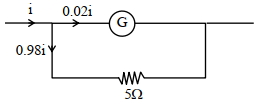
\(0.02 {i} {Rg}=0.98 {i} \times 5\)\({Rg}=245 \,\Omega\)
-
- (A) \(1\)
- (B) \(5\)
- (C) \(4\)
- (D) \(2\)
Show answer and solution
Correct Answer: (D)
\({I}_{\max }=\frac{50}{2}=25\, {mA}\)\(R=\frac{V}{{I}}=\frac{50\, {mV}}{25\, {mA}}=2\, \Omega\)
-
- (A) \(343\)
- (B) \(345\)
- (C) \(543\)
- (D) \(534\)
Show answer and solution
Correct Answer: (C)
\({V}=12\, {kV}\)Number of revolution \(={n}\)
\({n}\left[2 \times {q}_{{P}} \times {V}\right]=\frac{1}{2} {m}_{{p}} \times {v}_{{P}}^{2}\)
\({n}\left[2 \times 1.6 \times 10^{-19} \times 12 \times 10^{3}\right.\)
\(=\frac{1}{2} \times 1.67 \times 10^{-27} \times\left[\frac{3 \times 10^{8}}{6}\right]^{2}\)
\({n}\left(38.4 \times 10^{-16}\right)=0.2087 \times 10^{-11}\)
\({n}=543.4\)
-
- (A) \(0.2\)
- (B) \(0.1\)
- (C) \(0.15\)
- (D) \(1.0\)
Show answer and solution
Correct Answer: (B)
We know, the magnetic field on the axis of a current carrying circular ring is given by\(B =\frac{\mu_{0}}{4 \pi} \frac{2 NIA }{\left( R ^{2}+ x ^{2}\right)^{3 / 2}}\)
\(\therefore \frac{ B _{1}}{ B _{2}}=\frac{8}{1}=\left[\frac{ R ^{2}+(0.2)^{2}}{ R ^{2}+(0.05)^{2}}\right]^{3 / 2}\)
\(4\left[ R ^{2}+(0.05)^{2}\right]=\left[ R ^{2}+(0.2)^{2}\right]\)
\(4 R ^{2}- R ^{2}=(0.2)^{2}-4 \times(0.05)^{2}\)
\(4 R ^{2}- R ^{2}=(0.2)^{2}-(0.1)^{2}\)
\(3 R ^{2}=0.3 \times 0.1\)
\(R ^{2}=(0.1)^{2} \Rightarrow R =0.1\)
-
- (A) \(\frac{3}{2} \frac{ a ^{2}}{ r ^{2}}\)
- (B) \(\frac{2}{3} \frac{ a ^{2}}{ r ^{2}}\)
- (C) \(\frac{2}{3} \frac{ r ^{2}}{ a ^{2}}\)
- (D) \(\frac{3}{2} \frac{ r ^{2}}{ a ^{2}}\)
Show answer and solution
Correct Answer: (D)
\(B _{\text {axis }}=\frac{\mu_{0} i R ^{2}}{2\left( R ^{2}+ x ^{2}\right)^{3 / 2}}\)\(B _{\text {centre }}=\frac{\mu_{0} i }{2 R }\)
\(\therefore B _{\text {centre }}=\frac{\mu_{0} i }{2 a }\)
\(\therefore B _{ axis }=\frac{\mu_{0} ia ^{2}}{2\left( a ^{2}+ r ^{2}\right)^{3 / 2}}\)
\(\therefore\) fractional change in magnetic field \(=\)
\(\frac{\frac{\mu_{0} i }{2 a }-\frac{\mu_{0} ia ^{2}}{2\left( a ^{2}+ r ^{2}\right)^{3 / 2}}}{{\frac{\mu_{0} i }{2 a }}}=1-\frac{1}{\left[1+\left(\frac{ r ^{2}}{ a ^{2}}\right)\right]^{3 / 2}}\)
\(\approx 1-\left[1-\frac{3}{2} \frac{ r ^{2}}{ a ^{2}}\right]=\frac{3}{2} \frac{ r ^{2}}{ a ^{2}}\)
Note : \(\left(1+\frac{ r ^{2}}{ a ^{2}}\right)^{-3 / 2} \approx\left(1-\frac{3}{2} \frac{ r ^{2}}{ a ^{2}}\right)\)
[True only if \(r << a ]\)
-
- (A) \(\frac{\mu_{0} I}{4 \pi x y}\left[\sqrt{x^{2}+y^{2}}+(x+y)\right]\)
- (B) \(\frac{\mu_{0} I}{4 \pi x y}\left[\sqrt{x^{2}+y^{2}}-(x+y)\right]\)
- (C) \(\frac{\mu_{0} I x y}{4 \pi}\left[\sqrt{x^{2}+y^{2}}-(x+y)\right]\)
- (D) \(\frac{\mu_{0} I x y}{4 \pi}\left[\sqrt{x^{2}+y^{2}}+(x+y)\right]\)
Show answer and solution
Correct Answer: (A)
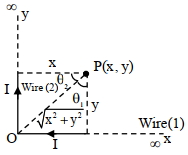
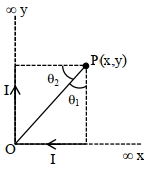
\({B}_{\text {due to wire }(1)}=\frac{\mu_{{o}} {I}}{4 \pi {y}}\left[\sin 90+\sin \theta_{1}\right]\)\(=\frac{\mu_{0}}{4 \pi} \frac{{I}}{{y}}\left(1+\frac{{x}}{\sqrt{{x}^{2}+{y}^{2}}}\right) \ldots \ldots(1)\)
\({B}_{\text {due to wire }(2)}=\frac{\mu_{0}}{4 \pi} \frac{{I}}{{x}}\left(\sin 90^{\circ}+\sin \theta_{2}\right)\)
\(=\frac{\mu_{0}}{4 \pi} \frac{{I}}{{x}}\left(1+\frac{{y}}{\sqrt{{x}^{2}+{y}^{2}}}\right) \ldots \ldots(2)\)
Total magnetic field
\({B}={B}_{1}+{B}_{2}\)
\({B}=\frac{\mu_{0} {I}}{4 \pi}\left[\frac{1}{{y}}+\frac{{x}}{{y} \sqrt{{x}^{2}+{y}^{2}}}+\frac{1}{{x}}+\frac{{y}}{{x} \sqrt{{x}^{2}+{y}^{2}}}\right]\)
\({B}=\frac{\mu_{0} {I}}{4 \pi}\left[\frac{{x}+{y}}{{xy}}+\frac{{x}^{2}+{y}^{2}}{{xy} \sqrt{{x}^{2}+{y}^{2}}}\right]\)
\({B}=\frac{\mu_{0} {I}}{4 \pi}\left[\frac{{x}+{y}}{{xy}}+\frac{\sqrt{{x}^{2}+{y}^{2}}}{{xy}}\right]\)
\({B}=\frac{\mu_{0} {I}}{4 \pi {xy}}\left[\sqrt{{x}^{2}+{y}^{2}}+({x}+{y})\right]\)
-
- (A) \(4: 3\)
- (B) \(3: 1\)
- (C) \(2: 3\)
- (D) \(1: 4\)
Show answer and solution
Correct Answer: (A)
\(R =\frac{ mv }{ qB }\)\(\Rightarrow \frac{ R _{1}}{ R _{2}}=\frac{\frac{ mv _{1}}{ q _{1} B }}{\frac{ mv _{2}}{ q _{2} B }}=\frac{ v _{1}}{ q _{1}} \times \frac{ q _{2}}{ v _{2}}=\frac{ q _{2}}{ q _{1}} \times \frac{ v _{1}}{ v _{2}}\)
\(=\frac{2}{ l } \times\left(\frac{2}{3}\right)=\frac{4}{3}\)
-
- (A) lighter ion will be deflected less than heavier ion
- (B) lighter ion will be deflected more than heavier ion
- (C) both ions will be deflected equally
- (D) no ion will be deflected
Show answer and solution
Correct Answer: (B)
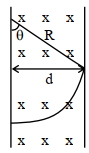
\({r}=\frac{{P}}{{qB}}=\frac{\sqrt{2 {mk}}}{{qB}}\)Given they have same kinetic energy
\({r} \propto \frac{\sqrt{{m}}}{{q}}\)
\(\frac{{r}_{1}}{{T}_{2}}=\frac{\sqrt{4}}{2} \times \frac{3}{\sqrt{16}}=\frac{3}{4}\)
\({I}_{2}=\frac{4 {r}_{1}}{3}\left[{r}_{2}\right.\) is for hearier ion and \({r}_{1}\) is for lighter ion)
\(\sin \theta=\frac{{d}}{{R}}\)
\(\theta \rightarrow\) Deflection
\(\theta \propto \frac{1}{{R}}\)
\(({R} \rightarrow\) Radius of path)
\(\because {R}_{2}>{R}_{1} \Rightarrow \theta_{2}<\theta_{1}\)
-
- (A) \(140\)
- (B) \(40\)
- (C) \(60\)
- (D) \(650\)
Show answer and solution
Correct Answer: (C)
Maximum emf \(\varepsilon={N} \omega {AB}\)\({N}=20, \omega=50, {B}=3 \times 10^{-2} {T}\)
\(\varepsilon=20 \times 50 \times \pi \times(0.08)^{2} \times 3 \times 10^{-2}=60.28 \times 10^{-2}\)
Rounded off to nearest integer \(=60\)
-
- (A) \(80\)
- (B) \(800\)
- (C) \(8\)
- (D) \(0.80\)
Show answer and solution
Correct Answer: (A)
\(\phi=\overrightarrow{ B } \cdot \overrightarrow{ S }\)\(\phi=\frac{4}{\pi} \times 10^{-3}\left(1-\frac{ t }{100}\right) \cdot \pi R ^{2}\)
\(\phi=4 \times 10^{-3} \times(1)^{2}\left(1-\frac{t}{100}\right)\)
\(\varepsilon=\frac{- d \phi}{ dt }\)
\(\varepsilon=\frac{- d }{ dt }\left(4 \times 10^{-3}\left(1-\frac{ t }{100}\right)\right)\)
\(\varepsilon=4 \times 10^{-3}\left(\frac{1}{100}\right)=4 \times 10^{-5} V\)
When \(B=0\)
\(1-\frac{t}{100}=0\)
\(t=100 sec\)
\(E=\frac{\varepsilon^{2}}{R} t\)
\(E=\frac{\left(4 \times 10^{-5}\right)^{2}}{2 \times 10^{-6}} \times 100 J\)
\(E=\frac{16 \times 10^{-10} \times 100}{2 \times 10^{-6}} J\)
\(E=0.08 J\)
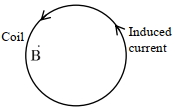
- 292. A coil is placed in a magnetic field \(\overrightarrow{{B}}\) as shown below: A current is induced in the coil because \(\overrightarrow{{B}}\) is:
 2021 Medium
- (A) Outward and decreasing with time
- (B) Parallel to the plane of coil and decreasing with time
- (C) Outward and increasing with time
- (D) Parallel to the plane of coil and increasing with time
Show answer and solution
Correct Answer: (A)
\(\vec{B}\) must not be parallel to the plane of coil for non zero flux and according to lenz law if \({B}\) is outward it should be decreasing for anticlockwise induced current. -
- (A) \(144\)
- (B) \(121\)
- (C) \(169\)
- (D) \(108\)
Show answer and solution
Correct Answer: (A)
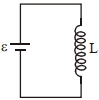
\(\varepsilon=\frac{L dI }{ dt }\)\(3 \int_{0}^{4} t dt =2 \int_{0}^{ I } d I\)
\(\frac{3}{2} \times 16=2 I\)
\(I =12\)
\(V =\frac{1}{2} LI ^{2}=\frac{1}{2} \times 2(12)^{2}=144 J\)
-
- (A) \(1\)
- (B) \(4\)
- (C) \(2\)
- (D) \(0\)
Show answer and solution
Correct Answer: (C)
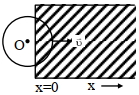
\({emf} ={BLV}\)\(=1 .(2 {R}) \cdot 1\)
\(=2 {V}\)
-
- (A) \(\frac{\mu_{0}}{4 \pi} 8 \sqrt{2} \frac{{a}^{2}}{{b}}\)
- (B) \(\frac{\mu_{0}}{4 \pi} \frac{8 \sqrt{2}}{{a}}\)
- (C) \(\frac{\mu_{0}}{4 \pi} 8 \sqrt{2} \frac{{b}^{2}}{{a}}\)
- (D) \(\frac{\mu_{0}}{4 \pi} \frac{8 \sqrt{2}}{{b}}\)
Show answer and solution
Correct Answer: (A)
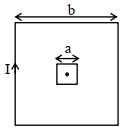
\({B}=\left[\frac{\mu_{0}}{4 \pi} \frac{{I}}{{b} / 2} \times 2 \sin 45\right] \times 4\)\(\phi=2 \sqrt{2} \frac{\mu_{0}}{\pi} \frac{{I}}{{b}} \times {a}^{2}\)
\(\therefore {M}=\frac{\phi}{{I}}=\frac{2 \sqrt{2} \mu_{0} {a}^{2}}{\pi {b}}=\frac{\mu_{0}}{4 \pi} 8 \sqrt{2} \frac{{a}^{2}}{{b}}\)
-
- (A) \(1\, {m} / {s}\)
- (B) \(1 \,{cm} / {s}\)
- (C) \(10^{2}\, {m} / {s}\)
- (D) \(10^{-2} \,{cm} / {s}\)
Show answer and solution
Correct Answer: (B)
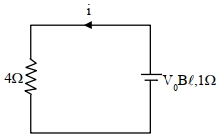
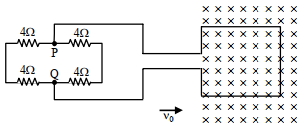
Equivalent circuit\(i=\frac{{VoB} \ell}{4+1} \Rightarrow {V}_{0}=\frac{5(2\, {mA})}{5 \times .2}=10^{-2} \,{m} / {s}=1\, {cm} / {s}\)
-
- (A) \(108.25\)
- (B) \(54.125\)
- (C) \(88.37\)
- (D) \(62.50\)
Show answer and solution
Correct Answer: (A)
\(\in=[\vec{B} \vec{V} \vec{L}]=B V L \sin \theta\)\(=\left(2.5 \times 10^{-4}\, T \right)\left(180 \times \frac{5}{18}\, m / s \right)(10 \,m ) \sin 60^{\circ}\)
\(=108.25 \times 10^{-3}\, V\)
-
- (A) \(0.4\)
- (B) \(0.8\)
- (C) \(0.125\)
- (D) \(0.2\)
Show answer and solution
Correct Answer: (D)
\(\mathrm{U}=\frac{1}{2} \mathrm{Li}^{2}=64 \Rightarrow \mathrm{L}=2\)\(\mathrm{i}^{2} \mathrm{R}=640\)
\(\mathrm{R}=\frac{640}{(8)^{2}}=10\)
\(\tau=\frac{\mathrm{L}}{\mathrm{R}}=\frac{1}{5}=0.2\)
-
- (A) \(71\)
- (B) \(73\)
- (C) \(74\)
- (D) \(80\)
Show answer and solution
Correct Answer: (C)
\(I_{\max }=\frac{V}{R}=\frac{20 V}{10 K \Omega}=2\; mA\)For LR - decay circuit
\(I=I_{\max } e ^{- R / L}\; mA\)
\(I=2 e ^{\frac{-10 \times 10^{3} \times 1 \times 10^{-6}}{10 \times 10^{-3}}}\; mA\)
\(I=2 e ^{-1}\; mA\)
\(I=2 \times 0.37\; mA\)
\(I=\frac{74}{100}\; mA\)
\(x=74\)
-
- (A) Auxilliary transformer
- (B) Auto transformer
- (C) Step-up transformer
- (D) Step down transformer
Show answer and solution
Correct Answer: (C)
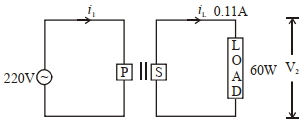
\(V _{ S }=\frac{ P }{ i }=\frac{60}{0.11}=545.45\)\(V _{ P }=220\)
\(V _{ S } > V _{ P }\)
\(\Rightarrow\) Step up transformer

No questions on this page match these filters.