


Questions
4 questionsShowing 1–4 of 4 questions
-
- (A) \(\frac{{32}}{{23}}\,\mu F\)
- (B) \(\frac{{31}}{{23}}\,\mu F\)
- (C) \(\frac{{33}}{{23}}\,\mu F\)
- (D) \(\frac{{34}}{{23}}\,\mu F\)
Show answer and solution
Correct Answer: (A)
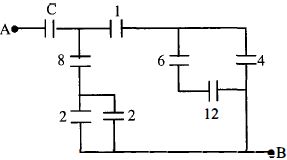
Capacitors \(2\, \mu \mathrm{F}\) and \(2\, \mu \mathrm{F}\) are parallel, their equivalent \(=4\, \mu \mathrm{F}\)\(6 \,\mu \mathrm{F}\) and \(12\, \mu \mathrm{F}\) are in series, their equivalent \(=4\, \mu \mathrm{F}\)
Now \(4 \,\mu F(2 \text { and } 2\, \mu F)\) and \(8\, \mu F\) in series
\(=\frac{3}{8}\, \mu F\)
And \(4\, \mu \mathrm{F}(12 \& 6\, \mu \mathrm{F})\) and \(4\, \mu \mathrm{F}\) in parallel \(=4+4=8\, \mu \mathrm{F}\)
\(8\, \mu \mathrm{F}\) in series with \(1\, \mu \mathrm{F}=\frac{1}{8}+1 \Rightarrow \frac{8}{9}\, \mu \mathrm{F}\)
Now \(C_{e q}=\frac{8}{9}+\frac{8}{3}=\frac{32}{9}\)
\(C_{eq}\) of circuit \(=\frac{32}{9}\)
With \(C-\frac{1}{C_{e q}}=\frac{1}{C}+\frac{9}{32}=1 \Rightarrow C=\frac{32}{23}\)
-
- (A) \({\rho _0}\, = \,20\,{\varepsilon _0}\) in the entire region
- (B) \({\rho _0}\, = \,10\,{\varepsilon _0}\) for \(\left| z \right|\, \le 1\,\,m\) and \(P_0 = 0\) elsewhere
- (C) \({\rho _0}\, = \,20\,{\varepsilon _0}\) for \(\left| z \right|\, \le 1\,\,m\) and \(P_0 = 0\) elsewhere
- (D) \({\rho _0}\, = \,40\,{\varepsilon _0}\) in the entire region
Show answer and solution
Correct Answer: (B)
\(\Sigma_{1}=\frac{-d v}{d r}=10|z|\)\(\Sigma_{2}=\frac{-\mathrm{dv}}{\mathrm{dr}}=10 \quad(\text { constant : } \mathrm{E})\)
\(\therefore \) The source is an infinity large non conducting thick plate of thickness \(2\, \mathrm{m}\).
\(\therefore 10 \mathrm{Z} \cdot 10 \mathrm{A}=\frac{\rho \cdot \mathrm{A} \propto \mathrm{Z}}{\varepsilon_{0}}\)
\(\rho_{0}=10 \mathrm{e}_{0}\) for \(|\mathrm{z}| \leq 1\, \mathrm{m}\)
-
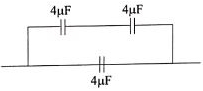
- (A) all in series
- (B) all in parallel
- (C) two in parallel and one in series
- (D) two in series and one in parallel
Show answer and solution
Correct Answer: (D)
To get effective capacitance of \(6\,\mu F\) two capacitors of \(4\, \mu \mathrm{F}\) each connected in series and one of \(4\, \mu \mathrm{F}\) capacitor in parallel with them.Two capacitances in series
\(\therefore \frac{1}{C}=\frac{1}{C_{1}}+\frac{1}{C_{2}}=\frac{1}{4}+\frac{1}{4}=\frac{1}{2}\)
\(1\) capacitor in parallel
\(\therefore \) \(C_{\mathrm{eq}}=C_{3}+C=4+2=6\, \mu \mathrm{F}\)
-
- (A) \(\rho \left( r \right) = \) constant
- (B) \(\rho \left( r \right) \propto \frac{1}{{{r^2}}}\)
- (C) \(\rho \left( r \right) \propto \frac{1}{r}\)
- (D) \(\rho \left( r \right) \propto r\)
Show answer and solution
Correct Answer: (C)
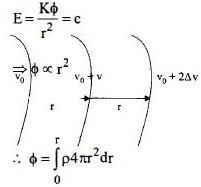
As we know electric field, \(E = \frac{{ - dv}}{{dr}}\)\(E=\) constant \(\therefore \) \(dv\) and \(dr\) same
\( \Rightarrow \,\rho \propto \frac{1}{r}\)
No questions on this page match these filters.