


JEE Mains · Physics · STD 11 - 6. system of particles and rotational motion
A particle of mass \(m\) is moving along the side of a square of side '\(a\)', with a uniform speed \(v\) in the \(x-y\) plane as shown in the figure Which of the following statement is false for the angular momentum \(\vec L\) about the origin ?
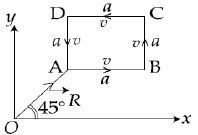
- A \(\;\left( a \right)\overrightarrow {\;L} \) \( = mv\left[ {\frac{R}{{\sqrt 2 }} + a} \right]\hat k\) ,when the particle is moving from \(B\) to \(C\)
- B \(\vec L\) \( = \frac{{mv}}{{\sqrt 2 }}\;R\;\hat k\) , when the particle is moving from \(D\) to \(A\)
- C \(\left( d \right)\overrightarrow {\;L} \) \( = mv\left[ {\frac{R}{{\sqrt 2 }} - a} \right]\hat k\) ,when the particle is moving from \(C\) to \(D\)
- D Both (b) and (c)
Answer & Solution
Correct Answer
(D) Both (b) and (c)
Step-by-step Solution
Detailed explanation
\(\overrightarrow{\mathrm{L}}=\overrightarrow{\mathrm{r}} \times \overrightarrow{\mathrm{P}}\) or \(\overrightarrow{\mathrm{L}}=\mathrm{rpsin} \theta \hat{\mathrm{n}}\) \(\overrightarrow{\mathrm{L}}=\mathrm{r}_{\perp}(\mathrm{P}) \hat{\mathrm{n}}\) For \(D\) to \(A\)…
See the Complete Solution
Get step-by-step explanations for this and 2.5 Lakh+ more JEE, NEET & CET questions.
- Unlock all solutions
- Practice the full chapter
- Track accuracy across PYQs
4.8 rated on Google Play · 14,000+ reviews
More questions from Physics
- Diameter of the objective lens of a telescope is \(250\, cm\). For light of wavelength \(600\, nm\). Coming from a distant object, the limit of resolution of the telescope is close toJEE Mains 2019 Easy
- Given below are two statements: one is labelled as Assertion \(\mathbf{A}\) and the other is labelled as Reason \(\mathbf{R}\)
Assertion A: In a central force field, the work done is independent of the path chosen.
Reason R: Every force encountered in mechanics does not have an associated potential energy.
In the light of the above statements, choose the most appropriate answer from the options given belowJEE Mains 2025 Easy - In an \(A.C.\) circuit, the instantaneous \(e.m.f\) and current are given by. \(e=100\) \(sin\) \(20t\) \(i=20sin\) \(\left( {30t - \frac{\pi }{4}} \right)\) In one cycle of \(A.C.\), the average power consumed by the circuit and the wattless current are, respectivelyJEE Mains 2018 Medium
- In the line spectra of hydrogen atom, difference between the largest and the shortest wavelengths of the Lyman series is \(304\,\mathring {A}.\) The corresponding difference for the Paschan series in \(\mathring {A}\) isJEE Mains 2020 Hard
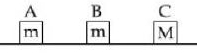
- Three blocks \(A, B\) and \(C\) are lying on a smooth horizontal surface, as shown in the figure. \(A\) and \(B\) have equal masses, \(m\) while \(C\) has mass \(M\). Block \(A\) is given an initial speed \(v\) towards \(B\) due to which it collides with \(B\) perfectly inelastically. The combined mass collides with \(C\), also perfectly inelastically. The combined mass collides with \(C\), also perfectly inelastically if \(\frac{5}{6}^{th}\) of the initial kinetic energy is lost in whole process. What is value of \(M/m\) ?
 JEE Mains 2019 Hard
 - A spaceship orbits around a planet at a height of \(20\,km\) from its surface. Assuming that only gravitational field of the plant acts on the spaceship. What will be the number of complete revolutions made by the spaceship in \(24\,hours\) around the plane? [Given: Mass of plane \(= 8 \times 10^{22}\,kg,\) Radius of planet \(= 2\times 10^6\,m,\) Gravitational constant \(G = 6.67\times 10^{-11}\,Mn^2/kg^2\) ]JEE Mains 2019 Hard
More PYQs from JEE Mains
- A rod of length \(L\) has non-uniform linear mass density given by \(\rho(\mathrm{x})=\mathrm{a}+\mathrm{b}\left(\frac{\mathrm{x}}{\mathrm{L}}\right)^{2},\) where \(a\) and \(\mathrm{b}\) are constants and \(0 \leq \mathrm{x} \leq \mathrm{L}\). The value of \(\mathrm{x}\) for the centre of mass of the rod is atJEE Mains 2020 Hard
- Let \(\alpha \) and \(\beta \) be the roots of the equation \(x^2 + x + 1 = 0.\) Then for \(y \ne 0\) in \(R,\) \(\left| {\begin{array}{*{20}{c}}
{y\, + \,1}&\alpha &\beta \\
\alpha &{y\, + \,\beta }&1\\
\beta &1&{y\, + \,\alpha }
\end{array}} \right|\) is equal toJEE Mains 2019 Hard - A \(1\,m\) long wire is broken into two unequal parts \(X\) and \(Y\) The \(X\) part of the wire is streched into another wire \(W\). Length of \(W\) is twice the length of \(X\) and the resistance of \(W\) is twice that of \(Y\). Find the ratio of length of \(X\) and \(Y\).JEE Mains 2022 Medium
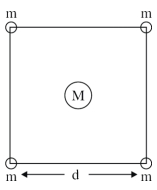
- Four spheres each of mass \(m\) form a square of side \(d\) (as shown in figure). A fifth sphere of mass \(M\) is situated at the centre of square. The total gravitational potential energy of the system is
 JEE Mains 2022 Medium
 - Two cells of same emf but different internal resistances \(I_{1}\) and \(I_{2}\) are connected in series with a resistance \(R\). The value of resistance \(R\), for which the potential difference across second cell is zero, isJEE Mains 2022 Medium
- If a line along a chord of the circle \(4 x^{2}+4 y^{2}+120 x+675=0\), passes through the point \((-30,0)\) and is tangent to the parabola \(\mathrm{y}^{2}=30 \mathrm{x}\), then the length of this chord is :JEE Mains 2021 Hard