


Questions
3 questionsShowing 1–3 of 3 questions
-
- (A) \(\left( {\pi \mu Bb} \right)\,a\)
- (B) \(\left( {2\pi \mu Bb} \right)\,\Delta a\)
- (C) \(\left( {\pi \mu Bb} \right)\,\Delta a\)
- (D) \(\left( {4\pi \mu Bb} \right)\,\Delta a\)
Show answer and solution
Correct Answer: (D)
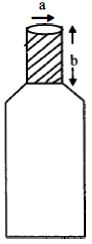
\(Stress = \frac{{Normal\,force}}{{Area}} = \frac{N}{A} = \frac{N}{{\left( {2\pi a} \right)b}}\)\(Stress = B \times strain\)
\(\frac{N}{{\left( {2\pi a} \right)b}} = B\frac{{2\pi a\Delta a \times b}}{{\pi {a^2}b}}\)
\( \Rightarrow N = B\frac{{{{\left( {2\pi a} \right)}^2}\Delta a{b^2}}}{{\pi {a^2}b}}\)
Force needed to push the cork.
\(f = \mu N = \mu 4\pi b\Delta aB = \left( {4\pi \mu Bb} \right)\Delta a\)
-
- (A) The maximum value of \(Y\) that can be determined is \(10^{14}\,N/m^2\)
- (B) \(\frac{{\Delta Y}}{Y}\) gets minimum contribution from the uncertainty in the length
- (C) \(\frac{{\Delta Y}}{Y}\) gets its maximum contribution from the uncertainty in strain
- (D) The figure of merit is the largest for the length of the rod.
Show answer and solution
Correct Answer: (A)
\(Young's\,modulus\,Y = \frac{F}{A}/\frac{{\Delta \ell }}{\ell }\)\(Y = \frac{{Fl}}{{\pi {r^2}\Delta l}}\)
\(Given,\,radius = 5mm,forceF = 50\pi KN,\)
\(\frac{\ell }{{\Delta \ell }} = 0.01\,mm\)
\(\therefore \,Y = \frac{F}{{\pi {r^2}}}\frac{\ell }{{\Delta \ell }} = 2 \times {10^{14}}N/{m^2}.\)
-
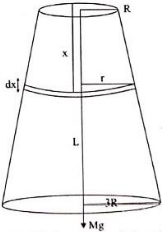
- (A) \(L\left( {1 + \frac{2}{9}\frac{{Mg}}{{\pi Y{R^2}}}} \right)\)
- (B) \(L\left( {1 + \frac{1}{9}\frac{{Mg}}{{\pi Y{R^2}}}} \right)\)
- (C) \(L\left( {1 + \frac{1}{3}\frac{{Mg}}{{\pi Y{R^2}}}} \right)\)
- (D) \(L\left( {1 + \frac{2}{3}\frac{{Mg}}{{\pi Y{R^2}}}} \right)\)
Show answer and solution
Correct Answer: (C)
Consider a small element \(dx\) of radius \(r\),\(r = \frac{{2R}}{L}x + R\)
At equilibrium change in length of the wire
\(\int\limits_0^l {dL = \int {\frac{{Mgdx}}{{\pi {{\left[ {\frac{{2R}}{L}x + R} \right]}^2}y}}} } \)
Taking limit from \(0\) to \(L\)
\(\Delta L = \frac{{Mg}}{{\pi y}} - \frac{1}{{\left[ {\frac{{2Rx}}{L} + R} \right]_0^L}} \times \frac{L}{{2R}} = \frac{{MgL}}{{3\pi {R^2}y}}\)
The equilibrium extended length of wire
\( = L + \Delta L\)
\( = L + \frac{{MgL}}{{3\pi {R^2}Y}} = L\left( {1 + \frac{1}{3}\frac{{Mg}}{{\pi Y{R^2}}}} \right)\)
No questions on this page match these filters.